How to know what God wants pt3. Walking by Faith

God is a Spirit: and they that worship him must worship him in spirit and in truth.”  (John 4:24)

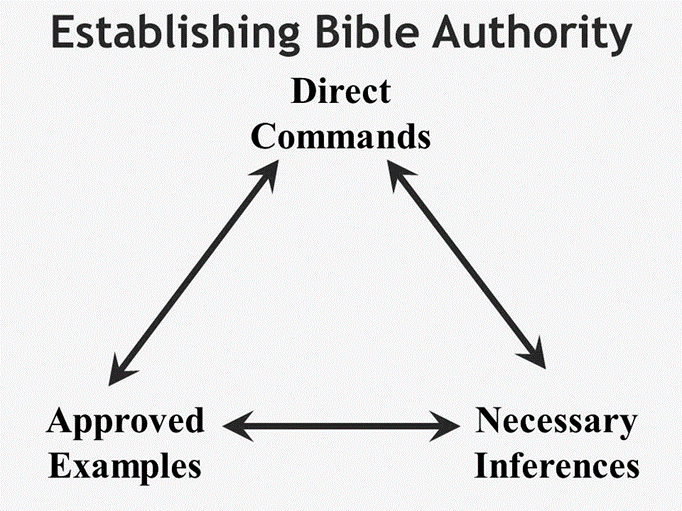
So far, we’ve learned how to know what God wants,

  1. Direct commands & statements.
  2. Approved Examples.
  3. Implications & Necessary Inferences.
  4. Silence, when God gives no command.

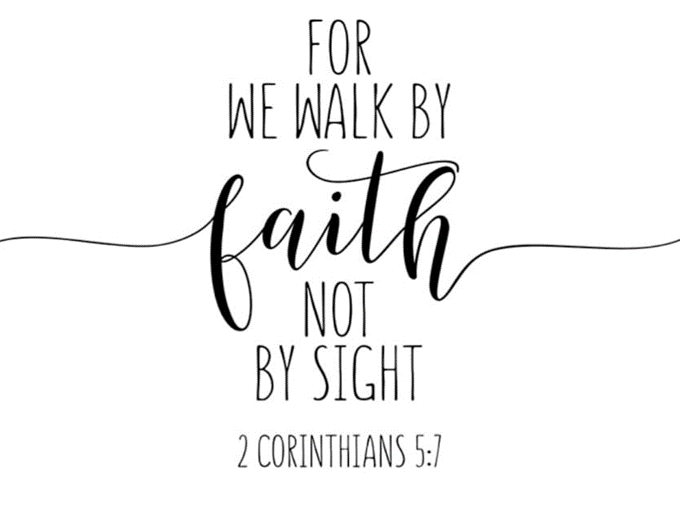
Today, let’s talk about walking by FAITH and not by sight. “For we walk by faith, not by sight” (2Cor 5:7).

I’ve written about FAITH before in the article “Lord, Increase our Faith” Sept 04, 2022. To summarize…

Faith is the FULL BODY of God’s revelation. Jude 1:3 “The faith once delivered.”

Faith is ACTION based on the information. James 2:14-24 “justified by works and not by faith only.”

Faith is INSISTENT on standing firm. Hebrews 11:24-25

By faith Moses, when he was come to years, refused to be called the son of Pharaoh’s daughter; [25] Choosing rather to suffer affliction with the people of God, than to enjoy the pleasures of sin for a season;”

Faith is Believing and TRUSTING in the results from keeping God’s word. Colossians 2:12. “Buried with him in baptism, wherein also ye are risen with him through the faith of the operation of God, who hath raised him from the dead.”

Faith is HOPE that the Lord will reward those that keep His word.

Hebrews 11:1, 6 “Now faith is the substance of things hoped for, the evidence of things not seen. But without faith it is impossible to please him: for he that cometh to God must believe that he is, and that he is a rewarder of them that diligently seek him.”

Faith is listed among the 9 spiritual gifts early saints could receive during the writing of the New Testament (1Cor 12:8-9; 13:2; Matt 17:20).

These several senses above all combine to mean FAITH. Where there is no word of God there can be no faith in God. This is an unquestioned teaching of God’s word. (See also John 20:30-31; Rom 10:17: Eph 3:1-4) If therefore, God says nothing concerning a given course, there can be no faith. Since we are to walk by faith, it follows that in any matter whatsoever in which we are not directed by the word of God, we are neither walking by faith nor pleasing God.

To walk by FAITH is to act upon God’s revealed word, the faith, and not by opinion. If people are seekers of God, they will seek His will before acting, rather than acting and hoping God will sanctify the actions.

One man said it this way about a particular religious action he had taken. “I don’t know if it’s right or wrong. I just do my best and ask God for mercy.” If you don’t know if it’s right, then DON’T DO IT. There’s a principle that speaks directly to this; “And he that doubteth is damned if he eat, because he eateth not of faith: for whatsoever is not of faith is sin” (Rom 14:23).

Let’s state it another way. God accepts no gratuitous service in matters to be rendered exclusively to Him. Man possesses an undeniable right to exercise his own judgment in the management of his personal affairs, as long as he does not violate any principles of moral correctness or righteousness. Man is guided in his personal life by God’s moral law and is given liberty to make individual choices under generic authority live, prosper and enjoy (1Thess 4:1-12; 1Tim 6:17; 3John 2).

However, In the service to be rendered exclusively to God, He has legislated. He has ordained the worship to be rendered to Him, and human wisdom must neither add to, take from, nor in any way modify what he has prescribed, otherwise those who do so are walking by their own judgment, and not by faith. Let’s review a few examples…

Water Baptism has been commanded by Christ (Mark 16:16; Acts 2:38; 8:35-36; 22:16; 1Pet 3:21). Who are we to alter it or even hint that one can be saved without it? Note the urgency of Baptism in the book of Acts. “And he took them the same hour of the night, and washed their stripes; and was baptized, he and all his, straightway” (Acts 16:33).

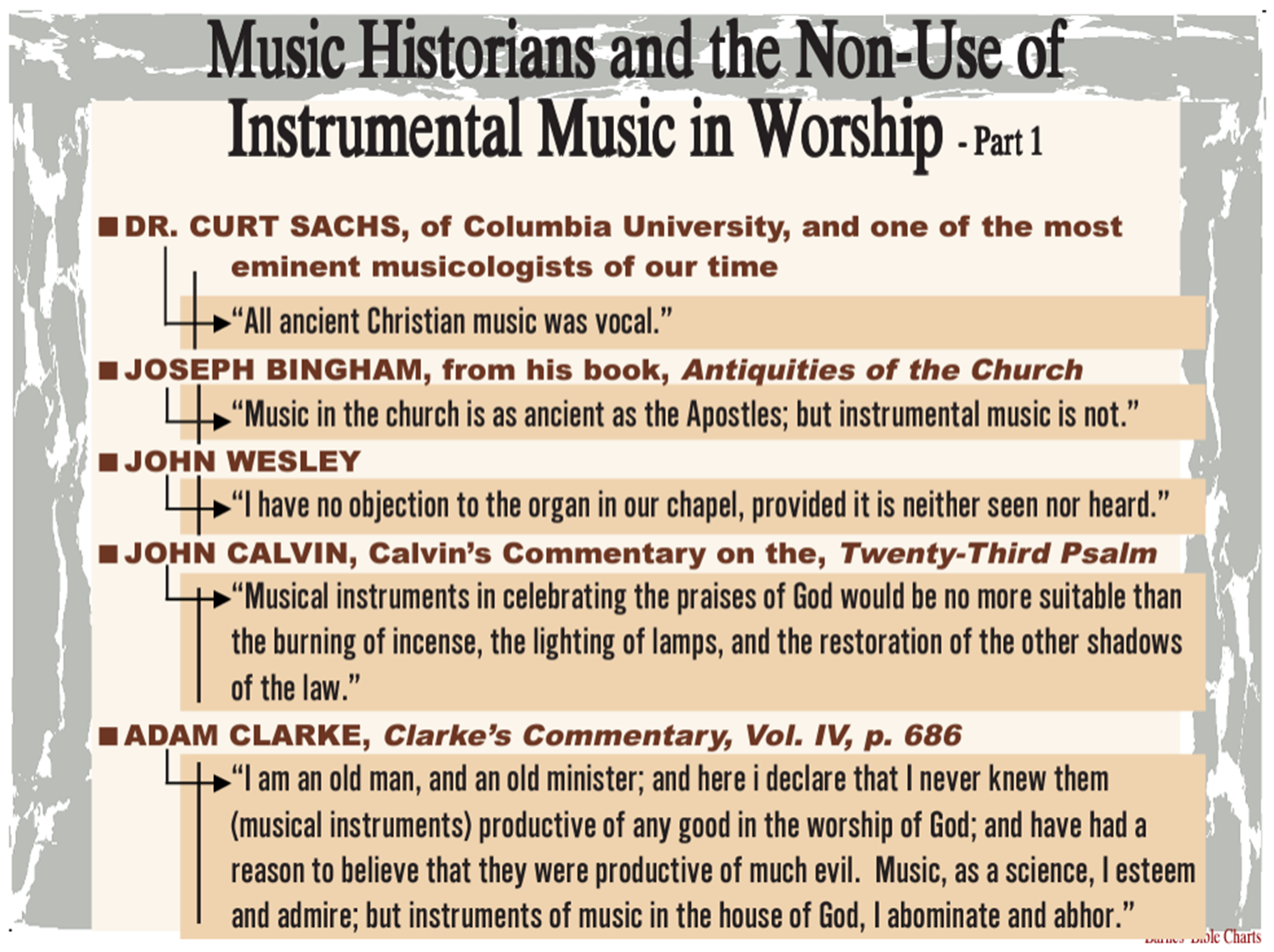
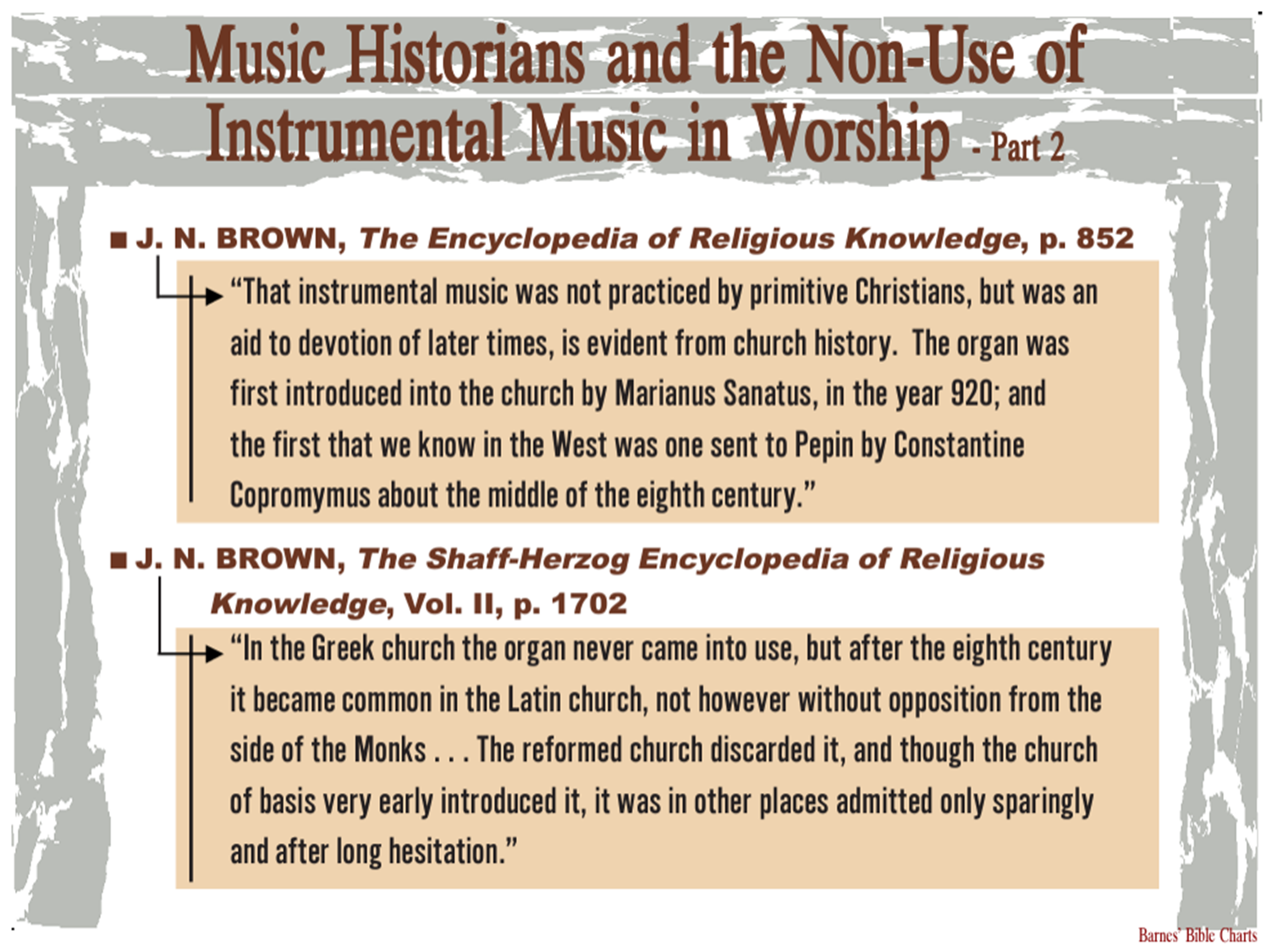
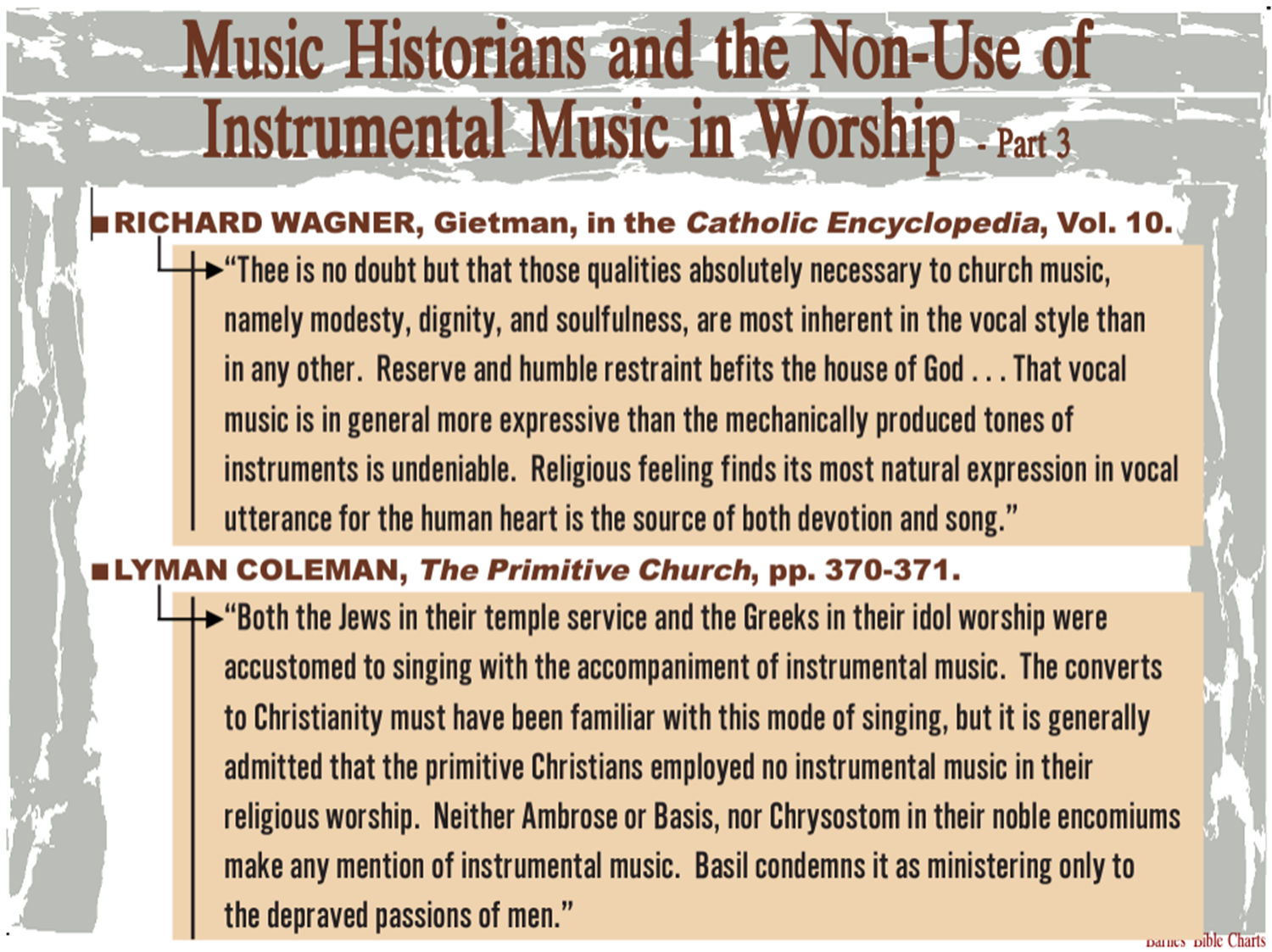
Adoration in vocal song (Eph 5:19; Col 3:16). Who are we to do what God has commanded not by introducing instrumental music? “Let the word of Christ dwell in you richly in all wisdom; teaching and admonishing one another in psalms and hymns and spiritual songs, singing with grace in your hearts to the Lord.”

The Lord’s Supper is given to be observed by the assembled local church (Matt 26:26-30; Luke 22:15-20; Acts 2:42; 20:7; 1Cor 11:17-34). Who are we to move it to a digital venue, or a cruise ship vacation, or to any other place of convenience where there is no local church assembled? The idea that any group of Christians is a church is false. (see Matt 18:16, a distinction is made between a 2-3 individuals and the church)

We are commanded to Keep the faith “I have fought a good fight, I have finished my course, I have kept the faith” (2Tim 4:7), and to Keep God’s commands (1John 5:3). Who are we to tell anyone that they may be saved without obedience to the faith, or that they can never fall from grace? “Looking diligently lest any man fail of the grace of God; lest any root of bitterness springing up trouble you, and thereby many be defiled” (Heb 12:15).

By whom we have received grace and apostleship, for obedience to the faith among all nations, for his name” (Rom 1:5).

We must walk by FAITH, not by the sight of our own opinions.

Agape,

Spencer
How to know what God Wants pt2

God is a Spirit: and they that worship him must worship him in spirit and in truth.”  (John 4:24)

One cannot be walking by faith in Christ while offering strange worship God commanded us not. How do we know what God wants? We can answer that question if we will learn how God communicates. He gives DIRECT commands & statements, He gives EXAMPLES, and He IMPLIES things from which we may infer. He also expects us to respect when He is SILENT on a matter.

Last week we looked at the first 2 ways to discover what God wants,

  1. Direct commands & statements.
  2. Approved Examples.

Today we will look at 2 more,

  1. Implications & Necessary Inferences.
  2. Silence, when God gives no command.

Since we’re not to ADD nor TAKE AWAY from His word, we need to understand how He communicates.

III) Implications & Necessary Inferences. (Inescapable conclusions)

One of the ways we communicate is by implying something and we infer from it. Here’s a simple example. When our parents gave us $20 to go to the store to buy bread and milk, it is necessarily inferred that they want the change brought back and we’re not to spend the rest of the money on candy & video games. A lesson my older brother learned quickly.

We all communicate this way. God does too. In Acts 10, Peter saw a vision Acts 10:12, “Wherein were all manner of fourfooted beasts of the earth, and wild beasts, and creeping things, and fowls of the air.” The Lord told him to rise, kill, and eat.

After Peter’s refusal because they were unclean, the Lord said, “What God hath cleansed, that call not thou common.” Peter would eventually understand the implication, that God had included gentiles as candidates for the gospel. Peter made a necessary inference based on what the Lord had implied through the vision, the events that followed, and His command to preach the gospel to every nation. (Read Acts 10-11; Mark 16:15-16).

Another example of necessary inference is in Acts 8:35-36. “Then Philip opened his mouth, and began at the same scripture, and preached unto him Jesus. And as they went on their way, they came unto a certain water: and the eunuch said, See, here is water; what doth hinder me to be baptized?” All that we read is that Philip preached Jesus, and the Eunuch concludes baptism is commanded. We Necessarily Infer that baptism is included in the preaching of Jesus.

Without a command from God, we do not make any inferences about what God wants.

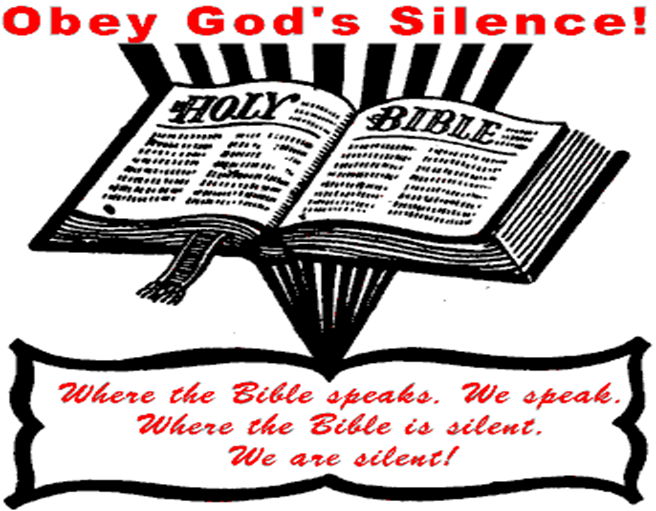
IV) God commands us not (no command). Silence is not permissive.

This is an answer to the objection, “it doesn’t say not to.” In regard to service rendered to God, human wisdom must not do what God has FORBIDDEN, OMIT what He’s commanded, nor add EXTRA which He has not commanded. To do otherwise is to walk by our own judgment, and not by faith.

Here are several examples which show that where there is no command there is no permission. GOD GAVE NO COMMAND.

  1. Lev 10:1 And Nadab and Abihu, the sons of Aaron, took either of them his censer, and put fire therein, and put incense thereon, and offered strange fire before the LORD, which he commanded them not.
  2. Deut 17:3 And hath gone and served other gods, and worshipped them, either the sun, or moon, or any of the host of heaven, which I have not commanded;
  3. Deut 18:20 But the prophet, which shall presume to speak a word in my name, which I have not commanded him to speak, or that shall speak in the name of other gods, even that prophet shall die.
  4. Jer 7:22 For I spake not unto your fathers, nor commanded them in the day that I brought them out of the land of Egypt, concerning burnt offerings or sacrifices:
  5. Jer 29:23 Because they have committed villany in Israel, and have committed adultery with their neighbours’ wives, and have spoken lying words in my name, which I have not commanded them; even I know, and am a witness, saith the LORD.
  6. Jer 32:35 And they built the high places of Baal, which are in the valley of the son of Hinnom, to cause their sons and their daughters to pass through the fire unto Molech; which I commanded them not, neither came it into my mind, that they should do this abomination, to cause Judah to sin.
  7. Acts 15:24 Because we have knowledge that some who went from us have been troubling you with their words, putting your souls in doubt; to whom we gave no such order; (BBE). KJV. we gave no such commandment:

In two other instances we find the same lesson.

  1. 2Sam 7:1-7. David’s desire to build a temple. God asks him where He ever asked for it. 2Sa 7:7 In all the places wherein I have walked with all the children of Israel spake I a word with any of the tribes of Israel, whom I commanded to feed my people Israel, saying, Why build ye not me an house of cedar?
  2. Heb 7:11-14 In explaining the Priesthood of Christ, the writer points out that God never spoke anything about Priests from Judah.
    1. Heb 7:14 For it is evident that our Lord arose from Judah, of which tribe Moses spoke nothing concerning priesthood.

When you say, “God never said not to.” I reply, “God doesn’t need to tell you not to do something when He’s told you specifically what He wants. Where did He ever give the command for it?” If it’s a good enough explanation for God, it’s a good principle for us to use today.

Men are not divided over what the Bible says but what it doesn’t say. We must respect His Silence.

Agape,

Spencer

You can read pt 1 of How to know What God wants here.

How to know what God wants pt1

How to know what God wants. Pt1

God is a Spirit: and they that worship him must worship him in spirit and in truth.”  (John 4:24)

God has not at any time authorized gratuitous service be rendered to Him. This means that God requires worship toward Him to be in accordance with His instructions.

From the very beginning we see this principle. In Genesis four, Abel offered an acceptable sacrifice by faith, and Cain did not. “By Faith” is first speaking about divine instruction, followed by our trust in His acceptance when we follow those instructions. “So then faith cometh by hearing, and hearing by the word of God.” (Rom 10:17).

One cannot be walking by faith in Christ while offering strange worship God commanded us not. How do we know what God wants? We can answer that question if we will learn how God communicates. He gives DIRECT commands & statements, He gives EXAMPLES, and He IMPLIES things from which we may infer. He also expects us to respect when He is SILENT on a matter.

I) God communicates through Direct commands & statements.

In the Gospel of Mark, Jesus gives a direct command to his disciples in the Great Commission. He says, “And he said unto them, Go ye into all the world, and preach the gospel to every creature.” (Mark 16:15). These are clear instructions from God on how his followers are to spread the message of salvation.

The Direct commands of God come in 2 forms:

1) SPECIFIC. God tells us exactly what He wants. We cannot add to, nor take away from the specific command. A specific command eliminates all other possibilities.

2) GENERIC. God gives a command but doesn’t tell us how. He leaves those details for us to implement.

The how of a generic command is called an expedient. We need to find the most efficient & effective means to fulfill the command. We cannot bind an expedient on others as being the only way. We have liberty.

II) God communicates using Approved Examples. There are many examples in the bible, but not every one of them is binding, nor authorized. Some examples are incidental like meeting in an upper room (Acts 1:13).

What makes an example an APPROVED EXAMPLE? When the example is in compliance with a Direct command of God. Jesus said “And he said unto them, Go ye into all the world, and preach the gospel to every creature. He that believeth and is baptized shall be saved; but he that believeth not shall be damned.” (Mark 16:15-16). In the Acts one we see exactly that. They preached the Gospel to everyone on Pentecost and baptized for remission of sins.

Another example is found in Acts 8. “Then Philip opened his mouth, and began at the same scripture, and preached unto him Jesus. And as they went on their way, they came unto a certain water: and the eunuch said, See, here is water; what doth hinder me to be baptized? And Philip said, If thou believest with all thine heart, thou mayest. And he answered and said, I believe that Jesus Christ is the Son of God. And he commanded the chariot to stand still: and they went down both into the water, both Philip and the eunuch; and he baptized him.” (Acts 8:35-38). Here we see Philip Going, Preaching, and Baptizing as was commanded by Jesus in the great commission. Philip is one of many APPROVED EXAMPLES.

Without a command an example is just an example. It is not to be bound on others. Examples are only APPROVED (or Apostolic) when there is a command from God. How can we sift the binding from non-binding examples? Here are 4 questions to ask.

  1. Is there Uniformity in all examples of same event? Baptism was all by immersion, but circumstances around event were different.
  2. Is there Unity in Harmony? The Example must harmonize with God’s commands. Without a command there is not an approved example.
  3. Is there Universal application? It must apply and be able for all. Grapes (fruit of the vine) grow everywhere. Water is everywhere man is. Truth is Universal to all mankind.
  4. Is the example Unnecessary or relevant to the command? The disciples met in an upper room.

People are constantly attempting to worship God according to their own desires (Col 2:23). They have introduced Mechanical Music, plays, interpretive dance, and in one place Roller Skating Praise.

Here are 4 types of False worship.

  1. Vain. Mark 7; Matt 15:9.
  2. Against His will. 1Cor 11:17-34; 1Sam 15:22-23
  3. Ignorant. Acts 17:23
  4. Narcissistic Self-Willed worship. Col 2:20-23

These should serve as warnings about doing what God FORBIDS, OMISSION of what God commands, or adding EXTRA to the commands of God that He has not commanded.

Ye shall not add unto the word which I command you, neither shall ye diminish ought from it, that ye may keep the commandments of the LORD your God which I command you

(Deut 4:2; 12:32; Pr 30:6; Ec 12:13; Re 22:18-19).

Agape,

Spencer

You can read pt 2 of How to know What God wants here.

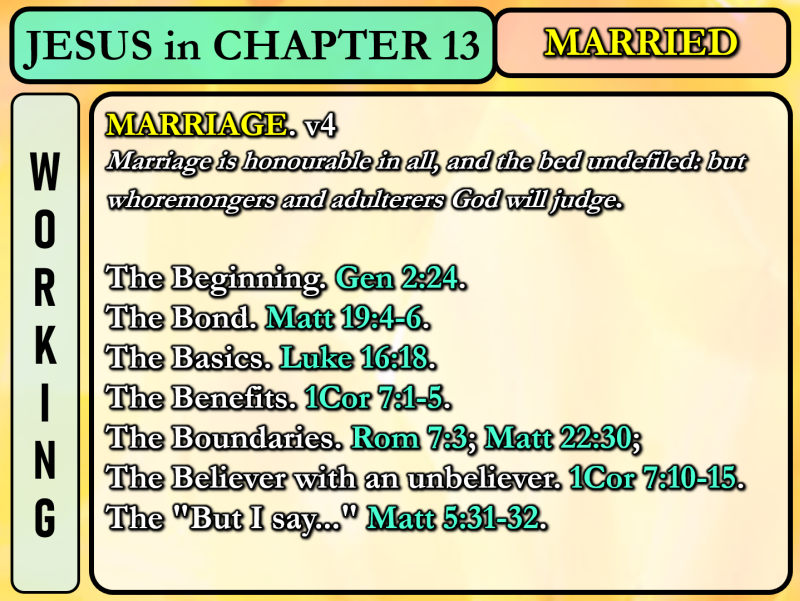
Hebrews 13:4 MARRIAGE

7 topics every couple should talk about before getting MARRIED.

  • MONEY. Prov 22:7; Eph 4:28.
    • Money is the #1 reason given for divorce.
  • AUTHORITY in the home & in life. Eph 5:23; 1Tim 2:12-15
    • Child rearing. Eph 6:1-4;
    • Deu 6:7,20; Prov 13:24
    • 1Cor 11:3 But I would have you know, that the head of every man is Christ; and the head of the woman is the man; and the head of Christ is God.
  • RELIGION. Eph 4:4; 1:22-23; 1Cor 1:10
    • 1Cor 7:39 The wife is bound by the law as long as her husband liveth; but if her husband be dead, she is at liberty to be married to whom she will; only in the Lord.
    • 2Cor 6:14 Be ye not unequally yoked together with unbelievers: for what fellowship hath righteousness with unrighteousness? and what communion hath light with darkness?
  • RELATIONS & RELATIONSHIPS.
    • Intimacy 1Cor 7:1-4.
    • Heb 13:4 Marriage is honourable in all, and the bed undefiled: but whoremongers and adulterers God will judge.
    • Friends. 1Cor 5:6; Gal 5:9.
      • Jas 4:4 Ye adulterers and adulteresses, know ye not that the friendship of the world is enmity with God? whosoever therefore will be a friend of the world is the enemy of God.
  • IN-LAWS. Mat 19:5-6.
    • Gen 2:24 Therefore shall a man leave his father and his mother, and shall cleave unto his wife: and they shall be one flesh.
  • EXPECTATIONS of each other. Goals. Rev 21:1-8; Phil 3:14.
    • Most sorrows come from UNSPOKEN, UNREALIZED, or UNREALISTIC EXPECTATIONS.
  • DISTRACTIONS. Directions.  Mark 4:19 And the cares of this world, and the deceitfulness of riches, and the lusts of other things entering in, choke the word, and it becometh unfruitful.

Spencer is an evangelist for the church of Christ on Franklin and Juniper in Borger Texas.

An overview study of the book of HEBREWS.

But David used Instruments

Praise ye the LORD. Praise God in his sanctuary: praise him in the firmament of his power. Praise him for his mighty acts: praise him according to his excellent greatness. Praise him with the sound of the trumpet: praise him with the psaltery and harp. Praise him with the timbrel and dance: praise him with stringed instruments and organs. Praise him upon the loud cymbals: praise him upon the high sounding cymbals. Let every thing that hath breath praise the LORD. Praise ye the LORD.”  (Psalm 150)

An appeal is often made to Psalm 150 as justification for the use of instru-mental music in the assembly of the saints. The argument goes like this;

“David used instruments in worship, and he is a man after God’s own heart. Therefore, we are authorized to use instruments today in worship.”

At first this may sound reasonable, but is it sound doctrine for the New Testament church?

Let’s examine some things David did.

I will offer unto thee burnt sacrifices of fatlings, with the incense of rams; I will offer bullocks with goats. Selah. Come and hear, all ye that fear God, and I will declare what he hath done for my soul.” (Psalm 66:15-16).

After reading this passage, Let’s Imagine this conversation…

Person A: Walking into the assembly carrying a lamb, a man asks, “can I bring a lamb to worship and sacrifice it to the Lord? David did it.”

Person B: No. That is part of the OT system. Jesus is the Lamb of God and it’s His blood that takes away sin (Heb 10:1-12). “Behold the Lamb of God, which taketh away the sin of the world” (John 1:29).

Person A: Walking into the assembly carrying a burning lamp of incense, a man asks, “can I burn incense of rams in the worship today? David did it.”

Person B: No, that is not authorized in the New Testament. Jesus is the sweet-smelling savor. “And walk in love, as Christ also hath loved us, and hath given himself for us an offering and a sacrifice to God for a sweetsmelling savour” (Eph 5:2).

Person A: Walking into the assembly carrying a guitar, or some other mechanical instrument, a man asks, “can I bring this into the assembly to worship using my God given talent to play an instrument? David did it.”

Person B: YES! David did, so we can too! Come on in!!

Do you see the ridiculousness of the above conversation? Let’s imagine an alternative ending to this conversation.

Person A: Walking into the assembly carrying a guitar, or some other mechanical instrument, a man asks, “can I bring this into the assembly to worship using my God given talent to play an instrument? David did it.”

Person B: Hold on a moment. Just because David did something doesn’t necessarily mean it’s authorized for us in the New Testament. As I’ve shown at other times, we need to look at the teachings and guidelines given in the New Testament for worship practices. Regarding music in the worship, we are given specific instructions.

Speaking to yourselves in psalms and hymns and spiritual songs, singing and making melody in your heart to the Lord” (Eph 5:19).

Let the word of Christ dwell in you richly in all wisdom; teaching and admonishing one another in psalms and hymns and spiritual songs, singing with grace in your hearts to the Lord” (Col 3:16). Note the specifics of the command which eliminates all other items. Sing, Speak, Teaching, Admonishing, Melody & Grace in your hearts; instruments can do none of that.

Person A: But if David did it, shouldn’t it be acceptable for us to do the same? After all, he was a man after God’s own heart.

Person B: While David was a significant figure in the Old Testament and had commands for worship in his age, the New Testament provides specific instructions and teachings for believers. It’s important to follow those guidelines rather than solely relying on David’s actions.

Person A: I see your point. So, if the New Testament hasn’t commanded bringing a lamb, burning incense, nor instruments, God has not authorized those practices in our worship. But there’s no command not to have it.

Person B: That’s correct, and we don’t need one. We should seek to worship in spirit and truth according to the teachings given in the New Testament. When God specifies what He wants, it cancels all other possibilities. We have no need of a passage to condemn it. The specific command automatically eliminates any additions.

Person A: That makes sense. We should prioritize aligning our worship practices with the teachings of the New Testament rather than simply imitating the actions of individuals from the Old Testament.

Person B: Exactly. It’s essential to have a solid foundation in the New Testament and understand the principles it teaches to ensure our worship is pleasing to God and in line with His will. “For do I now persuade men, or God? or do I seek to please men? for if I yet pleased men, I should not be the servant of Christ” (Gal 1:10).

Person A: I appreciate your insight. I’ll take the time to study the New Testament further and seek a thus saith the Lord to ensure our worship practices are in accordance with God’s Word.

Person B: That’s a wise approach. Let’s strive to worship in a way that honors God and reflects the truths revealed in the New Testament. Jesus says, “And why call ye me, Lord, Lord, and do not the things which I say?” And Paul wrote by the command of the Lord, “And whatsoever ye do in word or deed, do all in the name of the Lord Jesus, giving thanks to God and the Father by him” (Col 3:17).

Agape,

Spencer

Learning from King SAUL’s Mistakes

But now thy kingdom shall not continue: the LORD hath sought him a man after his own heart, and the LORD hath commanded him to be captain over his people, because thou hast not kept that which the LORD commanded thee.”  (1Sam 13:14)

After King Saul’s first mistake, the tearing of the kingdom away from him had begun.

We need to learn the lessons from Saul’s mistakes so that we will avoid having the kingdom of Christ torn from us.

And hath made us kings and priests unto God and his Father; to him be glory and dominion for ever and ever. Amen

(Rev 1:6; cf. 1Pet 2:9).

While Saul started out strong, the 4 mistakes in this article describe why the kingdom was torn from him so dramatically. Saul made other errors after these, but these are the reasons given by Samuel for the kingdom being given to David.

SACRIFICING without AUTHORITY: “And he tarried seven days, according to the set time that Samuel had appointed: but Samuel came not to Gilgal; and the people were scattered from him. And Saul said, Bring hither a burnt offering to me, and peace offerings. And he offered the burnt offering. And it came to pass, that as soon as he had made an end of offering the burnt offering, behold, Samuel came; and Saul went out to meet him, that he might salute him” (1Sam 13:8-10).

One of the key mistakes of King Saul, as seen in 1 Samuel 13, was his impatience and failure to wait for the prophet Samuel before offering a burnt sacrifice. Saul allowed fear and pressure from his army to push him into taking matters into his own hands, disregarding the authority of God’s chosen servant. This act revealed Saul’s lack of trust in God’s timing and his failure to follow divine instructions.

ARROGANCE and PRESUMPTION: “And Samuel came to Saul: and Saul said unto him, Blessed be thou of the LORD: I have performed the commandment of the LORD. And Samuel said, What meaneth then this bleating of the sheep in mine ears, and the lowing of the oxen which I hear? And Saul said, They have brought them from the Amalekites: for the people spared the best of the sheep and of the oxen, to sacrifice unto the LORD thy God; and the rest we have utterly destroyed” (1Sam 15:13-15).

In 1 Samuel 15, we witness another critical mistake of Saul: his arrogance and presumption in disobeying God’s explicit command. God commanded Saul to completely destroy the Amalekites and everything that belonged to them. However, Saul decided to spare King Agag and some of the best livestock. Saul’s presumptuous act displayed his prideful attitude, thinking that his own judgment and desires were superior to God’s commandments.

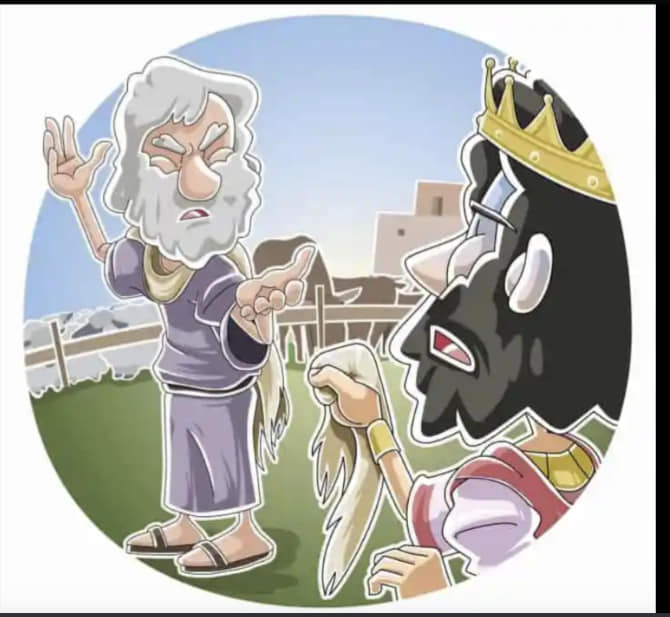
UNWILLINGNESS to Accept Responsibility: “And Samuel said, What hast thou done? And Saul said, Because I saw that the people were scattered from me, and that thou camest not within the days appointed, and that the Philistines gathered themselves together at Michmash; Therefore said I, The Philistines will come down now upon me to Gilgal, and I have not made supplication unto the LORD: I forced myself therefore, and offered a burnt offering. And Samuel said to Saul, Thou hast done foolishly: thou hast not kept the commandment of the LORD thy God, which he commanded thee: for now would the LORD have established thy kingdom upon Israel for ever” (1Sam 13:11-13).

Saul’s inability to take responsibility for his actions was evident in his response when confronted by Samuel. Instead of acknowledging his mistake and seeking repentance, Saul shifted blame onto others, making excuses for his disobedience. He attempted to justify his actions rather than humbly admitting his wrongdoing. This lack of accountability demonstrated a failure in Saul’s character as a leader.

LACK OF OBEDIENCE and Submission: “And Saul said unto Samuel, Yea, I have obeyed the voice of the LORD, and have gone the way which the LORD sent me, and have brought Agag the king of Amalek, and have utterly destroyed the Amalekites. But the people took of the spoil, sheep and oxen, the chief of the things which should have been utterly destroyed, to sacrifice unto the LORD thy God in Gilgal. And Samuel said, Hath the LORD as great delight in burnt offerings and sacrifices, as in obeying the voice of the LORD? Behold, to obey is better than sacrifice, and to hearken than the fat of rams. For rebellion is as the sin of witchcraft, and stubbornness is as iniquity and idolatry. Because thou hast rejected the word of the LORD, he hath also rejected thee from being king” (1Sam 15:20-23).

Overall, Saul’s mistakes can be summarized by his consistent failure to obey and submit to God’s authority. Whether it was sacrificing without Samuel’s presence, sparing King Agag, or not fully carrying out God’s command, Saul demonstrated a pattern of rebellion and disobedience. His lack of reverence for God’s instructions ultimately led to his downfall and the loss of his kingship.

In summary, Saul’s mistakes were: 

  1. Sacrificing without Authority, 
  2. Arrogance and Presumption, 
  3. Unwillingness to Accept Responsibility, and 
  4. Lack of Obedience and Submission.

 These lessons from Saul’s life serve as a reminder for us to humbly follow God’s commands, trust in His timing, and accept responsibility for our actions as we strive to be obedient servants.

Agape,

Spencer

Hebrews 12; SPEAKS from Heaven

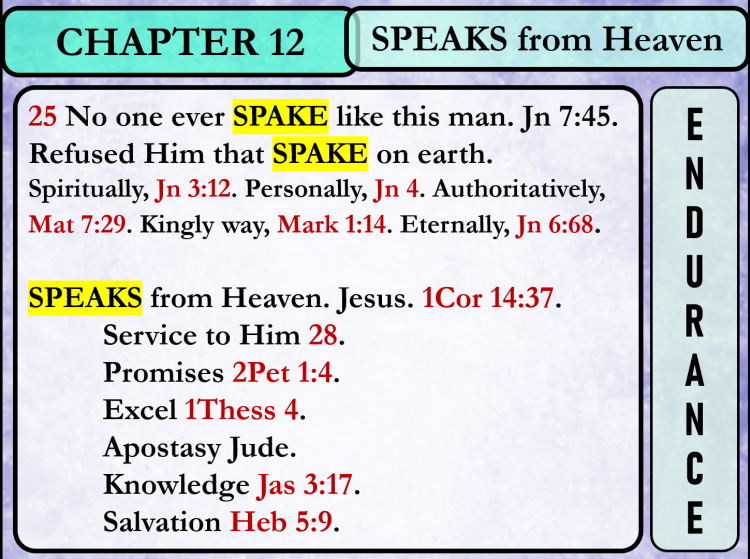
25 No one ever SPAKE like this man. Jn 7:45.

Refused Him that SPAKE on earth.

Spiritually, Jn 3:12.

Personally, Jn 4.

Authoritatively, Mat 7:29.

Kingly way, Mark 1:14.

Eternally, Jn 6:68.

SPEAKS from Heaven. Jesus. 1Cor 14:37.

  Service to Him 28.

  Promises 2Pet 1:4.

  Excel 1Thess 4.

  Apostasy Jude.

  Knowledge (wisdom from above) Jas 3:17.

  Salvation Heb 5:9.

Click here for an outline of the book of Hebrews.

We Gotta have GRIT

you’re going to Endure You Gotta have Grit.

Behold, we count them happy which endure. Ye have heard of the patience of Job, and have seen the end of the Lord; that the Lord is very pitiful, and of tender mercy.”  (James 5:11)

Endurance is a highly favored quality of mankind. It is most often associated with success despite difficulty or pain. We praise endurance because of the win that usually follows.

Endurance is necessary to our survival, and essential for our salvation. “And ye shall be hated of all men for my name’s sake: but he that endureth to the end shall be saved” (Matt 10:22).

Fear none of those things which thou shalt suffer: behold, the devil shall cast some of you into prison, that ye may be tried; and ye shall have tribulation ten days: be thou faithful unto death, and I will give thee a crown of life” (Rev 3:10; cf Jas 1:12).

GRIT is another description of endurance. It is having a firmness of character; an unconquerable spirit. We gotta have GRIT, but how do we get us some?

The Hebrew writer in chapter 12, a chapter about endurance, gives us 4 keys on how to get GRIT.

[12] Therefore, lift up the hands which hang down and the feeble knees,

[13] and make straight paths for your feet, lest that which is lame be turned out of the way, but let it rather be healed.

[14] Follow peace with all men, and holiness, without which no man shall see the Lord,

[15] looking diligently lest any man fail of the grace of God; lest any root of bitterness spring up to trouble you, and thereby many be defiled;

Key #1 is GET UP AND GO.

Therefore, strengthen the hands which hang down, and the feeble knees” (Heb 12:12). This is a command for us to get busy working on strength building.

When Elijah was facing persecution, God told him to GO. “And there he went into a cave, and spent the night in that place; and behold, the word of the LORD came to him, and He said to him, “What are you doing here, Elijah?” So he said, “I have been very zealous for the LORD God of hosts; for the children of Israel have forsaken Your covenant, torn down Your altars, and killed Your prophets with the sword. I alone am left; and they seek to take my life” (1Kings 19:9). “Go, return on your way to the Wilderness of Damascus; and when you arrive, anoint Hazael as king over Syria” (19:15).

Key #1 is GET UP AND GO.

Key #2 is to READ the Bible with a focus on the New Testament.

“…and make straight paths for your feet, lest that which is lame be turned out of the way, but let it rather be healed” (Heb 12:13). The straight path for our feet is found through the illumination of the word of God, consider Psalm 119:105… “Thy word is a lamp unto my feet, and a light unto my path.”

Key #2 is READ the Bible with a focus on the New Testament.

Key #3 is to be INTERESTED in and pursue peace with people.

Follow peace with all men, and holiness, without which no man shall see the Lord,” (Heb 12:14). We can endure longer when we stop making enemies.

If it be possible, as much as lieth in you, live peaceably with all men” (Rom 12:18). “I exhort therefore, first of all, that supplications, prayers, intercessions, and giving of thanks be made for all men, [2] for kings and for all who are in authority, that we may lead a quiet and peaceable life in all godliness and honesty” (1Tim 2:1-2).

Key #3 is to be INTERESTED in and pursue peace with people.

Key #4 is to look and TEST everything people are teaching.

“…looking diligently lest any man fail of the grace of God; lest any root of bitterness spring up to trouble you, and thereby many be defiled” (Heb 12:15). Looking diligently is about searching out the truth, proving it, and applying it to our lives.

Paul wrote; “Test all things; hold fast to that which is good” (1Thess 5:21). We must be on guard against error and false teachers. “But there were false prophets also among the people, even as there shall be false teachers among you…” (2Pet 2:1a). We’ll gain more endurance as we clear away errors and false teachers.

Key #4 is to look and TEST everything people are teaching.

Summary:

Key #1 is GET UP AND GO. Strengthen the hanging hands.

Key #2 is to READ the Bible to shine a light on your path.

Key #3 is to be INTERESTED in and pursue peace with people.

Key #4 is to look diligently and TEST everything people are teaching.

Agape,

Spencer

the 5 Mistakes of MICAH (Judges 17) pt 2

And he said unto them, Well did Isaiah prophesy of you hypocrites, as it is written, This people honoreth me with their lips, But their heart is far from me. But in vain do they worship me, Teaching as their doctrines the precepts of men.”  (Mark 7:6-7)

The Old Testament has many lessons for us today. In Judges 17, we see five mistakes of the man MICAH. Last week we looked at 3 of them that are repeated by many today.

  • He followed his Mother’s traditions.
  • He made Idols.
  • He Changed the law to suit himself.

I encourage you to review the previous article. 

Today’s article will look at the last two mistakes of MICAH.

The 5 mistakes of MICAH (Judges 17)repeated today. Pt2

The fourth mistake of Micah was that he ASSIGNED to himself a priest from the Levites to be his personal priest.

And Micah said unto him, Dwell with me, and be unto me a father and a priest, and I will give thee ten shekels of silver by the year, and a suit of apparel, and thy victuals. So the Levite went in. [11] And the Levite was content to dwell with the man; and the young man was unto him as one of his sons. [12] And Micah consecrated the Levite; and the young man became his priest, and was in the house of Micah. [13] Then said Micah, Now know I that the Lord will do me good, seeing I have a Levite to my priest” (Judges 17:10-13.

Today people will talk about their favorite preacher, pastor, televangelist, author and so on. Paul dealt with this issue with the church at Corinth. “For it hath been declared unto me of you, my brethren, by them which are of the house of Chloe, that there are contentions among you. Now this I say, that every one of you saith, I am of Paul; and I of Apollos; and I of Cephas; and I of Christ. Is Christ divided? was Paul crucified for you? or were ye baptized in the name of Paul” (1Cor 1:11-13)?

How do we correct this mistake? When we establish dividing lines based on popular preachers, or public figures we are carnal. That’s what Paul called it. “For ye are yet carnal: for whereas there is among you envying, and strife, and divisions, are ye not carnal, and walk as men” (1Cor 3:3)?

What can we do? Follow Jesus. Read about Him. Study Him. Walk like He walked. People living godly lives can serve as examples for us, but only as far as they imitate Christ (1Cor 11:1). We are not to elevate them above others and especially not to cause division. “And these things, brethren, I have in a figure transferred to myself and to Apollos for your sakes; that ye might learn in us not to think of men above that which is written, that no one of you be puffed up for one against another” (1Cor 4:6; cf 2Cor 12:6).

The last mistake we’ll consider is that Micah had a HOUSE of gods.

And the man Micah had a HOUSE of gods, and made an ephod and teraphim, and consecrated one of his sons, who became his priest” (Judges 17:5).

Besides the idolatry, this mistake is saying that all religions and denominations are equal. Paul saw this error in Athens. “For as I passed by, and beheld your devotions, I found an altar with this inscription, TO THE UNKNOWN GOD. Whom therefore ye ignorantly worship, him declare I unto you” (Acts 17:23).

We see this same mistake being made today. Religious people have become ECUMENICAL (aimed at achieving universal Christian unity and church union through international interdenominational organizations that cooperate on matters of mutual concern). In other words, religious folks are focusing on unity (Jews, Muslims, & Christians) despite clear scriptural and doctrinal differences. They see all religions as different ships going to the same destination. This sounds good on the surface, but misses the biblical definition of unity.

How do we correct this mistake? Paul warned; “For if he that cometh preacheth ANOTHER Jesus whom we have not preached, or if ye receive ANOTHER spirit which ye have not received, or ANOTHER gospel which ye have not accepted, ye might well bear with him” (2Corinthians 11:4; cf. Gal 1:6-9). We are warned repeatedly to beware of false teachers. They are described as wolves in sheep’s clothing, deceivers, dogs, and “hidden rocks in your love-feasts when they feast with you, shepherds that without fear feed themselves; clouds without water, carried along by winds; autumn leaves without fruit, twice dead, plucked up by the roots; Wild waves of the sea, foaming out their own shame; wandering stars, for whom the blackness of darkness hath been reserved forever” (Jude 1:12-13).

The main takeaway is that it’s possible for people to be following a different Jesus and not the Jesus of scripture (cf Phil 3:19). While many claim to follow Jesus, they may not be following the Jesus of the New Testament.

What can we do? Check out what your pastor teaches, what your church practices, & what sins they accept through the lens of the word of God. “These were more noble than those in Thessalonica, in that they received the Word with al lreadiness of mind and searched the Scriptures daily to see whether those things were so” (Acts 17:11). The folks in Berea were called more noble as they were checking out the teaching of the Apostle Paul!!

Be careful how you hear, and what you hear. There is only one truth and only one way to have unity and fellowship with God. “Sanctify them in the truth: thy word is truth” (John 17:17).

Spencer is the evangelist for the church of Christ in Borger on Franklin & Juniper.

Read part one, “the 5 mistakes of MICAH” here.

The book of JUDE overview

I: the EMERGENCY. [1-4]

(1-2) DESIGNATION of author & Readers.

(3-4) DANGER of apostates.

II: the EXAMPLES. [5-16]

(5-7) DESTINY of apostates.

(8-16) DESCRIPTION of apostates.

III: the EXHORTATION. [17-25]

(17-23) DUTY of believers.

(24-25) DOXOLOGY.

the Franklin & Juniper st church of Christ in Borger provides multiple bible study opportunities weekly.

Sunday morning at 9:30 followed by congregational worship at 10:30.

Wednesday night at 6:30.

We also provide individual private bible studies locally upon request.

Let us know how we can help you to know Christ through knowing His word.