A Survey of the Bible

SOMETIMES IT’S GOOD to stop to take in the entire landscape. This is what we are doing with our Wednesday study of the Old Testament.

One of the primary reasons many people haven’t made the effort to get to know the Bible is that they feel it is intimidating and confusing. Without a basic understanding of how the Bible is written this can often be the case. To help develop an overall picture of the Bible, turn to the Table of Contents. You will notice that the Bible is actually a collection of 66 books that are divided into two sections, the Old Testament and the New Testament. Let’s notice how the Old Testament can be outlined.   

The Old Testament is made up of 39 books. Here is how they can be grouped and categorized:

Genesis to Esther: History books (of the Jewish people), Mostly chronological, starts at beginning of time and goes to about 400 BC.

Job to The Song of Solomon: Poetry books, not chronological, all written sometime during the History section, designed to teach lessons about everyday life kinds of things: Job – trials, Psalms – worship/prayer, Proverbs – wisdom, Ecclesiastes – philosophy, Song of Solomon – love.

Isaiah to Malachi: Prophecy books, not chronological, all written sometime during the History section, basically they were preachers inspired by God to warn the people of judgment and foretell certain future events. 

The New Testament is made up of 27 books. Here is how they can be grouped and categorized:

Matthew to Acts: History books, not chronological, Matthew, Mark, Luke, & John are all self-contained histories of Jesus’ life. Acts is the history of the early church (or followers) of Jesus.

Romans to Jude: Letters to churches or individual Christians, not chronological, many written during the time frame of Acts’ history, designed to teach lessons about everyday life kinds of things: worship, morality, love, relationships, trials, philosophy, wisdom, etc.

Revelation: Prophecy book, written to correct and warn early Christians.

Recognizing these things will be extremely helpful in your reading of the Bible. Simply understanding the context of what you’re reading will make the Bible less confusing. Knowing the above should give you confidence in your ability to understand God’s Word.

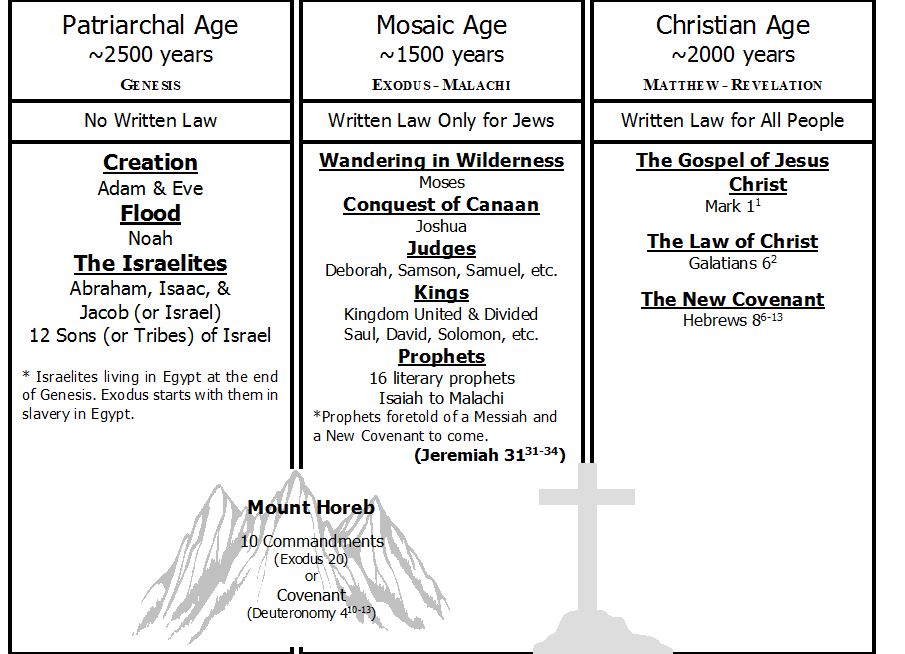
The Outline of the Bible:
overview

Study the chart above. Notice that the three periods of time are divided by how God delivered His laws to mankind. The first was through patriarchs or heads of families. Second was through Moses and the prophets. And finally He delivered His will to man through Jesus.

The Patriarchal Age. This period starts in Genesis 1 at the creation of the world. Adam & Eve disobey God and are made to leave the Garden of Eden. After many years the earth is full of evil and God decides to send a flood to destroy all that will not repent. Noah and 7 of his family are the only ones who are saved. Over 400 years later a man named Abram (later Abraham) is chosen by God to become the father of the Israelite nation (Gen. 12).

From this time on the Bible specifically traces the History of that one nation. Abraham has Isaac, Isaac has Jacob, and after Jacob’s name is changed to Israel he starts the family. The Israelites (also called Hebrews or Jews) begin to grow as a family after Jacob has 12 sons who later become 12 tribes. At the end of Genesis they are a still a small family who have moved to Egypt. They are taken into captivity for a couple hundred years and grow to be a large nation.

The Mosaic Age. God chooses a man named Moses to deliver the people of Israel out of Egyptian bondage. Moses leads the people out of Egypt to a mountain called Horeb (later Sanai). Here God delivers his law for the Israelites.

After the Israelites wander for 40 years in the wilderness, they go into “the Promised Land” (Canaan) under Joshua’s command. Once they settle the land God leads the people by appointing a series of Judges (who were basically military leaders) for around 350 years. After this the people want to be lead by a king like the nations around them. God warns them it’s a bad idea but grants their request by giving them Saul, David, and then Solomon. After Solomon’s reign (925 BC), the nation divides into two groups – Israel in the north and Judah in the south.  The northern kingdom of Israel grows increasingly evil and at God’s decree is taken into captivity by the Assyrians in 721 BC never to return again. Later, the southern kingdom of Judah is punished by being taken into captivity by the Babylonians. After 70 years they returned to their homeland and rebuilt their nation. It is their descendants who are the Jews of today and through whom Christ came.

During the time of these two kingdoms, the Prophets wrote their books. Almost all of them spoke of the coming of a Savior or Messiah. Most of them also spoke of a new covenant that would be enacted when this Savior came.

The Christian Age. This is the final way that God has revealed His will to mankind. We are now living in this age. The Bible teaches that once the Messiah came, so did the new covenant.

According to the Bible people today are to follow the New Testament. This is one reason why there are so many churches today doing so many different things yet all claiming to follow the Bible. There are many religious groups who say they follow the Bible but for some reason have missed this important Bible teaching. Can you think of any religious practices you’ve seen before which are only found in the Old Testament?

Jesus Has All Authority:

The Bible teaches us 4 things that are NOT our authority for religious practice. 1) The Old Testament, 2) Our own initiative to change something God commanded (like Nadab & Abihu), 3) Emotion or good motives (like David & Uzzah), 4) The traditions of men. If none of these can accurately define for us what God wants from us, where must we look?

He did not know the Lord had departed

THE PHILISTINES are upon you, Samson!” So he awoke from his sleep, and said, “I will go out as before, at other times, and shake myself free!” But he did not know that the LORD had departed from him. That is the situation Samson found himself in after he allowed Delilah to cut his hair in Judges 16:20.

That’s the worst place to be if you knew…. (Which would be far better). Not knowing is dangerous and even spiritually deadly. You can and should repent

Sampson was not the only one, there were so many others…

David hid his sin and didn’t know until Nathan told him. And Nathan said to David, “Thou art the man” [2Sa 12:7]. David had committed sin, but as he tried to hide it is when things got so much worse, leading to lying, conspiracy, murder and ultimately giving occasion for the enemies of God to blaspheme.

We can do our best to hide sin, but shall never hide them from God. I’ve heard that certain practitioners of Islam build walls in their homes facing Mecca and allah is unable to see the sin they commit if done behind that wall. The one true God doesn’t have that limitation, He sees everything! David learned this the hard way and wrote a Psalm about it, “Thou hast set our iniquities before thee, our secret sins in the light of thy countenance” [Ps 90:8]. The writer of Hebrews said, “Neither is there any creature that is not manifest in his sight: but all things are naked and opened unto the eyes of him with whom we have to do.” [Heb 4:13].

Simon the sorcerer tried to bypass authority and didn’t realize The LORD had departed until Peter told him. “But Peter said unto him, Thy money perish with thee, because thou hast thought that the gift of God may be purchased with money” [Acts 8:20]. We see this one all the time, folks thinking they can bypass the Authority of Christ [Mat 28:18].  None of us think we can buy the power of the Holy Spirit, but some do believe they can have power over the church through their contribution, dissensions or threats. This sin, sedition, is included with the list of the works of the flesh in Galatians 5:19-20. We must follow the instructions of Christ in all things, the church is not a democracy and we don’t vote on the doctrines of Christ.

Peter played the hypocrate until Paul told him – “But when I saw that they walked not uprightly according to the truth of the gospel, I said unto Peter before them all, If thou, being a Jew, livest after the manner of Gentiles, and not as do the Jews, why compellest thou the Gentiles to live as do the Jews? [Ga 2:14]”

We decieve our friends and family in our own hypocrisy. In our attempts to “fit in” with the world, they see our double minded actions toward God. We do this so as not to lose any friends. When we act in such a duplicitous way, are we really being a friend?

Annanias when he tried to outsmart God. “But Peter said, Ananias, why hath Satan filled thine heart to lie to the Holy Ghost, and to keep back part of the price of the land? [Acts 5:3 ]” It’s impossible to outsmart God, but many attempt to do it all the time. W.C. Fields, when asked why he was reading the bible said, “Loopholes, looking for loopholes!” Can you ever out smart God? Amazingly, Christians believe they can fool God. And what’s worse, they believe they can outsmart Him! Minimal attendance or removing your “membership” without going to another congregation so as to avoid withdrawal. Building a team to “out vote” the leadership. It didn’t work then and it won’t work now.

Sapphira ignored her chance but didn’t take it. “And Peter answered unto her, Tell me whether ye sold the land for so much? And she said, Yea, for so much” [Ac 5:8]. At least David siezed on his opportunity to repent. Peter gave her opportunity but she had her story and was sticking to it. Learn from Sapphira and repent before it’s too late.

Nadab & Abihu wouldn’t heed the instructions of the Lord. “And Nadab and Abihu, the sons of Aaron, took either of them his censer, and put fire therein, and put incense thereon, and offered strange fire before the LORD, which he commanded them not” [Lev 10:1]. The commandments are clear, and their not burdensome [1John 5:3], but we think that our way is better. We say things like, “the Bible doesn’t say we can’t.” Look again at Lev 10:1, it says, “the LORD commanded them not.” Silence is prohibitive, we have permission ONLY when we have a command.

Lot’s wife didn’t know when she ignored God’s command. “And it came to pass, when they had brought them forth abroad, that he said, Escape for thy life; look not behind thee, neither stay thou in all the plain; escape to the mountain, lest thou be consumed. But his wife looked back from behind him, and she became a pillar of salt” [Ge 19:17-20]. Perhaps she had grown so used to sin that she didn’t believe God’s command. This seems to be the prevailing view among some. “Because sentence against an evil work is not executed speedily, therefore the heart of the sons of men is fully set in them to do evil.” [Ecc 8:11]. Folks, just because God is delaying punishment doesn’t mean He will never punish it.

We can know if God is with us, by learning and keeping His word. Read 1John and learn about a wonderful hope for the Christian who loves God. It’s a book of hope and assurance for our faith. Eleven times John writes about what “we know.”

My little children, let us not love in word, neither in tongue; but in deed and in truth. 1John 3:18

Do you remember?

THERE ARE THOSE MAJOR events in a man’s life that burns an indelible mark in the memories of their mind. September 11th is one such event. We can vividly recall where we were, the folks we where with and how we felt in that moment, the day the towers burned. Then our own hearts sank along with those towers, reeling from the incredible loss of life.

There are other moments we shall never forget. Before 9/11 our parents told stories about a November day in Dallas. Having grown up near Canaveral (even though I was living in Alaska at the time), the Challenger explosion became my “Kennedy experience”.

Then there are the more personal moments, shared only by those close to you within your life. The day you met your future spouse, was it love at first sight? Perhaps the day you wed the love of your life. The birth of a child, can that ever be forgotten?

There are the tragic moments too, the loss of a mother, a father or even a child. My cousin’s daughter Jenny died suddenly after ingesting a peanut hidden in a brownie. Aspiring to be a country singer, she was on a trip to Nashville with her grandparents and was visiting the Grand Ole Opry. For over 20 excruciating hours My cousin awaited the return of her parents to see their faces and to hear first hand about what happened to their oldest child.

Yes, we do remember.

Could we ever forget? Excepting the degenerative diseases of the mind is there anything that could make us forget? We never “get over it”, never do we forget. We move forward as new people, affected by whatever it was that moved us. Lest we spend too much space reminiscing, there is another event we ought to remember.

That day the word of the Lord struck your heart, piercing it through, pricking it to obey the Gospel. Just like so many did on Pentecost; “Now when they heard this, they were pricked in their heart, and said unto Peter and to the rest of the apostles, Men and brethren, what shall we do?” [Ac 2:37]

Do you remember that day? Does it hold for you the same battle within your emotions between sorrow and joy. Sorrow for the recognition that your sin, and the whole worlds, sent our Savior to that cruel cross. Yet, there was also joy. Rejoicing that our Savior gave Himself, a substitutionary sacrifice, paying the debt caused by sin. [John 3:16]

And he is the propitiation for our sins: and not for ours only, but also for the sins of the whole world.” [1John 2:2]

Every week we’re given opportunity to “remember” when His blood was shed on the cross. Though we weren’t alive, His divine word is and provides for us all of the vivid detail, leaving us the “Supper” to eat in remembrance of Him. “And he took bread, and gave thanks, and brake it, and gave unto them, saying, This is my body which is given for you: this do in remembrance of me.” [Luke 22:19]

There are other times in which it becomes necessary to REMEMBER His death. When our days are darkened by sin. John was told to write letters to the 7 churches of Asia, and to the dead church at Sardis he told them; “Remember therefore how thou hast received and heard, and hold fast, and repent. If therefore thou shalt not watch, I will come on thee as a thief, and thou shalt not know what hour I will come upon thee.” [Rev 3:3]

When sin enters our lives, or despair from the burdens and memories of this life, let us revisit the memory of the day we were saved. Remember with a godly sorrow, that worketh repentance to salvation, and not the sorrow of the world that works death. [2Cor 7:9, 10]

We as Christians ought to remember that day. Unfortunately, there are so many more who have never had THAT day to remember. [2Thess 1:8] Perhaps the memory of that day would inspire us to share, with those who have yet to believe, the words of eternal life. [John 6:68]

Preacher or Pastor What’s the difference?

MOST FOLKS, myself included, have a hard time remembering names. However, many can remember what you do, probably because it’s more tangible than a name.    Let me share with you a conversation that I have nearly every single day;

Them: Hello pastor.
Me: Hello, I’m not a pastor, I’m a preacher.
Them: what’s the difference?
Me: a bunch, would you like to study it?
Them: No, I’m good.

This typical conversation has been condensed for space. I’m never short with them, always jovial and kind, but I do use it as an opportunity to engage in a gospel conversation with folks.

This article is for them. For all of us really. It will be posted online as a tool you can use when they ask you, “what’s your pastor like?”

What’s the difference?

Although all pastors are preachers, not all preachers are pastors.

PREACHERS: These people are “a herald, i.e. of divine truth (especially of the gospel)” WE Vines. Although any one can be a “preacher” when they speak about the Gospel, there is a position in the local congregation which is called “the evangelist.” According to scripture, this is a male who is a herald of the gospel during the preaching portion of the worship. He stands up and preaches the gospel, [2Timothy 4:2; 1Timothy 2:12; 1Corinthians 14:34]. It’s unpopular to say “male only”, but this is the teaching of the New Testament. In no way does this teaching speak to the worth of women, rather it is just a defining of roles. [Galatians 3:28]

In short, a preacher is an evangelist who, in addition to going out to spread the gospel, publicly preaches the gospel during the worship of the local congregation. Paul wrote to the evangelist / preacher Timothy, “But watch thou in all things, endure afflictions, do the work of an evangelist, make full proof of thy ministry.” [2Tim 4:5]

PASTORS: This is a specific position held in the local congregation, the qualifications of which are in 1Timothy 3:1-7 & Titus 1:5-9. There are some additional information about “pastors”, also called “elders” in Acts 20:17-35. Here we find that these men are to watch over the local church and to feed the flock; “Take heed therefore unto yourselves, and to all the flock, over the which the Holy Ghost hath made you overseers, to feed the church of God, which he hath purchased with his own blood.” [Acts 20:28]. From this verse it becomes clear why Elders are also Called Pastors.

An Elder / Pastor can also be an evangelist, laboring as his vocation in the Gospel. “Let the elders that rule well be counted worthy of double honour, especially they who labour in the word and doctrine.” [1Timothy 5:17]

What’s Your Pastor Like?” This is another question that is frequently asked. What they’re trying to determine is his speaking ability and personality. This questions is often asked by a person who’s thinking about visiting a particular church. While there’s nothing wrong in asking about the speaker, it shouldn’t be the FIRST nor ONLY prerequisite for choosing a church. (Other poor qualities for choosing a church are; games, entertainment, cafes of field trips)

One should seek first the truth; “But seek ye first the kingdom of God, and his righteousness; and all these things shall be added unto you” [Mat 6:33]. I’ve written about this in a previous article, “How to start a church” [April 19, 2015]. The basics of which are 3 points:

  • Reliance on God’s word for their only Authority. [1Peter 4:11]
  • Correct Worship in spirit and truth. [John 4:24]
    1. Assembling on the correct day, partaking of the Lord’s Supper [Acts 20:7]. Preaching, praying, singing (without the aid of mechanical music) and giving [Acts 20:7, 8, 36; Eph 5:19; 1Cor 16:1].
  • Doing the work of the church; Spreading the Gospel, Edification of the saints, and benevolence for needy saints. [Mat 28:18-20; Eph 4:12; 1Cor 16:1]

More could be said about this subject, hopefully this article has peaked your interest in confirming for yourself about the truth of all matters. Search the scriptures yourselves to learn all the counsel of God.  [Acts 17:11; 1John 4:1-3].

Prove all things; hold fast that which is good
[1Thess 5:21]

Does the Bible Answer Everything?

DURING A DISCUSSION with a 20 something, the question was raised, “do you really think that the Bible has answers for every situation of man?” I immediately responded with, “YES! In principle.”

What I mean by this is that the Bible contains principles that can aid us in working through any and every situation of life. The Bible is God’s revelation for man and contains His law, i.e. rules of conduct to govern man. (2Peter 1:21; 2Sam. 23:2; 1Cor. 2:7-13, Eph. 3:3-5; Gal. 6:2; James 2:12, etc.).  In fact, all Scriptures given by inspiration of God furnish man completely unto all good works, unto all things that pertain to life and godliness (2 Tim. 3:16-17, 2 Peter 1:3). This tells me that God has made known to mankind His will regarding every situation a person might face.

God, the creator of us all, knows what is best for us. Shall the clay question the potter? Unless we consult with God how shall we direct our own steps [Jeremiah 10:23]? This direction, given in His law, governs our total conduct. Conduct is the meaning of the word “conversation” in Phillippians 1:27; “Only let your conversation be as it becometh the gospel of Christ.” KJV

The total of man’s conduct may be catagorized into five relationship areas: religious, political, economic, domestic, and social.

God reveals His Direction for our conduct regarding our relationship to…

RELIGION in the gospel: John 4:24 ; James 1:27; Romans 12:13; Heb. 13:2; Gal. 6:10.

God is a Spirit: and they that worship him must worship him in spirit and in truth

GOVERNMENT (political: Rom. 13:1-7; 1Peter 2:13-14), to business (economic: Eph. 4:28; 2Thess. 3:10).

Let every soul be subject unto the higher powers. For there is no power but of God: the powers that be are ordained of God.

ECONOMIC (Eph 4:28; 2Thess 3:10;)

Let him that stole steal no more: but rather let him labour, working with his hands the thing which is good, that he may have to give to him that needeth.

FAMILY (domestic: 1 Tim. 5:1-6; Eph. 5:21; 6:4).

But if any provide not for his own, and specially for those of his own house, he hath denied the faith, and is worse than an infidel.

COMMUNITY (social: Matt. 7:12; Luke 10:30-37).

Therefore all things whatsoever ye would that men should do to you, do ye even so to them:

In the Bible, we can study God’s precepts and examples to learn how to direct our own steps. The conduct of many folks, good and bad, are recorded for our learning [1Corinthians 10:6,11; Romans 15:4]. God rejected sinful conduct and demonstrated His approval with conduct that was in harmony with His will. The conduct of their lives, exemplified in the scriptures, are aproved or disapproved according to the dispensation in which they lived.

We have a perfect example in Christ “For even hereunto were ye called: because Christ also suffered for us, leaving us an example, that ye should follow in his steps: who did no sin.” [1Peter 2:21-22]. Never did He violate God’s law [1John 3:4], but in every respect His conduct was in harmony with the Father’s will. This mind that was in Christ we are to imitate [Phil 2:5-11].

With regards to the final judgment, when this world will be dissolved, what manner of person ought we to be? [2Peter 3:11]. “But as he which hath called you is holy, so be ye holy in all manner of conversation; Because it is written, Be ye holy; for I am holy.” [1Pe 1:15-16].

The answer to the question is YES, the Bible does give us directions to face any situation in all of our relationships; Religion, Economic, Political, Family and socially. The Bible is God’s written instructions for mankind, His will for us.

So many people are walking around saying, “I know God has a plan for my life.” He does, yet many never bother to read it. God does have a plan for us, let us study it and do His will [2Timothy 2:15]. Most importantly, let us study His will on how to gain eternal life.

Then Simon Peter answered him, Lord, to whom shall we go? thou hast the words of eternal life. John 6:68

The one oar Christian

THERE’S A STORY TOLD OF an old wise man of God who was continually criticized for his motto, “pray and work.” A young pupil, struggling with the mounting problems of life, asked the wise man, “If God is so powerful, why then do you teach us also to work?” The wise man of God invited this youth to go fishing. As they entered the boat, the youth noticed that the old man only used one oar and said, “If you don’t use both, we’ll just go around in circles and you won’t get anywhere.” “That’s right, my son,” the elder man replied. “One oar is called prayer and the other is called work. Unless you use both at the same time, you just go in circles and you don’t get anywhere.”

Over the years I’ve learned that prayer alone, or work alone, is just like trying to row a boat using only one oar. All you ever seem to do is just go around in circles.

There is no doubt that prayer ought to be a part of every Christians day. Jesus taught this on several occasion, exemplifying it in His own life [Mat 14:23; 26:36,39; Mark 1:35; Luke 9:18,29].

_____________________________

And he spake a parable unto them to this end, that men ought always to pray, and not to faint;
Luke 18:1

_____________________________

Unfortunately, that is where many of us stop. We pray and pray and pray, wondering why nothing ever changes. What we forget is that God has also required us to act. Let us consider two Godly men Abraham, and Moses, men who are noted for how God spoke to them as a friend [Gen 18:17; Ex 33:11].

In reading Hebrews 11, we see that these two men had a great faith. Was their faith only seen in their prayer life? Are these men remembered for their inactive faith only? Do you recall reading about these men sitting in their easy chair, lifting up praise and prayers to God and softly drifting off to sleep comforted with the thought that God would take care of their troubles? No, never. What we DO READ is that these men of faith prayed and worked.

_____________________________

By faith Abraham, when he was called to go out into a place which he should after receive for an inheritance, obeyed; and he went out, not knowing whither he went. Heb 11:8

By faith Abraham, when he was tried, offered up Isaac: and he that had received the promises offered up his only begotten son, Heb 11:7

_____________________________

When Abraham heard God, he acted upon those commands. In the case of offering up Isaac, it is said that he “rose early” that morning to fulfill the commands of God [Gen 22:3].

Moses also acted upon the commands of God.

_____________________________

By faith Moses, when he was come to years, refused to be called the son of Pharaoh’s daughter; Choosing rather to suffer affliction with the people of God, than to enjoy the pleasures of sin for a season; Esteeming the reproach of Christ greater riches than the treasures in Egypt: for he had respect unto the recompence of the reward. Heb 11:24-26

_____________________________

Did either of these men think that they were accomplishing anything out of their own power? No, they had placed their trust in God, but this trust was manifested by a remarkable demonstration of action.

When we pray according to God’s will, we’re praying having sought to know His will through the study of His word [2Tim 2:15]. Then after we pray, we get up and apply that knowledge to our lives. We act, not because we think highly about ourselves, rather, because we are trusting God to bless our godly activities.

_____________________________

But be ye doers of the word, and not hearers only, deceiving your own selves. James 1:22

_____________________________

For if any be a hearer of the word, and not a doer, he is like unto a man beholding his natural face in a glass: 24 For he beholdeth himself, and goeth his way, and straightway forgetteth what manner of man he was. But whoso looketh into the perfect law of liberty, and continueth therein, he being not a forgetful hearer, but a doer of the work, this man shall be blessed in his deed.”  (KJV) [Jam 1:23-25]

You will never hear

WILL YOU EVER hear our Baptist, Presbyterian or any of our denominational friends say, “The most influential men in our history were opposed to the use of instrumental music in Christian assemblies.”? No, you will never hear a Baptist say, “Charles Spurgeon, one of our greatest Baptist preachers, opposed instrumental music.” And you will never hear a Presbyterian admit: “John Calvin, one of the most famous theologians in history, rejected instrumental music in the sacred assembly.” Why? Because most are completely unaware of several facts about church history and may never hear them as their assemblies become more like concerts than a worship.

In the first century, Christians merely sang in their assemblies (Woodson). Hundreds of years passed before instrumental music was ever introduced into the apostate church. In fact, instrumental music was rejected by leading Protestants; and even when introduced into the mainline denominations, there was resistance.

Men who influenced the Protestant landscape were themselves opposed to instrumental music. For example, in his commentary on Psalm 33:2-“Give thanks unto Jehovah with the harp: Sing praises unto him with the psaltery of ten strings”-John Calvin wrote:

For even now, if believers choose to cheer themselves with musical instruments, they should, I think, make it their object not to dissever their cheerfulness from the praises of God. But when they frequent their sacred assemblies, musical instruments in celebrating the praises of God would be no more suitable than the burning of incense, the lighting up of lamps, and the restoration of the other shadows of the law. The Papists, therefore, have foolishly borrowed this, as well as many other things, from the Jews. Men who are fond of outward pomp may delight in that noise; but the simplicity which God recommends to us by the apostle is far more pleasing to him.”

The Methodist scholar Adam Clarke wrote with reference to 2 Chronicles 29:25.

But were it even evident, which it is not, either from this or any other place in the sacred writings, that instruments of music were prescribed by Divine authority under the law, could this be adduced with any semblance of reason, that they ought to be used in Christian worship? No: the whole spirit, soul, and genius of the Christian religion are against this: and those who know the Church of God best, and what constitutes its genuine spiritual state, know that these things have been introduced as a substitute for the life and power of religion; and that where they prevail most, there is least of the power of Christianity. Away with such portentous baubles from the worship of that infinite Spirit who requires his followers to worship him in spirit and in truth, for to no such worship are those instruments friendly.”

In connection with Psalms 42:4, Charles Spurgeon wrote:

Here are the facts. The instrument was not taken out of worship; rather, the instrument was an innovation brought into assemblies. On Christ’s authority, congregational singing of spiritual songs is what belongs in the church.”

John L. Girardeau’s strong opposition among the Presbyterians to the instrument included this statement:

It is almost inconceivable that the majority of the officers and members of the Presbyterian Church can have abandoned the consecrated principle that a divine warrant is needed for every element which enters into the worship of God’s house (197). What a degradation to supplant the intelligent song of the whole congregation by … the blowing off of wind from inanimate bellows and pipes! We might as well pray by machinery as praise by it (272).”

Church history is very clear, the instrument was not taken out of worship; rather, the instrument was BROUGHT IN and it was TAUGHT IN by MEN. Jesus said – and I believe it – that such worship is VAIN. On Christ’s authority, congregational singing of spiritual songs is what belongs in the church.

1Corinthians 14:15; Ephesians 5:18, 19; Colossians 3:16

Is Demon Possession Possible today? pt2

IN LAST WEEK’S ARTICLE, I showed through scripture how demonic possession is no longer possible today. For the sake of review, let me remind you of two references that deal with the binding of fallen / sinful angels. “For if God spared not the angels that sinned, but cast them down to hell, and delivered them into chains of darkness, to be reserved unto judgment;” [2Peter 2:4]. And in Jude 1:6 “And the angels which kept not their first estate, but left their own habitation, he hath reserved in everlasting chains under darkness unto the judgment of the great day.” Demons (fallen angels) are bound, awaiting the judgment.

Now we turn our attention to the verse in 1Peter 5:8; “Be sober, be vigilant; because your adversary the devil, as a roaring lion, walketh about, seeking whom he may devour:” What is being taught by this verse?

Before we proceed, let’s not undo the previous truth; DEMON POSSESSION IS NOT POSSIBLE TODAY. Zechariah 13:2 prophesied it, and the New Testament confirms it. So whatever 1Peter 5:8 teaches, it cannot include the demonic possession of one’s person.

THE TRUTH ABOUT SATAN

We first read of Satan in the book of Genesis. There is no information given about his origin, but the Bible displays his working throughout. He is called the “adversary” in our passage and seeks to supplant the authority of God [Luke 4:7]. He is a liar, and the father of lies [John 8:44]. 1John 3:8, says that the devil sinned from the beginning and has been condemned [1Timothy 3:6].

Satan is also called the “god of this world” [2Corinthians 4:4]. “World” as used in this context is speaking about people who are separated from God, people who are doing what is right in their own eyes and not following the will of God. Paul wrote in Ephesians 2:1-2, that He (Christ) has made alive…those who previously had walked according to the course of the world. To walk the course of the world (Satan’s playground) is to follow Satan’s example of rebellion and disobedience toward God. Verse 3 points out that these in the world, “once conducted ourselves in the lusts of our flesh, fulfilling the desires of the flesh and of the mind, and were by nature children of wrath...” This condition fits the description of the progression of sin in James 1:14-15.

Just as knowing God’s truth can set one free from sin [John 8:32], “He that committeth sin is of the devil” [1John 3:8]. Although Satan is a real being, HE CANNOT IRRISISTABLY CONTROL MEN. We act as his agents when we seek to do as he does, to pervert, corrupt, depart from or misrepresent the word of God [Mat 16:23; 2Corinthians 11:3; Galatians 1:6-9; 1Timothy 4:1-3].

Just as modern day Nazi’s or Marxists act as agents for their long dead leaders, so too those who wish to follow the workings of Satan. Because they don’t have a love for the truth, “God will send them strong delusion that they should believe a lie” [2Thessalonians 2:9-12].

Satan doesn’t physically possess anyone today. He has always been limited, [Job 1:12, 2:6; 1Cor 10:13]. Lies and all evil was introduced into this world by Satan, and this disease of sin is spread by wicked men who are “lovers of their own selves, covetous, boasters, proud, blasphemers, disobedient to parents, unthankful, unholy, without natural affection, trucebreakers, false accusers, incontinent, fierce, despisers of those that are good, Traitors, heady, highminded, lovers of pleasures more than lovers of God; Having a form of godliness, but denying the power thereof” who will lead astray the gullible [2Timothy 3:2-6].

God’s people can resist the devil [James 4:7], and the Omnipotent God will not allow us to be tempted beyond our ability [1Corinthians 10:13]. It is the gospel of Christ, the word of God, that is our defense against Satan’s teachings. Jesus combated Satan with “it is written” and we also have the same weapon in the “sword of the Spirit, which is the word of God” [Matthew 4:4; Ephesians 6:17]. We are instructed to withstand the devil by faith [1Peter 5:9] and we know that faith comes by hearing the Word of God [Romans 10:17].

God is great, and His love is so great that He gave us His Son, to free us from sin, and “deliver us from this present evil world” [Galatians 1:4].

— Spencer

What if we could end sin?

SUPPOSE THAT we could convince everyone in the world to quit sinning.  What would we have accomplished?

It would appear at first glance that we would have made the world a much better place, but have we really done anything?

Let’s say we could convince all the world to quit drunkenness, yet they still don’t have Christ, we have done very little. Though repentance is a part of the gospel plan of salvation [Luke 13:3], it alone will not save you. Just as faith alone will never save you.

Pick a sin, whatever bothers you most, that you would end instantly. If folks repented of these sin on their own initiative, or through sound reasoning on your part, but they have not Christ you have done nothing.

The Apostle Paul wrote, “For as in Adam all die, even so in Christ shall all be made alive.” [1Corinthians 15:22]. We are made alive when we are “in Christ”, and according to the scriptures we get into Christ through obeying the gospel.

Galatians 3:27, “For as many of you as were baptized into Christ have put on Christ.” This is the only way a person can get into Christ. The preposition into indicates a change of relationship. You can search from the front to the back of your Bible, and you will find no other way to get into Christ except by being baptized into Christ. Also Romans 6:3 says the same thing, “Or do you not know, that as many of us as were baptized into Christ Jesus were baptized into his death?” So the only way we can get into Christ is to be baptized into Christ. Either a person has been baptized into Christ, or he is still outside of Christ. We are either in or we are out. Have you been baptized into Christ in order to be saved and have your sins forgiven?  If you haven’t been, then no amount of good works can save you. [Ephesians 2:8-9].

SEEK YE FIRST…

Nowhere in this article am I saying that a person can continue in sin. Paul, in his letter to the Romans said such, [Romans 6:1-3]. It is sin that has separated us from God. “But your iniquities have separated you from your God; and your sins have hidden His face from you, so that he will not hear” [Isaiah 59:2]. What I am saying is that we need to approach evangelism from the top down.

All too often we find ourselves in discussions with the world about some particular sin. The discussion usually degrades into a debate, then into an argument until finally they will say, “We just have to agree to disagree.” If, on the other hand, you do convince them that a particular thing is wrong and they change, all you’ve really done is made them a better person, or a better Baptist or a better Lutheran, but you have NOT made them a Christian. If they repent of all of their sins, they still fall short of being “IN CHRIST” just as all who believe that “FAITH ONLY” is all that is necessary unto salvation.

TOP DOWN EVANGELISM

I’ve come to the realization that when a person is truly convicted in their heart that Jesus is the Christ, just as they were at Pentecost [Acts 2:37], then they will do whatever it takes to become a Christian. Until then, it’s nearly impossible to get a person to repent of anything, much less the popular sins of our culture.

It’s for this reason that I have in mind to divert every topic of conversation, with those outside of Christ, to the topic of the Authority of Christ and His plan of salvation. This is what Philip did with the Ethiopian Eunuch on the road. “Then Philip opened his mouth, and began at the same scripture, and preached unto him Jesus.” [Acts 8:35, 36]. This is why the Eunuch asked, “See, here is water; what doth hinder me from being baptized?”

When Jesus was asked, “What is the greatest commandment?”, Jesus said to them, “Thou shalt love the Lord thy God with all thy heart, and with all thy soul, and with all thy mind.” [Matthew 22:36, 37]. This is a true statement, for our Lord said it. Before we can truly obey any command of God, we must first embrace and obey this one. If we can convince the whole world about this command, THEN we have truly done something.

WRITTEN FOR OUR LEARNING

IT SAYS IN ROMANS 15v4, “For whatsoever things were written aforetime were written for our learning, that we through patience and comfort of the scriptures might have hope.” It also says in 1Corinthians 10v11 “Now all these things happened unto them for ensamples: and they are written for our admonition, upon whom the ends of the world are come.”

These passages refer to the Old Testament Scriptures. The meaning being, that we should read the OT and study how God deals with mankind, and gain knowledge of how God applies His laws.

One particular story of interest is found in Numbers chapters 13-14. It’s here we find the Israelites are approaching the promised land after just escaping Egyptian slavery. They were given permission to send in 12 men to spy out the land, each man a “ruler among them.” [Numbers 13:2]

Upon their return from spying out the land, all of them report that the land truly is a land as God had described, “a land flowing with milk and honey.” [Numbers 13:27; Ex 3:8]

However, 10 of the spies also reported that the inhabitants of the land were, “strong that dwell in the land, and the cities are walled, and very great:”, thus giving a bad report. Caleb, one of the 12 spies, said, “Let us go up at once, and possess it;” but the 10 went against him and against Joshua.

The children of Israel were persuaded by the bad report and refused to take possession of the land as the Lord had commanded, complaining about how it would have been better to remain in Egyptian slavery. [Num 14:1-4] They even said, “If only we had come to our death in the land of Egypt, or even in this waste land!” To this God said, OK. He gave them what they requested. “Your carcases shall fall in this wilderness;” [Num 14:29a]

So…What are we to learn?

There are some similarities between them and Christians today.

First, they had been freed from bondage. We Christians have also been freed from bondage, we were enslaved to sin. “Being then made free from sin, ye became the servants of righteousness.” [Romans 6:18] We have been freed from a hopeless situation, enslaved to sin.

Second, they were between two places. Their previous condition and their future home. They were pilgrims heading to a wonderful place “flowing with milk and honey.” Christians are also between two places.  We are not in heaven, but want to go there, and we’re no longer in a lost condition. We are warned, “Dearly beloved, I beseech you as strangers and pilgrims, abstain from fleshly lusts, which war against the soul;” [1Peter 2:11]

Lastly, some of them rejected the promises of God for this new home and refused to follow His commandments to attain it. God refused to allow these disobedient unbelievers to enter the land and obtain a rest. Christians can also reject the commands of the Lord and miss out on entering our rest, heaven. We do this be following their example of turning away from God’s commands. This comparison is drawn by the Hebrews writer in chapter 3, 7-19. This letter is addressed to Christians and has this warning, “Harden not your hearts, as in the provocation, in the day of temptation in the wilderness: When your fathers tempted me, proved me, and saw my works forty years. Wherefore I was grieved with that generation, and said, They do alway err in their heart; and they have not known my ways. So I sware in my wrath, They shall not enter into my rest.)”

So you see, their example should teach us to remain faithful to God. To never neglect our salvation [Hebrews 2:3], and to obey Him by “continuing in the apostles’ doctrine” [Acts 2:42; Matthew 28:20]

Can a Christian so sin as to lose their salvation?

If we do as they did, disobedience and unbelief [Heb 3:17-19], then we will have what they had, no other options. There remains no more sacrifice for sins. 

“For if we sin wilfully after that we have received the knowledge of the truth, there remaineth no more sacrifice for sins,” (KJV) [Hebrews 10:26]