What the Bible DOESN’T Say

It’s a very good thing to find out what the Bible has to say. This is the only way to discover the will of God for our lives.

Bible students also know that when God is silent about something, that He is not giving His approval.

For example, when David came up with the idea to build a permanent temple to God in replacement of the tabernacle, God sent Nathan to him and asked; “Go and tell my servant David, Thus saith the LORD, Shalt thou build me an house for me to dwell in? Whereas I have not dwelt in any house since the time that I brought up the children of Israel out of Egypt, even to this day, but have walked in a tent and in a tabernacle. In all the places wherein I have walked with all the children of Israel spake I a word with any of the tribes of Israel, whom I commanded to feed my people Israel, saying, Why build ye not me an house of cedar?” [2Sam 7:5-7]. The point God was making is clear, if He hasn’t revealed His will on the matter He has not given His approval.

We see this same thing in the New Testament in Acts 15:24 when the Apostles wrote a letter to the gentiles over the issue of circumcision. They applied this same principle from God when they wrote, “to whom we gave no such commandment.” Silence prohibits.

Unfortunately, people are doing all sorts of things contrary to this principle by saying, “God never said we can’t.”

THINGS NOT FOUND IN GOD’S WORD.

Thinking about this principle, what are some things we see in modern day religious activities NOT FOUND IN THE BIBLE.

  • Denominational church names – Rom 16:16; Acts 20:28; Heb 12:23
  • When any Denomination Began – Dan 2:44; Mat 16:18; Acts 1:5-8, 2:1-47
  • Where anyone ever ‘JOINED’ a church – Acts 2:47; Mark 16:15-16
  • How to become a member of any denomination – The N.T. only tells us how to become a Christian Acts 2:38, 47; Acts 22:16, Gal 3:27
  • Where any were ever voted on.
  • There is no description of any denomination or how to begin one.

If there are no instructions for denominational names, beginnings or how to join one, WHY BE A MEMBER OF ONE?

JUDGEMENT BEGINS – at the house of God [1Pet 4:17]

LOST – obey not the Gospel [2Thess 1:8-9]

US, THE CHURCH – ground & pillar of the truth [1Tim 3:15]

UNGODLY – ungodly men [2Pet 3:7]

RIGHTEOUS SCARCELY SAVED –  1Peter 4:18

SINNER – But the fearful, and unbelieving, and the abominable, and murderers, and whoremongers, and sorcerers, and idolaters, and all liars, shall have their part in the lake which burneth with fire and brimstone: which is the second death. [Rev 21:8]

SALVATION IN CHRIST – And this is the record, that God hath given to us eternal life, and this life is in his Son. [1John 5:11]

CONDEMNED – Mr 16:16 He that believeth and is baptized shall be saved; but he that believeth not shall be damned.

1Peter 4:17-18

Bible believers understand that there will be a judgement [2Cor 5:10; Ecc 12:14; Heb 9:27]. Peter said, “judgment must begin at the house of God.” Who are they? Those who have obeyed the Gospel. Note the contrast at the end of v17. This alone ought to end the discussion that one can be saved outside of the church.

Finally, look closely at v18; “And if the righteous scarcely be saved, where shall the ungodly and the sinner appear?”

The Bible never tells us one thing about a denomination, as a matter of fact, it condemns it [1Cor 1:10]. However, it tells us everything we need for life and godliness [2Pet 1:3-4]. Let’s do that.

I Can Worship Alone

We’ve all heard someone say, “I don’t need to go to church to worship God.” Or, “I worship God alone, because all organized religion is wrong anyway.” Others will say, “Our entire life is worship, so it doesn’t matter if I go to church or not.” Is there any truth in these statements?

For you to offer these folks better answers, below are 7 Reasons why Public worship is better…

  1. It’s Commanded. This should end the discussion, but in this day and age, the commands of our Lord are often ignored.

John 4:24 God is a Spirit: and they that worship him MUST worship him in spirit and in truth.

Matthew 18:20 For where TWO or THREE are GATHERED TOGETHER in my name, there am I in the midst of them.


To do something “in the name of the Lord” is to do it by His command or with His permission. Doing whatever we want and attributing it to God is the sin of presumption [Deuteronomy 18:20, Acts 15:24].

  1. It’s what the 1st Century Christians did. One of the ways we understand the commands of our Lord is through the examples of the Apostles and the first Christians as revealed in the New Testament. They gathered on each 1st day of the week.

Acts 20:7 And upon the first day of the week, when the disciples came together to break bread, Paul preached unto them, ready to depart on the morrow; and continued his speech until midnight.

1Corinthians 11:20-34 When ye come together therefore into one place… [1Cor 16:1-2]

  1. The only time we are authorized to take the Lord’s Supper. Paul wrote to the Corinthian brethren about their perverting the Lord’s Supper. He reminded them of the command of the Lord on this matter.

1Corinthians 11:23-26 For I have received of the Lord that which also I delivered unto you, That the Lord Jesus the same night in which he was betrayed took bread: And when he had given thanks, he brake it, and said, Take, eat: this is my body, which is broken for you: this do in remembrance of me. After the same manner also he took the cup, when he had supped, saying, This cup is the new testament in my blood: this do ye, as oft as ye drink it, in remembrance of me. For as often as ye eat this bread, and drink this cup, ye do shew the Lord’s death till he come.

  1. We are strengthened when we come together. Paul warned the brethren that many are weak and dying because of failure to worship properly.

1Corinthians 11:29-30 For he that eateth and drinketh unworthily, eateth and drinketh damnation to himself, not discerning the Lord’s body. For this cause many are weak and sickly among you, and many sleep.

  1. Not worshipping together is called “FORSAKING THE ASSEMBLING.” If private worship is acceptable, then there could not be a forsaking of an assembly.

Hebrews 10:25 Not forsaking the assembling of ourselves together, as the manner of some is; but exhorting one another: and so much the more, as ye see the day approaching.

  1. We teach and admonish one another in public worship. One of the five acts of worship is to sing (A Capella) psalms, hymns and spiritual songs for the purpose of teaching each other. Your voice is needed.

Colossians 3:16 Let the word of Christ dwell in you richly in all wisdom; teaching and admonishing one another in psalms and hymns and spiritual songs, singing with grace in your hearts to the Lord.

  1. Private, in lieu of public worship is vain worship. Any time we replace the command of our Lord with our own, our efforts become worthless. Jesus warned us to always do His will.

Matthew 7:21-23 Not every one that saith unto me, Lord, Lord, shall enter into the kingdom of heaven; but he that doeth the will of my Father which is in heaven. Many will say to me in that day, Lord, Lord, have we not prophesied in thy name? and in thy name have cast out devils? and in thy name done many wonderful works? And then will I profess unto them, I never knew you: depart from me, ye that work iniquity.

When we’re sick, or circumstances beyond our control, prevent us from attending the local body of Christ, we have not sinned. It’s when we have opportunity and willfully choose to skip it, or replace it with a private worship that we have disobeyed the Lord.

One more thing…If we’ve failed to obey the gospel [2Thess 1:8-9] no amount of worship will help us. Worship is only acceptable when it’s done by the FAITHFUL and is AUTHORIZED. On the back panel of this bulletin answers the question, “What Must I Do to Be Saved?”

– Spencer

GIVING THANKS

One winter, while a junior in high school in Fairbanks, a friend of mine invited me to have dinner with his family (we called the evening meal ‘dinner’ in Alaska). As his dad was plating the food and delivering it to the table one at a time, his mom began eating having been served first. As my plate was set before me, I refrained from eating as a courtesy toward the host. Mr. LaPerierre noticed me waiting and asked, “Spencer, are you waiting because you’re wanting to say grace?” At that moment, his wife, fork in mouth, looked at me with wide mortified eyes, filled with the realization that she may have committed a grievous faux pas.

Has something like that ever happened to you, folks begin shoveling food in their mouths before everyone even has a chance to sit down, much worse, discovering mid bite that a prayer of thanksgiving was going to be offered? Perhaps you’ve been the one with the fork in your mouth.

It’s called different things in different places. Some call it, ‘giving thanks’, ‘saying grace’ ‘asking a blessing’ or simply, ‘the blessing.’ As families come together this week to celebrate the national holiday of Thanksgiving, the above scenario will likely repeat as folks stumble through an awkward and unprepared prayer, while the rest choke down a premature mouthful or pause mid chew.

Is it your habit to ‘say grace’ for your food?

It may not, and not just for Thanksgiving. According to a recent poll, only about 43% of Americans pray before a meal. Of those that pray, the researchers discovered they only pray 2-3 times per week. When they examined denominational backgrounds, 52% of Catholics, 60% of Protestants and 74% of Evangelicals prayed before taking a meal. Interestingly, 80% of African American families prayed, regardless of religious affiliation.

It was surprising to learn so many folks were actually praying in America. However, surprise gave way to disgust as the pollsters found that it wasn’t necessarily God being thanked. Eleven percent who claimed to be atheist, agnostic or irreligious said a prayer. An atheist man, cited in a news article about the poll, said that he and his wife give thanks to the spirits of his food. When they eat beef, they thank the four-legged spirits, and the winged ones whenever they eat chicken. When eating veggies, he thanks the veggie spirits. Sounds like a veggie tale to me.

What does the Bible say?

Many who are reading this article already have a good handle on this subject, and I hope that had we been asked, we would have skewed the polling higher. Prayer is as much a subject of scripture as God Himself. We all know that it says, “Pray without ceasing” in 1Thessalonians 5:17, but did you know that verse 18 says “in everything give thanks?”

Among the “everything”, food is a daily opportunity to “give thanks.” We ought to be thankful for our daily food, “which God created to be received with thanksgiving by them that believe and know the truth” [1Timothy 4:3b].

Our Lord and Savior, Christ Jesus, lived an example of praying before eating. In John 6:11 He, “took the loaves; and having given thanks, he distributed to them that were set down; likewise also of the fishes as much as they would.” Then, during His final meal with His disciples, “he took bread, and when he had given thanks, he brake it, and gave to them, saying, This is my body which is given for you: this do in remembrance of me” [Luke 22:19]. On the very night that he would be betrayed, Jesus knowing all things, was thankful. How simple a thing it is, and so worthwhile, to pause and to pray.


Our most Holy and Righteous Father,

Thank you for this beautiful day

For we know Father, only you can make our day.

Thank You for this food,

Which You created

And for the nourishment within it.

May it provide us the strength

For continued service in Thy Kingdom.

Please forgive us our trespasses,

For they have been many,

And we have been weak.

Your mercy, O Lord, endures forever.

Amen.

Many ways to be successful

There are all kinds of ways someone can be successful:
You can gain influence and power
You can make a lot of money
You can change peoples physical & emotional lives.
However, none of that means anything if you have to sacrifice what matters most to achieve it.
Time with family
Giving back to your community
Spending time with loved ones
Your health
God.
For what shall it profit a man, if he shall gain the whole world, and lose his own soul? Mark 8:36
Jesus said that. Nothing in this life can be considered a success if we’ve failed to follow Jesus. He knew that we would become preoccupied with striving for success, but He gave us this warning to keep our priorities straight.
It doesn’t surprise me that people will exchange their salvation for earthly treasure. What surprises me is how cheap they sell it.
Jesus warned about this as well as He continued teaching…
“Or what shall a man give in exchange for his soul?
Whosoever therefore shall be ashamed of me and of my words in this adulterous and sinful generation; of him also shall the Son of man be ashamed, when he cometh in the glory of his Father with the holy angels.” Mark 8:37-38
Let’s keep our priorities straight.

Memorial Day

Do This In Remembrance…

MONDAY marks an important holiday for our country. It’s a day we take time to remember the people who have died while serving in the country’s armed forces defending the freedoms we often take for granted.

Unfortunately, it has become less about remembering and more about hot dogs, picnics and sleeping in. Until we became blue star parents we spent the holiday in much the same way. When two of our sons served simultaneously in Afghaninstan, the concern for their lives made us take notice of holidays such as this one. Fortunately, our sons returned safe and sound, but so many other’s children did not. It’s for them we take time to remember.

It’s sad to think that many, if not most, will not even pause to consider the cost of their freedom. It has become a day off, not to reflect, rather a day of revelry.

Do This In Remembrance of Me…

The church of Christ has a memorial day. It was instituted by our Savior on the night He was betrayed, and then observed in the church He bought with His own blood [Mat 26:26-29; Acts 20:28].

For I have received of the Lord that which also I delivered unto you, That the Lord Jesus the same night in which he was betrayed took bread: And when he had given thanks, he brake it, and said, Take, eat: this is my body, which is broken for you: this do in remembrance of me. After the same manner also he took the cup, when he had supped, saying, This cup is the new testament in my blood: this do ye, as oft as ye drink it, in remembrance of me. [1Corinthians 11:23-25]

Rather than being an annual observance, the first century saints observed this memorial supper each week… “And upon the first day of the week, when the disciples came together to break bread, Paul preached unto them…” [Acts 20:7].

Even the first century saints neglected this memorial, turning it into a common meal and neglecting the ‘remembrance in me.’ The Apostle Paul rebuked this perversion when he wrote, “What? have ye not houses to eat and to drink in? or despise ye the church of God, and shame them that have not? What shall I say to you? shall I praise you in this? I praise you not.” [1Corinthians 11:22]

Monday is a day to remember the soldiers who gave their lives in service for our country. Sunday, however, is the Lord’s Day, the day that Christians come together to worship, to pray, to sing, to learn, to have fellowship (to lay by in store) and to remember the Lord’s Death. When we take this supper, we “proclaim the Lord’s death til He come.”

Wouldn’t it be sad if folks today started to view Sunday (the 1st day of the week) as just another day off? Wouldn’t it be sad if folks treated the Lord’s Day as a day for hot dogs, picnics and sleeping in? Wouldn’t it be sad if folks started asking, “why do I have to go to church?” Wouldn’t it be sad if folks stopped observing the Lord’s Supper every week? Wouldn’t it be sad if folks looked forward to playing games at the worship rather than meditating on the incredible price paid for our freedom from sin?

May it never be so, but alas…

A Survey of the Bible

SOMETIMES IT’S GOOD to stop to take in the entire landscape. This is what we are doing with our Wednesday study of the Old Testament.

One of the primary reasons many people haven’t made the effort to get to know the Bible is that they feel it is intimidating and confusing. Without a basic understanding of how the Bible is written this can often be the case. To help develop an overall picture of the Bible, turn to the Table of Contents. You will notice that the Bible is actually a collection of 66 books that are divided into two sections, the Old Testament and the New Testament. Let’s notice how the Old Testament can be outlined.   

The Old Testament is made up of 39 books. Here is how they can be grouped and categorized:

Genesis to Esther: History books (of the Jewish people), Mostly chronological, starts at beginning of time and goes to about 400 BC.

Job to The Song of Solomon: Poetry books, not chronological, all written sometime during the History section, designed to teach lessons about everyday life kinds of things: Job – trials, Psalms – worship/prayer, Proverbs – wisdom, Ecclesiastes – philosophy, Song of Solomon – love.

Isaiah to Malachi: Prophecy books, not chronological, all written sometime during the History section, basically they were preachers inspired by God to warn the people of judgment and foretell certain future events. 

The New Testament is made up of 27 books. Here is how they can be grouped and categorized:

Matthew to Acts: History books, not chronological, Matthew, Mark, Luke, & John are all self-contained histories of Jesus’ life. Acts is the history of the early church (or followers) of Jesus.

Romans to Jude: Letters to churches or individual Christians, not chronological, many written during the time frame of Acts’ history, designed to teach lessons about everyday life kinds of things: worship, morality, love, relationships, trials, philosophy, wisdom, etc.

Revelation: Prophecy book, written to correct and warn early Christians.

Recognizing these things will be extremely helpful in your reading of the Bible. Simply understanding the context of what you’re reading will make the Bible less confusing. Knowing the above should give you confidence in your ability to understand God’s Word.

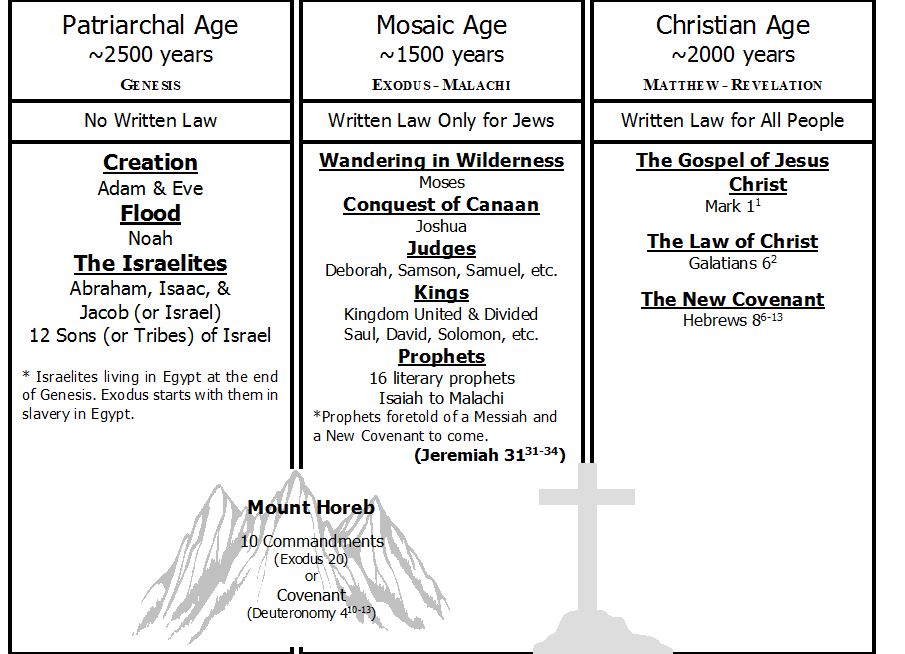
The Outline of the Bible:

overview

Study the chart above. Notice that the three periods of time are divided by how God delivered His laws to mankind. The first was through patriarchs or heads of families. Second was through Moses and the prophets. And finally He delivered His will to man through Jesus.

The Patriarchal Age. This period starts in Genesis 1 at the creation of the world. Adam & Eve disobey God and are made to leave the Garden of Eden. After many years the earth is full of evil and God decides to send a flood to destroy all that will not repent. Noah and 7 of his family are the only ones who are saved. Over 400 years later a man named Abram (later Abraham) is chosen by God to become the father of the Israelite nation (Gen. 12).

From this time on the Bible specifically traces the History of that one nation. Abraham has Isaac, Isaac has Jacob, and after Jacob’s name is changed to Israel he starts the family. The Israelites (also called Hebrews or Jews) begin to grow as a family after Jacob has 12 sons who later become 12 tribes. At the end of Genesis they are a still a small family who have moved to Egypt. They are taken into captivity for a couple hundred years and grow to be a large nation.

The Mosaic Age. God chooses a man named Moses to deliver the people of Israel out of Egyptian bondage. Moses leads the people out of Egypt to a mountain called Horeb (later Sanai). Here God delivers his law for the Israelites.

After the Israelites wander for 40 years in the wilderness, they go into “the Promised Land” (Canaan) under Joshua’s command. Once they settle the land God leads the people by appointing a series of Judges (who were basically military leaders) for around 350 years. After this the people want to be lead by a king like the nations around them. God warns them it’s a bad idea but grants their request by giving them Saul, David, and then Solomon. After Solomon’s reign (925 BC), the nation divides into two groups – Israel in the north and Judah in the south.  The northern kingdom of Israel grows increasingly evil and at God’s decree is taken into captivity by the Assyrians in 721 BC never to return again. Later, the southern kingdom of Judah is punished by being taken into captivity by the Babylonians. After 70 years they returned to their homeland and rebuilt their nation. It is their descendants who are the Jews of today and through whom Christ came.

During the time of these two kingdoms, the Prophets wrote their books. Almost all of them spoke of the coming of a Savior or Messiah. Most of them also spoke of a new covenant that would be enacted when this Savior came.

The Christian Age. This is the final way that God has revealed His will to mankind. We are now living in this age. The Bible teaches that once the Messiah came, so did the new covenant.

According to the Bible people today are to follow the New Testament. This is one reason why there are so many churches today doing so many different things yet all claiming to follow the Bible. There are many religious groups who say they follow the Bible but for some reason have missed this important Bible teaching. Can you think of any religious practices you’ve seen before which are only found in the Old Testament?

Jesus Has All Authority:

The Bible teaches us 4 things that are NOT our authority for religious practice. 1) The Old Testament, 2) Our own initiative to change something God commanded (like Nadab & Abihu), 3) Emotion or good motives (like David & Uzzah), 4) The traditions of men. If none of these can accurately define for us what God wants from us, where must we look?

Is Demon Possession Possible today? pt2

IN LAST WEEK’S ARTICLE, I showed through scripture how demonic possession is no longer possible today. For the sake of review, let me remind you of two references that deal with the binding of fallen / sinful angels. “For if God spared not the angels that sinned, but cast them down to hell, and delivered them into chains of darkness, to be reserved unto judgment;” [2Peter 2:4]. And in Jude 1:6 “And the angels which kept not their first estate, but left their own habitation, he hath reserved in everlasting chains under darkness unto the judgment of the great day.” Demons (fallen angels) are bound, awaiting the judgment.

Now we turn our attention to the verse in 1Peter 5:8; “Be sober, be vigilant; because your adversary the devil, as a roaring lion, walketh about, seeking whom he may devour:” What is being taught by this verse?

Before we proceed, let’s not undo the previous truth; DEMON POSSESSION IS NOT POSSIBLE TODAY. Zechariah 13:2 prophesied it, and the New Testament confirms it. So whatever 1Peter 5:8 teaches, it cannot include the demonic possession of one’s person.

THE TRUTH ABOUT SATAN

We first read of Satan in the book of Genesis. There is no information given about his origin, but the Bible displays his working throughout. He is called the “adversary” in our passage and seeks to supplant the authority of God [Luke 4:7]. He is a liar, and the father of lies [John 8:44]. 1John 3:8, says that the devil sinned from the beginning and has been condemned [1Timothy 3:6].

Satan is also called the “god of this world” [2Corinthians 4:4]. “World” as used in this context is speaking about people who are separated from God, people who are doing what is right in their own eyes and not following the will of God. Paul wrote in Ephesians 2:1-2, that He (Christ) has made alive…those who previously had walked according to the course of the world. To walk the course of the world (Satan’s playground) is to follow Satan’s example of rebellion and disobedience toward God. Verse 3 points out that these in the world, “once conducted ourselves in the lusts of our flesh, fulfilling the desires of the flesh and of the mind, and were by nature children of wrath...” This condition fits the description of the progression of sin in James 1:14-15.

Just as knowing God’s truth can set one free from sin [John 8:32], “He that committeth sin is of the devil” [1John 3:8]. Although Satan is a real being, HE CANNOT IRRISISTABLY CONTROL MEN. We act as his agents when we seek to do as he does, to pervert, corrupt, depart from or misrepresent the word of God [Mat 16:23; 2Corinthians 11:3; Galatians 1:6-9; 1Timothy 4:1-3].

Just as modern day Nazi’s or Marxists act as agents for their long dead leaders, so too those who wish to follow the workings of Satan. Because they don’t have a love for the truth, “God will send them strong delusion that they should believe a lie” [2Thessalonians 2:9-12].

Satan doesn’t physically possess anyone today. He has always been limited, [Job 1:12, 2:6; 1Cor 10:13]. Lies and all evil was introduced into this world by Satan, and this disease of sin is spread by wicked men who are “lovers of their own selves, covetous, boasters, proud, blasphemers, disobedient to parents, unthankful, unholy, without natural affection, trucebreakers, false accusers, incontinent, fierce, despisers of those that are good, Traitors, heady, highminded, lovers of pleasures more than lovers of God; Having a form of godliness, but denying the power thereof” who will lead astray the gullible [2Timothy 3:2-6].

God’s people can resist the devil [James 4:7], and the Omnipotent God will not allow us to be tempted beyond our ability [1Corinthians 10:13]. It is the gospel of Christ, the word of God, that is our defense against Satan’s teachings. Jesus combated Satan with “it is written” and we also have the same weapon in the “sword of the Spirit, which is the word of God” [Matthew 4:4; Ephesians 6:17]. We are instructed to withstand the devil by faith [1Peter 5:9] and we know that faith comes by hearing the Word of God [Romans 10:17].

God is great, and His love is so great that He gave us His Son, to free us from sin, and “deliver us from this present evil world” [Galatians 1:4].

— Spencer

Justified by Faith

THE FAITH ONLY crowd will “prove” their belief by quoting Romans 4:5. “But to him that worketh not, but believeth on him that justifieth the ungodly, his faith is counted for righteousness.” They may even go further and include Romans 3:28, “Therefore we conclude that a man is justified by faith without the deeds of the law.” Then, if you press them, they will quote Ephesians 2:8-9, “For by grace are ye saved through faith; and that not of yourselves: it is the gift of God: Not of works, lest any man should boast.”

Let me say here and now that I believe each of these passages, just not how THEY believe them. Their problem is that these passages are quoted out of context and interpreted without that context. They come to the conclusion that a person is justified (saved) by FAITH ALONE.

What do these passages mean?

When one studies the bible, one rule that is often overlooked but must always be applied is the rule of context. A passage needs to be interpreted in the light of its context. Another consideration is that the bible harmonizes with other similar texts.

When we teach about salvation from scripture, we need to deliver, “all the counsel of God.” [Acts 20:27]

In Romans chapter 4, Paul is making a case regarding salvation that includes gentiles (those folks who were not Jews). Abrahams justification is given PRIOR to his becoming circumcised which became part of the Law of Moses [Leviticus 12:3] . Paul asks then answers, “How was it then reckoned? when he was in circumcision, or in uncircumcision? Not in circumcision, but in uncircumcision.” [Romans 4:10]

The faith only folks want you to believe that Abraham did NOTHING prior to his JUSTIFICATION. This simply is not true. When Paul said in Romans 4 that Abraham was justified, he is referring to Genesis 15:6. However, by that time, Abraham had already OBEYED God by leaving his homeland in Gen 11:31-12:3.

It is this OBEDIENT FAITH on the part of Abraham that the Hebrew writer acknowledges in the HALL OF FAITH in Hebrews 11:8. “By faith Abraham, when he was called to go out into a place which he should after receive for an inheritance, obeyed; and he went out, not knowing whither he went.”

It is true that Abraham was justified without the deeds of the law, which according to the context refers to the Law of Moses. Nowhere does the Scripture teach that a person is justified (saved) without works.

What about Ephesians 2:8-9?

For this passage we need to apply the same rules, context & harmony. Let us read verse 10, “For we are his workmanship, created in Christ Jesus unto good works, which God hath before ordained that we should walk in them.” Once again, the context teaches us something about works.

There are 2 kinds of works, works of man & works of God. Ephesian 2:10 teaches that there are works that God has prepared. Works that God commands. Please understand what I am saying, a person is never justified by works when he places his trust in JUST the works. We are justified when we put our trust in God WHILE DOING THE WORKS HE HAS COMMANDED.

This harmonizes with the rest of the scriptures. Look at James 2, another passage that quotes this same Justification of Abraham from Genesis 15:6, “And he believed in the LORD; and he counted it to him for righteousness.”

But wilt thou know, O vain man, that faith without works is dead? Was not Abraham our father justified by works, when he had offered Isaac his son upon the altar? Seest thou how faith wrought with his works, and by works was faith made perfect? And the scripture was fulfilled which saith, Abraham believed God, and it was imputed unto him for righteousness: and he was called the Friend of God. Ye see then how that by works a man is justified, and not by faith only.” [James 2:20-24]

Let’s look again at that HALL OF FAITH in Hebrews 11…By faith…
  • Abel OFFERED vs4
  • Enoch WALKED vs5; Gen 5:24
  • Noah PREPARED vs7
  • Abraham OBEYED & SOJOURNED vs8-9
  • Moses parents HID Moses vs23
  • Moses REFUSED, CHOSE, FORSOOK vs24-27
  • Israel PASSED through vs 29
  • Rahab RECEIVED vs30
  • Others SUBDUED kingdoms, WROUGHT righteousness, OBTAINED promises, STOPPED the mouths of lions, vs33

To follow their example, people today must obey the word of the Lord. He said, “He that believeth and is baptized shall be saved; but he that believeth not shall be damned.” [Mark 16:16] The faith alone people, “make an error, not knowing the scriptures.”  [Matthew 22:29] When you weigh ALL the evidence, harmonize the scriptures and read the context then you will know the truth, and this truth shall set you free. [John 8:32]

THE TRUTH HAS SET US FREE…FROM WHAT?

JESUS SAID TO the believing Jews, “If ye continue in my word, then are ye my disciples indeed; And ye shall know the truth, and the truth shall make you free.” [John 8:31-32]

From this passage, as disciples, we must continue in His word, and from this word we will know the truth. Then this truth will set us free. Later on Jesus will say that God’s word is truth. [John 17:17]

The first question you should ask is; “From what are we being set free?”

WE ARE FREE FROM…
  • The curse of the Law of Moses. Galatians 3:10 points out “Cursed is every one that continueth not in all things which are written in the book of the law to do them.” This was referring to the Law of Moses, for in chapter 5v4 Paul then says that a person seeking to return to that law “has fallen from Grace.”
  • The power of the Law. Romans 7:1-7 teaches us that until Christ’s death, burial and resurrection that the Law of Moses was still in effect. It wasn’t until His death were we freed from the power of the Law, “nailing it to his cross.” [Colossians 2:14]
  • The dominion of sin.Being then made free from sin, ye became the servants of righteousness.” [Romans 6:17-18] Without the death, burial & resurrection of Jesus, “ye are yet in your sins.” [1Corinthians 15:17]
  • The guilt of sin. The guilt that most people experience is dependent upon a future punishment. In Christ, who paid the debt for our sins, Christians have been made free from the condemnation of sin. “Who shall lay any thing to the charge of God’s elect? It is God that justifieth.” [Romans 8:33] Does this mean that we can continue to sin? No sir. Rather, we have someone who cleanses us of our sin, but only if we’re in Christ. [1John 1:9]
  • The power of darkness. Because we are His disciples, having obeyed the Gospel, God has “…delivered us from the power of darkness, and hath translated us into the kingdom of his dear Son:” [Colossians 1:13] Many say that the kingdom will begin sometime later, but this scripture teach that Christians are in His kingdom now and free from the darkness of this world.
  • The fear of man. No longer bound by sin, under the power of darkness of this world, Christians are also free of what man can do to us. The Apostles faced persecution, beatings and imprisonments, even being commanded to stop speaking about Jesus. Yet, they had no fear saying, “We ought to obey God rather than men.” [Acts 5:29; 4:18-20] Though we may be persecuted or threatened for our faith, no man can ever take away our salvation. “The LORD is on my side; I will not fear: what can man do unto me?” [Psalm 118:6]
  • The fear of death’s sting. Because we are in Christ, and freed from the bondage of sin, we no longer have the fear of death. “O death, where is thy sting? O grave, where is thy victory?” [1Corinthians 15:56,57] Being in Christ, we look forward to a day when we can be with the Lord even if He comes sometime after our life on this Earth. [1Thessalonians 4:14-17]
  • The position of no hope. Becoming a Christian puts us into a living hope. This hope becomes a part of our lives and is demonstrated to the world through our lives. Peter noted that this hope shall be seen by those around us to the point that they may ask us of this hope. [1Peter 3:15]
  • The state of separation from God. Christians become children of God through adoption. Prior to our obedience to the gospel, we are separated from God because of sin, but now we are reconciled to God by the death of His son. [Romans 5:10] What a wonderful thing it is to be called a child of God. “For ye are all the children of God by faith in Christ Jesus.” [Galatians 3:26]
WE HAVE BEEN SET FREE IF….

…we become one of His disciples. This begs the next question, How do I become a disciple of Christ? Remember, Jesus said, ““If ye continue in my word, then are ye my disciples indeed; And ye shall know the truth, and the truth shall make you free.” [John 8:31-32] To become His disciple we must obey the Gospel. Before He ascended into heaven He gave this command, “Go ye therefore, and make disciples of all the nations, baptizing them into the name of the Father and of the Son and of the Holy Spirit:” [Mt 28:19 (ASV)]

The Gospel is what calls us [2Thessalonians 2:14]. Leaving sin, we obey the Gospel which shall deliver us [Romans 6:17]. The gospel is about the Death, burial and resurrection of Jesus [1Corinthians 15:1-4]. When Jesus is preached [Acts 8:35], one will conclude the need to be baptized [Acts 8:36].

If you “love the Lord thy God with all thy heart, and with all thy soul, and with all thy mind.” [Matthew 22:37] then you will also do whatever he commands.

And why call ye me, Lord, Lord, and do not the things which I say?” [Luke 6:46]

What saves you?

God’s plan for you

new year 2016

As 2015 ends, and 2016 is about to being, folks are putting together resolutions and plans for the new year. But, have you ever considered what Godly planning looks like? As you make your New Years Resolutions, let’s consider a Godly formula for making plans. 

BIBLICAL EXAMPLES OF PLANNING… The Scriptures show us many folks planning, some good and others making evil plans…..

EVIL PLANS – The Psalmist said, “Who plan evil things in their hearts; They continually gather together for war. (NKJV) [Psalm 140:2]. Solomon warned his son not to go with those who plan evil, “If they say, Come with us, let us lay wait for blood,” [Proverbs 1:11]. Jesus Himself told a parable of a man who planned fraud against his master [Luke 16:4 ].

Clearly, the scriptures condemn the making of evil plans, rather we should be making Godly plans….

GODLY PLANNING – Paul was planning to visit the church at Corinth to encourage them, “And in this confidence I was minded to come unto you before, that ye might have a second benefit; 17 Therefore, when I was planning this, did I do it lightly?” (NKJV) [2Co 1:15]

When MOSES was leading the children of Israel out of Egypt, he was working without much of a plan as he decided matters between one another. Jethro, his father-in-law, taught him a better way. “Hearken now unto my voice, I will give thee counsel, and God shall be with thee: Be thou for the people to God-ward, that thou mayest bring the causes unto God:” [Exodus 18:19]

DAVID faced Goliath with a plan. “This day will the LORD deliver thee into mine hand; and I will smite thee, and take thine head from thee; and I will give the carcases of the host of the Philistines this day unto the fowls of the air, and to the wild beasts of the earth; that all the earth may know that there is a God in Israel.” [1Samuel 17:46]. If you’ve ever wondered why David, a man of faith, needed 5 smooth stones, this is the reason, he needed one to kill Goliath and with the others he planned to route the Philistines!

There were others plans made as well. As men moved to fulfill commands of God to build the Temple, they made plans and set aside materials to ensure an expedient completion. [1Ch 22:1-19; 28:14-18; 29:1-5; 2Ch 3:1; 5:1]. Then Nehemiah also made plans as he oversaw the rebuilding of the Temple, after their return from the captivity. [Nehemiah 2:7, 8]

[Since God has ALLOWED MAN TO PLAN, ought you plan your life to serve Him?]

GODLY PLANNING FOR OUR LIVES – As we’ve seen, God has allowed and approved of man to make plans to serve Him. Looking at additional scripture, we find that planning is wise.

IT’S RIGHTEOUS TO PLAN – The book of Proverbs teaches us to make plans, by telling us to give thought to our steps, and that the plans of the diligent lead surely to abundance. Included is a warning to those who fail to pause and plan that living impulsively only leads to poverty. [Proverbs 14:15; Proverbs 21:5]

Our Lord commended planning when He told how the wise count the cost before building a tower [Luke 14:28], or when a King goes to battle [v31, 32]. Let us never forget that obedience to Him is like the wise one who built his house on a rock [Matthew 7:24-27].

The Prophet Isaiah wrote, “But he who is noble plans noble things, and on noble things he stands [32:8 ESV]. Shall we not, as children of God, make noble plans? The question then becomes, what are noble plans and how do we make them?

Using scriptures, let’s look at a 7 step formula for making Godly, noble plans.

Step 1 – KEEP GOD’S WILL IN MIND – The first, and most important step is to begin with God’s plan / will. Before making any choice or plans ask yourself, “Is this what God would want?” We should always consider whether or not our plans are involving sin, if so, it no longer qualifies as noble.

Looking again to the Proverbs, “There are many devices (plans) in a man’s heart; nevertheless the counsel of the LORD, that shall stand” [Pr 19:21]. By committing our work to the Lord, our plans will be pleasing to the Lord [Prov 16:3].

“If the Lord wills, we will live and do this or that,” ought to be our beginning attitude. [James 4:13-15]. Along with faithful obedience to the commands of God [Deuteronomy 28:1-68; John 14:15; Matthew 28:20].

Step 2 – SEEK WISE COUNSEL – “Plans fail for lack of counsel, but with many advisers they succeed,” [Proverbs 15:22]. We need to seek advice, but seek it from the right sources.

We need to ask GOOD PEOPLE, folks that are already living a Godly life. “Ye cannot drink the cup of the Lord, and the cup of devils: ye cannot be partakers of the Lord’s table, and of the table of devils,” [1Corinthians 10:21; Ephesians 5:11]. Remember that Paul taught, “Evil company corrupts good habits,” [1Corinthians 15:33].

We should make plans by seeking advice, [Proverbs 20:18]. Even something like building a house, and filling it with our stuff, needs wise plans and advice or it will fail, [Proverbs 20:18; 24:3-4].

Sometimes NATURE provides us wise counsel. “Go to the ant, O sluggard; consider her ways, and be wise. Without having any chief, officer, or ruler, she prepares her bread in summer and gathers her food in harvest,” [Proverbs 6:6-8]. Job said to “ask the beasts” [Job 12:7], “and they shall teach thee.” God’s own creation can be a source of wisdom and counsel.

But God gives us a warning about FALSE INFORMATION. There are silly myths, false and selfish desires which cause us to seek teachers to tell us what we want to hear, [1 Timothy 4:7; Proverbs 19:2; 23:4; 2Timothy 4:3]. You’ve met those folks. They ask for advice but seldom take it, doing what they had intended from the beginning as they chase their own lusts.

Step 3 – SET THE RIGHT PRIORITIES, Sometimes we make nonsinful plans, but we’ve neglected other areas of our lives. Jesus condemned the Pharisees for this very thing. “..ye pay tithe of mint and anise and cummin, and have omitted the weightier matters of the law, judgment, mercy, and faith:” Note that He wanted them to do the “WEIGHTIER MATTERS” but He also wanted them “not to leave the other undone” [Matthew 23:23].

Our first priorities are always to seek the kingdom of God, [Matthew 6:33], then the others things will be added to you. We also need to be mindful of giving, being benevolent, and taking care of our family’s needs [2Corinthians 9:7; 1Timothy 5:8]. If we seek our own selfish ambitions, we’re no longer making noble plans.

Step 4 is to PUT THINGS IN THE RIGHT ORDER, to do the things that are expedient to complete our plans. “.. get everything ready for yourself in the field, and after that build your house” [Proverbs 24:27 ESV]. We’re commanded our worship be done “decently and in order [1 Corinthians 14:40], should our lives, which is a service to God, be any less?

Step 5 is to DO IT, we need to get busy with our plans. Without work, no plans ever come to completion. When we work, let’s do it with all our might, [Ecclesiastes 9:10], without being slothful with our business [Romans 12:11], and to “do it heartily, as to the Lord” [Colossians 3:23]. God wants us to be active, not to be thieves, rather, “labour, working with his hands the thing which is good, that he may have to give to him that needeth” [Ephesians 4:28].

Step 6 is to EVALUATE the successes or failures of our plans. Are you still doing the right thing? Has your work changed making it sinful? Paul told the Corinthians to examine themselves, whether they be in the faith [1Cor 13:15], which must include our work activities as well as spiritual. If we stray away from the noble, Godly plans then let us bring ourselves back to the right.

Step 7 is to EXPECT TROUBLE and to prepare for it. This is a realistic view of life and many of us want to avoid or ignore trouble. Unfortunately, it is a part of life and the scriptures teach this. “time and chance happeneth to them all” [Ecc 9:11], is a reminder for us that things happen. Some good, and some bad. Look at the weather, God causes the rain on the just and the unjust, but sometimes floods come with the rain. [Matthew 5:45; 7:27] Consider the recent flooding in our own area.

Because of sin, and the broken world we live in because of sin, life is sometimes a struggle and we ought to expect it. We’re going to sweat, we’re going to get cut by thorns, but god has given us the strength to endure it. [Genesis 3:17, 18]

Even the people around us will sometimes be against us. Be it for jealousy or envy, they will be obstacles to our success [1Pe 4:4]. But don’t let the ungodly of this world, keep you from doing noble things.

CONCLUSION: With Godly planning, we can make the best of this world. God wants joy for us, but not just for this life. He has bigger and better plans. He has made a plan of SALVATION, which He made even before He created the world [Ephesians 1:4; Romans 16:25, 26; 1Peter 1:20].

His plans meant that His son, Christ Jesus, would be slain. This too was determined before the world was made [Revelation 13:8; Titus 1:2, 3].

His plans include for us to be a thinking people, [John 14:26]. His plans include for us to be obedient to Him [Ephesians 2:10; Titus 2:14; Matthew 28:20], to obey the Gospel [1 Thessalonians 1:8].

Finally, His plans include for us a FUTURE HOME which Jesus has gone to prepare [John 14:2]. A place that shall have no death, neither sorrow, nor crying, neither shall there be any more pain and God shall wipe away all tears [Revelations 21:1].

We can make all the plans in the world, but if we fail to plan for eternity, we’ve lost it all. “For the time is come that judgment must begin at the house of God: and if it first begin at us, what shall the end be of them that obey not the gospel of God?” [1Peter 4:17]

Spencer