Bearing Fruit: the Fruit of the Spirit pt1


“But the fruit of the Spirit is love, joy, peace, longsuffering, gentleness, goodness, faith, Meekness, temperance: against such there is no law. And they that are Christ’s have crucified the flesh with the affections and lusts. If we live in the Spirit, let us also walk in the Spirit.” (Galatians 5:22-23)

No discussion is complete without talking about the “fruit of the Spirit” listed in Galatians 5. Paul describes the fruit of the Spirit through nine qualities. We will examine them three at a time.

Technically Paul isn’t necessarily giving us nine separate “fruits” in the way a produce stand has nine different kinds of apples. He gives one description of the Spirit-produced character of the Christian, expressed through these qualities.

The fruit of the Spirit is produced in the lives of those who belong to Christ as they walk according to the Spirit’s revealed will. “This I say then, Walk in the Spirit, and ye shall not fulfil the lust of the flesh” (Galatians 5:16).

Abiding in Christ includes keeping His commandments: “If you keep my commandments, you will abide in my love, just as I have kept my Father’s commandments and abide in his love” (John 15:10).

It’s so easy to understand. As we learn God’s will through the Word and submit our lives to it, the character described as the fruit of the Spirit should increasingly be seen in our lives. These fruits of the Spirit are to be expected when we from faith walk in the Spirit. “All scripture is given by inspiration of God, and is profitable for doctrine, for reproof, for correction, for instruction in righteousness: That the man of God may be perfect, throughly furnished unto all good works” (2Timothy 3:16-17).

The first fruit is LOVE. There are a few different Greek words that are translated as “love.” This one is , which is the New Testament term for selfless, and sacrificial love. Unlike emotional or romantic affection, it is a word used in the New Testament for love that expresses itself in seeking the good of others. (1Cor 13:4-7; John 14:15; 1John 4:9-11)

This can be seen in the commands of Jesus surrounding love. We are to Love the LORD with all our heart, soul, mind, & strength (Mark 12:30). We are to love ONE another as saints & brethren (1Thess 4:9). We are to love our NEIGHBORS as ourselves which places a high value on them, (Matt 22:39). We are to love our ENEMIES, (Luke 6:35).

“Beloved, let us love one another: for love is of God; and every one that loveth is born of God, and knoweth God. He that loveth not knoweth not God; for God is love. In this was manifested the love of God toward us, because that God sent his only begotten Son into the world, that we might live through him. Herein is love, not that we loved God, but that he loved us, and sent his Son to be the propitiation for our sins. Beloved, if God so loved us, we ought also to love one another” (1John 4:7-11).

The second is JOY. in Galatians 5:22 means joy or gladness; specifically a deep, calm delight and inner gladness. As a fruit of the Spirit it must then be a result of knowing what good things we have in Christ revealed to us through the word by the Holy Spirit. This joy can remain even despite difficult circumstances. “My brethren, count it all joy when ye fall into divers temptations; Knowing this, that the trying of your faith worketh patience” (James 1:2-3). In another place we find joy in knowing brethren are walking in truth (2John 1:4; 3John 1:3). This joy is exemplified by Paul while in a Roman prison, knowing the Gospel is being preached; “What then? notwithstanding, every way, whether in pretence, or in truth, Christ is preached; and I therein do rejoice, yea, and will rejoice” (Phil 1:18). The Bible doesn’t teach that Christians are supposed to be emotionally happy about every circumstance. Rather, joy can remain despite circumstances because it rests upon something deeper than circumstances.

The third is PEACE. The Greek word <eirēnē> means peace. In Scripture, peace can describe reconciliation with God as well as the settled peace believers can have in Christ. This peace is rooted in the reconciliation God has provided through Christ. Paul reminds Christians that this reconciliation is something in which they must continue by remaining grounded and settled in the faith. “And, having made peace through the blood of his cross, by him to reconcile all things unto himself; by him, I say, whether they be things in earth, or things in heaven. And you, that were sometime alienated and enemies in your mind by wicked works, yet now hath he reconciled In the body of his flesh through death, to present you holy and unblameable and unreproveable in his sight: If ye continue in the faith grounded and settled, and be not moved away from the hope of the gospel, which ye have heard, and which was preached to every creature which is under heaven; whereof I Paul am made a minister;” (Colossians 1:20-23).

“But we all, with open face beholding as in a glass the glory of the Lord, are changed into the same image from glory to glory, even as by the Spirit of the Lord” (2Cor 3:18).

Agape
spencer

6 things SAINTS can do


“I can do all things through Christ who strengthens me.” (Phil 4:13)

Saints in the Bible are people who believe in Jesus Christ and have obeyed the gospel. Launching from Paul’s statement, let’s look at 6 things all SAINTS can do through Christ.

We can stand firm against the schemes of the devil. Ephesians 6:13 says to take up the whole armor of God so that we may be able to withstand in the evil day and having done all to stand firm. Jesus stood against every temptation by answering with the written word of God (Matt 4:1-11). Joseph stood firm when tested in Egypt. Daniel and his friends stood firm in Babylon. The word of God gives the strength to stand.

We can have assurance of our salvation. “I write these things to you who believe in the name of the Son of God that you may know that you have eternal life.” (1John 5:13). Paul knew whom he had believed. This assurance rests on the clear promises of Scripture.

We can increase in love and good works. Hebrews 10:24 calls us to stir one another up to love and good works. The church in Thessalonica already showed love yet Paul told them to excel still more and more (1Thess 4:10). The early believers in Jerusalem grew in care for one another. Growth comes as we keep learning and obeying the word of God.

We can be nice, kind, and merciful. Colossians 3:12 tells God’s people to “put on tender mercies, kindness, humility, meekness, longsuffering.” These qualities come from knowing what God has said and choosing to live by it. “And be kind to one another, tenderhearted, forgiving one another, just as God in Christ forgave you” (Eph 4:24).

We can be thankful and joyful despite trials. James 1:2-3 says, “My brethren, count it all joy when you fall into various trials, knowing that the testing of your faith produces patience.” Paul and Silas sang hymns while in prison. Habakkuk chose to rejoice even when the fields failed (Hab 3:17). The word of God teaches us to give thanks in all circumstances.

We can share the reasons for the hope that is in us. 1Peter 3:15 says, “But sanctify the Lord God in your hearts, and always be ready to give a defense to everyone who asks you a reason for the hope that is in you, with meekness and fear.” The woman at the well told her whole town about Jesus. Hope grows strong through the knowledge of God’s word, people take notice, and then we speak of it.

These six things belong to every saint. They rest on the plain teaching of Scripture.

Agape
seb

THANKSGIVING JOY

Gratitude isn’t just a seasonal practice—it’s a lifestyle. The Bible teaches us that thanksgiving can shift our perspective and strengthens our faith.

Thanksgiving in Trouble: Jehoshaphat’s Singers
Imagine being in King Jehoshaphat’s position: three armies are marching toward you, and the situation looks hopeless. Instead of panicking, Jehoshaphat sought the Lord, and the strategy God gave him was extraordinary—send singers ahead of the army to praise Him! The singers declared, “Praise the LORD, for His mercy endureth forever” (2 Chronicles 20:21).

When the singers began to praise, God set ambushes against their enemies, causing them to destroy one another. Victory was won, not with weapons, but with thanksgiving and faith.
When we face challenges today, we are called to respond in a similar way. Paul reminds us in Philippians 4:6-7, “Be careful for nothing; but in every thing by prayer and supplication with thanksgiving let your requests be made known unto God. And the peace of God, which passeth all understanding, shall keep your hearts and minds through Christ Jesus.”

Thanksgiving in Loneliness: The Psalmist’s Cry
Loneliness is a reality many of us face, and the psalmist captures this struggle in Psalm 42: “Why art thou cast down, O my soul? And why art thou disquieted in me? Hope thou in God: for I shall yet praise Him for the help of His countenance” (Psalm 42:5).

The psalmist’s honesty about his emotions is relatable, but his decision to praise God despite his feelings is inspiring. Thanksgiving shifts our focus from our emptiness to God’s fullness..

Jesus Himself assures us of His abiding presence in Matthew 28:20: “And, lo, I am with you alway, even unto the end of the world.” Gratitude for God’s unchanging presence can anchor our hearts when we feel alone. Instead of dwelling on what’s missing, we can thank Him for His faithfulness where we’ll find comfort and strength to keep going.

Thanksgiving for Christ’s Goodness: The One Thankful Leper
In Luke 17, ten lepers cried out to Jesus for mercy, and He healed them all. However, only one returned to give thanks. He fell at Jesus’ feet and praised Him, and Jesus said, “Thy faith hath made thee whole” (Luke 17:16-19).

This Samaritan’s gratitude set him apart. While the other nine received physical healing, he recognized and remembered the one from whom all blessings flow. Thanksgiving acknowledges that everything good in our lives comes from above.

This reminder in Colossians helps, “And let the peace of God rule in your hearts, to the which also ye are called in one body; and be ye thankful… And whatsoever ye do in word or deed, do all in the name of the Lord Jesus, giving thanks to God and the Father by Him.” (Col 3:15-17). Thanksgiving is a daily recognition of Christ’s goodness, shaping our actions and attitudes through His word.

A Challenge for Thanksgiving
This week, take time to reflect on your own heart of thanksgiving. Are you thanking God in the midst of your troubles, trusting Him to bring victory? Are you finding reasons to praise Him, even in seasons of loneliness? And are you remembering to give thanks for all the blessings you’ve received through Christ?

As we cultivate a grateful heart, we’ll find that thanksgiving doesn’t just change our circumstances—it changes us. Let our thanksgiving be a reflection of our faith, a reminder of God’s presence, and a response to His abundant goodness.

“In every thing give thanks: for this is the will of God in Christ Jesus concerning you” (1 Thessalonians 5:18).

a Study on the book of JAMES

INTRODUCTION: The Franklin and Juniper church of Christ begins an overview study of the book of James. If you live in the Borger area, We invite you to join us at 6:30pm each Wednesday night for the next few weeks.

Click here for an overview chart of the Book of James.

JAMES CHAPTER 1: JOY in Trials.

6 keys to facing TRIALS. (1:1-4)

Praying for wisdom. How to be WISE? (1:5-8)

God GIVES. (1:5)

3 steps into SIN. (1:12-15)

The Father of Lights brings GIFTS. (1:17)

JAMES CHAPTER 2: ASSEMBLE w/o Hypocrisy.

Showing Respect of Persons, Who’s your NEIGHBOR?

FAITH of Abraham and Rahab.

JAMES CHAPTER 3: the MOUTH unhinged.

(coming soon)

JAMES CHAPTER 4: How to have ENMITY with God.

Life is a VAPOR. Jas 4:13-17.

what the Lord’s WILLS. Jas 4:13-17

JAMES CHAPTER 5: Solutions for SUFFERING.

(coming soon)

Facing WOES

1Corinthians 10:13:

“There hath no temptation taken you but such as is common to man: but God is faithful, who will not suffer you to be tempted above that ye are able; but will with the temptation also make a way to escape, that ye may be able to bear it.”

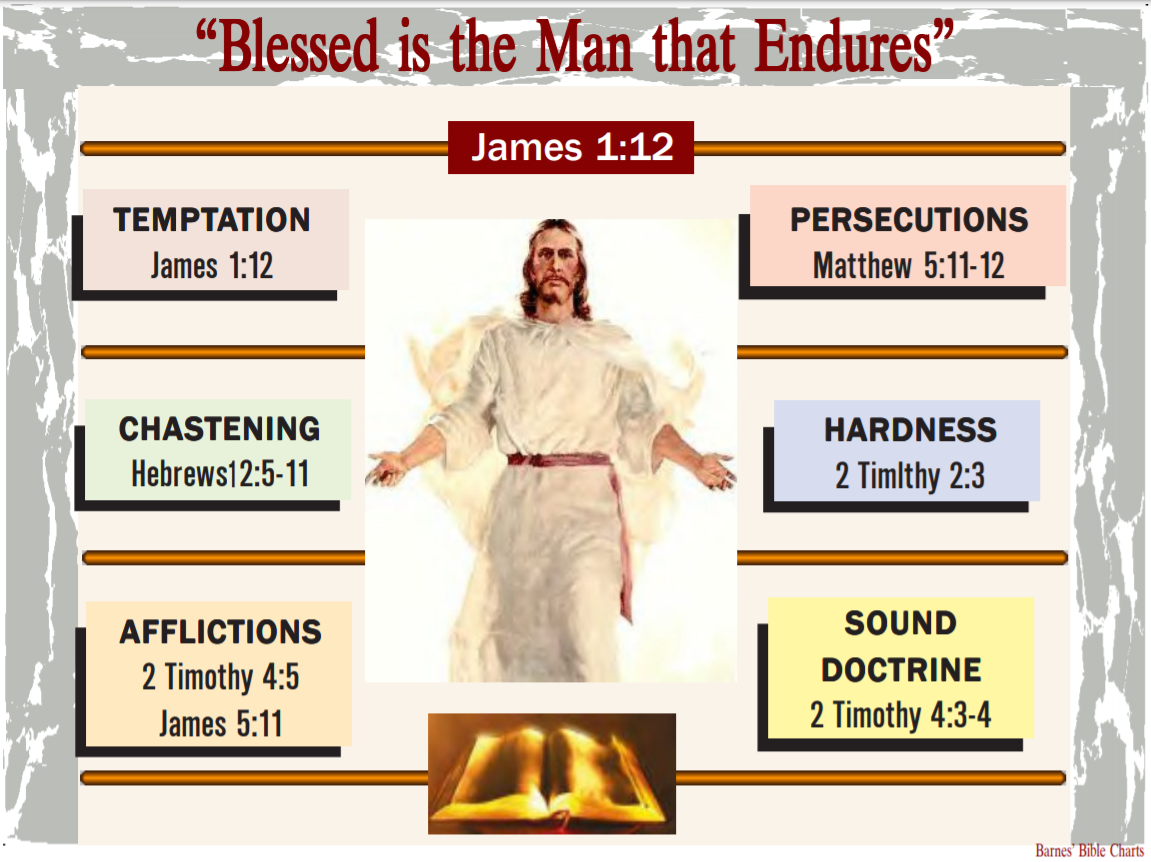
Nobody likes trouble. However, God tells us in His Word to find joy in our trials…

“My brethren, count it all joy when ye fall into divers temptations;” [James 1:2]

“Rejoice, and be exceeding glad: for great is your reward in heaven: for so persecuted they the prophets which were before you.” [Mat 5:12]

“And they departed from the presence of the council, rejoicing that they were counted worthy to suffer shame for his name.” [Acts 5:41]

“Therefore I take pleasure in infirmities, in reproaches, in necessities, in persecutions, in distresses for Christ’s sake: for when I am weak, then am I strong.” [2Cor 12:10]

How are we to handle these verses? A solid biblical principle is this; When God gives a command, it’s within our ability to do it. If we SHOULD, the it is something we COULD.

Let’s examine 1Corinthinas 10:13 and see some very comforting truths…

“There hath no temptation taken you but such as is common to man:”

First, we must recognize is that trouble comes to everyone, it’s WIDESPREAD. Any trouble, temptation or trial you will face will have been faced by others before. “…and there is no new thing under the sun.” [Ecc 1:9b]. There is comfort in the realization that no trouble is truly exotic. You’re not the first person to face trouble, nor the last. The main take away is this, we’re all in this together. The person that struggles with struggles often believes that they’re struggles are special. This mindset will only make things more miserable. We’ll never be able to “rejoice” if we believe we’re the only ones with trouble.

“but God is faithful, who will not suffer you to be tempted above that ye are able;”

Next, Paul writes that no trouble is able to OVERWHELM us beyond our ability to endure. God won’t allow it. That’s what the verse says. There’s comfort in these words. God doesn’t remove the trouble, but He does limit it to your capacity. Some might say, “I wish God wouldn’t trust me so much.” I get it, nobody likes trouble. However, we need to remember that nothing worthwhile ever comes without effort. James writes, “Knowing this, that the trying of your faith worketh patience. But let patience have her perfect work, that ye may be perfect and entire, wanting nothing.” [Jas 1:3-4]. This, along with the teaching from Hebrews 12 shows us that enduring trials makes one stronger, more experienced and more capable. This growth then puts us into the position to help others in their time of crisis. It’s through this understanding where we can begin to find Joy in suffering.

“but will with the temptation also make a way to escape, that ye may be able to bear it.”

Third, God will also provide the way of ESCAPE. Comforting words to be sure. There will always be a means of ESCAPE to all of life’s temptations. Here’s the key that is often overlooked; YOU MUST SEEK IT AND TAKE IT!!! We have to participate in our own rescue. God provides the way of ESCAPE, but it’s up to each of us to take it. This key principle helps us to understand the true nature of Grace. God provides the means, that’s Grace, we must take it and utilize it. God provides the ultimate way of ESCAPE from the penalty of death for our sins; Salvation through obedience to the Gospel. That is Grace. We must act upon this Grace by doing what is commanded in the way of ESCAPE.

“Yea, and for this very cause adding on your part all diligence, in your faith supply virtue; and in your virtue knowledge; and in your knowledge self-control; and in your self-control patience; and in your patience godliness; and in your godliness brotherly kindness; and in your brotherly kindness love.” [2Peter 1:5-7]

Implied in 1Cor 10:13, and directly stated elsewhere, is the command for us to apply SELF-CONTROL. The reality is that SELF is the only control we have. We cannot often control what happens to us, but we can ALWAYS control how we respond to what happens. Our response to the troubles, trials & tribulations of life are within our ability. Is it any wonder that the word ‘RESPONSIBILITY’ has within it the word ‘RESPONSE?’ Taking Responsibility for what happens to us is vital to our finding joy. This is not to say that all trouble is our fault. Often times it is not. However, acting & responding to whatever happens to us is ALWAYS our responsibility. If God says we SHOULD, we must know that we COULD.

Being challenged in life is inevitable. Being defeated is a choice. As shown through our verse, we can see that we have the means and the choice to endure temptations, trials, tribulations, and troubles. When we take responsibility, when we take action, we will instantly begin to discover JOY.

“Rejoice in the Lord always:

again I will say, Rejoice.”

[Phil 4:4]

Hold My Mule

Image result for farm mule plow

Robert F. Turner wrote a story that tells of an old Farmer, who couldn’t carry a tune in a bucket.

Many of the members thought the old Farmer compensated for his inability to sing by singing loud. His singing disrupted those who sat nearby and disturbed those that sat on the other side.

The looks of disapproval didn’t seem to catch the notice of the man’s joyful noise.

The men of the congregation talked amongst themselves and appointed 3 men to make the long drive to the old man’s farm and have a chat with him about his obnoxious behavior in the assembly. “Didn’t he know that we don’t act like that during worship? Didn’t he know that there are dignitaries and all sorts of important people hearing his off tune, off key, off tempo singing?” they reasoned among themselves.

Dressing in their suits and shiny shoes, which meant to make a statement about their importance, they trekked out to the old man’s farm.

As they pulled up to his run-down house, they saw him out back plowing a dusty field ‘Jeeing & Hawing” a tired old mule. They honked the horn hoping to gain his attention to avoid having to get out and mess up their nice suits. However, the old Farmer was busy wrestling that old mule.

After some time, they reluctantly pulled themselves out of their air-conditioned car and walked out to talk to him.

As they approached, the Farmer excitedly said, “Well looky here, what a pleasant surprise. It’s so wonderful you made the trip out to this old farm. What brings you ‘round?”

One of the men replied, “We’ve come to talk to you about your singing…” Before he could finish his prepared speech, the farmer interrupted. “I know what you mean. When we start singing those songs about heaven, I can’t help but think about my ramshackle house and the MANSION Jesus has gone to prepare for me.”

“In my Father’s house are many mansions: if it were not so, I would have told you. I go to prepare a place for you.”

[John 14:2]

“When we sing those songs about heaven, I can’t help but think about this dusty field, the sweat and toil. Then I’m reminded about how God promised there’d be no more sorrow.”

“When we start to sing those songs about heaven, I can’t help but be reminded of how much sin and sadness there is in this world. I think about my wife and son and how they died together at his birth and I’m reminded how the good book says that God will wipe away all tears. I’m reminded how we’re to meet our loved ones in the air when Jesus comes back to get those that are His.”

“And God shall wipe away all tears from their eyes; and there shall be no more death, neither sorrow, nor crying, neither shall there be any more pain: for the former things are passed away.” [Rev 21:4]

“Then we which are alive and remain shall be caught up together with them in the clouds, to meet the Lord in the air: and so shall we ever be with the Lord.” [1Thess 4:17]

He kept on, “I just get so excited about God’s promises that I can’t help but sing praises to our King. As a matter of fact, I feel like singing right now. HOLD MY MULE.” Then the Farmer handed the reins of his old mule to the men and began to sing (perhaps he sang “No Tears in Heaven”) as the men just stood there in the middle of that dusty field.

After a few moments, the men tied up the mule and somberly walked back to their shiny new car. After several quiet minutes of the long drive back to town one of them said, “You know, I didn’t realize how beautiful that man’s voice really sounds.”

“Yes indeed,” replied another. The third man said, “If I get to heaven, I hope that God will see to it that I get to sing with that good man.”

—Spencer

Do you remember when you were without hope?

You may be thinking that this title refers to that time in your life when you had great financial distress, but it doesn’t. Or you may suppose that it refers to that time when you may have been in fear for your life at the threat of a thief or a maniac, but it doesn’t. Or you may be thinking it’s referring to the loss of a parent or a spouse, but it doesn’t.

It’s referring to Ephesians chapter 2: “Wherefore remember, that ye being in time past Gentiles in the flesh,… That at that time ye were without Christ, being aliens from the commonwealth of Israel, and strangers from the covenants of promise, having no hope, and without God in the world.”

Too many people are hopeless, and far too many Christians are displaying hopelessness as well. It’s very easy to get caught up in the concerns for this life and to forget that there’s an eternity awaiting us. Paul is saying that without Christ this life is hopeless. Without Christ this life holds no promises.

The writer of Ecclesiastes makes the same point in a very powerful way. He writes about seeking success, wealth, joy and meaningful work, but at the end of the day it’s vanity, “grasping after the wind.” He’s not suggesting that these pursuits are worthless. His conclusion is the same as Paul’s, without God in your life all these things are hopeless. His conclusion of the whole matter is, “Fear God, and keep his commandments: for this is the whole duty of man.” [Ecc 12:13]

Have you ever met someone that appeared to have nothing, no money, had physical disabilities or otherwise devoid of many of this world’s goods but was happy? I have, many times. I met a man, whom I’ve told you about, who had a disease called Fibrodysplasia ossificans progressiva (FOP). It is a disorder in which muscle tissue and connective tissue are gradually replaced by bone (ossified), forming bone outside the skeleton. He was one of the happiest guys I knew. I loved being around him because he brightened every room he entered.

How can anyone in a condition like that be happy? It was by no cause of his own, it happened to him beginning from his youth up. He experienced daily pain because of his disease but brought joy to those around him. How did he do it, what’s the key? I’ll tell you, he looked forward to being with God. In other words, he had purpose. This is true of nearly everyone who, despite the difficulties of life, are happy. They have found purpose, meaning and a direction.

THE KEY TO TRUE JOY…PURPOSE

People with purpose are some of the happiest people on the planet. They will endure great pain & struggle because of purpose.

I read about a study where scientists tossed lab rats into a jar of water that had been placed in total darkness to see how long they would swim to survive. In total darkness it took 3 minutes before they gave up. Then they took the rats and placed them in the same conditions, but this time with a small ray of light at the top. How long did the rats struggle this time? 36 hours! When they had a light, a possibility of escape, they were able to endure.

Think about how strong we can be when we have hope, true hope that is in Christ. We can face tomorrow when we know that we’ve been reconciled to God in Christ. Paul finishes his command to remember by saying, “But now in Christ Jesus ye who sometimes were far off are made nigh by the blood of Christ.”

So, let us be reminded that without Christ we are without hope, without the promise of heaven, but IN CHRIST we have both the promise of heaven and hope that He will return to take us there. [Gal 3:27 put on Christ in baptism]

The next time life gets you down, and it will, look up and be reminded that God loves you, and that He sent His Son to provide you a way of escape.

“Behold, we count them happy which endure. Ye have heard of the patience of Job, and have seen the end of the Lord; that the Lord is very pitiful (compassionate), and of tender mercy.” [James 5:11]

THAT’S SO FRUSTRATING!!

We all face frustrations in our lives. It’s a part of life for just about everyone. It comes because of unresolved problems or unfulfilled goals, desires, or needs. [These things I have spoken unto you, that in me ye might have peace. In the world ye shall have tribulation: but be of good cheer; I have overcome the world. John 16:33] The definition of frustration is;

(n) the feeling of being upset or annoyed, especially because of inability to change or achieve something.

Frustration is often manifested by feelings of discouragement, anger, and annoyance. Since each of these is condemned by scripture, we need to learn how to handle frustrations in our lives.

I’d like to offer a modification to the current definition of frustration:

“the feeling of being upset or annoyed, especially because they DON’T KNOW HOW to change or achieve something.”

ANGER:  Col 3:8 But now ye also put off all these; anger, wrath, malice, blasphemy, filthy communication out of your mouth.

DISCOURAGEMENT:  Ps 27:14 Wait on the LORD: be of good courage, and he shall strengthen thine heart: wait, I say, on the LORD.

The regular definition has a feeling of inability, helplessness and hopelessness. That’s just not true. We DO HAVE ABILITY to do something about those things that frustrate us. There is hope.

OVERCOMING FRUSTRATION: Below are a few ways we can minimize or even eliminate frustration using the example of evangelism.

LEARN / GROW: Ask Yourself, “What Is Working?” Arguing with folks is very counterproductive. Has anyone ever been won over by an argument? Evangelism used to be frustrating when all I ever did was use conjecture without ever opening the Bible. When we study, we can turn to passages and show them to people. Their anger with us then becomes anger at the Bible and they know they can’t do that.

But grow in grace, and in the knowledge of our Lord and Saviour Jesus Christ. [2Peter 3:18]

LOOK AHEAD: Many sorrows come upon us because we just don’t pay attention. When speaking with someone about salvation they often jump around from subject to subject. Knowing ahead of time about this, we can prepare ourselves to remain on the subject at hand.

See then that ye walk circumspectly, not as fools, but as wise, [Ephesians 5:15]

TRY AGAIN: We will face Mockers which can be very aggravating. However, it’s not new, Paul faced mockers when he preached [Acts 17:32]. What did he do? He kept on preaching, he just took those who wanted to hear and spoke with them.

So Paul departed from among them. Howbeit certain men clave unto him, and believed. [Acts 17:33-34a]

AUTOPILOT: Critics of the Lord’s church will use about 10 of the same arguments (i.e. thief on the cross, just love, the Roman road etc.). Rather then let that bother us, prepare an answer. If we’re going to get the same objections from most everyone we preach to, learn the answers. Now, instead of frustration, it makes me smile which always improves the interaction.

Let your speech be alway with grace, seasoned with salt, that ye may know how ye ought to answer every man. [Col 4:6]

STOP FIGHTING GOD: We often believe that just because we’re having a conversation with someone that we’re doing God’s will. Not so. When we face the mockers, the disinterested or the haters we end up in an argument and, fighting against God. Jesus explicitly told us not to do this.

Give not that which is holy unto the dogs, neither cast ye your pearls before swine, lest they trample them under their feet, and turn again and rend you. [Matthew 7:6]

REMAIN POSITIVE: We need to acknowledge that we can’t change people, they must want to change. Once we admit that the only way things will change is when we change, then we can have a new perspective about frustrations and recognize them as just challenges to overcome. Challenges are good and very rewarding. [Mat 5:10-12]

Peace I leave with you, my peace I give unto you: not as the world giveth, give I unto you. Let not your heart be troubled, neither let it be afraid. [John 14:27]

Be careful for nothing; but in every thing by prayer and supplication with thanksgiving let your requests be made known unto God. And the peace of God, which passeth all understanding, shall keep your hearts and minds through Christ Jesus. [Philippians 4:6-10]

A life of frustration is no way to live and can never glorify God because it contains no joy, it has no hope and it leads to sinful attitudes.

But the fruit of the Spirit is love, joy, peace, longsuffering, gentleness, goodness, faith, Meekness, temperance: against such there is no law. [Galatians 5:22-23]

Tis the season to be Jolly

grinch

YOU KNOW SPRING, summer, fall and winter, but do you recall the most famous season of all? As a popular song proclaims this time of year, “TIS THE SEASON TO BE JOLLY.”

It seems the “jolly-season” starts earlier and earlier because people just can’t wait to be jolly. Why do we wait until now to be jolly? For some, it’s hard to be jolly, even during the ‘jolly-days’. Folks who are off to war, or upset over a recent election. Still others find it difficult to be jolly because they don’t have enough money to buy more STUFF.

What is Jolly? Is it the ability to have more stuff? Is it the congested roads as we race across the country to be with folks that we hardly speak to at other times of the year? Perhaps it’s the dread of the extra pounds that we’ll ‘resolve’ to lose after the new year. The jolly season contains mixed feelings, especially as we consider unresolved goals and issues from this year.

The reality is this, a single season to be jolly is contrived. Being Jolly is an idea that should continue throughout the year. Especially among God’s people [1Peter 3:15].

Life is always filled with ups and downs. Instead of calling them problems, we ought to call them challenges. Everybody’s got them. Are we to wait until the challenges of life are gone before we feel jolly?

Jolly is the joy that springs forth from an attitude of hopefulness.  Jolly is a mindset, not a season. Jolly is HERE (point to head) not here (jiggle belly). Why do we wait for a season to be jolly? Are we going to go back to being miserable after the season is over? Perhaps our new year’s resolution ought to be jolly all year long. Is it possible? I believe that it is because God says that it’s so. Paul was joyful in prison, [Phil 1:18]. Peter taught of hopefulness in the persecuted saint, [1Peter 3:15].

When does JOY actually begin? Does it start the day after Thanksgiving, or does it start within your heart as a child of God? The eunuch, in Acts 8:39, went away ‘rejoicing’ upon his resurrection from the watery grave of baptism. Can a Christian be anything but joyful (jolly) regardless the time of year? As the ‘Grinch’ said, “What if (it) doesn’t come from a store? (Our joy) came without ribbons. It came without tags. It came without packages, boxes or bags.” it was delivered upon a cross.

How can we be Jolly? Here are a few things to think about that may help us keep joy in our lives throughout the year: [Phil 4:8]

  • whatsoever things are true,
  • whatsoever things are honest,
  • whatsoever things are just,
  • whatsoever things are pure,
  • whatsoever things are lovely,
  • whatsoever things are of good report;

In the context of the above, can we also meditate on what goes well rather than what goes wrong? A habitual daily pause to look for the joyful things in life may be part of the answer to a perpetual joy. What is good, joyful or jolly…

  • About yourself?
  • About your life?
  • About your relationships?
  • About what you’re doing?
  • About the love IN your life? (notice I didn’t say love OF your life?)
  • About doing your BEST at what you do?
  • About knowing the reason why you get up every day?

The truth is, there’s no better time to be joyful, than today. Why wait for a season, a present or a person to make you happy? If not now, when? When the economy gets better? When people stop being mean? When the stars align? You’re not promised that much time [James 4:14].

I am resolving to be jolly all year long and I challenge you to do the same. Why wait to be happy, after?