John 3:16, the greatest verse

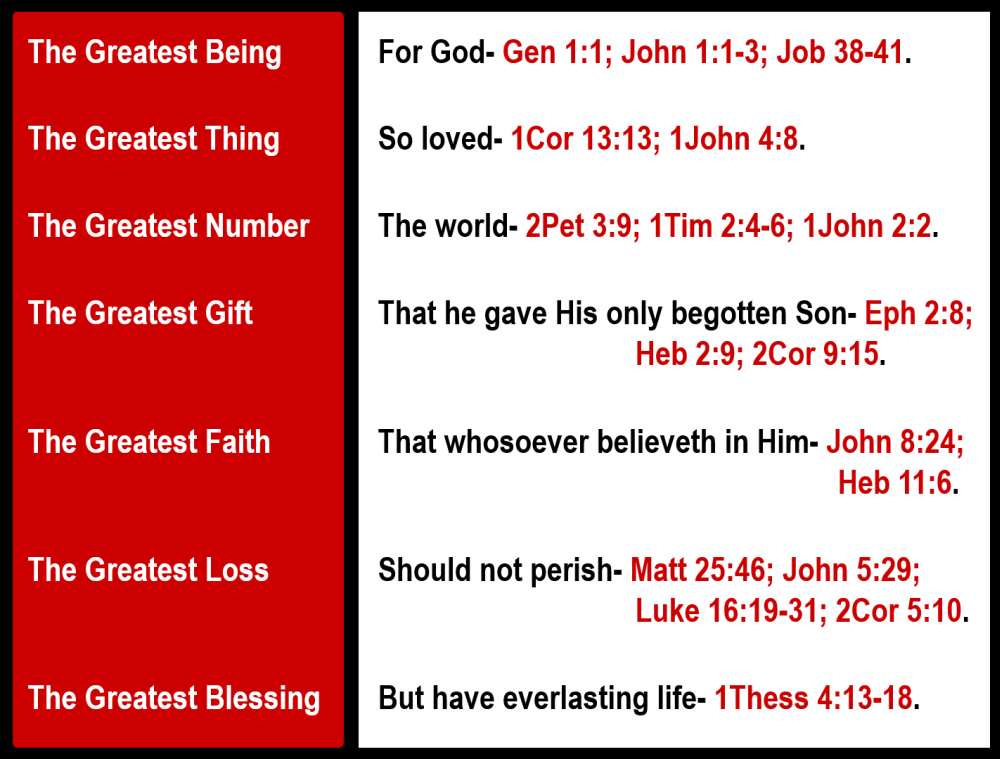
The Greatest Being

The verse begins with “FOR GOD.” The verse begins with the greatest being in existence. In Genesis 1:1, we read, “In the beginning, God created the heavens and the earth.” God is the Creator, the Alpha and the Omega, the beginning and the end. John 1:1-3 tells us, “In the beginning was the Word, and the Word was with God, and the Word was God. The same was in the beginning with God. All things were made by him; and without him was not any thing made that was made.” Job 38-41 presents a majestic depiction of God’s power and wisdom. Our faith rests upon the foundation of this greatest being, who is sovereign over all creation.

The Greatest Thing

Next, we see the greatest thing: “SO LOVED.” God is love. In 1Corinthians 13:13, we learn that “the greatest of these is love.” 1John 4:8 declares, “He that loveth not knoweth not God; for God is love.” God’s love is unparalleled and incomprehensible. It is a love that is willing to sacrifice, a love that seeks the well-being of others. It is the greatest thing because it defines the actions of the greatest being.

The Greatest Number

“THE WORLD.” This phrase encompasses the greatest number: the entire world. God’s love is not limited to a select few but extends to every person on this earth. 2Peter 3:9 states, “The Lord is not slack concerning his promise, as some men count slackness; but is longsuffering to us-ward, not willing that any should perish, but that all should come to repentance.” 1Timothy 2:4-6 reinforces this by saying, “Who will have all men to be saved, and to come unto the knowledge of the truth.” 1John 2:2 confirms that “And he is the propitiation for our sins: and not for ours only, but also for the sins of the whole world.” The greatest number shows the expanse of God’s love. God is not a respecter of persons (Rom 2:11).

The Greatest Gift

“THAT HE GAVE HIS ONLY BEGOTTEN SON.” In this we see the greatest gift. Ephesians 2:8 reminds us that “For by grace are ye saved through faith; and that not of yourselves: it is the gift of God.” Hebrews 2:9 tells us, “But we see Jesus, who was made a little lower than the angels for the suffering of death, crowned with glory and honour; that he by the grace of God should taste death for every man.” 2Corinthians 9:15 exclaims, “Thanks be unto God for his indescribable gift!” The greatest gift (grace) is God’s own Son, given for the redemption of mankind.

The Greatest Faith

“THAT WHOSOEVER BELIEVETH IN HIM.” This phrase highlights the greatest faith. Jesus declares in John 8:24, “I said therefore unto you, that ye shall die in your sins: for if ye believe not that I am he, ye shall die in your sins.” Hebrews 3:18-19 warns of the consequences of unbelief as seen through disobedience, while Hebrews 11:6 teaches that “without faith it is impossible to please God.” The greatest faith is an active belief in Jesus Christ as the Son of God and the Savior of the world (James 2:14-26).

The Greatest Loss

“SHOULD NOT PERISH.” The greatest loss is the eternal separation from God. While any can be saved, the bible tells us that not all will obey the Gospel (Matt 7:24-29; 2Thess 1:8-9). Matthew 25:46 warns of “everlasting punishment,” and John 5:29 speaks of those who will “resurrection of damnation.” The story of the rich man and Lazarus in Luke 16:19-31 vividly portrays the torment of those who perish. 2Corinthians 5:10 reminds us that “we must all appear before the judgment seat of Christ.” The greatest loss is the eternal consequence of rejecting God’s gift of salvation.

The Greatest Difference

“BUT.” While all may be saved, some won’t obey the gospel. “And being made perfect, he became the author of eternal salvation unto all them that obey him” (Heb 5:9). Some will hear, but not do; “Therefore whosoever heareth these sayings of mine, and doeth them, I will liken him unto a wise man, which built his house upon a rock: And the rain descended, and the floods came, and the winds blew, and beat upon that house; and it fell not: for it was founded upon a rock. And every one that heareth these sayings of mine, and doeth them not, shall be likened unto a foolish man, which built his house upon the sand: And the rain descended, and the floods came, and the winds blew, and beat upon that house; and it fell: and great was the fall of it.” (Matt 7:24-27). Many may confess Jesus as Lord and Savior, but not do what He says, “And why call ye me, Lord, Lord, and do not the things which I say” (Luke 6:46)?

The Greatest Blessing

“HAVE EVERLASTING LIFE.” Finally, we come to the greatest blessing. 1Thessalonians 4:13-18 describes the hope of the resurrection and the promise of eternal life with Christ. Everlasting life is the ultimate blessing, the fulfillment of God’s promise to those who believe.

John 3:16 is a verse that reveals to us the greatest being, the greatest thing, the greatest number, the greatest gift, the greatest faith, the greatest loss, and the greatest blessing. Let us hold fast to this truth, share it with others, and walk in the light of God’s incredible love and grace.

Agape, Spencer

Do MORALS Matter? Not according to the WORLD.

For the time past of our life may suffice us to have wrought the will of the Gentiles, when we walked in lasciviousness, lusts, excess of wine, revellings, banquetings, and abominable idolatries: Wherein they think it strange that ye run not with them to the same excess of riot, speaking evil of you.” (1Peter 4:3,4).

This passage highlights the contrast between the behaviors of Christians and those of the secular world.

It describes a past life indulged in excesses and immoral activities such as lust, drunkenness, revelry, and idolatry.

Upon turning to a Christian way of life, believers abstain from these practices, leading to a stark difference in conduct.

This transformation often confounds non-believers, who find it strange that Christians no longer join in their excessive and riotous behaviors. As a result, Christians might face criticism or slander for their newfound restraint and moral discipline.

In our secular society, there is a growing trend to sideline morality, with the world often asserting that ethical standards are subjective and unimportant. The Bible warns against this destructive philosophy.

The idea that wrong is relative is exemplified by the biblical account of Pharaoh’s defiance in Exodus 5:2: “And Pharaoh said, Who is the LORD, that I should obey his voice to let Israel go? I know not the LORD, neither will I let Israel go.” Pharaoh’s stance reflects a broader modern sentiment that moral obligations are negotiable based on personal belief systems or the lack thereof. This relativism undermines the concept of an absolute moral authority.

The pursuit of personal gain often overrides moral considerations. In Luke 12:13-21, Jesus tells the parable of the rich fool, who hoards wealth without regard for others or his spiritual well-being. This story highlights how the quest for material success can eclipse ethical responsibilities, leading individuals to prioritize self-interest over faithfulness to God.

Doing what is “right in one’s own eyes” epitomizes the relativistic approach to morality. Judges 21:25 states, “In those days there was no king in Israel: every man did that which was right in his own eyes.” This verse illustrates the chaos and moral decay that arise when subjective judgments replace universal ethical standards.

Contemporary society often masks moral deviations under the guise of love. This rationalization can be seen in the acceptance of various forms of relationships, such as living together, polyamory, and other more controversial issues. By framing these practices as expressions of love, societal norms shift, challenging biblical moral frameworks.

The belief that death is the end and therefore morality is inconsequential is a profound reflection of nihilistic thought. If life has no ultimate purpose beyond physical existence, ethical considerations may seem futile. This outlook fosters a disregard for moral behavior, as the finality of death negates the perceived need for a moral compass.

The world’s dismissal of morality poses significant contrast to sound ethical standards. This is why we must be on guard against such flawed reasoning.

Agape,

Spencer

The Lord give mercy unto the house of Onesiphorus

For he oft refreshed me

The Lord give mercy unto the house of Onesiphorus; for he oft refreshed me, and was not ashamed of my chain,” (2Tim 1:16).  

Who inspires or impresses you? Take a serious moment to think about it.

Is it because they’re successful? Is it because they’re famous? Is it because they’re big shots?

After you think about that, who do you suppose inspires or impresses them? Are they impressed by more successful people, or more famous celebrities? Bigger big shots?

One more question… Who inspires or impresses true big shots? Paul is an Apostle, but he was humble and was able to see the labors of others.

Onesiphorus impressed Paul.

Impressed may not be the right word. He was Grateful, Glad, Invigorated, Renewed, Refreshed. Did Paul release an audible sigh of relief upon being found by him? The scripture is full of lesser known & unknown names of mighty heroes of faith.

Paul was in a Roman prison, (2Tim 1:8). It was about the time that Nero was blaming Christians for the burning of Rome (64AD). This is Paul’s last writing of the New Testament with the purpose to encourage the young evangelist Timothy, (1:6, 2:1, 3:14-15).

Paul was ready to die, and it looked like it was going to happen this time. “For I am now ready to be offered, and the time of my departure is at hand” (2Tim 4:6). It was no sad moment for him, because he had “fought a good fight, I have finished my course, I have kept the faith: Henceforth there is laid up for me a crown of righteousness, which the Lord, the righteous judge, shall give me at that day: and not to me only, but unto all them also that love his appearing” (2Tim 4:7,8).

Even though he had been forsaken by many, he still encouraged Timothy to come to him, for there was still work to be done. “Do thy diligence to come shortly unto me. The cloke that I left at Troas with Carpus, when thou comest, bring with thee, and the books, but especially the parchments” (2Tim 4:9,13).

In this letter we learn about ONESIPHORUS. He was a man of…

UNPARALLELED SUPPORT: “for he oft Refreshed me.” (2Tim 1:16a)

UNABASHED FRIEND: “was not ashamed of my chain.” (2Tim 1:16b)

UNSTOPPABLE EFFORT: “when he was in Rome, he sought me out very diligently, and found me.” (2Tim 1:17)

UNUSUAL SERVICE: “in how many things he ministered unto me at Ephesus, thou knowest very well.” (2Tim 1:18)

UNSURPASSED REWARD: “He that receiveth you receiveth me, and he that receiveth me receiveth him that sent me. He that receiveth a prophet in the name of a prophet shall receive a prophet’s reward; and he that receiveth a righteous man in the name of a righteous man shall receive a righteous man’s reward. And whosoever shall give to drink unto one of these little ones a cup of cold water only in the name of a disciple, verily I say unto you, he shall in no wise lose his reward” (Mat 10:40-42).

The scripture is full of lesser known & unknown names of mighty heroes of faith. God doesn’t waste ink, these examples are there for a reason. “Brethren, be followers together of me, and mark them which walk so as ye have us for an ensample” (Phil 3:17).

 Agape,

Spencer

This article is based on a sermon presented at the Franklin & Juniper st church of Christ in Borger, Texas. We invite you to visit one of our assemblies to learn more about Christ.

Rejoice Always, Phil 4:4

There is a direct command in scripture that is often overlooked by even the most zealous Saint. “Rejoice in the Lord alway: and again I say, Rejoice.” (Phil 4:4).

It is a discriminating command. In matters of the Lord of what does an alien sinner have to rejoice? All spiritual blessings are “in Christ” (Eph 1:3), and only those that have obeyed the Gospel are in the Lord (Gal 3:26-27). Those that have obeyed the Gospel are the only ones that have reason to rejoice (Acts 8:37).

The command is discriminating in that it also excludes rejoicing in the flesh (Phil 3:3,7). It excludes rejoicing in the wisdom of the world (1Cor 1:20-21). It also excludes rejoicing in one’s own works (Titus 3:5; Is 64:6). We are to work God’s righteousness (Acts 10:34-35; Rom 10:1-3).

By the words of some one is led to wonder if Christians are aware of this command to rejoice.

Let us see about what it means to rejoice always in the Lord.

ALWAYS” tells us it is a perpetual command without regard to external conditions. The Apostle Paul wrote this by inspiration while imprisoned in Rome for his faith. This epistle has been called the epistle of joy, for it contains the words “joy,” “rejoice,” or “rejoicing” some sixteen times.

The command is without regard to Adversity or Prosperity. “Yea, and if I be offered upon the sacrifice and service of your faith, I joy, and rejoice with you all. For the same cause also do ye joy, and rejoice with me” (Phil 2:17-18). Paul is able to rejoice in adversity because it was in service to Christ. “But I have all, and abound: I am full, having received of Epaphroditus the things which were sent from you, an odour of a sweet smell, a sacrifice acceptable, wellpleasing to God” (Phil 4:18).

The command is without regard to being Loved or Hated. “The one preach Christ of contention, not sincerely, supposing to add affliction to my bonds: But the other of love, knowing that I am set for the defence of the gospel. What then? notwithstanding, every way, whether in pretence, or in truth, Christ is preached; and I therein do rejoice, yea, and will rejoice” (Phil 1:16-18). Paul is able to rejoice despite the haters because Christ was being preached. “And I will very gladly spend and be spent for you; though the more abundantly I love you, the less I be loved” (2Cor 12:15).

The command is without regard to Weariness or Strength. “I know both how to be abased, and I know how to abound: every where and in all things I am instructed both to be full and to be hungry, both to abound and to suffer need. I can do all things through Christ which strengtheneth me” (Phil 4:12-13). Paul’s life in the Lord is marked by great adversity (2Cor 11:22-29), but it was from his pen the Holy Spirit wrote, “And let us not be weary in well doing: for in due season we shall reap, if we faint not” (Gal 6:9).

The command is without regard to Arrest or Among Friends. “But I would ye should understand, brethren, that the things which happened unto me have fallen out rather unto the furtherance of the gospel; So that my bonds in Christ are manifest in all the palace, and in all other places; And many of the brethren in the Lord, waxing confident by my bonds, are much more bold to speak the word without fear” (Phil 1:12-14). Paul could rejoice in his arrest and detainment because of the increased boldness of others to speak the gospel. Peter and John could rejoice for being beaten for the name of Christ. “And to him they agreed: and when they had called the apostles, and beaten them, they commanded that they should not speak in the name of Jesus, and let them go. And they departed from the presence of the council, rejoicing that they were counted worthy to suffer shame for his name” (Acts 5:41).

The command is without regard even for Your very life. “For to me to live is Christ, and to die is gain. But if I live in the flesh, this is the fruit of my labour: yet what I shall choose I wot not. For I am in a strait betwixt two, having a desire to depart, and to be with Christ; which is far better: Nevertheless to abide in the flesh is more needful for you.” (Phil 1:21-24). The life that one lives in the Lord prepares him for the appointment of death (Heb 9:27). “And I heard a voice from heaven saying unto me, Write, Blessed are the dead which die in the Lord from henceforth: Yea, saith the Spirit, that they may rest from their labours; and their works do follow them” (Rev 14:13). There is comfort in the death of faithful saints (1Thess 4:13-18). For them “to die is gain.”

The command is without regard to Sickness or Health. Paul could rejoice in the highs or lows of his physical life because of the grace of Christ. “Therefore I take pleasure in infirmities, in reproaches, in necessities, in persecutions, in distresses for Christ’s sake: for when I am weak, then am I strong” (2Cor 12:9-10). There was rejoicing for Epaphroditus despite his sickness because he didn’t regard his life to supply those things that were lacking from the church at Philippi. “I sent him therefore the more carefully, that, when ye see him again, ye may rejoice, and that I may be the less sorrowful” (Phil 2:28; cf, 25-30).

Rejoicing in the Lord always brings about many gratifying results. It is the means by which hope can be seen in the midst of adversity (cf. 1Pet 3:14-15). Rejoicing can put to death the PLAGUES of the mind. Rejoicing and negativity cannot coexist nor be done at the same time.

Rejoicing in the Lord always is the means by which our light can shine in this dark world. Our rejoicing in the Lord becomes a beacon of attraction to the lost and our religion will radiate a wholesome influence upon the lives of those around us. 

Rejoicing in the Lord always can do us no harm, but rather only bring about good, and in many ways will preserve our health and effectiveness.

Rejoicing in the Lord always is easy when we remember that our names are written in the heaven as we obey the Gospel of Christ. “And I intreat thee also, true yokefellow, help those women which laboured with me in the gospel, with Clement also, and with other my fellowlabourers, whose names are in the book of life” (Phil 4:3; Acts 2:38-41; Heb 12:23).

Agape,

Spencer

Why did you Doubt? pt4

The previous articles looked at doubt from Disbelief, Obstacles, Untruths, and now we look at doubt that comes from strife & divisive behavior.

Casting doubt is the next on our list of reasons why we doubt. There are some outside of the church that cast doubt, but there are also some inside the church.

The church is wonderful. Jesus said this about the church, “I will build my church; and the gates of hell shall not prevail against it” (Matt 16:18b). He built it, and it’s indestructible, but that doesn’t mean some won’t try.

For the most part, folks aren’t necessarily trying to wreck the church, but we can be casting doubt upon it through certain attitudes and actions. This leads to some leaving the church.

People do not like conflict. When we fail to resolve issues in kind, loving and truthful ways it leads to disappointment and division. Some leave to another congregation. Others leave the church for a denomination.

To ward off doubt, we need to identify our negative behaviors without casting more doubt!

5 things we do to cast doubt upon others in the church.

The first negative behavior that casts doubt on others is BACKBITING. “A froward man soweth strife: and a whisperer separateth chief friends” (Prov 16:28). In Romans, backbiting is in the list of the unrighteous (Rom 1:30. It’s among the list of thing Paul hoped to find missing when he visited the church at Corinth (2Cor 12:20). Backbiting is defaming speech to attack the good name or reputation of a person by uttering anything false or injurious. This can cast doubt on the faith of some by tearing down those who teach, aid, or example for others. This kind of doubt leads to trust issues and divisions.

The next way we could cause doubt is through RIVALRIES. The church at Corinth had this problem. “For ye are yet carnal: for whereas there is among you envying, and strife, and divisions, are ye not carnal, and walk as men” (1Cor 3:3)? The first chapter shows the root of this rivalry was about who baptized who. In chapter six there was rivalry caused by doing wrong to one another and they were taking their grievances before unbelievers (6:1-6). This causes doubt about the church inside and outside the church. “For where envying and strife is, there is confusion and every evil work” (James 3:16). This sort of doubt causing gives occasion for the enemies of God to blaspheme.

EVIL Speaking is another area when we might cast doubt. I recall a friend telling me about when he was a kid riding home with his parents from worship. They began to speak about something a brother in Christ had done when his father stopped the conversation. His father told him that he didn’t want to talk poorly about a brother in front of the kids. Perhaps the brother would repent, but if they had poisoned the mind of the children about this brother, they may harbor ill feelings toward him into adulthood. “Wherefore laying aside all malice, and all guile, and hypocrisies, and envies, and all evil speakings, As newborn babes, desire the sincere milk of the word, that ye may grow thereby” (1Pet 2:1-2). “A false witness that speaketh lies, and he that soweth discord among brethren” (Prov 6:12-14; 19). This kind of doubt leads to division between brethren and ultimately a weaker congregation.

The next attitude is ANGER toward others in the church. “But now ye also put off all these; anger, wrath, malice, blasphemy, filthy communication out of your mouth.” (Col 3:8, 21; Eph 4:31, 26). Animosity is in opposition to loving kindness. “Put on therefore, as the elect of God, holy and beloved, bowels of mercies, kindness, humbleness of mind, meekness, longsuffering. (Col 3:12). When people come together there may times when we disappoint each other, but we must not allow this to develop into anger and cause division and doubt about our brethren or doubt about the church. “Beloved, let us love one another: for love is of God; and every one that loveth is born of God, and knoweth God. He that loveth not knoweth not God; for God is love” (1John 4:7-8).

Lastly, there is doubt cast on another when someone lays claim to special KNOWLEDGE that others lack. Paul warned Timothy about these people. “But foolish and unlearned questions avoid, knowing that they do gender strifes” (2Tim 2:23). “He is proud, knowing nothing, but doting about questions and strifes of words, whereof cometh envy, strife, railings, evil surmisings” (1Tim 6:4). When people engage in doubtful disputations (Rom 14:2) it may cause a weaker brother to stumble. Paul also wrote about KNOWLEDGE that a strong brother has that a weaker brother does not have. In these cases, the stronger brother is to forebear so as not to cause stumbling in the weaker.

But take heed lest by any means this liberty of yours become a stumblingblock to them that are weak. For if any man see thee which hast knowledge sit at meat in the idol’s temple, shall not the conscience of him which is weak be emboldened to eat those things which are offered to idols; And through thy knowledge shall the weak brother perish, for whom Christ died” (1Cor 8:9-11)?

Casting doubt about brethren casts doubt about the church for the church is the brethren. There will be disagreements, disappointments, and differences in understanding. However, these can be overcome through Love for God, Love for His word and Love for one another.

Agape,

Spencer

This is part 4 of a series on Overcoming Doubt.

1John 3:14-15 How do we KNOW?

HOW DO WE KNOW IF WE’VE PASSED FROM DEATH INTO LIFE?

KEEP HIS COMMANDS. 2:3-5, 24; 1:5-10.

NO Love of the World. 1John 2:15-17.

OUGHT TO LOVE AS HE LOVED.
3:16 Lay down our lives for the Brethren.
4:11 Love the Brethren.

WALK as He walked. 1John 2:6.

xxxxxxxxxxxxxxxxxxxxxxx

Here’s a link to all the published studies from 1 John.

The Franklin and Juniper church of Christ did a study of the book of 1John in the summer and fall of 2023. If you live in the Borger area, We invite you to join us at 9:30am each Sunday Morning for similar Bible studies.

What a Saint KNOWS in 1John

The Letter of 1John is an outline of the things the Saint KNOWS about salvation, love, sin, the Holy Spirit and Obedience.

When we read it, we can use it as a personal Test or examination of ourselves.

2Co 13:5 Examine yourselves, whether ye be in the faith; prove your own selves. Know ye not your own selves, how that Jesus Christ is in you, except ye be reprobates?

Here are ALL the verses in 1John about knowing.

KNOW. 31 verses.

1Jo 2:3 And hereby we do know that we know him, if we keep his commandments.

 1Jo 2:4 He that saith, I know him, and keepeth not his commandments, is a liar, and the truth is not in him.

 1Jo 2:5 But whoso keepeth his word, in him verily is the love of God perfected: hereby know we that we are in him.

 1Jo 2:11 But he that hateth his brother is in darkness, and walketh in darkness, and knoweth not whither he goeth, because that darkness hath blinded his eyes.

 1Jo 2:13 I write unto you, fathers, because ye have known him that is from the beginning. I write unto you, young men, because ye have overcome the wicked one. I write unto you, little children, because ye have known the Father.

 1Jo 2:14 I have written unto you, fathers, because ye have known him that is from the beginning. I have written unto you, young men, because ye are strong, and the word of God abideth in you, and ye have overcome the wicked one.

 1Jo 2:18 Little children, it is the last time: and as ye have heard that antichrist shall come, even now are there many antichrists; whereby we know that it is the last time.

 1Jo 2:20 But ye have an unction from the Holy One, and ye know all things.

 1Jo 2:21 I have not written unto you because ye know not the truth, but because ye know it, and that no lie is of the truth.

 1Jo 2:29 If ye know that he is righteous, ye know that every one that doeth righteousness is born of him.

 1Jo 3:1 Behold, what manner of love the Father hath bestowed upon us, that we should be called the sons of God: therefore the world knoweth us not, because it knew him not.

 1Jo 3:2 Beloved, now are we the sons of God, and it doth not yet appear what we shall be: but we know that, when he shall appear, we shall be like him; for we shall see him as he is.

 1Jo 3:5 And ye know that he was manifested to take away our sins; and in him is no sin.

 1Jo 3:6 Whosoever abideth in him sinneth not: whosoever sinneth hath not seen him, neither known him.

 1Jo 3:14 We know that we have passed from death unto life, because we love the brethren. He that loveth not his brother abideth in death.

 1Jo 3:15 Whosoever hateth his brother is a murderer: and ye know that no murderer hath eternal life abiding in him.

 1Jo 3:19 And hereby we know that we are of the truth, and shall assure our hearts before him.

 1Jo 3:20 For if our heart condemn us, God is greater than our heart, and knoweth all things.

 1Jo 3:24 And he that keepeth his commandments dwelleth in him, and he in him. And hereby we know that he abideth in us, by the Spirit which he hath given us.

 1Jo 4:2 Hereby know ye the Spirit of God: Every spirit that confesseth that Jesus Christ is come in the flesh is of God:

 1Jo 4:6 We are of God: he that knoweth God heareth us; he that is not of God heareth not us. Hereby know we the spirit of truth, and the spirit of error.

 1Jo 4:7 Beloved, let us love one another: for love is of God; and every one that loveth is born of God, and knoweth God.

 1Jo 4:8 He that loveth not knoweth not God; for God is love.

 1Jo 4:13 Hereby know we that we dwell in him, and he in us, because he hath given us of his Spirit.

 1Jo 4:16 And we have known and believed the love that God hath to us. God is love; and he that dwelleth in love dwelleth in God, and God in him.

 1Jo 5:2 By this we know that we love the children of God, when we love God, and keep his commandments.

 1Jo 5:13 These things have I written unto you that believe on the name of the Son of God; that ye may know that ye have eternal life, and that ye may believe on the name of the Son of God.

 1Jo 5:15 And if we know that he hear us, whatsoever we ask, we know that we have the petitions that we desired of him.

 1Jo 5:18 We know that whosoever is born of God sinneth not; but he that is begotten of God keepeth himself, and that wicked one toucheth him not.

 1Jo 5:19 And we know that we are of God, and the whole world lieth in wickedness.

 1Jo 5:20 And we know that the Son of God is come, and hath given us an understanding, that we may know him that is true, and we are in him that is true, even in his Son Jesus Christ. This is the true God, and eternal life.

If you live in the Borger area, We invite you to join us at 9:30am each Sunday Morning for Bible Study on 1John.

The Holy Spirit and the Written Word of God are said to do the same thing.

When a Person uses a tool, we know it was the Person that does the work through the use of the tool.

What can the 7 Sayings of Jesus on the Cross teach us about our pain?

Jesus said, “Take up your cross and follow me” (Matt 16:24). We are to die to self and live for Him.

The Gospels reveal 7 sayings of Jesus when He was on His cross. These sayings have important meaning for themselves, but they also leave an example for us who are suffering on our crosses.

What can the 7 sayings of Jesus on the cross teach us about handling our own pain, suffering, & earthly hurting?

Father, forgive them; for they know not what they do.” (Luke 23:34)

We often suffer at the hands of those close to us. Jesus suffered at the hands of God’s chosen people. We will often complain about what they should do, but didn’t do. Yes, they shoulda, and coulda, but didn’t. This powerful example of Jesus teaches us to be a forgiving people. We need to complain with grace, ready to Forgive, or Forebear, or Forget (release from our heart). Forgive those that are hurting you…

But Stay on the cross.

To day shalt thou be with me in paradise.” (Luke 23:43)

When others fail, remember that God doesn’t fail. There’s hope in the midst of our pain. There’s even hope when our pain is self induced. The thief admitted his guilt, and was a mocker along with the other one, but later he had a change of heart. It’s then he looked to the only one that could help, Jesus. Sometimes our suffering is self induced, but the Lord is faithful to forgive those that are in Him (1John 1:9). Repent…

But Stay on the cross.

Woman, behold, thy son! Behold, thy mother!” (John 19:26-27)

Your friends may have turned their back on you. I hate that. However, If you’ll look, you’ll see that not everyone has left you. Some are nearby unable to take away your pain, But they can take some of your responsibilities. Just ask them for help. Some of us just don’t know what to do, but we’re willing if you’ll let us know.

When you’re overwhelmed with your main priority, let go of some of the other important, but lesser stuff.

But Stay on the cross.

My God, my God, why hast thou forsaken me?” (Mat 27:46)

People will let you down at your lowest point. The disciples left Jesus. It will also APPEAR that God has left you too. He hasn’t. He’s with you. While this saying has prophetic significance, it is a reminder of how lonely we can feel in our darkest moments. We need to remember that Jesus said, “I will never leave thee, nor forsake thee” (Heb 13:5).

But Stay on the cross.

I thirst.” (John 19:28-29)

Life is a dry, and thirsty struggle, metaphorically speaking. Jesus asked the woman at the well for a drink. He received a bit of a rebuke (John 4:7-9). Isn’t that the way it goes sometimes? Jesus said, “I thirst,” and He received sour wine. When we need help we sometimes receive a sour response. Ask anyway…

But Stay on the cross.

It is finished.” (John 19:30)

Jesus stayed on that cross to the very end because He knew that what He was doing was essential for salvation for the world. (cf. Matt 16:21-23; 26:52-55). Keep on pushing through the pain until you complete your duty as a child of God. It’s important that we stay the course of faithfulness. We may not see the benefits until much later (Rev 2:10),

But Stay on the cross.

Father, into thy hands I commend my spirit.” (Luke 23:46)

Even when all others fail you, God never does. Trust God. “For the which cause I also suffer these things: nevertheless I am not ashamed: for I know whom I have believed, and am persuaded that he is able to keep that which I have committed unto him against that day.” (2Tim 1:12). Whatever happens to you…

Stay on the cross.

Agape,

Spencer

1John 2:3-11: 2 tests of fellowship.

TESTS of FELLOWSHIP:

Test ONE: 1John 2:3-6. If we keep His commandments.

And hereby we do know that we know him, if we keep his commandments. He that saith, I know him, and keepeth not his commandments, is a liar, and the truth is not in him. But whoso keepeth his word, in him verily is the love of God perfected: hereby know we that we are in him. He that saith he abideth in him ought himself also so to walk, even as he walked.

Test TWO: 1John 2:7-11. If we love the brethren.

Brethren, I write no new commandment unto you, but an old commandment which ye had from the beginning. The old commandment is the word which ye have heard from the beginning. Again, a new commandment I write unto you, which thing is true in him and in you: because the darkness is past, and the true light now shineth. He that saith he is in the light, and hateth his brother, is in darkness even until now. He that loveth his brother abideth in the light, and there is none occasion of stumbling in him. But he that hateth his brother is in darkness, and walketh in darkness, and knoweth not whither he goeth, because that darkness hath blinded his eyes.

The Franklin and Juniper church of Christ had an overview study of the book of 1John. If you live in the Borger area, We invite you to join us at 9:30am each Sunday Morning for the next few weeks.

Click here for the Overview Chart and links to other study outlines in this series.