
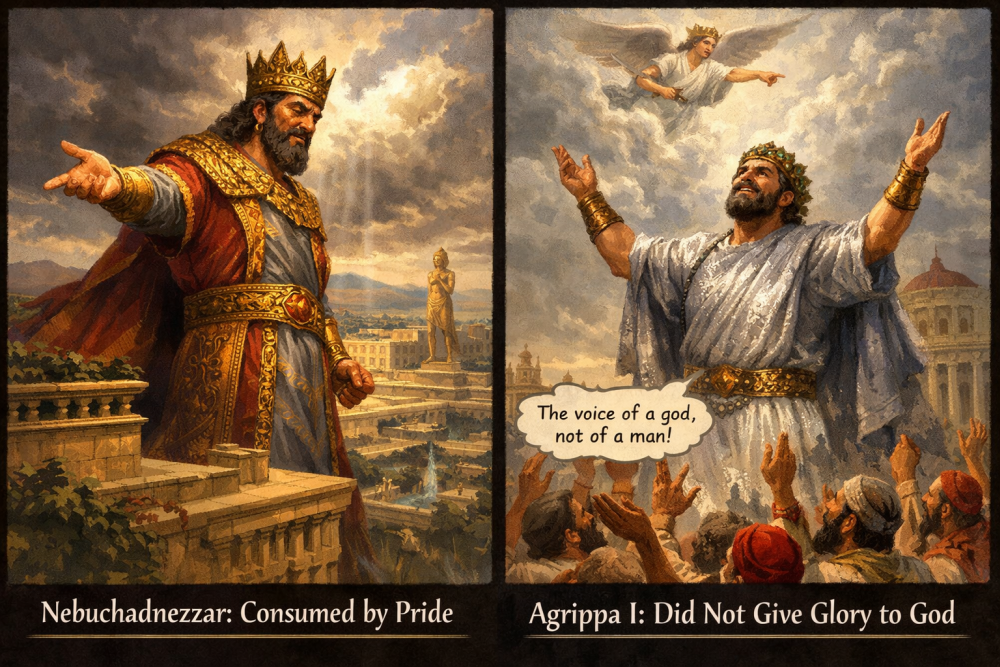
Nebuchadnezzar & Agrippa I: Leadership Without Humility
The Bible does not shy away from showing the consequences when leaders forget their place before God. Two striking accounts—one from the Old Testament and one from the New—illustrate a timeless warning: when earthly rulers exalt themselves or accept the exaltation of others, the outcome is always ruinous. These stories serve as sober reminders for any generation about the perils of pride in positions of power.
King Nebuchadnezzar of Babylon stands as a vivid example of self-aggrandizement. After great military victories, he erected a massive golden image and commanded all his subjects to bow down and worship it under penalty of death (Daniel 3). His pride reached its peak when he boasted of his own achievements while surveying his magnificent city: “Is not this the great Babylon I have built as the royal residence, by my mighty power and for the glory of my majesty?” (Daniel 4:30). A divine warning had come in a dream, urging him to acknowledge that “the Most High is sovereign over all kingdoms on earth and gives them to anyone he wishes” (Daniel 4:17). Yet he refused to humble himself. As judgment, he was driven away from people, lived like a wild animal, eating grass, with his body drenched by the dew of heaven, until seven times passed over him. Only after he lifted his eyes to heaven and praised the Most High God was his sanity and kingdom restored (Daniel 4:34-37). The lesson is clear: God opposes the proud, and no leader, no matter how powerful, can claim glory that belongs to God alone.
A different but equally sobering example appears in the New Testament with King Herod Agrippa I. After a period of persecution against the early church, Herod delivered a public address in Caesarea. The people, seeking his favor, shouted, “This is the voice of a god, not of a man!” (Acts 12:22). Herod did not rebuke the flattery or redirect the praise to the living God. Instead, he accepted it in silence. Immediately, “an angel of the Lord struck him down, because he did not give God the glory, and he was eaten by worms and died” (Acts 12:23). His end was swift, painful, and public. The contrast is striking: where Nebuchadnezzar actively demanded worship, Herod passively allowed it. In both cases, the failure to humble oneself before God brought severe judgment.
These two accounts reveal a common pattern. Leadership without humility inevitably leads to idolatry—either self-imposed or encouraged by followers. Whether a ruler builds his own monument to greatness or simply fails to correct those who offer divine honors, the result is the same: divine opposition. Scripture repeatedly emphasizes that “God opposes the proud but shows favor to the humble” (James 4:6; 1 Peter 5:5). Pride in high places does not merely affect the individual leader; it corrupts those under authority, distorts truth, and invites disorder and decay.
The Bible’s warning is therefore general and enduring. Any leader—whether in government, business, religion, or any sphere of influence—who forgets that all authority comes from God and who fails to give Him the glory due His name risks the same tragic trajectory. Nebuchadnezzar’s madness and Herod’s gruesome death stand as monuments to the truth that exaltation of self, whether bold or subtle, always precedes a fall. True leadership begins with the fear of the Lord and the recognition that “the Most High rules over the kingdom of men” (Daniel 4:17). Without such humility, even the mightiest throne becomes a path to humiliation.
May every person in authority—and every citizen who supports them—heed this ancient scriptural counsel: give glory to God alone, walk in humility, and reject every form of self-deification. For in the end, only God is worthy of worship, and He will not share His glory with another (Isaiah 42:8).
agape
spencer
 Borger church of Christ @ Franklin & Juniper