
Beware of False Teacher: 4 Lessons from Colossians 2

In Colossians 2, Paul issues a powerful warning to believers: “Stop letting people disqualify you” (Colossians 2:18). He urges the church to stand firm against deceptive influences that threaten to lead them astray from the truth of Christ. Paul identifies four types of false teachers, each with distinct tactics that remain relevant today. By understanding these dangers, we can guard our faith against those who distort the gospel.

1. Enticing Speech (Colossians 2:4-7)

False teachers often wield persuasive language to deceive. Paul warns against those who use “enticing words” to sway believers (Colossians 2:4). This tactic echoes Romans 16:18, where smooth talk and flattery manipulate the unsuspecting, and Ephesians 4:14, which describes cunning words that toss believers like waves. In our digital age, TikTok influencers, online preachers, and charismatic personalities can charm audiences with polished rhetoric, much like Satan’s subtle deception in Genesis 3 and Matthew 4. These voices may sound convincing, promising quick spiritual fixes or worldly success, but they often lead away from Christ’s sufficiency. Believers must root themselves in the truth of Scripture, as Paul encourages in Colossians 2:6-7, to discern and resist such deception.

2. Traditions of Men and the World (Colossians 2:8-10)

Another group of false teachers promotes human traditions and worldly philosophies over Christ’s authority. Paul cautions against being captivated by “philosophy and empty deceit, according to human tradition” (Colossians 2:8). Jesus confronted similar issues in Matthew 15:2, where religious leaders prioritized their traditions over God’s commands. Today, this manifests in appeals to “the way we’ve always done it” or the approval of experts, organizations, or governments. Philosophies like those Paul encountered in Acts 17 (stoicism, epicureanism, or modern ideologies) can subtly infiltrate the church. These traditions and ideas may seem appealing, but they lack the fullness of Christ, who is “the head of all rule and authority” (Colossians 2:10). Believers must test every teaching against the gospel, rejecting what elevates human wisdom over divine truth.

3. Judgments About the Old Law (Colossians 2:16-17)

Paul also warns against those who judge believers based on adherence to the Old Testament law, such as dietary rules or festivals (Colossians 2:16). Romans 14:2-3 and Galatians 4:10 highlight the danger of imposing outdated regulations, while Hebrews 8:13 declares the old covenant “obsolete.” False teachers may pressure Christians to follow Old Testament practices, claiming they are essential for righteousness (see Acts 15). Yet, Paul emphasizes that these are mere “shadows” of Christ, the true substance (Colossians 2:17). Some modern churches continue to impose the Law of Moses upon people. Why return to the shadows when the true Light has come into the world?

4. Puffed-Up Wisdom and Will Worship (Colossians 2:18-23)

The final type of false teacher Paul warns against is those who promote self-made spirituality and “puffed-up” wisdom (Colossians 2:18). These individuals boast of esoteric knowledge or mystical experiences, such as worshipping angels or embracing strange beliefs like sun gods or witchcraft. Paul describes such practices as “self-imposed worship” and “false humility” (Colossians 2:18, 23), which appear spiritual but lack true substance. Romans 6:3-6 and Ephesians 2:15 emphasize that believers are freed from such elemental principles through Christ’s death and resurrection. Paul warns against turning to weak and worthless spiritual systems. Today, this might look like New Age mysticism, occult practices, or prideful claims of exclusive spiritual insight. These teachings inflate human ego rather than exalting Christ, who alone is sufficient (Colossians 2:10). Paul urges believers to reject such distractions and cling to the gospel’s simplicity.

Guarding Against Deception

The common thread among these false teachers is their attempt to disqualify believers by shifting focus from Christ’s all-sufficient work. Whether through persuasive speech, human traditions, Old Testament practices, or puffed-up mysticism, they undermine the gospel’s power. Colossians 2 reminds us that Christ is the fullness of God, in whom all wisdom and knowledge reside (Colossians 2:3, 9-10). Believers are complete in Him, needing no additional rituals or philosophies to earn God’s favor.

In our modern context, these warnings are strikingly relevant. Social media amplifies enticing voices, from influencers peddling self-help spirituality to charismatic leaders pushing personal or mystical agendas. Cultural traditions (like prioritizing societal norms or “expert” consensus over biblical truth) can subtly erode faith. The Law of Moses persists in churches that impose Old Testament rules, while puffed-up wisdom appears in trendy spiritual fads that promise enlightenment apart from Christ.

To avoid being disqualified, believers must remain rooted in Christ (Colossians 2:6-7). This means immersing ourselves in Scripture and testing every teaching against God’s Word. Assembling with other believers provides accountability, helping us stay anchored in truth. Prayer is also vital, as we seek God’s wisdom in matters of truth.

Paul’s exhortation in Colossians 2 is a reminder for vigilance. False teachers will always arise, but we are not defenseless. By holding fast to Christ as our head, we can stand firm against enticing words, worldly traditions, Old Testament judgments, and prideful spirituality. Let us walk in the freedom and fullness of Christ, rejecting anything that seeks to disqualify us from the truth of His gospel.

agape

spencer
Ad Hominem & Personal Attacks p1; You’re ARROGANT

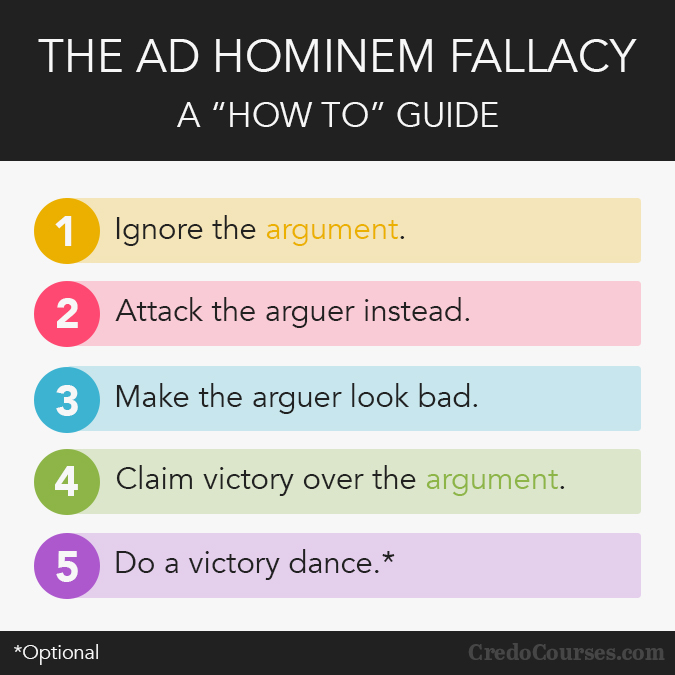
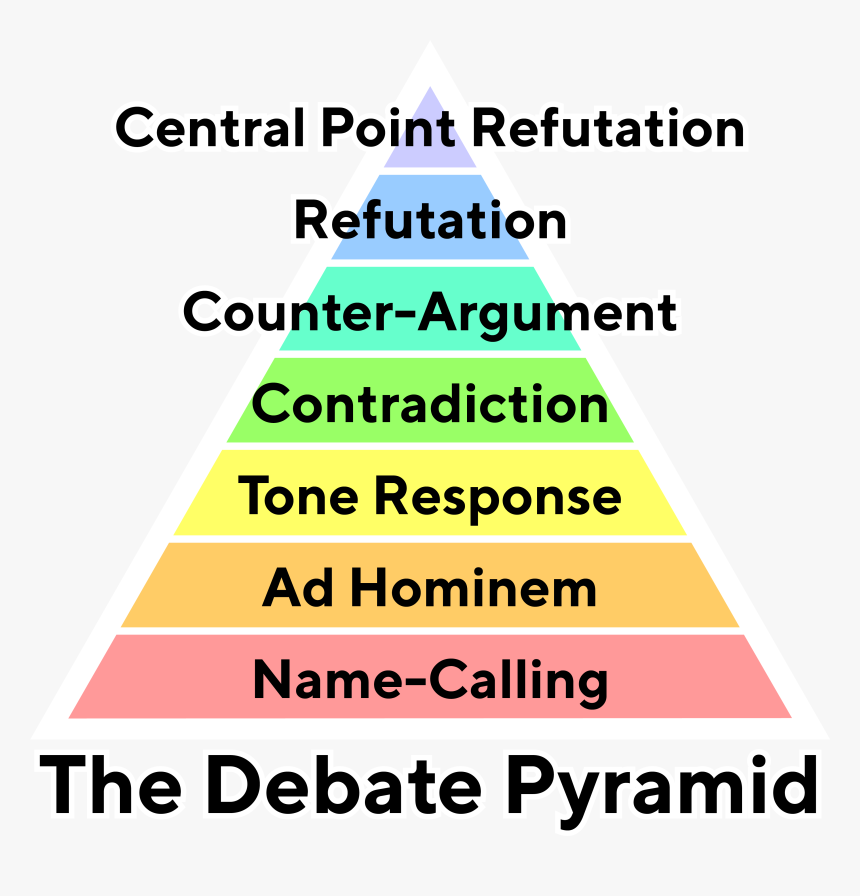
The Debate Pyramid V2 Simple Tt Norms Bold Text - Pyramid, HD Png ...   The Ad Hominem Fallacy (3 Flavors) and Ridicule in the Bible


If you’ve done any evangelism at all, you’ve likely experienced a personal attack (Ad Hominem; in a way that is directed against a person rather than the position they are maintaining).

This should come as no surprise for Christ gave us warnings about it in addition to experiencing the ultimate attack, the one against His life. “And ye shall be hated of all men for my name’s sake: but he that shall endure unto the end, the same shall be saved.” [Mark 13:13]

While some accusations may be well founded due to our own poor attitudes, words & acts, most are ad hominem attacks.

Let’s look at a few and learn how to respond without reviling.


Before we answer this attack, we need to remember how Jesus responded to personal attacks. He didn’t revile in return. “Who, when he was reviled, reviled not again; when he suffered, he threatened not; but committed himself to him that judgeth righteously:” [1Peter 2:23; Isa 53:7]


The First ATTACK has a few versions: “You’re Arrogant. You’re just closed minded. It’s obvious you’ve already got your mind made up.”

First off, ACCURATELY define your intentions & motives. Tell them that it is true that you have your mind made up, and it’s not because you haven’t examined the evidence nor heard the arguments. It’s made up BECAUSE you’ve given careful consideration to the scriptures. “These were more noble than those in Thessalonica, in that they received the word with all readiness of mind, and searched the scriptures daily, whether those things were so.” [Acts 17:11].

This attack is vile in that it impugns your motives. It attempts to judge you unfairly and we know how the Lord feels about that [Matt &:1-2].

RESPOND calmly with a question; “Are you saying it’s arrogant to say & do what the bible teaches? [Luke 6:46; Mat 7:21-23; Col 3:16] Jesus often used questions (about 100) to challenge His accusers & His disciples. [Matt 15:3; 21:25]

One good question from Christ’s spiritual arsenal is, “Have you READ this scripture?” [Matt 21:42]. It’s much more effective to show someone the verse in the bible than it is to refer to it or even to quote it from memory. Otherwise it’s just arguing opinions. Show them, not just tell them. Let them READ it for themselves.

I sometimes ask; “Is it ONLY the OTHER guy that has his mind made up?” The other person has their own steadfastness and sees your steadfastness as pride. “How come your unwavering assertions aren’t arrogant?” This response is not to conflate the conversation. It’s to calm it down by finding common ground. Paul used a similar strategy at the beginning of his speech on Mars Hill [Acts 17:22].

It’s a good reminder for them and for yourself that GOD HATES pride & arrogance. [Prov 8:13; Luke 18:14]. Perhaps you can restore civility by admitting that you’re working on avoiding this sin.

Remember that debate is healthy, ARGUMENT is not. We must have discussions about our differences, but we mustn’t allow ourselves to resort to ANGER & HATE. “Let nothing be done through strife or vainglory; but in lowliness of mind let each esteem other better than themselves.” [Phil 2:3] Consider these passages for additional study on scriptural debate [1Thess 5:21; Titus 2:15; 2Tim 4:2; 1Tim 5:20; 2Tim 2:24-26; Jude 3; 1Tim 6:12; 2Cor 10:4-5; Acts 14:26-15:2] It’s better to end the discussion if either of you are having trouble with their emotions. [Mat 7:6; 15:14]

Another good reminder is that it’s NOT ABOUT WINNING an argument, it’s about winning a soul. “To the weak became I as weak, that I might gain the weak: I am made all things to all men, that I might by all means save some.” [1Cor 9:22]

Finally, if you’ve handled yourself well, made no mistakes in your defense of the Gospel and never raised your voice or rolled your eyes, THEY MAY STILL accuse you of pride. THEY did it to the Master Teacher, are you any more special than He? [Mark 14:61-65]

–Spencer

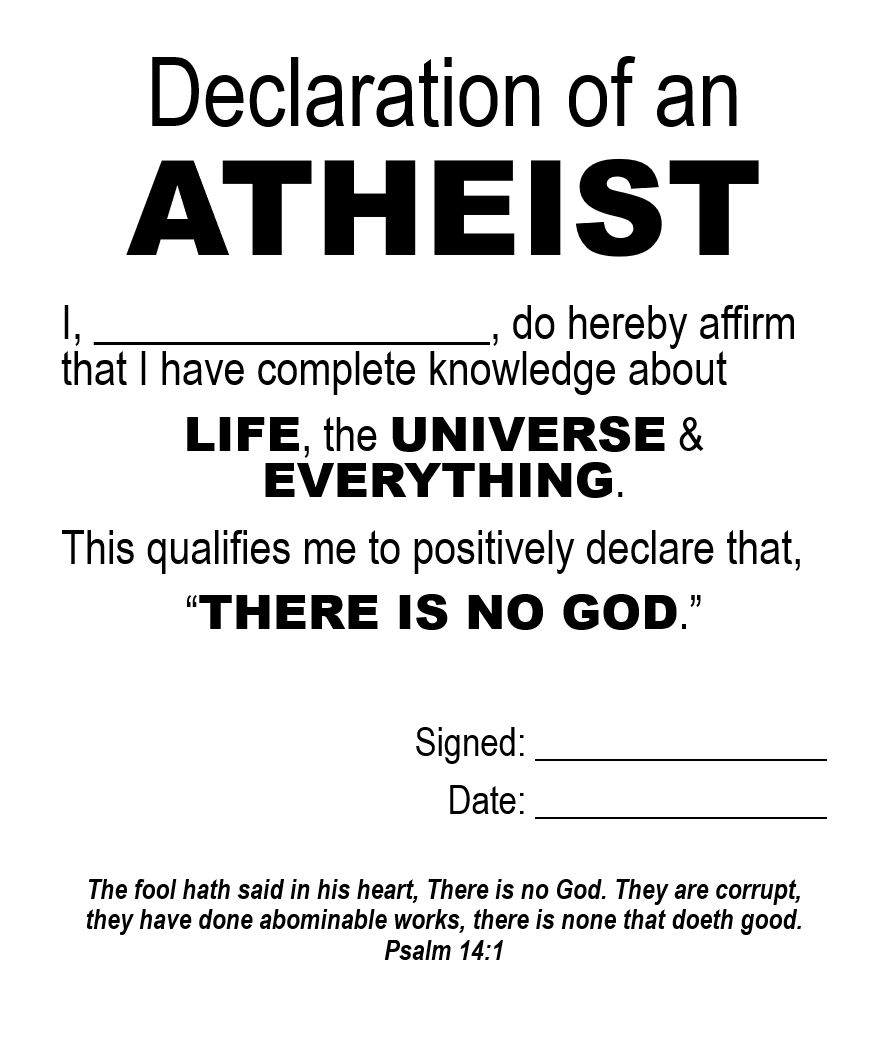
Declaration of an ATHEIST

When you meet an Atheist, you’ve met a person with a serious problem. Atheism is declaring that there is no God. For this to be an honest statement, one must first have complete knowledge of LIFE, the UNIVERSE & EVERYTHING. If you don’t know everything, perhaps God is in that missing knowledge.

Here are a few questions for the Atheist…

  • What happened at the beginning of everything? Were you there?
  • Do you know everything about the bottom of the ocean?
  • Do you know everything about what happens to the soul at death?
  • Do you know everything about deep space?
  • Can you explain how we have consciousness?

These are only a few of the 72 questions God asks in Job 38-41. Several of the questions have multiple parts. Man is still searching for the answers to these questions and more. Yet, the atheist declares with certainty, “THERE IS NO GOD!” That’s arrogance.

“The fool hath said in his heart, There is no God.”

Psalm 53:1

Pride is at the center of atheism. I’m not impugning anyone’s motives, God is, for He knows the motives of us all. “The wicked, through the pride of his countenance, will not seek after God: God is not in all his thoughts.” [Psalm 10:4; cr Heb 4:12]

Atheism searches for answers without a Divine source, but it’s an exercise in futility. Every time they introduce a theory stating a natural beginning, the question remains, “who / what created that?” Ad infinitum. Whereas the Christian doesn’t have this dilemma. We believe in a self-existent God who has always been and will always be. It’s the more logical conclusion.

I am Alpha and Omega, the beginning and the ending, saith the Lord, which is, and which was, and which is to come, the Almighty.”

[Rev 1:8]

Above is a ‘DECLARATION of an ATHEIST’ for the next time you meet someone claiming to be one. The intent is not to mock, rather to help them see the futility of atheism and to encourage looking at the possibility there is a God.


–spencer