
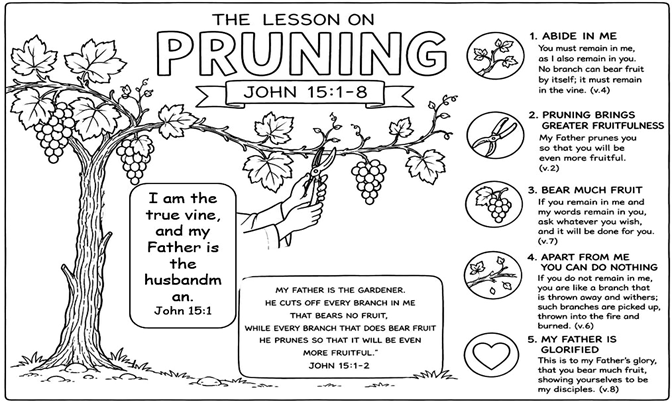
“Every branch in me that beareth not fruit he taketh away: and every branch that beareth fruit, he purgeth (prunes) it, that it may bring forth more fruit.” (John 15:2)
PRUNING for greater fruitfulness.
In grape production (viticulture), the vinedresser removes dead or unfruitful branches entirely to concentrate the vine’s energy to improve growth and health for greater productivity. This is not destruction but care. God actively tends His people for fruitfulness, accomplished primarily through His Word, all aimed at greater Christlikeness and productivity. From this verse in John 15 we see two actions being taken by the vinedresser (God the Father):
ONE: Branches that produce no fruit are removed. “If a man abide not in me, he is cast forth as a branch, and is withered; and men gather them, and cast them into the fire, and they are burned” (John 15:6). This is a warning about those who were “in me” but are not bearing fruit. We see other scriptures warning of this same condition; The parable of the Sower (Mark 4:13-20); the warning about false prophets (Matt 7:15-20); and the breaking off of branches (Romans 11:11-27). The possibility of apostasy is real.
TWO: The Father cleanses or prunes fruitful branches “that it may bring forth more fruit.” The goal is increase, not comfort—removing what hinders maximum productivity. Paul wrote about a similar “pruning” using the metaphor of “mortifying” and “putting off” the works of the world (Colossians 3:5-17).
The primary instrument of pruning Jesus says is the word, “Now ye are clean through the word which I have spoken unto you… If ye abide in me, and my words abide in you” (John 15:3, 7). Reading, applying, and obeying Scripture convicts, corrects, and trains (cf. 2Timothy 3:16-17).
Another way God prunes is through the trials that are in this world since the fall. “My brethren, count it all joy when ye fall into divers temptations; Knowing this, that the trying of your faith worketh patience. But let patience have her perfect work, that ye may be perfect and entire, wanting nothing” (James 1:2-4). Trials test and develop endurance, leading to maturity (perfection). God has established principles in creation and redemption that automatically correct deviation (sowing and reaping, consequences of sin, Galatians 6:7). Any true understanding of discipline through trial comes from the revealed Word of God.
Hebrews 12 informs us that discipline is for our good, as a father who loves and disciplines his son. It’s considered loving to train a child. “For whom the Lord loveth he chasteneth, and scourgeth every son whom he receiveth” (Hebrews 12:6). God may use circumstances, but understanding flows from knowing His Word. God “prunes” for greater fruitfulness, because He loves us, for maturity, and to remove hindrances. We respond by abiding in Him (through His word), count trials as joy because of what it will produce in us, actively participate by removing sin & distractions, and fully trusting in God who wants us to be fully equipped for every good work. “Herein is my Father glorified, that ye bear much fruit; so shall ye be my disciples” (John 15:8).
Agape
spencer

