
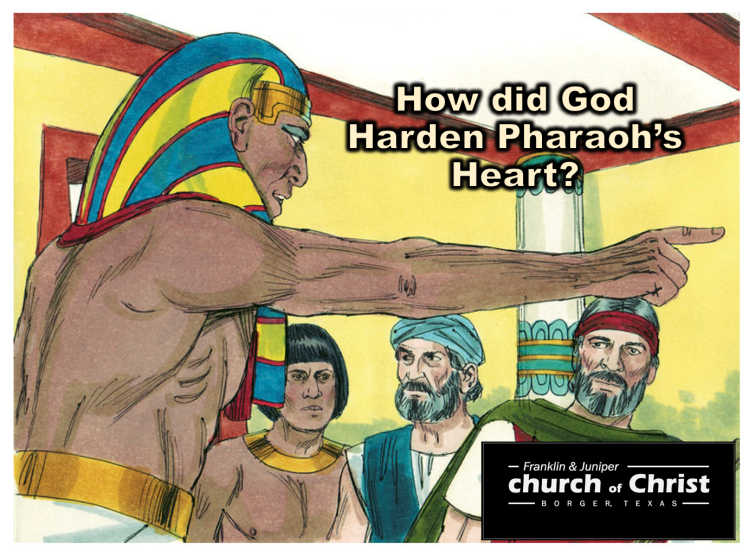
God Hardened Pharaoh’s Heart
For the Scripture says to Pharaoh, “For this very purpose I have raised you up, that I may show My power in you, and that My name may be declared in all the earth.” (Rom 9:17)
This objection sounds like this; Calvinists might say that Pharaoh’s hardening is evidence of predestination separate from free will:
“God hardened Pharaoh’s heart to display His sovereign power, showing that human will is subject to His eternal decree.”
“Pharaoh’s hardening proves that God chooses whom to have mercy on and whom to harden, independent of human action.”
“God raised Pharaoh up to be a vessel of wrath, predestined to resist Him, to magnify divine glory.”
“Pharaoh had no free will to resist God’s hardening, as his rebellion was ordained to serve God’s redemptive plan.”
At the end of the day, this error makes God out to be a monster, and that He is a respecter of persons. “Then Peter opened his mouth, and said, Of a truth I perceive that God is no respecter of persons.” (Acts 9:34)
How can we answer this objection?
We Harden Our Own Hearts
The Bible repeatedly warns against hardening our hearts, emphasizing that this is a choice we make by disregarding God’s word. Hebrews 3:15 urges, “To day if ye will hear his voice, harden not your hearts, as in the provocation.” Similarly, Hebrews 4:7 echoes, “To day, after so long a time; as it is said, To day if ye will hear his voice, harden not your hearts.” These verses, rooted in Psalm 95:7–8, recall Israel’s rebellion in the wilderness, where they hardened their hearts by refusing to trust God. Proverbs 28:14 warns, “He that hardeneth his heart shall fall into mischief,” while Zechariah 7:12 describes those who “made their hearts as an adamant stone, lest they should hear the law.” When we ignore God, we actively choose to harden our hearts, shutting out God’s truth. The responsibility lies with us, not with God overriding our will.
God Allows Rebellion to Accomplish His Purpose
God permitted Pharaoh to exalt himself in pride, using his defiance to demonstrate His power. Exodus 7:3–5 declares, “I will harden Pharaoh’s heart, and multiply my signs… that the Egyptians may know that I am the Lord.” Similarly, Exodus 10:1–2 explains that God hardened Pharaoh’s heart “that ye may tell in the hearing of thy son… what I have wrought in Egypt.” Exodus 14:4 adds, “I will harden Pharaoh’s heart, and he will pursue them, and I will get glory over Pharaoh.” This purpose is echoed in Romans 9:17: “For the scripture saith unto Pharaoh, Even for this same purpose have I raised thee up, that I might shew my power in thee.” Like Judas, chosen yet betraying Jesus (John 6:70–71: “Have not I chosen you twelve, and one of you is a devil?”), Pharaoh’s rebellion serves God’s plan without excusing his guilt. God allows human pride to run its course, turning it to His glory.
Rebellion Is to Harden Our Own Heart
Pharaoh’s story vividly illustrates this truth. In Exodus 5:2, he defiantly declares, “Who is the Lord, that I should obey his voice and let Israel go? I do not know the Lord.” This rejection of God’s authority marks the beginning of his heart’s hardening. The Bible shows Pharaoh repeatedly choosing to disregard God’s word through Moses. In Exodus 7:13, after Aaron’s staff becomes a serpent, “Pharaoh’s heart was hardened, and he did not listen to them.” Again, in Exodus 8:15, after the plague of frogs, “he hardened his heart and would not listen to them.” These passages highlight Pharaoh’s active role in hardening his heart by failing to regard God’s signs and commands.
Yet, God’s sovereignty is also at work. Exodus 4:21 states, “I will harden his heart, so that he will not let the people go,” and Exodus 9:12 confirms, “The Lord hardened the heart of Pharaoh.” Does this mean God forced Pharaoh to sin? No. The text consistently shows Pharaoh’s rebellion preceding God’s hardening, as in Exodus 9:27, where Pharaoh admits, “I have sinned this time: the Lord is righteous, and I and my people are in the wrong.” God does not cause Pharaoh’s sin but uses his rebellion to fulfill divine purposes, as Exodus 10:1 explains: “I have hardened his heart… that I may show these signs of mine among them.” Pharaoh remains accountable for his choices, while God sovereignly works through them.
“The Devil Made Me Do It”?
Some might claim, like the old saying, “The devil made me do it,” to shift blame for their sin. But Scripture places responsibility squarely on us. Pharaoh’s pride in Exodus 5:2 mirrors the rebellion of Israel in Judges 17:6 and 21:25: “Every man did that which was right in his own eyes.” This self-rule leads to a hardened heart. James 1:14–15 clarifies, “Every man is tempted, when he is drawn away of his own lust… when lust hath conceived, it bringeth forth sin.” Our deceitful hearts (Jeremiah 17:9: “The heart is deceitful above all things”) and evil thoughts (Mark 7:21–22: “From within, out of the heart of men, proceed evil thoughts… pride”) drive rebellion, not God or the devil. Like Pharaoh, we harden our hearts when we prioritize our own desires over God’s truth.
We are to Soften Our Hearts by God’s word.
The hardening of Pharaoh’s heart teaches us a profound lesson: We harden our hearts by disregarding God’s word, but God uses even our rebellion to fulfill His purposes. The Bible warns us to choose differently. Hebrews 3:15 pleads, “To day if ye will hear his voice, harden not your hearts.” Unlike Pharaoh, who persisted in pride, we must repent and seek a soft heart, as David prayed in Psalm 51:10: “Create in me a clean heart, O God.” Have you ignored God’s voice through Scripture? Choose to obey, for the responsibility to heed the Gospel call is ours.
Agape
 Borger church of Christ @ Franklin & Juniper
If you insist the Calvinist’s heresy is so severe that no genuinely born-again person could adopt Calvinism, then because all Calvinists believe 1) Jesus is God and Man in completeness, 2) his atonement was sufficient to save all for whom it was intended, 3) his resurrection was bodily in nature, 4) his conception took place without a human father (virgin birth), 5) that the bible is the infallible inerrant word of God, and 6) they manifest the fruit of the Spirit in their life by good works and routine prayer/repentance no less than Arminians, the unbeliever could justify apathy toward the gospel on the grounds that even if they believe the essentials and produce all the personal transformation one can expect of an authentically born-again person, that does not qualify as sufficient evidence that the person is actually saved. And yet apostle Paul often characterized the people in his churches using the past tense of “saved”.
If you allow that a Calvinist can possibly be authentically born-again despite their adoption of Calvinism, then you are allowing that the Calvinist can possibly be equally as spiritually regenerate as you think yourself to be. At that point, the unbeliever could argue that because spiritually alive people not only disagree so acutely on bible doctrine, but respectively accuse each other of denying what scripture “clearly” teaches, they are fools to expect spiritually dead unbelievers to to manifest more accurate discernment of true doctrine. Since you don’t expect more from spiritually dead people, you have no basis to say spiritually dead people who reject the gospel are unreasonable to do so. The accusation would not amount to anything more substantive or meritorious than than Sunday sermonizing rhetoric.
You said “Some might claim, like the old saying, “The devil made me do it,” to shift blame for their sin. But Scripture places responsibility squarely on us.”
Did Jesus ever express or imply that demon-possessed persons remained responsible for the acts they committed while possessed?
Must demon-possession necessarily be limited to dramatic shocking acts, or could demon possession possibly manifest solely in the unbeliever’s adoption of a biblically “false” belief?
If the latter, then you create the possibility that the reason many atheists adopt atheism is because they are demon-possessed. This would then commit you to the premise that they are not responsible for their rejection of god and the gospel. That would refute many Sunday preachers who unqualifiedly assert that a person is always personally responsible and justly sent to hell for their rejection of the gospel. Perhaps biblical doctrine on personal culpability isn’t quite as “clear” as many dogmatic evangelists would wish?
If you get out of that dilemma by saying it’s possible for an unbeliever to adopt biblically false beliefs without being demon-possessed, we could point to many Trinitarians, usually Pentecostals, who, despite believing all 5 “essential” doctrines, supra, insist that demon possession ultimately explains ALL human resistance to the gospel (e.g., “you have a demon of alcohol”; “you have a demon of skepticism”; “you have a demon of pornography”; “you have a demon of gluttony” etc, etc). And at that point we would, again, conclude that if spiritually alive people cannot agree on the true minimal fruits of demon-possession, they are fools to expect spiritually dead people to recognize one party to this in-house Christian debate as “correct”.
Since I care about actual honesty more than I can to maintain a good public image, my replies are cross-posted to my blog, with links back here, to make sure that the world knows a) reasonable rebuttals to your beliefs are easy to argue, and b) the reason my rebuttal shows up at my blog but not yours, is because YOU deleted or refused to approve the rebuttal I attempted to post.
If you are going to “honestly” set forth the gospel, you also need to “honestly” tell the world when the true reason for a rebuttal-reply not appearing on your blog is because you have chosen to disapprove it, not approve it, or have deleted it. If you think it morally questionable or bad for skeptics to quietly delete responses from Christian apologists, fairness and consistency on your part would demand that you also think it morally questionable or bad when Christian apologists similarly quietly delete rebuttal-replies. I cannot find a bible verse that expresses or implies that god requires unbelievers to be more candid and honest than He requires Christians to be.