
The birth of Jesus Christ stands as one of history’s most profound events, not merely because of who He is, but because of when He came. The Old Testament, written centuries before His arrival, contains precise prophecies about the timing of the Messiah’s appearance. These predictions, fulfilled in Jesus, provide compelling evidence that He is the promised Christ. As Paul declares in Galatians 4:4, “But when the fullness of the time had come, God sent forth His Son, born of a woman, born under the law.” These prophecies build unbreakable confidence in the Gospel today and obeying the gospel of the Kingdom of Christ is the right path because Jesus arrived precisely as foretold.
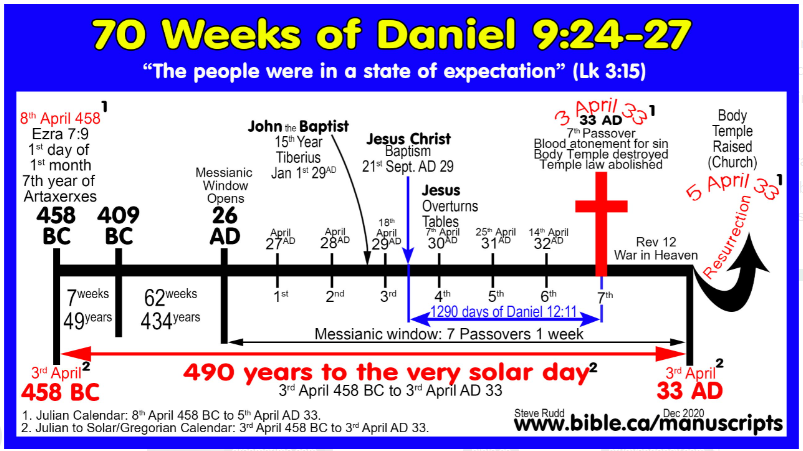
One of the most astonishing prophecies is Daniel’s 70 weeks (Daniel 9:24-27). Given around 538 BC, this vision outlines “seventy weeks” (or “sevens”) determined for the Jewish people to finish transgression, to make an end of sins, and anoint the Most Holy. Scholars widely interpret these as weeks of years; totaling 490 years. The prophecy begins “from the going forth of the command to restore and rebuild Jerusalem” until “Messiah the Prince.”
The clearest timing prophecy appears in Daniel 9:24–27. Daniel wrote during the Babylonian exile, yet he predicted the coming of “Messiah the Prince” with astonishing precision. He spoke of “seventy weeks” (symbolic weeks of years) counting from the decree to restore and rebuild Jerusalem. Daniel declares that after the sixty-nine weeks, “shall Messiah be cut off, but not for himself” (Daniel 9:26). This sets a specific window when the Messiah would appear and give His life as a sacrifice. History confirms that from the Persian decrees to rebuild Jerusalem to the first century AD fits Daniel’s prophetic timeline exactly; placing the arrival of the Messiah squarely at the time of Jesus of Nazareth. No other figure in history appears within that window fulfilling the works of the Messiah. That timing alone anchors our faith: God promised, and God delivered. Modern statisticians estimate 1 in 10^17 for Daniel’s Messianic prophecies alone.
Another key timing indicator is Genesis 49:10: “The scepter shall not depart from Judah, nor the lawgiver from between his feet, until Shiloh comes.” Jacob prophesied that Judah’s tribal authority would endure until the Messiah (“Shiloh,” meaning “He whose right it is”). Judah retained self-governance, including the right to execute capital punishment, until around AD 6-7, when Rome stripped the Sanhedrin of this power under Archelaus’ deposition. Jesus, from Judah’s line (Matthew 1:1-16; Luke 3:23-33), was crucified shortly after; precisely when the “scepter departed.” Had the Messiah come later, Judah would have lost its authority too soon.
The period between Malachi (c. 430 BC) and Jesus also aligns prophetically. After Haggai, Zechariah, and Malachi, a 400-year prophetic silence ensued; no major prophets arose in Israel. This “silence” heightened anticipation, as Malachi promised Elijah’s return before the great day of the Lord (Malachi 4:5-6). John the Baptist fulfilled this as the forerunner (Matthew 11:13-14; Luke 1:17), announcing Jesus. The silence ended exactly when the Messiah appeared.
These timings were no coincidence. The Roman Empire (also a predicted kingdom Dan 2:44) provided roads and peace (Pax Romana) for Gospel spread; Greek language unified communication; Jewish synagogues worldwide prepared diaspora hearts. Jesus came in the “fullness of time;” politically, culturally, and spiritually ripe.
Today, this evidence strengthens faith. If God orchestrated history with such precision (down to years and events) then Jesus is undeniably the Christ. He fulfilled not just timing prophecies, but many, many more: born in Bethlehem (Micah 5:2), of a virgin (Isaiah 7:14), from David’s line (2 Samuel 7:12-16). His life, death, and resurrection confirm the Old Testament’s promises.
Believer, take heart: Obeying the Gospel of the Kingdom of Christ is sound because history proves Jesus arrived at the predicted moment. The same God who timed the Messiah’s birth can be trusted for eternal life.
Agape
spencer
 Borger church of Christ @ Franklin & Juniper
John Goldingay was an Anglican Priest who taught at Fuller Theological Seminary for many years. He was a devout Christian scholar. He denies that Daniel 9 is talking about Jesus:
“In Jewish and Christian tradition, Gabriel’s promise has been applied to rather later events: the birth of the messiah, Jesus’ death and resurrection, the fall of Jerusalem, various subsequent historical events, and the still-future manifesting of the messiah. Exegetically such views are mistaken. The detail of vv 24–27 fits the second-century b.c. crisis and agrees with allusions to this crisis elsewhere in Daniel. The verses do not indicate that they are looking centuries or millennia beyond the period to which chaps. 8 and 10–12 refer. They do not suggest that the cleansing and renewal of which v 24 speaks is the cleansing and renewal of the world: it is the cleansing and renewal of Jerusalem. The passage refers to the Antiochene crisis.”Goldingay, J. E. (2002). Vol. 30: Word Biblical Commentary : Daniel. Word Biblical Commentary (Page 267). Dallas: Word, Incorporated.
So us unbelievers have an excuse: If spiritually alive Christians disagree with each other on whether Daniel 9 contains a chronologically intended prediction of Jesus, they are fools to “expect” spiritually dead unbelievers to read it and draw ‘correct’ conclusions. So unless God is irrational, then no, he does not expect spiritually dead people to find the Jesus-fulfillment-interpretation to have merit.
Thus I do nothing “wrong” when I find Daniel 9 to be about as worrisome as the Gospel of Thomas.
What are you asking? Do you want me to be an unbeliever also? You send many articles to “prove” me wrong. Tell me plainly what you want of me. I know what I want for you, to have faith in Jesus as the Christ and to obey the Gospel to your salvation. Obviously you’re unconvinced. So were many during the time of Christ and the inspired Apostles. Tell me plainly, why do you persist trying to convince me into unbelief, or do you have another agenda? (BTW, While I have respect for scholarship, I hold to the Scripture as final authority).
I am not trying to convince you of anything. I am merely trying to remind you and your readers that the conservative Christian viewpoint, which your articles are typically limited to, is not the only viewpoint that possesses reasonableness or merit.
For reasons known only to you, your “arguments” usually do little more than quote the bible and quote theologically conservative scholars for support.
In none of this, do I express or imply that your own position is unreasonable. I believe you can possibly be reasonable to be a follower of Jesus in the 21st century.
Instead, I merely show that a person can possibly be reasonable to disagree with your conclusions.
Reasonableness can possibly derive from accurate belief, of course, but my purpose is to show that reasonableness can often be achieved even if the belief in question is wrong. It is not true that to be “wrong” is to therefore necessarily harbor unreasonableness of some sort. Sometimes there is such a thing as a genuinely honestly mistake. Thus a person can possibly be wrong about a biblical issue, without being morally culpable.
You have a certain view of eschatology. Thus, you think the Christians who disagree with you on the point are wrong. Fair enough. But how likely would you be to insist they were also “unreasonable” merely because they were wrong? Not likely. You know perfectly well there is much scholarly disagreement about biblical eschatology, so if those other Christians are wrong to disagree with you on the matter, there may still exist a genuine possibility that they cannot be faulted.
Unless you are a bigot and presume that the only reason anybody ever rejects something in the bible is because they weren’t sufficiently sincere toward god, or didn’t pray enough, or had secret unconfessed sins, or were never genuinely born-again, etc, etc, (and I don’t see you as that bigoted), then you must agree with me in principle that the fact that the gospel-rejecter is “wrong”, does not automatically necessitate that she is unreasonable.
Can you think of plausible situations in which an atheist, after hearing the true gospel, could nevertheless be reasonable to reject it?
Or do you deny any such possible reasonableness, on the grounds that the truth of the gospel is equally as indisputable as the truth of the existence of cars?
Is the “truth” of your faith so obvious that only irrational hatred of god could possibly explain refusal to repent upon hearing the gospel?
If both sides would learn that “you are unreasonable” is most often inappropriate coming from either side, we might succeed in dialing down the bitterness that characterizes 98% of Christian apologetics debates. Your articles, by arguing only the “truth” of the conservative Christian position, give the impression that such position is also the only “reasonable” one…thus contributing to the vitriolic nature of debates between Christians and non-Christians.
But I don’t know, maybe you’ll respond that God wants such debates to be full of “righteous indignation”, because in this you are “rebuking the devil”, who deserves no mercy? If that’s how you seriously feel, then my arguments for reasonableness will mean nothing to you, they will only be meaningful to Mike Licona, Frank Turek, Sean McDowell, Tim McGrew, Craig Blomberg and the vast majority of conservative Christian scholars and apologists today who are forever talking about whether it is “reasonable” to be a Christian.