Illustrating Colossians 3:17.

Doing All in the NAME of the Lord.

And whatsoever ye do in word or deed, do all in the name of the Lord Jesus, giving thanks to God and the Father by him.” (Col 3:17)

This verse encapsulates the essence of living a life fully devoted to Christ. It means more than just offering lip service or superficial honor to God; it demands genuine obedience to His commands in every aspect of our lives. To fully understand this, let us explore scriptural examples where individuals desired to honor God but failed to keep His commandments, thus illustrating the true meaning of doing all in the name of the Lord.

Nadab & Abihu:

A Cautionary Tale. Leviticus 10:1-2 provides a stark example of what happens when individuals seek to honor God without adhering to His explicit instructions. Nadab and Abihu, the sons of Aaron, offered “strange fire before the Lord, which he commanded them not.” Despite their likely intentions to honor God, their offering was contrary to His command, and as a result, fire came out from the Lord and consumed them. This incident underscores the critical importance of obedience. Honoring God is not just about good intentions; it requires strict adherence to His directives.

Saul’s Amalekite Error.

Another poignant example is King Saul’s disobedience in 1 Samuel 15. God commanded Saul to utterly destroy the Amalekites and all their possessions. Instead, Saul spared King Agag and kept the best of the livestock, justifying his actions by claiming that the animals were preserved for sacrifice to the Lord (1Samuel 15:15). However, Saul’s partial obedience was deemed rebellion. Samuel rebuked him, stating, “Behold, to obey is better than sacrifice, and to hearken than the fat of rams” (1Samuel 15:22). Saul’s failure highlights that honoring God involves complete obedience to His commands, not selective adherence.

Well Meaning Uzzah.

In 2 Samuel 6, we read about Uzzah, who, in a well-meaning effort to honor God, reached out to steady the Ark of the Covenant when the oxen stumbled. Despite his intentions, he violated God’s command that no one should touch the Ark (Numbers 4:15). As a result, Uzzah was struck dead by God (2Samuel 6:7). This account demonstrates that good intentions are not enough when they lead to disobedience. Honoring God requires respecting and following His specific instructions even under extreme circumstance.

The Errors of the Pharisees.

The Pharisees in the New Testament provide a further illustration of misplaced honor. They meticulously followed traditions and outward rituals, believing they were honoring God. However, Jesus criticized them for neglecting the more important matters of the law—justice, mercy, and faithfulness (Matthew 23:23). Their focus on external observance rather than heartfelt obedience and adherence to God’s true commands showed that they were not truly honoring God in their actions.

Jesus Himself addressed the importance of true worship in Matthew 15:8-9, quoting Isaiah: “This people draweth nigh unto me with their mouth, and honoureth me with their lips; but their heart is far from me. But in vain they do worship me, teaching for doctrines the commandments of men.” Here, Jesus condemns those who appear to honor God outwardly but fail to adhere to His commands, substituting human traditions for divine instructions. True worship, according to Jesus, is rooted in obedience to God’s word.

Applying Colossians 3:17 Today.

For believers today, Colossians 3:17 is a call to full obedience. It challenges us to ensure that every word and deed aligns with God’s will as revealed in Scripture. It is not enough to perform acts of worship or service with good intentions if those acts are not grounded in obedience to God’s commands.

For instance, when it comes to worship practices, evangelism, or daily living, our actions must be rooted in biblical directives. Doing everything in the name of the Lord means we act under His authority and guidance, ensuring our lives reflect His teachings and commands.

Colossians 3:17 reminds us that honoring God involves more than mere intention or lip service. It requires a heart and life fully committed to obeying His will. True honor to God is found in faithful obedience to His word. Let us strive to do all in the name of the Lord, giving thanks to God and living in full submission to His divine will.

Agape,

Spencer

This is part 4 of a series of lessons on the Duties of Saints, pt1

Here is part 4 on the Duties of Saints.

What is the Value of your Soul?

For what shall it profit a man, if he shall gain the whole world, and lose his own soul? Or what shall a man give in exchange for his soul?” (Mark 8:36-37).

The question of the soul’s worth is one that transcends time and culture, touching the very essence of human existence. Jesus Himself addressed this profound query in Mark 8:34-38 and Matthew 16:24-26, challenging us to consider the eternal value of our souls. Let us explore four pivotal aspects that underscore the immeasurable worth of a soul.

As living souls, we have much greater potential than all others of God’s creation. Technology, Arts, and Mercy are unique to humans. More than these, we have the potential to become like Christ. “So also is the resurrection of the dead. It is sown in corruption; it is raised in incorruption: It is sown in dishonour; it is raised in glory: it is sown in weakness; it is raised in power: It is sown a natural body; it is raised a spiritual body. There is a natural body, and there is a spiritual body” (1Cor 15:42-44). When we obey the gospel, we look forward to eternal life with our Savior and to see Him as He is, (cf. Rev 22:4).

In Matthew 10:28, Jesus admonishes, “And fear not them which kill the body, but are not able to kill the soul: but rather fear him which is able to destroy both soul and body in hell.” This declaration underscores the eternal nature of the soul, distinguishing it from our temporal physical bodies. The body may perish, but the soul endures beyond the grave, facing either eternal life or eternal punishment as stated in Matthew 25:46: “And these shall go away into everlasting punishment: but the righteous into life eternal.”

The everlasting nature of the soul is a solemn reminder of its infinite value. Our earthly concerns often distract us from this reality, yet Jesus calls us to prioritize our spiritual well-being. The choices we make in this life have eternal consequences, emphasizing the need for a life aligned with God’s will.

Jesus highlighted the incomparable worth of a soul by pointing to God’s providence over creation. In Matthew 6:26-30, He illustrates His care for the birds and the flowers, reminding us that we are of far greater value: “Are ye not much better than they?” Jesus also said that “the very hairs of your head are all numbered” (Matt 10:30). These passages underscore the unique and cherished place humanity holds in God’s creation.

I am fearfully and wonderfully made” (Psalm 139:14). This divine craftsmanship reflects the soul’s worth, a masterpiece of God’s creative power. Unlike the rest of creation, the human soul bears a unique value.

The soul’s worth is further magnified by its divine origin. Acts 17:29 declares, “Forasmuch then as we are the offspring of God, we ought not to think that the Godhead is like unto gold, or silver, or stone, graven by art and man’s device.” We are not merely physical beings but spiritual offspring of God, created in His image.

Genesis 1:26-27 records God’s decision to create humanity in His likeness, endowing us with attributes that reflect His nature: “And God said, Let us make man in our image, after our likeness.” The Preacher reminds us that at death, “Then shall the dust return to the earth as it was: and the spirit shall return unto God who gave it” (Ecc 12:7). The soul’s divine origin and destiny underscore its unparalleled worth, calling us to live in a manner that honors our Creator.

The ultimate measure of the soul’s worth is found in the sacrifice of Jesus Christ. John 3:16, perhaps the most well-known verse in the Bible, proclaims, “For God so loved the world, that he gave his only begotten Son, that whosoever believeth in him should not perish, but have everlasting life.” This profound act of love underscores the soul’s value, worthy of the highest price (cf. Rom 5:8-10).

2Peter 3:9 emphasizes God’s desire for our salvation, stating, “The Lord is not slack concerning his promise, as some men count slackness; but is longsuffering to us-ward, not willing that any should perish, but that all should come to repentance.” The sacrificial death of Christ on the cross is the ultimate testament to the worth of our souls, offering us redemption and eternal life.

In contemplating the worth of a soul, we must recognize its eternal nature, its unparalleled value in creation, its divine origin, and the supreme sacrifice made for its salvation. As we reflect on these truths, let us heed Jesus’ call in Mark 8:34-38 and Matthew 16:24-26 to deny ourselves, take up our cross, and follow Him. For in doing so, we affirm the immeasurable worth of our souls and align our lives with God’s eternal purpose.

Agape,
Spencer

This article is from a series of sermons on the Gospel of Mark. Click here for the list of available articles on the Gospel of Mark.

Duties of SAINTS


The letter to the Colossians, penned by the Apostle Paul, serves as a profound guide for Christian living. In Colossians 3:1-4:6, Paul outlines the duties of saints, offering a roadmap for believers to follow. These duties can be encapsulated in six main directives: Seek things above, Abolish sin, Implement virtues, Act in the Name of the Lord, Treat your family well, and Serve with steadfastness.

Seek Things Above
(Colossians 3:1-4)

Paul begins by urging believers to set their minds on things above, where Christ is seated at the right hand of God. This heavenly focus requires a shift from earthly desires to a pursuit of spiritual growth and eternal truths. As Christians, our lives are hidden with Christ in God, and our ultimate hope is in His return and our future glory with Him. This perspective not only shapes our priorities but also transforms our daily actions, aligning them with God’s eternal purposes.

Abolish Sin (Colossians 3:5-9)
The next step is to mortify, or put to death, sinful behaviors. Paul specifically mentions immorality, impurity, passion, evil desire, and greed. These vices are part of the old self, which believers are to shed. Additionally, anger, wrath, malice, slander, and obscene talk must be eradicated from our lives. By abolishing these sins, we break free from their destructive power and align ourselves with God’s holiness (cf 1Pet 1:16).

Implement Virtues
(Colossians 3:10-14)

Having discarded the old self, Paul instructs us to put on the new self, which is being renewed in knowledge after the image of its Creator. This new self is characterized by virtues such as compassion, kindness, humility, meekness, and patience. Forgiveness and love are paramount, with love binding all these virtues together in perfect harmony. These qualities reflect the character of Christ and foster a spirit of unity and peace within the church.

Act in the Name of the Lord
(Colossians 3:15-17)

In every action, whether in word or deed, believers are to do everything in the name of the Lord Jesus, giving thanks to God the Father through Him. This command underscores the importance of living a life that seeks the authority of Christ in all circumstances. The peace of Christ should rule in our hearts, and the word of Christ should dwell richly among us, teaching and admonishing one another with wisdom. Our lives become a model of God’s grace and truth when we consistently act in His name.

Treat Your Family Well
(Colossians 3:18-21)

Paul then addresses family relationships, emphasizing the importance of treating each other well. Wives are called to submit to their husbands as is fitting in the Lord, and husbands are instructed to love their wives and not be harsh with them. Children are to obey their parents in everything, as this pleases the Lord, while fathers are cautioned not to provoke their children, lest they become discouraged. These instructions promote faithfulness to God and love within the home, reflecting God’s design to lead them to heaven.

Serve with Steadfastness
(Colossians 3:22-4:6)

Finally, Paul speaks to servants and masters, urging them to serve and lead with integrity and devotion. Servants are to obey their earthly masters with sincerity of heart, as if serving the Lord, while masters are to treat their servants justly and fairly, knowing they too have a Master in heaven. This principle extends to all areas of life, encouraging believers to serve wholeheartedly, remain steadfast in prayer, and conduct themselves wisely towards outsiders, making the most of every opportunity.

Conclusion
The duties outlined in Colossians 3:1-4:6 provide a comprehensive framework for Christian living. By seeking things above, abolishing sin, implementing virtues, acting in the name of the Lord, treating our families well, and serving with steadfastness, we fulfill our calling as saints. These principles guide us to live lives that are pleasing to God, edifying to the church, and impactful to the world around us. May we, as followers of Christ, diligently pursue these duties, growing in faith and reflecting the glory of our Savior in all we do.

GOD is the Genesis, Owner, & Definer

In the beginning, God created the heavens and the earth” (Genesis 1:1).

This statement is a foundational truth that establishes God’s existence and His unparalleled power. As Creator, God brought everything into being out of nothing, speaking life and order into the void. The intricate design of the universe, from the vast galaxies to the smallest particles, testifies to His wisdom and omnipotence. This truth is said also of Jesus, “For by him were all things created, that are in heaven, and that are in earth, visible and invisible, whether they be thrones, or dominions, or principalities, or powers: all things were created by him, and for him” (Col 1:16). But some do not recognize the Creator, “Who is the LORD, that I should obey his voice to let Israel go? I know not the LORD…” (Exo 5:2_

Everything that exists owes its existence to Him. This includes not only the physical universe but also the moral and spiritual dimensions of life. Since He is the source of all life, He possesses an inherent authority over His creation.

Because God is the Creator, He is also the Owner of all that He has made. Psalm 24:1-2 proclaims, “The earth is the Lord’s, and everything in it, the world, and all who live in it; for he founded it on the seas and established it on the waters.” Ownership implies a deep and comprehensive authority. Just as an artist has rights over their masterpiece, God has the ultimate right and claim over His creation.

God’s ownership extends to every aspect of our lives. Our talents, resources, and even our very breath belong to Him. This perspective shifts our focus from self-centered living to a life that honors and glorifies Him. But some would not honor Him, “Because that, when they knew God, they glorified him not as God, neither were thankful” (Rom 1:21a).

Flowing from this truth that God is Creator and Owner, He possesses the sole right to define and decide what is right, just, and necessary for salvation. This divine prerogative is evident throughout Scripture. In Isaiah 45:9, the prophet declares, “Woe to those who quarrel with their Maker… Does the clay say to the potter, ‘What are you making?’” This rhetorical question highlights the absurdity of creation questioning its Creator.

God’s authority encompasses defining moral and ethical standards. In a world rife with moral relativism, God’s Word stands as the absolute standard. His laws and commandments, revealed through Scripture, are not arbitrary rules but reflections of His holy and righteous character.

Moreover, God’s authority extends to the realm of salvation. Throughout the Bible, He has clearly delineated the path to reconciliation with Him. The New Testament emphasizes that salvation is through Jesus Christ alone. In John 14:6, Jesus asserts, “I am the way and the truth and the life. No one comes to the Father except through me.” This exclusivity underscores God’s right to determine the means by which humanity can be saved. But some say that salvation can be found another way, “And when they heard of the resurrection of the dead, some mocked” (Acts 17:32). For some, the gospel is foolishness, (1Cor 1:18).

Understanding God as the ultimate authority challenges us to submit to His will and to obey the gospel (Mark 16:16; Acts 2:38). We trust His wisdom, even when it contradicts our limited understanding or societal norms.

Agape,

Spencer

Titus, a fine example of service

To Titus, mine own son after the common faith: Grace, mercy, and peace, from God the Father and the Lord Jesus Christ our Saviour.” (Titus 1:4)

The New Testament offers us many exemplary figures whose lives embody the teachings and values of Christ. One such figure is Titus, a close companion of the Apostle Paul, who stands as a shining example of what it means to be a true child of God. As we strive to live out our faith, examining the life of Titus can provide us with valuable insights and inspiration.

In a world where actions speak louder than words, the life of Titus provides clear evidence of a true follower of Christ. Paul’s confidence in Titus is evident in 2 Corinthians 8:23, where he refers to Titus as “my partner and fellowhelper concerning you.” This statement alone speaks volumes about the character and dedication of Titus. He was not just a believer in name but one whose actions and commitment were evident to all who knew him.

Christians today, must continue to ensure that our lives provide similar evidence of our faith. Are we known as partners and workers for the benefit of the gospel? Do our actions consistently reflect our commitment to Christ?

Titus was entrusted with significant responsibilities within the early church. Paul sent him to various challenging assignments, including dealing with difficult issues in the church at Corinth, and “ordain elders in every city” in Crete. Such trust from Paul indicates Titus’s reliability and dedication to the work of the Lord.

Trust is built over time through consistent and faithful actions. We must also be trustworthy stewards of God. “Moreover it is required in stewards, that a man be found faithful” (1Cor 4:2). Our reliability in carrying out God’s work is a testament to our faith and commitment.

Titus demonstrated unwavering faithfulness in his service to the Lord. He faced numerous challenges and opposition but remained steadfast. “But neither Titus, who was with me, being a Greek, was compelled to be circumcised” (Gal 2:1-3). Unwavering faithfulness means holding fast to the word of God, even when it is difficult. It means standing firm in our faith amid a world that often promotes contrary values. Just as Titus remained faithful despite opposition, we too must be resolute in our commitment to Christ, trusting that our perseverance is pleasing to God.

One of the most admirable qualities of Titus was his sincerity in service. Paul speaks of Titus’s genuine care and concern for the well-being of the believers. “But thanks be to God, which put the same earnest care into the heart of Titus for you” (2Cor 8:16). He genuinely cared for the church.

Sincere service is rooted in love and genuine concern for others. This means serving without seeking personal gain or recognition, serving out of a heartfelt desire to please God, to help and uplift others. Sincere service is a powerful demonstration of God’s love at work within us (cf. 1John 4:7-8).

The example of Titus provides a powerful blueprint for how we should live as true children of God. Our faith should be evident in our actions, as we build trust through our reliability and dedication to God’s work. We must remain unwavering in our faith, standing firm against opposition.

Agape,

Spencer

Jeroboam REPLACED the worship

“Here are your gods, Israel, who brought you up out of Egypt.” (1Kings 12:28)

Jeroboam, the first king of the northern kingdom of Israel, initiated a series of significant changes that altered the course of worship for his people. His actions were driven by political motives rather than spiritual fidelity, leading to the establishment of a false system of worship that had long-lasting ramifications.

Replacing the Place, Object, and Priests of Worship

His primary objective was to prevent his subjects from traveling to Jerusalem, in the southern kingdom of Judah, for worship. He feared that such pilgrimages would foster loyalty to the house of David and threaten his own reign. To counter this, Jeroboam replaced the central place of worship and also substituted the object of worship with idols. He also appointed non-Levitical priests to serve, undermining the divinely ordained priesthood.

The Enduring Error of Jeroboam

Jeroboam’s innovations did not end with his reign but extended into the next generations. His establishment of idolatrous practices became a stumbling block for the northern kingdom of Israel. Kings who followed Jeroboam perpetuated these errors, leading the people further away from true worship. The legacy of Jeroboam’s apostasy was so significant that it became a standard by which the sins of Israel’s kings were measured (1Kings 16:26).

The Idolatrous Practices of Ahab and Jezebel

The reign of Ahab and his queen, Jezebel, marked a further decline in the spiritual state of Israel. Jezebel introduced the worship of Baal and Asherah into Israel, practices that were abominable to the Lord. Ahab provoked the Lord more than all the kings of Israel before him (1Kings 16:31-33).

The Lord’s disapproval on Mount Carmel

The prophet Elijah emerged as a powerful voice against the rampant idolatry. In one of the most dramatic confrontations recorded in Scripture, Elijah challenged the prophets of Baal on Mount Carmel. He called upon the Lord to demonstrate His sovereignty, and God responded with fire from heaven, consuming Elijah’s sacrifice (1Kings 18:36-39). This miraculous event underscored the Lord’s disapproval of Israel’s idolatry and called the people back to genuine worship.

Prophetic Admonishment and Call for Repentance

Despite Elijah’s victory, the prophets continuously admonished Israel to repent. The persistent call for repentance echoed throughout the ministries of subsequent prophets, yet the people remained obstinate. Their refusal to abandon false worship led to their downfall (see Hos 8:4-6; Amos 4:4-5).

The Consequences of Continued Apostasy

Israel’s continued apostasy ultimately resulted in their captivity. In 722 BC, the Assyrians conquered the northern kingdom, scattering the ten tribes and bringing an end to the Northern Kingdom. The seeds of their destruction were sown by Jeroboam’s initial departure from true worship.

The Persistence of Errors in Judah

In the southern kingdom of Judah, despite periodic reforms, such as those under King Josiah, errors persisted. Josiah’s reforms were extensive, yet they could not completely eradicate the entrenched practices of idolatry.

Nehemiah’s Acknowledgment of Persistent Disobedience

Centuries later, Nehemiah reflected on Israel’s history of disobedience and idolatry. In his prayer, he acknowledged the persistent sinfulness that had plagued the nation, attributing their suffering to their unfaithfulness (Nehemiah 9:26-37). Nehemiah’s reflection underscores the long-lasting impact of Jeroboam’s initial errors, demonstrating that false worship and disobedience to God’s commands lead to severe consequences.

Conclusion

The establishment of false worship by Jeroboam in 1Kings 12:25-33 had long-lasting effects on the northern kingdom of Israel. This sin was perpetuated by subsequent kings and contributed to the spiritual decline of Israel. Prophets repeatedly condemned these practices and called for repentance, but the people’s persistence in idolatry ultimately led to their downfall and exile. The enduring influence of Jeroboam’s sin is a stark reminder of the consequences of deviating from God’s commands.

Agape,
Spencer

Lest we DRIFT away, Heb 2:1-3

Therefore we ought to give the more earnest heed to the things that were heard, lest haply we drift away from them. For if the word spoken through angels proved stedfast, and every transgression and disobedience received a just recompense of reward; how shall we escape, if we neglect so great a salvation?” (Heb 2:1-3a ASV)

In the swiftly changing currents of life, it is all too easy to drift away from the secure anchor of hope, “which we have as an anchor of the soul, a hope both sure and stedfast and entering into that which is within the veil” (Heb 6:19).

Let us explore five guiding principles from the book of Hebrews that can help us avoid spiritual drift and ensure our steadfastness in the faith.

The first one is found in Hebrews 6:11, “And we desire that each one of you may show the same diligence unto the fulness of hope even to the end.”

Think of diligence as the steady hand guiding the helm of a ship through treacherous waters. It is not enough to start well; we must persist, with our eyes fixed on the horizon of God’s promises.

Hebrews 4:11 exhorts us, “Let us labour therefore to enter into that rest, lest any man fall after the same example of unbelief.” The necessity of constant effort to avoid spiritual shipwreck is a recurring theme (Hebrews 10:22; 12:1). Are we laboring earnestly, or merely drifting along?

Reading and studying the Bible is the second way we will be able to remain on course, avoiding drift. The writer reminds us, “For the word of God is quick, and powerful, and sharper than any twoedged sword” (Heb 4:12). To avoid drift we must become skilled in the word. Hebrews 5:12-6:8 reveals the peril of spiritual immaturity and the dire consequences of neglecting the deeper teachings of Christ. Is our Bible a well-worn map or an unused artifact?

Another aid in avoiding drift is imitation which calls us to follow the examples of those who have walked the path of faith before us. Hebrews 6:12 instructs us to be “followers of them who through faith and patience inherit the promises.” We should emulate the faithful who have demonstrated unwavering trust in God. Consider the heroes of faith outlined in Hebrews 11. Their lives serve as beacons, illuminating the way for us to follow. By imitating their faith and perseverance, we reinforce our commitment to Christ. Whose shipping lane are we following today? (1Cor 11:1; 3John 11)

A healthy reverence for God is the fourth in our efforts to maintain our spiritual course. Hebrews 4:1 warns, “Let us therefore fear, lest, a promise being left us of entering into his rest, any of you should seem to come short of it.” Godly fear keeps us vigilant. It reminds us of the gravity of our salvation and the importance of living in a manner worthy of our calling. Does our reverence for God inspire vigilance or apathy?

Finally, we ought to take heed. Taking heed requires self-awareness and caution. Hebrews 3:12 cautions, “Take heed, brethren, lest there be in any of you an evil heart of unbelief, in departing from the living God.” The vigilance of the watchman who stands in the crow’s nest of the ship is akin to the spiritual alertness we must maintain to remain on course. By taking heed, we guard against the drift caused by doubt and sin. Are we watchful or wandering?

Let us heed the wisdom of Hebrews and apply these principles diligently. Through our earnest efforts we anchor our souls firmly in Christ, avoiding the perilous drift that leads away from so great a salvation.

Agape,

Spencer

John 3:16, the greatest verse

The Greatest Being

The verse begins with “FOR GOD.” The verse begins with the greatest being in existence. In Genesis 1:1, we read, “In the beginning, God created the heavens and the earth.” God is the Creator, the Alpha and the Omega, the beginning and the end. John 1:1-3 tells us, “In the beginning was the Word, and the Word was with God, and the Word was God. The same was in the beginning with God. All things were made by him; and without him was not any thing made that was made.” Job 38-41 presents a majestic depiction of God’s power and wisdom. Our faith rests upon the foundation of this greatest being, who is sovereign over all creation.

The Greatest Thing

Next, we see the greatest thing: “SO LOVED.” God is love. In 1Corinthians 13:13, we learn that “the greatest of these is love.” 1John 4:8 declares, “He that loveth not knoweth not God; for God is love.” God’s love is unparalleled and incomprehensible. It is a love that is willing to sacrifice, a love that seeks the well-being of others. It is the greatest thing because it defines the actions of the greatest being.

The Greatest Number

“THE WORLD.” This phrase encompasses the greatest number: the entire world. God’s love is not limited to a select few but extends to every person on this earth. 2Peter 3:9 states, “The Lord is not slack concerning his promise, as some men count slackness; but is longsuffering to us-ward, not willing that any should perish, but that all should come to repentance.” 1Timothy 2:4-6 reinforces this by saying, “Who will have all men to be saved, and to come unto the knowledge of the truth.” 1John 2:2 confirms that “And he is the propitiation for our sins: and not for ours only, but also for the sins of the whole world.” The greatest number shows the expanse of God’s love. God is not a respecter of persons (Rom 2:11).

The Greatest Gift

“THAT HE GAVE HIS ONLY BEGOTTEN SON.” In this we see the greatest gift. Ephesians 2:8 reminds us that “For by grace are ye saved through faith; and that not of yourselves: it is the gift of God.” Hebrews 2:9 tells us, “But we see Jesus, who was made a little lower than the angels for the suffering of death, crowned with glory and honour; that he by the grace of God should taste death for every man.” 2Corinthians 9:15 exclaims, “Thanks be unto God for his indescribable gift!” The greatest gift (grace) is God’s own Son, given for the redemption of mankind.

The Greatest Faith

“THAT WHOSOEVER BELIEVETH IN HIM.” This phrase highlights the greatest faith. Jesus declares in John 8:24, “I said therefore unto you, that ye shall die in your sins: for if ye believe not that I am he, ye shall die in your sins.” Hebrews 3:18-19 warns of the consequences of unbelief as seen through disobedience, while Hebrews 11:6 teaches that “without faith it is impossible to please God.” The greatest faith is an active belief in Jesus Christ as the Son of God and the Savior of the world (James 2:14-26).

The Greatest Loss

“SHOULD NOT PERISH.” The greatest loss is the eternal separation from God. While any can be saved, the bible tells us that not all will obey the Gospel (Matt 7:24-29; 2Thess 1:8-9). Matthew 25:46 warns of “everlasting punishment,” and John 5:29 speaks of those who will “resurrection of damnation.” The story of the rich man and Lazarus in Luke 16:19-31 vividly portrays the torment of those who perish. 2Corinthians 5:10 reminds us that “we must all appear before the judgment seat of Christ.” The greatest loss is the eternal consequence of rejecting God’s gift of salvation.

The Greatest Difference

“BUT.” While all may be saved, some won’t obey the gospel. “And being made perfect, he became the author of eternal salvation unto all them that obey him” (Heb 5:9). Some will hear, but not do; “Therefore whosoever heareth these sayings of mine, and doeth them, I will liken him unto a wise man, which built his house upon a rock: And the rain descended, and the floods came, and the winds blew, and beat upon that house; and it fell not: for it was founded upon a rock. And every one that heareth these sayings of mine, and doeth them not, shall be likened unto a foolish man, which built his house upon the sand: And the rain descended, and the floods came, and the winds blew, and beat upon that house; and it fell: and great was the fall of it.” (Matt 7:24-27). Many may confess Jesus as Lord and Savior, but not do what He says, “And why call ye me, Lord, Lord, and do not the things which I say” (Luke 6:46)?

The Greatest Blessing

“HAVE EVERLASTING LIFE.” Finally, we come to the greatest blessing. 1Thessalonians 4:13-18 describes the hope of the resurrection and the promise of eternal life with Christ. Everlasting life is the ultimate blessing, the fulfillment of God’s promise to those who believe.

John 3:16 is a verse that reveals to us the greatest being, the greatest thing, the greatest number, the greatest gift, the greatest faith, the greatest loss, and the greatest blessing. Let us hold fast to this truth, share it with others, and walk in the light of God’s incredible love and grace.

Agape, Spencer

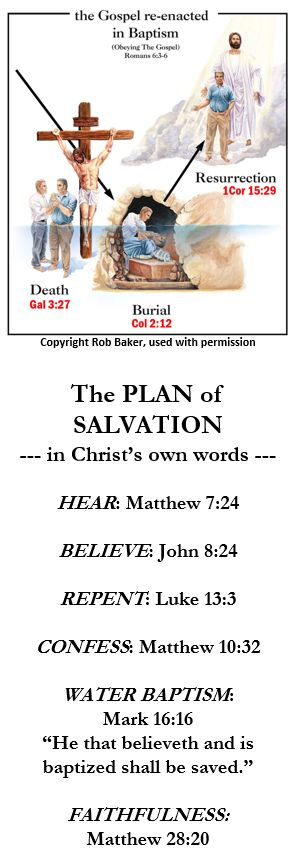
How to be saved according to the Bible

People often appeal to single passages on how to be saved, but ignore an entire book in the New Testament that shows people going from a lost condition to being saved. That book is called ACTS. It contains the founding of the church of Christ at Pentecost, and the conversion of the lost to salvation in Christ Jesus.

1. The first of these conversions happened on the notable day of Pentecost when the church was established. The text (Acts 2:14) shows that they had the Gospel preached to them; they heard (vv. 36-37); they repented of their sins (v. 38); and they were baptized into Christ (v. 38). The result was that they had their sins washed away. 

2. In Acts 8:4-5, Phillip preached to the people of Samaria; they heard (v. 6); they were baptized (v. 12).

3. Phillip also preached to Simon (Acts 8:4-5); he heard the Gospel (v. 6); he was baptized (v. 13).

4. Phillip preached to the Eunuch (Acts 8:35-39); he made the good confession (v. 37); he was baptized (v. 38) and rejoiced in the forgiveness of his sins (v. 39).

5. Ananias preached to Saul, later called Paul (Acts 9:17); he was baptized (Acts 22:16), and the rest of his life he taught others to do the same (I Cor. 12:13).

6. Peter preached to Cornelius (Acts 10:34-35); he and his family heard (v. 44); they repented of their sins (Acts 11:18); they were baptized (v. 48). They were saved (Acts 11:14).

7. Paul preached the saving message to Lydia on his second missionary journey (Acts 16:13); she heard (v. 14); she was baptized (v. 15).

8. Paul preached to the Jailor (Acts 16:32); he repented (v. 33); he was baptized (v. 33).

9. Paul preached to and converted souls at Corinth (Acts 18:5); they heard (v. 8); they were baptized (v. 8).

10. Paul preached to Crispus (Acts 18:5); though it is not recorded in the book of Acts that he was baptized, he was baptized according to Paul’s writing to the Corinthian church (1Cor. 1:14).

11. The Ephesians had the Gospel preached to them (Acts 19:8); they heard the message of salvation (Eph. 1:13). They were baptized (Acts 19:5) and were in this way saved by grace (Eph. 2:8-10).

agape,

spencer

Here is a link to another article on the conversions in Acts.

Joseph: the man God chose to raise His Son.

The Man God chose to Raise His Son.

Joseph’s life and actions, as depicted in the Gospels, offer an example of virtue and obedience, qualities that emphasize his critical role in the life of Jesus.

Described in the Gospel of Matthew as a “just man” (Matthew 1:19), Joseph’s character is first revealed through his merciful reaction to Mary’s unexpected pregnancy. Engaged to Mary, he discovers she is pregnant before they have come together, and knowing the child is not his, he faces a societal and personal crossroad. He chooses a path of kindness, intending to spare Mary from possible humiliation or harm, which alone sets a significant tone for his character.

Later, He is visited by an angel in a dream, instructing him to not fear taking Mary as his wife because the child conceived in her is from the Holy Spirit (Matthew 1:20). His response to this divine intervention highlights another of his virtues: obedience. Matthew 1:24-25 tells us that Joseph did as the angel of the Lord commanded; he took Mary as his wife and named the child Jesus. This act of faith and submission to God’s will shows him as a man deeply committed to following God’s direction without hesitation.

Later, he and Mary bring Jesus to the temple to present Him to the Lord as prescribed in the Law of Moses (Luke 2:22-24), and they make the annual pilgrimage to Jerusalem for Passover, demonstrating his commitment to his faith and his role as a spiritual guide to his family (Luke 2:41-43).

Joseph’s profession as a carpenter, mentioned in Matthew 13:55, underscores his role as a provider who earns a living for his family. Moreover, the offering described in Luke 2:24, “a pair of doves or two young pigeons,” which was allowed for those who could not afford a lamb, indicates that Joseph’s means were limited, yet he did what was necessary within his resources to fulfill his service to God (cf. 1Tim 5:8).

When Herod seeks to kill the newborn Jesus in Matthew 2:13-23, Joseph again heeds an angelic warning in a dream, this time to flee to Egypt, and later, to return to Nazareth, safeguarding his family from harm. These episodes not only portray him as a decisive protector but also as a man of action who places the safety and well-being of Mary and Jesus above his own comfort and security.

Lastly, Joseph’s honorable acceptance to adopt Jesus as his own son seals his legacy as a man of immense faith and virtue. This act of adoption was not merely a legal formality but a wholehearted acceptance of Jesus into his life, treating Him as his own and providing for Him as any father would, so that all knew Jesus as the son of Joseph and Mary. “And they said, Is not this Joseph’s son” (Luke 4:22; cf; John 6:42)?

Joseph’s life, therefore, offers a remarkable model of justice, obedience, scriptural fidelity, diligent earning, protection, and honor. In the grand narrative of Christianity, Joseph might often be seen in the background, but his influence and guidance were surely foreground in the early life of Jesus, the Savior of mankind. Through Joseph’s exemplary character, we see the qualities that God values in those He chooses.

Agape,

Spencer