What about the Thief on the Cross?

what about the thief

Folks will use many reasons to take away the command by our Lord to be baptized. The one heard most commonly by me is, “What about the thief on the cross?” This one is offered by those who have a little biblical knowledge, and by those who’ve heard it before, but have never been challenged with scriptural evidence.

THE ARGUMENT goes like this; “If, as you say, baptism is necessary for salvation, then what about the thief on the cross? He was never baptized, yet the Lord said, “To day shalt thou be with me in paradise.” Baptism is not necessary to salvation, because the thief could not obey that command, yet the Lord said he would be in paradise.” [Lu 23:43]

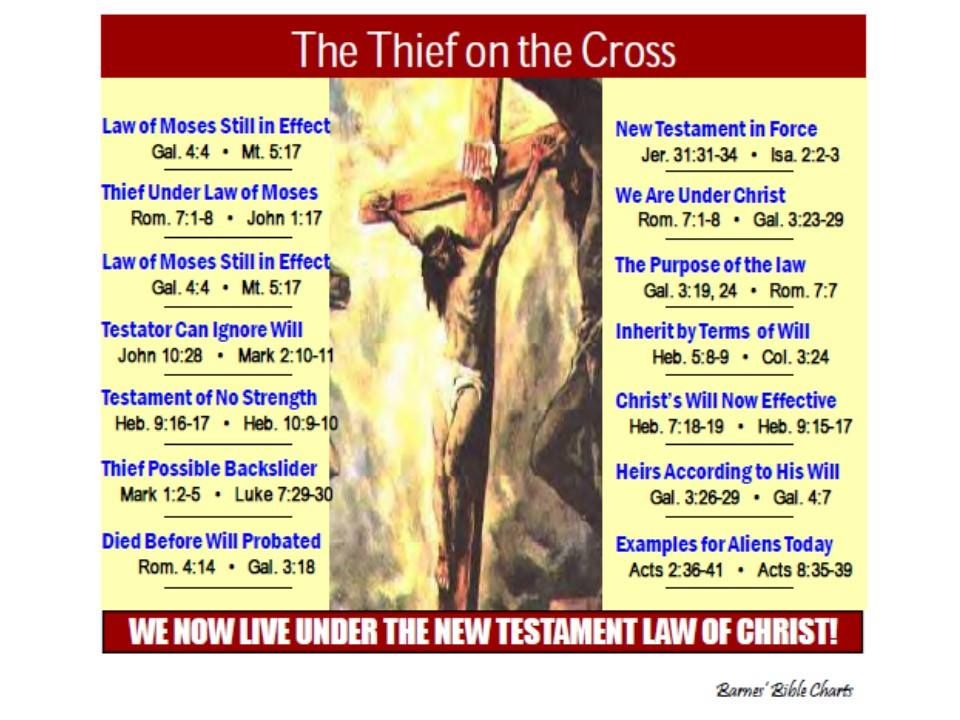
The Scriptures examined: The real issue pertains to a crucial feature of Bible interpretation, are we to take all 66 books of the Bible and take everything that is said and apply it directly and equally to everyone? The Bible is literally filled with commands, instructions, and requirements that were not intended to be duplicated by people living today. People are amenable to the law period under which they lived. [2Timothy 2:15]. There are three dispensations found in the Scriptures:

  • The Patriarchal Dispensation – From creation, everyone was subject to a body of legislation passed down by God through the fathers of family clans (cf. Hebrews 11:1), until the giving of the Law of Moses.
  • The Mosaic Dispensation – At Mt. Sinai, Moses was given a new Law from God and Jews were subject to that body of legal information [Law of Moses] from that time until it also was terminated at the cross of Christ. Consider the following passages:[Matthew 27:51; Romans 2:12-16; Galatians 3:7-29; Ephesians 2:11-22; Colossians 2:11-17]
  • The Christian Dispensation – After Jesus’ death on the Cross, all peoples are now amenable to the Law of Christ. [Galatians 6:2]
Now that we have this background information, let’s examine the reasons which make their argument invalid:

Reason #1– The Law of Moses was still in effect. Many folks are confused when reading the Gospels for it is commonly called, “The New Testament.” However, the majority of the gospel story in Matthew, Mark, Luke & John, take place while Jesus was alive and living as a Jew subject to the Law of Moses.

Jesus was born to a Jewish family under the Law [Mat 1; Luke 3; Ga 4:4], circumcised the 8th day [Lu 2:21], observed the Passover [Lu 2:41, 22:8-20], taught people to follow the Law [Matthew 5:23-24; 8:4], and followed the Law Himself [Matthew 5:17-18].

Under the Law of Moses, never was there a command to be baptized for the remission of sins. Sins were atoned for through the sacrifice of bulls; And he shall do with the bull as he did with the bull as a sin offering; thus he shall do with it. So the priest shall make atonement for them, and it shall be forgiven them. (Leviticus 4:20). The word “atonement” <kaphar> literally means “to cover” and is the same as in Gen 6:14 regarding covering the ark with pitch.

Nowhere in the Old Testament is the teaching that sins were totally removed. As we study our Bibles, we find in Hebrews 10:4 For it is not possible that the blood of bulls and of goats should take away sins. [Heb 10:11 …can never take away sins.] This system pointed to the sacrifice of Jesus on the cross and terminated at the cross [see above scripture references]

The thief on the cross lived during this Mosaic period, therefore was subject to the Law of Moses and it’s system of sacrifice through bulls and goats.

Which brings us to the second reason……

Reason #2 – Since Jesus lived under the Law of Moses, He followed that law. Of course, He would have no reason to offer a sacrifice on His own behalf [Hebrews 4:15] being without sin, He did teach those around Him to do it for themselves [Mt 8:1-4]

As we study, we find out that the sacrifices in the Law of Moses were pointing to the sacrifice that Jesus would offer of Himself. Galatians 3:19-27 teaches that the Law was a teacher to bring us to Christ.

The letter to the HEBREWS teaches us that it was Christ’s death that ended the Law and began the New Covenant. [Hebrews 8-10]. Paul, speaking about the death of Jesus in relationship to the Law of Moses, said “Blotting out the handwriting of ordinances that was against us, which was contrary to us, and took it out of the way, nailing it to his cross;” [Colossians 2:14]

Therefore, the THIEF on the cross never had a command to be baptized for the remission of sins. He died, having repented and placed his trust in the Christ, as EVERYONE UNDER THE LAW OF MOSES did when they obeyed the ordinances under that law.

Reason #3– The command to be baptized “for the remission of sins” was issued AFTER Jesus’ death, burial and resurrection. When Jesus was on the cross, He was fulfilling the Law of Moses, ending it, and bringing in the New Covenant. It was AFTER His death, burial and resurrection that He gave the great commission, “Go ye therefore, and teach all nations, baptizing them in the name of the Father, and of the Son, and of the Holy Ghost:” [Matthew 28:19]

FOR THE REMISSION OF SIN – This phrase is found in connection with baptism. It is particularly important to note how and when it was used;

  • Mt 26:28 For this is my blood of the new testament, which is shed for many for the remission of sins.
  • Ac 2:38 Then Peter said unto them, Repent, and be baptized every one of you in the name of Jesus Christ for the remission of sins, and ye shall receive the gift of the Holy Ghost.

These two verses show the connection between, baptism, Christ’s blood AND the remission of sins.

The other instances of this phrase are connected to the preaching of John “the Baptist”. When we study the scriptures, we find that John’s baptism never remitted any sins, for we read in Acts 19:1-5;

And it came to pass, that, while Apollos was at Corinth, Paul having passed through the upper coasts came to Ephesus: and finding certain disciples, 2 He said unto them, Have ye received the Holy Ghost since ye believed? And they said unto him, We have not so much as heard whether there be any Holy Ghost. 3 And he said unto them, Unto what then were ye baptized? And they said, Unto John’s baptism.  4 Then said Paul, John verily baptized with the baptism of repentance, saying unto the people, that they should believe on him which should come after him, that is, on Christ Jesus. 5 When they heard this, they were baptized in the name of the Lord Jesus.

CONCLUSION:
  • The thief on the cross lived AND DIED under the Law of Moses, as did Jesus our Lord, where there was NO COMMAND to be baptized.
  • The thief, had he been able to obey the command, was not under any obligation to obey it for it DIDN’T APPLY TO HIM at the time of his death, because the Law of Moses was the covenant in force at the time of the statement, “To day shalt thou be with me in paradise.”
  • The command to be baptized was given AFTER his death.

No Absolute Truth?

what is truth

SOMEBODY once said, “There is no absolute truth.” To which we must ask, “Is that absolutely true?”

I find funny the things people assert about the Bible, God and religion. They’re “absolutely certain” about what they claim. When pressed, they never have a logical answer.

We should be ready for these assertions and be able to answer them [1Peter 2:15]. Let’s examine a few things people claim…….

I’M AGAINST ORGANIZED RELIGION: This claim is often used to excuse a person from weekly Sunday worship. They bolster the claim by pointing out the hypocrisy of church goers.

AN ANSWER: We are hypocrites. That’s because we’re people. John said, “If we say that we have no sin, we deceive ourselves, and the truth is not in us.” [1John 1:8] Paul reminded the Corinthian Christians what kind of person they once were, fornicators, idolaters, thieves, drunkards and the list goes on [1Co 6:9-11]. Do you suppose that every Christian stops all sins as soon as they are baptized?

Another answer for this is found in the fallacy of the argument. Why is this discussion only used with religion, but seldom elsewhere? We never criticize the Ford Motor CompanyTM for a few lousy drivers of their cars. We never criticize the grocery store when one of the shoppers is rude to us. Why then do we criticize God’s command to worship? I suppose it’s because of the false notion from the first part, that all Christians must be perfect.

Sometimes we foster that belief when we as Christians act arrogantly, and speak with unbelievers without love. [Ephesians 4:15] Besides, can we ignore the commands of God when others fail to follow them accurately?

I’VE READ THE BIBLE: This one is usually used when a person is attempting to establish their credibility as they preach an opinion. This is hard to contradict because you have no actual proof, (other than they don’t know scriptures), and they get angry when you call them out.

AN ANSWER: One way you can disqualify this assertion, without calling them a liar, is by pointing out that the Bible cannot be learned with ONE reading. It requires continual, daily, reading and study [Acts 17:11]. Ask them this, “Did you go to school? If so, were you able to understand all of your lessons upon reading your textbooks once?”

ALL CHURCHES LEAD TO THE SAME PLACE: Another way this claim is stated is when a preacher says, “Find a church of your choice.” The belief is that, due to the different personalities of people, the Lord has allowed different style of churches, but they’re all leading people to heaven.

AN ANSWER: The Scriptures teach that the church is the body of the Lord, [Ephesians 1:22, 23], therefore, when in chapter 4 it says, “There is one body,” it’s teaching that there is only one church. If there is only one church, then why are there so many different doctrines, even ones that teach a different gospel? [Galatians 1:6-9]

In order for any assembly of Christians to be considered a church of our Lord is if they follow the whole council of God. [Acts 20:27] Our desire here in Borger is to be a true church of Christ. [Matthew 7:21]

THE BIBLE DOESN’T SAY I CAN’T: For me, this is one of the most ridiculous statements I ever hear. What they mean is that there is no specific mention of their sin, therefore, they are free to commit said sin.

I tried this line of reasoning with my parents once. Just once. This method of reasoning NEVER works in other areas of our lives, yet we expect to use this rational with bible study. It is this attitude that causes problems, not just in the church, but in our personal lives. You’ve heard the unverified story of the person that is injured because he used his lawn mower as a hedger. He subsequently sued the mower company using this logic, “you didn’t say in the manual that I couldn’t use it as a hedger.”

AN ANSWER: The Lord has taught us that silence is not authoritative. When King David sought to build God a permanent Temple, he was stopped because God NEVER SAID ANYTHING ABOUT IT.  In 2Samuel 7:7, God asks, “Wherever I have moved about with all the children of Israel, have I ever spoken a word to anyone from the tribes of Israel, whom I commanded to shepherd My people Israel, saying, ‘Why have you not built Me a house of cedar?‘”‘  This is also taught in the book of Hebrews regarding the priesthood of Jesus [Hebrews 7:14], as well as over the issue of circumcision, [Acts 15:24].

These passages teach clearly, silence is prohibitive. If the bible doesn’t say you can, then you can’t. To argue, as do so many denominations, “any practices not expressly forbidden could be considered”, is to argue AGAINST God and His divine word.

There is an absolute truth, it is God’s inspired and divine word [John 17:17]. God delivered this truth to His Apostles and inspired men, and they wrote it down. When we read it, we can know what they knew about the mystery of God. Let us study God’s word and know the truth. [John 16:13; Ephesians 3:3-4; John 8:32]

spencer blackwelder
evangelist – Franklin St Church of Christ, Borger Texas.

Are you Noble?

SOMEBODY asked me one time about a preacher on a certain website to find out if they’re any good. I responded by saying, “Whether they’re on the internet, in a book or preaching from a pulpit in the church of Christ, we are to test every person to determine if their teaching aligns with God’s teachings.

That is the meaning of the verse in 1John 4:1; “Beloved, believe not every spirit, but try the spirits whether they are of God:” Then the writer added; “because many false prophets are gone out into the world.”

The Apostle John was warning that some will teach error, “false prophets.” The Apostle Peter had a similar warning, except that he said some false teachers would come from among the Christians; “But there were false prophets also among the people, even as there shall be false teachers among you, who privily shall bring in damnable heresies, even denying the Lord that bought them, and bring upon themselves swift destruction.” [2Peter 2:1]

Is there a way to determine between a false teacher and a true teacher from God? Yes, there is, and we MUST prove for our own knowledge what is being taught. [1Thessalonians 5:21]

TESTING THE TEACHER

In John’s 1st letter, he gives us two tests…..

TEST ONE – Do they deny that Jesus Christ came in the flesh? A true teacher will say that Jesus Christ has come in the flesh [1John 4:2]. Some folks are denying that Jesus is the Christ, the Son of the living God. [2John 1:7]

TEST TWO – Does the teaching match what the Apostles taught? We perform the test by matching it to what the Apostles taught as they were taught it by the Holy Spirit.

Looking at verse 6 of John’s 1st letter he tells us how to know the difference between truth and error, “We are of God: he that knoweth God heareth us; he that is not of God heareth not us. Hereby know we the spirit of truth, and the spirit of error.”

The Apostles were told what to teach and what to write by the Holy Spirit [John 16:13]. Also in 2Timothy 3:16 Paul wrote, “All scripture is given by inspiration of God…..” He also said, “How that by revelation he made known unto me the mystery; (as I wrote afore in few words,” [Ephesians 3:3].

In Galatians 1, Paul wrote, “But though we, or an angel from heaven, preach any other gospel unto you than that which we have preached unto you, let him be accursed” [Galatians 1:8].

He warned us in the 1st Corinthian letter, not to follow men further than what we can see in the word of God, “….that ye might learn in us not to think of men above that which is written, that no one of you be puffed up for one against another.” [1Corinthians 4:6b]

TWO OTHER TESTS

Though not mentioned by John, we can read about two more tests…..

TEST THREE – Moses answered this question, “How shall we know the word which the LORD hath not spoken?” [Deuteronomy 18:21-22]

            When a prophet makes a statement in the name of the Lord, if what he says does not take place and his words do not come true, then his word is not the word of the Lord. Certain modern denominations have made some predictions that have NOT come to pass. By this test, they are NOT from God.

TEST FOUR – This test is to be used if someone claims to do a wonder (miracle) or a sign [Deuteronomy 13:1-3]. If their teaching, doctrine, contradicts what God has already revealed, they are to be rejected. It matters not whether they were able to perform the sign or to give a wonder. This is very similar to what John taught in the second test. (BTW – signs, wonders & tongues have ceased 1Cor 13:8)

PERFORMING THE TEST

At the beginning of the church, as the inspired men and Apostles taught, folks performed these tests. We read of one such group in Acts 17, the Bereans. The writer notes that these were “more noble (honorable).” Why were they nobler? Simple, because they, “received the word with all readiness of mind, and searched the scriptures daily, whether those things were so.”

Look closely at this passage, the context shows that it was the Apostle Paul, along with Silas, who are teaching. God COMMENDS the Bereans for performing the tests for the Apostle Paul! Compare that to some denominations, even today, who CONDEMN the examination of scripture and tell their members that they are unable to know the truth unless the leadership teaches it.

The title asks if you are noble. We can be noble too, when we search the scriptures, just as they did. A message repeated yesterday and remains today, SEARCH THE SCRIPTURES. [Isaiah 34:16; Luke 16:29; John 5:39; 2Timothy 2:15, 16].

A final word. Let’s note one other thing that the Bereans did. It says that they searched the scriptures DAILY. I was studying with a brother in Christ the other day and he punched me right in the heart when he said, “We would all be better off if we INCREASED to weekly our DAILY STUDY.” Did you catch it? He is suggesting, and I agree, that we’re falling short in our daily reading of God’s word. So, I ask you, nay, I ask myself, Am I more noble?

Spencer Blackwelder

Outsmarting God, so we can continue to sin

W.C. Fields once told someone who caught him reading a Bible that he was “looking for loopholes”

This seems to be the approach to Bible study among denominations, and I fear among some Christians. Sin has crept into the religious world disguised as “enlightenment” or “modernism”. Folks are tearing down the Bible by calling it “out dated” or “mythical”, AND THIS IS AMONG THOSE PROFESSING TO BE CHRISTIANS!!

I recall a friend that was invited to speak at a denomination about Noah’s ark and the flood. Moments before giving his presentation, the pastor of that denomination pulled him aside and said, “Just so you know, we don’t believe those events to be literal, nor the first 11 chapters of Genesis.”

Is it any wonder that many of the major denominations no longer teach the commands of our Lord, allowing all sorts of sinful behaviors to be allowed to exist inside their churches?

It should also be no surprise that they’ve changed the commands of God and are now teaching for doctrine the commands of men by allowing women preachers, organizations that deprecate the work of the church and many other innovations. Calling these changes “fitting in to the times” or “expedients” to reach out to the world.
But in vain they do worship me, teaching for doctrines the commandments of men. [Mt 15:9]

We all know, and are on the watch, for those outside of the body to attack the validity of the Bible, but we need to be on watch for those who are INSIDE the body doing the same. Paul warned us that wolves would enter the church…..
For I know this, that after my departing shall grievous wolves enter in among you, not sparing the flock. [Ac 20:29]

Where did Paul come up with this? From Jesus the Christ our Lord Himself. He warned us, even before the church began, that there would be those among us that would attempt to destroy us.
Beware of false prophets, which come to you in sheep’s clothing, but inwardly they are ravening wolves. [Mt 7:15]

Jude had the very same warning;
For there are certain men crept in unawares, who were before of old ordained to this condemnation, ungodly men, turning the grace of our God into lasciviousness, and denying the only Lord God, and our Lord Jesus Christ. [Jude 1:4]

Please brethren, understand that I am not pointing my finger at any of you in particular. Nor am I suggesting that this is going on here. I simply write this as a warning for us as I witness what is happening among the denominations. It’s for this reason that we are involved in a study on “How to determine Scriptural Authority”.

An Answer to the Problem

And that is the answer to this problem. We must study our Bible.
Study to shew thyself approved unto God, a workman that needeth not to be ashamed, rightly dividing the word of truth. [2Ti 2:15]

A diligent study of our Bibles is essential for us get to heaven. Let us read the next few verses….
16 But shun profane and vain babblings: for they will increase unto more ungodliness. 17 And their word will eat as doth a canker: of whom is Hymenaeus and Philetus; 18 Who concerning the truth have erred, saying that the resurrection is past already; and overthrow the faith of some.

Did you see it? Without study we are susceptible to error, which increases ungodliness and potentially overthrows our faith. Losing your faith, your salvation, can occur by letting someone lead you away from the truth. If anyone tells you that you can never lose your salvation, that person is one of those wolves.
How shall we escape, if we neglect so great a salvation; [Heb 2:3]

Let us shun (take no part) in profane (wrong) and vain (foolish) babblings (fruitless discussions). We must be diligent to present ourselves approved to God. I didn’t bring this up, He did.

He is the one that commands us to rightly divide the word. [2Tim 2:15]

He is the one that commands us to observe all things that the Lord has commanded. [Mat 28:20]

He is the one that said add to your faith virtue, knowledge, temperance, patience, godliness, brotherly kindness and Love. [2Pet 1:4-11]

And He is the one that said…
And being made perfect, he became the author of eternal salvation unto all them that obey him; [Heb 5:9]


spencer is the evangelist for the Franklin St. church of Christ in Borger Texas

Where does bible say ask Jesus into your heart?

Other ways of asking this question are;

Is “ask Jesus into your heart” biblical? What are the verses supporting ask Jesus into your heart.

I’ve believed all of my believing life that in order to be saved a person needed was to “ask Jesus into their hearts.” That all a person had to do to be saved was believe. I believed in salvation by faith alone until I met Spencer. He asked a simple question, “Where do you find that in the scriptures?” [This is just a summary of the many hours we spent together in Bible reading.]

He and I looked and looked through the scriptures. We’ve never found that phrase or ones similar. We have found verses, if cherry picked, that may lead people to that belief. When you examine those scriptures you’ll find that the entirety of the passage teaches the opposite.

For example, in Acts 16:25-34 we read of the Philippian Jailor. In verse 30 & 31 he asks, “Sirs, what must I do to be saved?” Then Paul answers, “Believe on the Lord Jesus Christ, and thou shalt be saved, and thy house.”

The rest of the story is that during the night, the prison bars were open and in fear he was about to take his own life. Paul tells him to do himself no harm, for we are all here. Then the jailor asks his questions and receives Paul’s answer, but note the REST OF THE STORY…..

Ac 16:32 And they spake unto him the word of the Lord, and to all that were in his house. 33 And he took them the same hour of the night, and washed their stripes; and was baptized, he and all his, straightway.

When we read “….all the counsel of God.” Ac 20:27, we are able to learn the whole truth. The Jailor didn’t know anything about Jesus, therefore, he needed to believe. Before you can or will do anything, you first must believe. Then they “spake unto him the word of the Lord”. A person needs to hear about that which he is required to believe.

Ro 10:14 How then shall they call on him in whom they have not believed? and how shall they believe in him of whom they have not heard? and how shall they hear without a preacher?

Based on this story, what did the jailor do upon hearing the “word of the Lord”? He repented, washing their stripes, and was baptized. These actions show that he was convinced, a believer.

Does the Bible teach that we ask Jesus into our hearts?

Yeah, sort of. Turn and look at John 14:23-24.

23 Jesus answered and said unto him, If a man love me, he will keep my words: and my Father will love him, and we will come unto him, and make our abode with him. 24 He that loveth me not keepeth not my sayings: and the word which ye hear is not mine, but the Father’s which sent me.

This is the closest passage to having Jesus come into your heart, but when you look carefully, you’ll see that there’s no ASKING, there’s OBEYING!!!

This message is consistent with the teaching of Jesus,

Mt 28:19 Go ye therefore, and teach all nations, baptizing them in the name of the Father, and of the Son, and of the Holy Ghost: 20 Teaching them to observe all things whatsoever I have commanded you: and, lo, I am with you alway, even unto the end of the world. Amen.

This message is also consistent with the teaching of the Apostles,

Ro 1:5 By whom we have received grace and apostleship, for obedience to the faith among all nations, for his name:

Ro 16:26 But now is made manifest, and by the scriptures of the prophets, according to the commandment of the everlasting God, made known to all nations for the obedience of faith:

2Co 10:5 Casting down imaginations, and every high thing that exalteth itself against the knowledge of God, and bringing into captivity every thought to the obedience of Christ;

Ga 3:1 ¶ O foolish Galatians, who hath bewitched you, that ye should not obey the truth, before whose eyes Jesus Christ hath been evidently set forth, crucified among you?

2Th 1:8 In flaming fire taking vengeance on them that know not God, and that obey not the gospel of our Lord Jesus Christ

2Th 3:14 And if any man obey not our word by this epistle, note that man, and have no company with him, that he may be ashamed.

Heb 5:9 And being made perfect, he became the author of eternal salvation unto all them that obey him;

The scriptures go on and on talking about obedience, to do works. Not works of man, rather the works of God…

Eph 2:10 For we are his workmanship, created in Christ Jesus unto good works, which God hath before ordained that we should walk in them.

Daniel Surges

If you want to ask me more about this, I’m usually at Braum’s in Borger Texas most days.

WHAT’S IN A NAME?

I’ve recently been asked “why do we care so much about the name Church of Christ?” I’ve had this before and have a response, but then I actually came across a religious group that pride themselves on having no name.

This is a problem folks. It’s already disappointing to have denominations calling themselves after the names of men, but to go so far as to not have a name at all just takes the cake!

Why is this such a problem you ask? Because God did supply names from the very beginning. God sent the animals He created to Adam to “see what he would call them” [Gen 2:19]. God also found it important to change Abrams name to Abraham, [Ge 17:5]. Moses also needed to know God’s name, and God gave one, [Ex 3:14] which Jesus called Himself and was convicted of Blasphemy by the Jews [Joh 8:58, Mr 14:62-63].

The Psalms also proclaim the name of God, [Ps 83:18]. His name is to be revered, and not blasphemed, [Ex 20:7; De 5:11; 28:58; Ps 111:9; Mic 4:5; 1Ti 6:1]

The names of the Old Testament often had meaning. Hosea was commanded by God to give his children certain names which had meaning, [Ho 1:3,4,6,9; 2:1]

Names were given in prophecy as a proof of their fulfillment, i.e., Josiah [1Ki 13:2].Then there are the prophecies about Jesus, including His name! [Isa 7:14, Mat 1:23]. Isaiah also prophesied about a new name for God’s people, “And the Gentiles shall see thy righteousness, and all kings thy glory: and thou shalt be called by a new name, which the mouth of the LORD shall name. [Isa 62:2]

Is this enough to show that names are important? I believe so, but let’s continue our study.

The chief priests sought for a name from Jesus for the things that He said and did, [Mt 21:23]. The Samaritan Woman knew what the Savior would be called, [Joh 4:25]. His parents “called His NAME Jesus”, [Mt 1:25, Lu 2:21]

As we continue to study, we find that the Holy Spirit found it important to reveal a name for God’s people under the new covenant, “And the disciples were called Christians first in Antioch.” Ac 11:26

NAMES IN THE NEW TESTAMENT

So, all of this leads us to the questions, what should His church be called? Should there be a name, is there a name given in the scriptures? Let’s turn to the word of God in the New Testament….

Jesus said, “And I say also unto thee, That thou art Peter, and upon this rock I will build my church; and the gates of hell shall not prevail against it.” [Mt 16:18] Peter had just given the confession in vs 16 “Thou art the Christ, the Son of the living God.” This shows upon what His church would be built. A careful examination shows that it’s NOT Peter, he has the keys. It’s NOT Christ Himself, He’s doing the building. Upon what is Christ building His church? The confession that Jesus is the Christ, the son of the Living God. HIS NAME.

We see this confession being professed by the Ethiopian, [Ac 8:37]. There are multiple passages about confessing and believing in the name of Jesus the Christ. [1Jo 4:15; 5:5, 13]

Looking to the letters to the churches, we find the authors using names for the New Testament Church… church of God [Ac 20:28, 1Co 1:2]. Church of the living God, [1Ti 3:15]. Church of the firstborn, [Heb 12:23]. We find letters addressed to a particular city, “church of the Thessalonians which is in God the Father and in the Lord Jesus Christ:” [1Th 1:1] Paul ended his letter to the Roman Christians with the salutation, “The churches of Christ salute you.” [Ro 16:16]  Body of Christ, [Eph 4:12].

With all of these names, which one are we to use? Let’s consider some things about Jesus the Christ. He said He would build His church, [Mat 16:17]. He, Jesus the Christ, commanded that the Apostles “Teaching them to observe all things whatsoever I have commanded you:” [Mt 28:20]. Which is His doctrine, [2Jo 1:9]. His, Jesus the Christ’s, blood was shed for us, [Mt 26:28, Mr 14:24]. He, Jesus the Christ, is the head of the church, which is His body, and is the savior of the body, which He gave Himself for it. [Eph 1:22-23, 5:23-25]. And we are often reproached for His name, [1Pe 4:14].

Space prevents me from including other “____ of Christ” writings. Doctrine, partakers, gospel, servant, word, mystery, minister, cross, faith, knowledge, work, kingdom, obedience, grace, members and of course the day of Christ.

An honest study of the Word of God reveals that the church belongs to Jesus the Christ, it is the church of Christ. What we fail to find is denominational names, too many to even list. What’s in a name? Ownership, that’s what. [1Co 6:15, 19] Who owns you, is it Jesus the Christ or someone else? [Joh 8:44]

Spencer Preaches and Teaches at the Franklin St. Church of Christ in Borger, Tx

How to start a church

What if there were no church in Borger, how would you start one?

I knew of a man that became a Christian. The way that he learned the truth was very motivational. He had suffered a debilitating accident which caused him to search for meaning. He began reading his bible. Upon completing the Old Testament, he said, “I’ve got to learn how to serve God, but I’m going to finish reading the Bible first.”

After completely reading the New Testament he said, “I’ve got to do be saved.” He then began seeking Christians. First he looked to the largest “church”. He was immediately disappointed because what he found didn’t match what he had read about in the Bible.

So he continued visiting churches, Baptists, Methodists etc. All along the way he kept asking the people at these places, “why do you do what you do and how do I get saved?” Their answers disappointed him, for they were unable to give an answer that matched what he had read in his Bible.

Then one day he responded to a newspaper ad offering a Bible correspondence course to people that wanted to study the Bible. He completed the course and was very excited because everything taught was completely consistent with the Bible that he read.

After the completion of the course, he invited the man that sent him the course to his home and asked to be saved. He already knew what to do, He believed, confessed Jesus to be the son of God, repented and wanted to be baptized for the remission of sins. [Romans 10:14, John 11:24, Luke 13:3, Matthew 10:32-33, Mark 16:15-16, 2Peter 2:20-22]

Because there was a group of Christians that met in his area, he began assembling with them until the day he passed from this earth.

What if there wasn’t a church in Borger?

What if he had read the whole bible, learning to obey the Gospel yet finding nowhere to worship as God had commanded? [John 4:24] How would he go about starting a New Testament church? Certainly he must find others of ‘like precious faith’. [2Peter 1:1] He would have read, “For where two or three are gathered together in my name, there am I in the midst of them.” [Matthew 18:20]

He would have either found them or taught them. Then what? Now that there are 2 or more, what do they do next? Certainly they have learned to serve the Lord, [Colossians 3:24] but how would they worship? [John 4:21]

You study the Bible.

How did folks do it before us? How did they do it in the Bible? They read and studied it. Paul wrote to the early Christians, “whereby, when ye read, ye can perceive my understanding in the mystery of Christ;” [Ephesians 3:4] He also taught people to study the scriptures. [2Timothy 3:15] We can be honorable today, just like the Bereans when they searched the scriptures daily. [Acts 17:11]

Let’s imagine what might have happened, had this small group of people sought to serve God and begin a church in their city.

The Bible our only Guide.

So they read and studied their Bibles. The first thing they did, as a small group of Christians wishing to worship God and to serve him correctly, is to decide to use the Bible as their only guide. To speak where the Bible speaks, and to be silent when it is silent. [1Peter 4:11; 2Samuel 7:7]

Scriptural Worship

Next they asked one another, “How shall we worship Him and what shall we do?” Turning again to scripture they learn that truth is necessary. [John 4:24] They find that Jesus commanded Christians to remember His death by observing the Lord’s Supper. [Luke 22:14-20; 1Corinthians 11:14-34]

Then one of them might ask, “When should we do this remembrance? Should we meet annually, perhaps once a month?” Back to the scriptures they go, seeking the TRUTH of the matter. It is there that they find this passage, “And upon the first day of the week, when the disciples came together to break bread, Paul preached unto them, ready to depart on the morrow; and continued his speech until midnight.” [Acts 20:7] Since every week has a first day, and there being no additional instruction, they decide to meet every first day of the week, which is Sunday the day following the Sabbath.

While searching the answer to that question, they noted that the passage mentions Paul preaching. Remembering that he also taught to imitate him as he imitated Christ, [1Corinthians 11:1] they recognize that since Christ preached, they must also follow the Godly examples of the scriptures. [Mark 2:2] So they included preaching along with the Lord’s Supper during their worship assembly.

Praying and Singing

So they came together to worship. Then one may have said, “I wonder if we could pray during our worship?” So once again, they return to the scriptures to find permission to pray during the assembly. This answer came quickly, for multiple passages supported the exercise of prayer. [1Thessalonians 5:17, Acts 20:36, Luke 5:16, 1Corinthians 11:23-26]

Another asked about singing. Once again the scriptures showed them they could and should sing. [Ephesians 5:19, Colossians 3:16] Another may have suggested an instrument to aid in the singing, but to their dismay, no command, example or suggestion of an instrument was found in the New Testament worship. They easily found those aids in the Old Testament, but somebody pointed out in the scriptures where it said, “In that He says, “A new covenant,” He has made the first obsolete.” [Hebrews 8:13]

By now they have become quite accustomed to searching the scriptures for what they must do. Finding additional passages confirming that they were on the right path. Passages like, “And whatsoever ye do in word or deed, do all in the name of the Lord Jesus, giving thanks to God and the Father by him.” [Colossians 3:17]

Problems in the church

All was bliss until one of their number had a need for aid. Since the habit was now engrained into their minds for searching the scriptures, they once again sought the advice of the Lord. They found that money was an important aspect of completing the work. They found in the scriptures where the members were commanded to lay aside money for the work of the Lord. That this work included helping needy saints, but also was to be used for spreading the gospel through the support of preachers and edification of the church. [1Corinthians 16:1-4, 2Corinthians 8 & 9, 1Timothy 5:18, Ephesians 4:16; 1Corinthians 14:26; Acts 20:32]

What’s the name of the church?

The church began to grow, for they were doing exactly what the Lord commanded them, “Go therefore and make disciples of all the nations, baptizing them in the name of the Father and of the Son and of the Holy Spirit, 20 “teaching them to observe all things that I have commanded you; and lo, I am with you always, even to the end of the age.” [Mt 28:19-20] They were teaching others, teaching only what was in the Bible from God. There was one more problem that arose, the new comers began asking, “What do we call this church?

It hadn’t yet occurred to them that they might need a name. Again, as they have done for every question thus far, they searched the scriptures for a name. One person suggested they name the group after the founding member, Gus. He would have none of that telling them that he didn’t die for the church. [1Corinthians 1:13] As they searched they found several names. ‘They Way’ [Acts 19:9, 23] ‘Church of God’ [Acts 20:28] ‘church of Christ’ [Romans 16:16] ‘The general assembly and church of the firstborn’ [Hebrews 12:23]. What name should they choose, since so many were found? Then this scripture was read, “Simon Peter answered and said, “You are the Christ, the Son of the living God.” 17 Jesus answered and said to him, “Blessed are you, Simon Bar-Jonah, for flesh and blood has not revealed this to you, but My Father who is in heaven. 18 “And I also say to you that you are Peter, and on this rock I will build My church, and the gates of Hades shall not prevail against it.” [Matthew 16:16-18]

This reminded them of another passage, “And are built upon the foundation of the apostles and prophets, Jesus Christ himself being the chief corner stone;” [Ephesians 2:20] and others [1Corinthians 3:11, Ephesians 5:23, 1Peter 2:6, 7]. After completing a full study of God’s word on the matter, the settled upon the church of Christ.

Everyone was happy, endeavoring for unity in the knowledge of Jesus Christ. [Ephesians 4:3-6] If any other “issues” arose, they would consult the scriptures. When difficulties came, they searched the scriptures. Whatever they did, in word or deed, they did all in the name of the Lord Jesus, giving thanks to God the Father through Him. They were just Christians.

Would you like to be just a Christian? You may, if you do what so many others have done and what is shown in the Bible.

drifting along

Years ago while just a freshman in high school, my friend and I were horsing around on the banks the Chena river in Fairbanks. It was during “break up”, the time when the water is beginning to flow after a long winter.

There were large chunks of ice on the bank of the river, and my friend decided that he should go “Huckleberry Finn” with one of those chunks of ice. As we pushed one of the larger pieces into the river, he jumped atop with a 6 foot piece of wood that he would use to steer.

The trouble is this, among many others, the Chena river is much deeper than six feet and he soon found himself drifting down the river.

This story got me to thinking about drifting in the church…..

DRIFTING REQUIRES NO EFFORT…a boat or a raft, without an oar or sail will just float along without any destination in mind and requires no thought, effort or sweat. <“We must give the more earnest heed…” – He 2:1> Drifting is often unconscious and you never drift UPSTREAM. To avoid drifting, you must be continually adding to your faith <2 Pe 1:5> and you need to grow, <2 Pe 3:18>

If you stop adding and growing, you’re actually going backwards or downwards. Just as rowing will get you closer to your destination, drifting will take you farther and farther away. Farther from the brethren, the Word and ultimately, the Lord.

DRIFTING JEAPARDIZES THE CARGO…A drifting vessel is a danger to other vessels in the water. Think about a drifting life, a drifting parent, a drifting church member. The consequences are terrible, when we lose interest in Bible study, or worship, so often so do those that are close to us. Our drifting begets drifting in others. We begin to be “tossed to and fro and carried about by every wind of doctrine” <Ep 4:14>

A DRIFTING BOAT HAS NO DESTINATION...and will likely crash among the rocks. A drifting boat is like building on unstable ground, when the rains come, it washes away the house. “And the rain descended, and the floods came, and the winds blew, and beat upon that house; and it fell: and great was the fall of it.” <Mt 7:27>

ARE YOU DRIFTING? If you’ve lost interest in the things of God, you may be adrift.
Have you stopped a regular reading or study of God’s word?
Have you stopped a regular attendance when the saints meet for worship?
Have you stopped a regular coming together with church members in their homes?
Have you stopped praying?
Have the interests of this world supplanted an interest in the things of God? <1Jn 2:15-17>
Have you become a lover of pleasure more than a lover of God? <2Ti 3:4>

START ROWING…You can correct the drifting vessel, you can reset the sails, you can set a destination. Give diligence <2Pe 1:5-10> adding to your faith, making your calling and election sure.

“Therefore we must give the more earnest heed to the things we have heard, lest we drift away. For if the word spoken through angels proved steadfast, and every transgression and disobedience received a just reward, how shall we escape if we neglect so great a salvation, which at the first began to be spoken by the Lord, and was confirmed to us by those who heard Him…” (He 2:1-3)

Back to my story;

As my friend drifted, the danger ever increasing, there was a moment of hope, escape from the raging waters. Just before the river took him away, the river narrowed where he could grab an overhanging tree. I shouted for him to grab that tree that was firmly anchored on the bank.

He jumped, he got wet, but he was able to firmly grasp that tree. He was saved.

Are you drifting? Grab that anchor of hope we have in Christ Jesus.” Which hope we have as an anchor of the soul, both sure and stedfast,” <Heb 6:19>

Let us help you reset the sails of your life. Stop drifting. If you live near Borger Texas, we would love to invite you to one of our assemblies.

8 things that happen when you read the Bible

One of the things we as evangelists work hard to do, is to get our members to READ their Bibles. I’m reminded of the great commandment that our Lord quoted from De 6:5 “You shall love the LORD your God with all your heart, with all your soul, and with all your strength.” (Mr 12:30) The rest of the passage in Deuteronomy goes on to teach, “And these words which I command you today shall be in your heart.” (De 6:6 ) It appears that the continued study of God’s word is connected with the very Love of God.

There is much emphasis in the Bible for all Christians to study it. With that in mind, I would like to share with you

8 things the Bible says will happen to you when you read….

…you will….

1- Gain Understanding – The Apostle Paul wrote that we could understand what he knew by revelation, “when we read”. (Eph 3:4). Luke also wrote so that we, “may know the certainty of those things in which you were instructed.” (Lu 1:1-4) With the instruction you will gain Instruction in Righteousness – By reading the Bible, we will have godly instruction and become “thoroughly equipped for every good work.” (2Tim 3:16, 17). In Romans, Paul tells us that even the Old Testament was “written for our learning.” (Ro 15:4) When you read, you will read better, be better at business, life and Godliness.

2- Gain Utterance – “And for me, that utterance may be given unto me, that I may open my mouth boldly, to make known the mystery of the gospel,” (Eph 6:19)
You will become clearer about your faith.

3- Gain confidence / boldness – When the Apostles were preaching the gospel, the prayed for boldness, “And now, Lord, behold their threatenings: and grant unto thy servants, that with all boldness they may speak thy word,” (Ac 4:29 ). We can have boldness, not only through prayer, but through our continued study. (1Ti 4:13)
You will have more confidence to share your faith.

4- Know the Truth – “Sanctify them by Your truth. Your word is truth.” (Joh 17:17) The Lord promised to send a Helper, “I have yet many things to say unto you, but ye cannot bear them now. Howbeit when he, the Spirit of truth, is come, he will guide you into all truth:” (Joh 16:12-13) We will also recognize error.
If you know the truth, the error will become evident.

5- Be Ready – Peter tells us to “be ready always to give an answer..” (1Pe 3:15) And Paul writes, “Let your speech be alway with grace, seasoned with salt, that ye may know how ye ought to answer every man.” (Col 4:6) If we read, we can be prepared to share our faith.

6. Apt to Teach – The writer of Hebrews rebuked the brethren, “For when for the time ye ought to be teachers,” (Heb 5:12) There are plenty of passages about us becoming teachers, “You are the light of the world. A city that is set on a hill cannot be hidden.” (Mt 5:14) as well as, “And He Himself gave some to be apostles, some prophets, some evangelists, and some pastors and teachers,” (Eph 4:11) – Ro 12:7; Eph 4:1Co 12:28;
You will be able to, and perhaps desire to teach.

7. Believe – Our Lord and Savior said that the written word served the purpose of helping folks believe, “But these are written, that ye might believe that Jesus is the Christ, the Son of God…..” (Joh 20:31)
You will become more firm in your faith.

8. Have Salvation – In the same passage He also said, “…and that believing ye might have life through his name.” (Joh 20:31) When questioned whether he would stay or go, Simon Peter answered, “Lord, to whom shall we go? You have the words of eternal life.” (Joh 6:68) By reading, we keep His word, “Most assuredly, I say to you, if anyone keeps My word he shall never see death.” (Joh 8:51) By reading, we are showing that we are receiving His word, “He who rejects Me, and does not receive My words, has that which judges him–the word that I have spoken will judge him in the last day.” (Joh 12:48) By reading the Bible, you will learn what it means to “…obey the Gospel.” (1Pe 4:17)
You can be certain of your salvation.

As I wrote this, I was reminded of the quote from Mark Twain, “The man who does not read has no advantage over the man who cannot read.” But his words pale in comparison to the words of God spoken through the prophet Hosea,

My people are destroyed for lack of knowledge: because thou hast rejected knowledge, I will also reject thee, that thou shalt be no priest to me: seeing thou hast forgotten the law of thy God, I will also forget thy children.” (Ho 4:6)