The Season of Life

THE SEASONS OF LIFE

Today is the first day of summer. While we in Texas thought it already began, it’s officially today.

I find it interesting that last winter I complained about the cold, and now I’m complaining about the heat. I guess I’m shocked by each season’s weather. Perhaps it’s just me?

Spiritually speaking, the seasons are there for our benefit. Paul told those in Lystra about God and His seasons, “Nevertheless He did not leave Himself without witness, in that He did good, gave us rain from heaven and fruitful seasons, filling our hearts with food and gladness” (Acts 14:17).

God’s regulated creation gives us constancy in our lives which allows us to live, plan, and grow. If nature did not have this constant regularity we could not survive. The seasons have their order and their purpose. There is WINTER (preparation), which every single time is followed by SPRING (planting), bringing us back to SUMMER (cultivation) after which is AUTUMN (harvesting). Every human everywhere can count on the seasons (within their regions). These seasons, a part of God’s overall creation, is there for us, for our health, and for our spiritual well-being. “For the invisible things of him from the creation of the world are clearly seen, being understood by the things that are made, even his eternal power and Godhead; so that they are without excuse” (Romans 1:20; cf Matt 5:45).

Other parts of God’s creation teach us about the seasons of life, “Go to the ant, you sluggard! Consider her ways and be wise…Provides her supplies in the summer, And gathers her food in the harvest” (Prov 6:6-8). Ants are all in all the time. They Never quit, and they take advantage of every season in its TIME.

Other scriptures give us spiritual lessons through the physical seasons. The law of Sowing & Reaping is a powerful lesson both physically and spiritually. Let us be Sowing & or Reaping in its proper season.

The famous passage in Ecclesiastes 3 teaches us the seasons of life have a certain opportunity, “To everything there is a season, A time for every purpose under heaven” (Ecc 3:1). We often view these negatively (read most times at funerals), but that view overlooks the opportunities available in every season of life, both the positive and the negative.

A lesson for me from the seasons and its regularity is to never give up when you’re in one particularly hard season. Winter reminds me of death and sadness. When we lived in Alaska we were warned about cabin fever. That’s when folks experience the distressing irritability, restlessness, and anxiety from being confined inside during the harsh subzero weather and prolonged darkness. Never let one hard season ruin all the seasons.

We need to stay strong and remember that SPRING follows every WINTER. It might be hot today, but very soon we’ll enjoy the beautiful cooler Autumn weather. But I haven’t been talking about weather.

Agape
spencer

The Scheme of Redemption

THE SCHEME (PLAN) OF REDEMPTION:

Creation and the Entrance of Sin

  1. Genesis 1:27 God created man in His own image.
  2. Ecclesiastes 7:29 Man sought to sin
  3. Romans 3:9, 10, 23 All stand as sinners before God.

The Nature and Definition of Sin

  1. 1 John 1:8 If one says he has no sin he is not truthful. What is sin?
  2. 1 John 5:17 Sin is unrighteousness.
  3. Romans 1:16 Righteousness is revealed in the Bible.
  4. 1 John 3:4 Sin is lawlessness (acting without law). What law?
  5. James 1:25 Authority is found in the perfect law of liberty, the gospel of Christ.
  6. Romans 14:23 Whatever is not of faith is sin. How does one get faith?
  7. Romans 10:17 Faith comes by hearing the word of God.
  8. James 4:17 Not doing good is sin. How does one know what is good?
  9. Micah 6:8 What is good is shown by God to man in the Bible.

The Tragic Consequences of Sin
1) Isaiah 59:1-2 Sin is tragic. It separates man from God. (Separates; Injures; Never lets go)
2) Romans 6:23 Without God’s help, sin will separate man from God eternally.

God’s Love and Provision for Salvation
1) John 3:16 God’s love made it possible for man not to die because of his sin.
2) Matthew 1:21 Jesus came to save man from sin.
3) Jeremiah 10:23 God knew man needed help to deal with sin.
4) Proverbs 14:12 The end of the ways of man is death.
5) 2 Peter 1:3 God, in His word, has given man what he needs for life and godliness.
6) Romans 1:16 The gospel, God’s word, is His power unto salvation given through Jesus.

The Necessity of Hearing and Believing
1) Matthew 7:24-27 People must hear the words of Christ.
2) John 12:48 We will be judged by the words of Christ, therefore, we must live by them.
3) John 6:68 We must hear Christ’s words because they are the words of eternal life.
4) Romans 10:17 We must hear Christ’s words in order to believe (have faith. see John 20:30-31).
5) Hebrews 11:6 We must believe in order to come to God and be pleasing to Him.
6) John 8:24 We must believe in Jesus to keep from dying in sin.

Faith Must Lead to Obedience
1) Matthew 7:21 We must act on our belief (faith) with obedience.
2) Hebrews 5:8-9 Jesus will only save those who obey Him.
3) John 14:15 If you love Jesus, you will keep His commandments. What are they?

The Commands of the Gospel
1) Luke 13:3 Jesus commands all to repent.
2) Acts 17:30 All people are required to repent.
3) Matthew 10:32 All are required to confess Jesus as Lord.
4) Romans 10:10 Confession is essential to salvation.
5) Mark 16:16 Jesus commands baptism.
6) 1 Peter 3:21 Baptism now saves us.
7) Acts 22:16 Baptism washes away sin.

The Blessings of Being in Christ and His Church
1) Galatians 3:27 In baptism one puts on Christ.
2) Ephesians 1:3 All spiritual blessings are in Christ.
3) 1 Corinthians 12:13 Baptism puts one in the body of the saved.
4) Colossians 1:18 That body is Christ’s church.
5) Acts 2:47 God adds the saved to His church.
6) Ephesians 5:23 Christ is the Savior of the body, the church. (Eph 1:22-23)

The Urgency of Obedience
1) 2 Thessalonians 1:7-9 Those who do not know God and those who do not obey Him will perish.
2) 2 Corinthians 6:2 Now is the time to obey.
3) James 4:13-14 There is no guarantee of a tomorrow.

Hero of Faith: Epaphroditus

Philippians 2:25-30; 4:18.

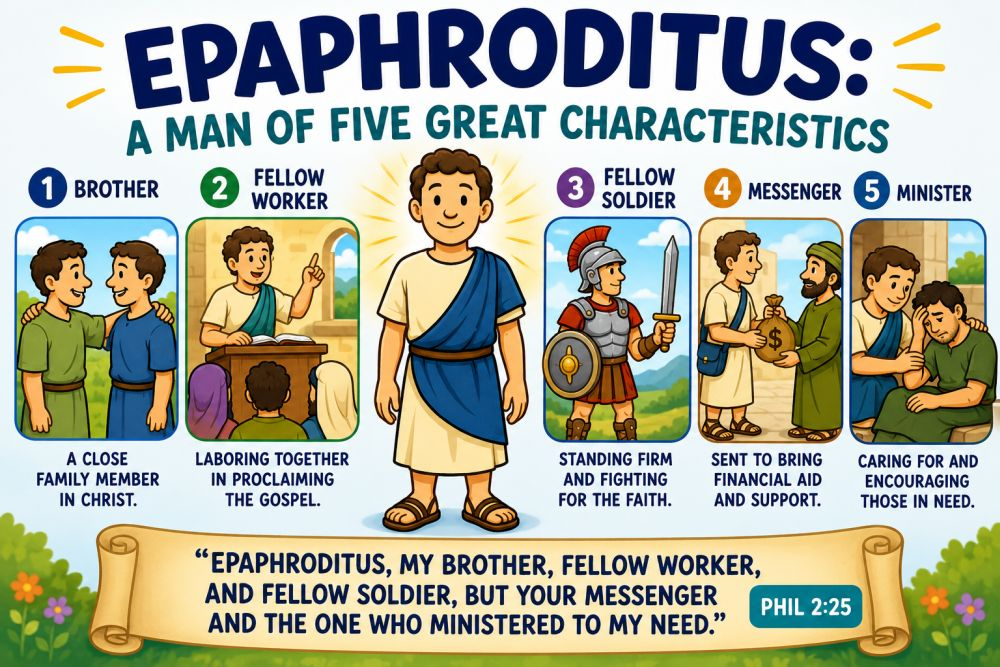
Epaphroditus may not be the most remembered person in scripture, but what is said about him speaks volumes. Mentioned in Paul’s letter to the Philippians (2:25-30; 4:18), he stands as a model for Saints today. His story offers profound lessons on love, risk, and honor in God’s kingdom.

Paul describes him warmly as “my brother and fellow-worker and fellow-soldier, and your messenger and minister to my need” (Philippians 2:25). As a fellow worker and soldier alongside Paul, Epaphroditus labored tirelessly in the gospel. He was not a distant supporter but a close companion who shared in the hardships of ministry. To the church at Philippi, he served as their trusted representative, carrying their financial gift to the imprisoned apostle. Paul received “the things that came from you” through him—an “odor of a sweet smell, a sacrifice acceptable, well-pleasing to God” (4:18). Epaphroditus was the bridge between the Philippian believers and Paul, faithfully delivering their love in tangible form.

His journey, however, came at great personal cost. Somewhere along the way or after arriving at Rome, Epaphroditus became seriously ill, “nigh unto death” (2:30). Paul notes that he “longed after you all, and was sore troubled” (2:26), distressed not primarily for his own suffering but out of deep concern for his brethren in Philippi. He regarded not his own life and hazarded everything “for the work of Christ… to supply that which was lacking in your service toward me” (2:30). This was no reckless gamble but faithfulness, risking health and safety to advance the gospel and meet Paul’s needs.

Remarkably, Epaphroditus was not healed through the means of miraculous spiritual gifts. We know Paul had theses gifts, but their use was for a purpose determined by God (Heb 2:4; 1Cor 13:8-10). This became a lesson about the purpose of spiritual gifts, and prayer; “God had mercy on him; and not on him only, but on me also” (2:27). Epaphroditus’s recovery highlighted that God works providentially in the Saints lives. This episode underscores that faith and service do not always shield believers from suffering. Instead, it reveals that faithfulness isn’t determined by miraculous healing; a lesson we learned also from Job (Job 1-2). We trust in a future hope.

Because of such character, Paul urged the Philippians: “Receive him therefore in the Lord with all joy; and hold such in honor” (2:29). Men and women who risk their lives for Christ’s work deserve high esteem. Epaphroditus exemplified true servanthood—to the Philippians as their messenger, to Paul as a loyal companion, and ultimately to Christ as a faithful soldier who placed kingdom priorities above personal comfort.

In an age that still clings to the earthly measures of success, the life of Epaphroditus challenges us to consider spiritual measures of faith. He was eager, loving, sacrificial, and Christ-focused. His life, though briefly recorded, still speaks through centuries as an example for us to emulate. Like him, we can become fellow workers and soldiers who count not our lives dear unto ourselves, but pour them out as acceptable sacrifices to God and His people.

True heroes of faith rarely seek the spotlight. They simply obey, serve, and love—often at great cost—trusting God as they look forward to a future hope in Christ. Epaphroditus did exactly that, and the church is richer for his example.

Agape
spencer

ALL SPIRITUAL BLESSINGS: NO CONDEMNATION IN CHRIST

There is therefore now no condemnation to them which are in Christ Jesus, who walk not after the flesh, but after the Spirit.” (Rom. 8:1)

This happy condition of not being damned comes only to those in Christ Jesus. Being in Christ evidently refers to those who are obedient to the Gospel having been baptized into His death (Rom. 6:3-4; Gal. 3:36-27).

Sin condemns us. In Romans 7, Paul describes mankind’s struggle with sin and the bondage it produces. Sin separates us from God and through it we have sold ourselves into bondage (Rom. 7:14; Isaiah 50:1). But now, through Christ our redeemer, there is NO CONDEMNATION for those who are in Him and walk after the Spirit.

The Law of Moses condemns us. Paul wrote, “What shall we say then? Is the law sin? God forbid. Nay, I had not known sin, but by the law: for I had not known lust, except the law had said, Thou shalt not covet” (Rom. 7:7). The law itself was holy and good (Rom. 7:12), but it exposed sin and made men conscious of their guilt. Through Christ, however, those who are in Him are freed from the condemnation that comes from transgressing the old law (Rom. 8:2-4).

Satan, is called the accuser (Rev. 12:10; Job 1:9; Zec. 3:1), and there are many who oppose the gospel of Christ and seek to condemn God’s people. “Who shall lay any thing to the charge of God’s elect? It is God that justifieth. Who is he that condemneth? It is Christ that died, yea rather, that is risen again, who is even at the right hand of God, who also maketh intercession for us” (Rom. 8:33-34). Through Christ, the accusations of the adversary cannot condemn those who remain faithful to Him.

Romans 8:1 specifies this freedom from condemnation is for those “who walk not after the flesh, but after the Spirit.” It is not a one-time event only, but a continuing walk. To walk after the Spirit is to live according to the teaching revealed by the Holy Spirit through Christ’s Apostles and prophets (John 14:26; 16:13-15; Eph. 3:3-5). Those who are led by the Spirit are those who submit themselves to the word the Spirit revealed (Rom. 8:13-14). Faith comes by hearing God’s word (Rom. 10:17), and the written testimony of the Apostles was given so men might believe and have life through Christ (John 20:30-31).

This spiritual blessing provides comfort for those who are in Christ, “These things I have written to you who believe in the name of the Son of God, that you may know that you have eternal life” (1John 5:13). Some may interpret this as once saved always saved, but don’t be confused. We can leave Christ (1Tim. 4:1; Heb. 3:12; 6:4-6; 10:26-29) and stop abiding in the doctrine of Christ (2John 1:9-10; John 6:66).

But now, through Christ, there is NO CONDEMNATION to those who are in Christ and walk after the Spirit. We are imperfect people, and we have access to forgiveness through Christ. “My little children, these things write I unto you, that ye sin not. And if any man sin, we have an advocate with the Father, Jesus Christ the righteous” (1John 2:1).

Agape
spencer