Bearing Fruit: to Glorify God

GLORIFYING GOD with our fruits

To glorify God means to honor Him by making His character, power, and goodness known through our words and actions, so that others recognize and praise Him. Scripture shows this clearly. Jesus said in Matthew 5:16, “Let your light so shine before men, that they may see your good works, and glorify your Father which is in heaven.” Paul likewise commanded in 1Corinthians 10:31, “Whether therefore ye eat, or drink, or whatsoever ye do, do all to the glory of God.” Glorifying God is not abstract praise alone. It is lived out when we do what is our duty to do.

Jesus declares this truth directly in John 15:8: “Herein is my Father glorified, that ye bear much fruit; so shall ye be my disciples.” The Father is glorified when believers produce abundant fruit. This fruit comes from abiding in Christ, the true vine. Jesus explains in John 15:5, “I am the vine, ye are the branches: He that abideth in me, and I in him, the same bringeth forth much fruit: for without me ye can do nothing.” Apart from Him we can accomplish nothing of lasting spiritual value. When we remain in Him through faith and obedience, fruit appears, and that fruit brings glory to the Father.

The New Testament consistently links fruitfulness with God’s glory. Paul prays in Philippians 1:11 that believers would be “filled with the fruits of righteousness, which are by Jesus Christ, unto the glory and praise of God.” In Colossians 1:10 he urges walking “worthy of the Lord unto all pleasing, being fruitful in every good work, and increasing in the knowledge of God.” These fruits include love, joy, peace, longsuffering, gentleness, goodness, faith, meekness, and temperance as listed in Galatians 5:22-23.

Bearing much fruit therefore proves genuine discipleship. Jesus ties the two together in John 15:8. Disciples (and false prophets) are known by their fruit, just as He taught in Matthew 7:20, “Wherefore by their fruits ye shall know them.” This results from remaining in Christ, and obeying His word. John 15:10 confirms, “If ye keep my commandments, ye shall abide in my love; even as I have kept my Father’s commandments, and abide in his love.”

When believers bear this fruit, the Father receives the glory. Others see the transformed life and give honor to God rather than to human strength. The pattern holds throughout the New Testament: fruit from abiding in Christ magnifies the Father and confirms true discipleship. This truth rests on the plain words of Jesus and the apostles. It simply tells every follower of Christ to abide in Him so that much fruit appears and the Father is glorified.

Agape
spencer

6 things SAINTS can do


“I can do all things through Christ who strengthens me.” (Phil 4:13)

Saints in the Bible are people who believe in Jesus Christ and have obeyed the gospel. Launching from Paul’s statement, let’s look at 6 things all SAINTS can do through Christ.

We can stand firm against the schemes of the devil. Ephesians 6:13 says to take up the whole armor of God so that we may be able to withstand in the evil day and having done all to stand firm. Jesus stood against every temptation by answering with the written word of God (Matt 4:1-11). Joseph stood firm when tested in Egypt. Daniel and his friends stood firm in Babylon. The word of God gives the strength to stand.

We can have assurance of our salvation. “I write these things to you who believe in the name of the Son of God that you may know that you have eternal life.” (1John 5:13). Paul knew whom he had believed. This assurance rests on the clear promises of Scripture.

We can increase in love and good works. Hebrews 10:24 calls us to stir one another up to love and good works. The church in Thessalonica already showed love yet Paul told them to excel still more and more (1Thess 4:10). The early believers in Jerusalem grew in care for one another. Growth comes as we keep learning and obeying the word of God.

We can be nice, kind, and merciful. Colossians 3:12 tells God’s people to “put on tender mercies, kindness, humility, meekness, longsuffering.” These qualities come from knowing what God has said and choosing to live by it. “And be kind to one another, tenderhearted, forgiving one another, just as God in Christ forgave you” (Eph 4:24).

We can be thankful and joyful despite trials. James 1:2-3 says, “My brethren, count it all joy when you fall into various trials, knowing that the testing of your faith produces patience.” Paul and Silas sang hymns while in prison. Habakkuk chose to rejoice even when the fields failed (Hab 3:17). The word of God teaches us to give thanks in all circumstances.

We can share the reasons for the hope that is in us. 1Peter 3:15 says, “But sanctify the Lord God in your hearts, and always be ready to give a defense to everyone who asks you a reason for the hope that is in you, with meekness and fear.” The woman at the well told her whole town about Jesus. Hope grows strong through the knowledge of God’s word, people take notice, and then we speak of it.

These six things belong to every saint. They rest on the plain teaching of Scripture.

Agape
seb

Heroes of Faith: Epaphras

Epaphras
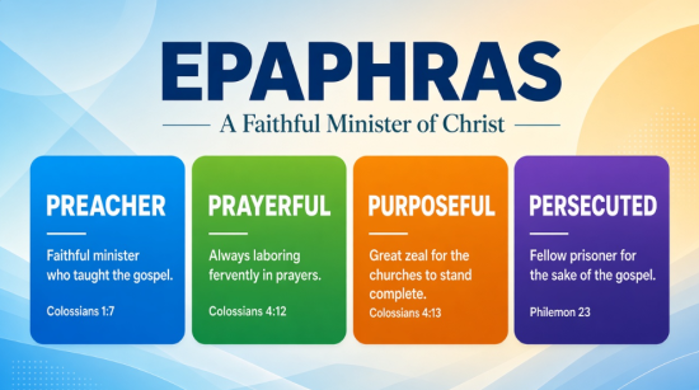
Preacher, Prayerful, Purposeful, and Persecuted

The New Testament gives us a strong picture of Epaphras in just a few verses. He appears in Colossians 1:7-8, Colossians 4:12-13, and Philemon 23. From these passages alone we see a man who lived as a faithful servant of Christ.

Epaphras was a PREACHER. “As ye also learned of Epaphras our dear fellowservant, who is for you a faithful minister of Christ;” (Col 1:7).

The Colossians learned the grace of God in truth from him. He brought them the gospel. He also reported their love in the Spirit to Paul and those with him. The word reached Colossae through this man’s faithful work. He did not invent a message. He delivered the truth about Christ.

Epaphras was a PRAYERFUL man. “Epaphras, who is one of you, a bondservant of Christ, greets you, always laboring fervently for you in prayers, that you may stand perfect and complete in all the will of God” (Col 4:12).

Paul writes that he was always laboring fervently for the Colossian brethren in prayers. His goal in prayer was clear. He asked that they might stand perfect and complete in all the will of God. This was not occasional prayer. It was constant and intense. He cared deeply about their spiritual growth and full obedience to God’s will.

Epaphras was PURPOSEFUL. “For I bear him witness that he has a great zeal for you, and those who are in Laodicea, and those in Hierapolis” (Col 4:13).

His zeal reached beyond one group of believers. Paul bore witness that he had great zeal for the saints in Colossae, and also for those in Laodicea and Hierapolis. He wanted the churches to stand firm and complete. His purpose matched the will of God revealed in the gospel. He worked and prayed so that the brethren would grow to maturity in Christ.

Epaphras was PERSECUTED for the sake of the gospel. “There salute thee Epaphras, my fellowprisoner in Christ Jesus” (Philemon 23).

Paul calls him his fellow prisoner in Christ Jesus. He shared bonds with the apostle. Faithfulness to the message of Christ brought hardship. Yet he continued as a servant of Christ even while imprisoned.

These four marks stand on the plain statements of Scripture. Epaphras preached the gospel as a faithful minister. He prayed with fervent labor for the perfection of the saints. He showed purposeful zeal for multiple congregations. He suffered as a prisoner for Christ. No extra details are added. The record is short, but it is complete and true.

The church today needs the same kind of servants.

Agape
spencer

the Truth about GRACE

A Bible-Only Perspective

The religious world remains deeply confused about the grace of God. Many treat it as an automatic covering for every person regardless of response, or reduce it to a mental assent called “faith only.” Scripture alone presents a clear, consistent picture centered on Christ.

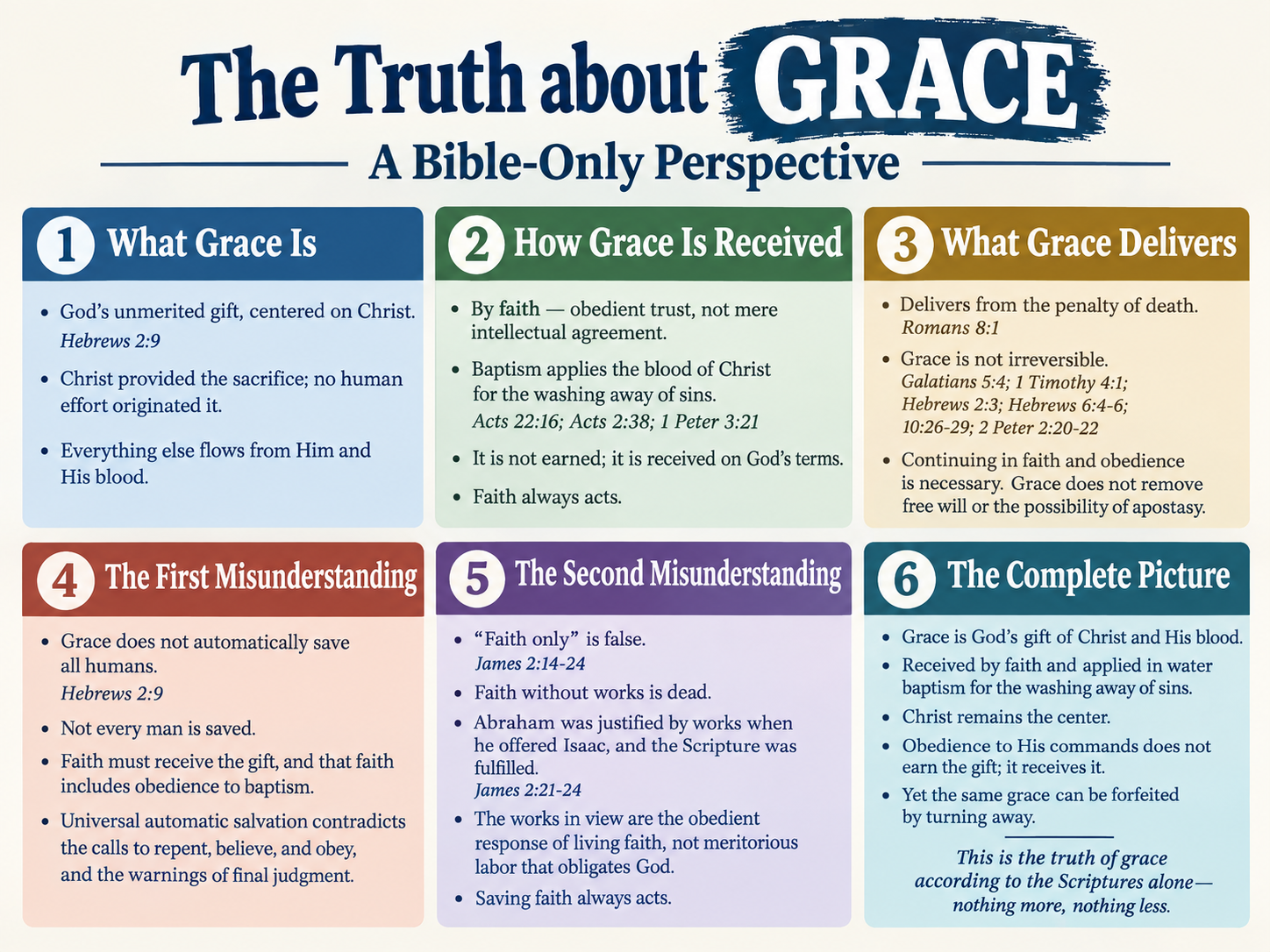
Grace is God’s unmerited GIFT expressed supremely in the sending of His Son to taste death for every man. Hebrews 2:9 declares that Jesus “by the grace of God should taste death for every man.” This is the heart of grace: God provided the sacrifice. No human effort originated it. Christ is the focus of the grace of God. Everything else flows from Him and His blood.

On man’s side, this grace is RECEIVED by faith. Faith is the obedient trust that takes hold of what God has freely offered. It is never mere intellectual agreement. The blood of God’s grace—the blood that cleanses from sin—is APPLIED when a believing person is baptized in water. At that point sins are washed away by His blood. Acts 22:16 records the command, “Arise, and be baptized, and wash away thy sins, calling on the name of the Lord.” Acts 2:38 links repentance and baptism “for the remission of sins.” First Peter 3:21 states that baptism “doth also now save us.” The power is not in the water itself but in the blood of Christ applied through the obedient act God appointed. COMPLYING with the Lord’s COMMAND is not earning salvation; it is receiving the gift on the terms God set. No one works his way into grace by obeying; one simply submits so that the blood can cleanse.

Grace delivers from the penalty of death. Through Christ we ESCAPE condemnation. Yet Scripture nowhere presents grace as irreversible once received. A person can be EJECTED from grace by turning away from God. Galatians 5:4 warns those who seek justification by law that “ye are fallen from grace.” 1Timothy 4:1 speaks of some who “shall depart from the faith.” Hebrews 2:3 asks how we shall escape if we neglect so great salvation. These and similar passages (Hebrews 6:4-6; 10:26-29; 2 Peter 2:20-22) show that continuing in faith and obedience is necessary. Grace does not cancel free will or remove the possibility of apostasy.

Two common misunderstandings distort this biblical picture. The first is the idea that grace automatically saves all humans. Hebrews 2:9 shows Christ died for every man, yet not every man is saved. Faith must receive the gift, and that faith includes the obedience of baptism for the washing away of sins. Universal automatic salvation contradicts the many calls to believe, repent, and obey, as well as the warnings of final judgment.

The second error is “faith only.” James 2:14-24 addresses it directly. Faith without works is dead. Abraham was justified by works when he offered Isaac, and the Scripture was fulfilled that “Abraham believed God, and it was imputed unto him for righteousness.” James concludes, “Ye see then how that by works a man is justified, and not by faith only.” The works in view are not meritorious labor that obligates God; they are the obedient response of living faith. Saving faith always acts. Separating faith from the obedience God requires empties faith of its biblical meaning and leaves a person still in sin.

Thus, the Bible’s teaching is straightforward. Grace is God’s gift of Christ and His blood. That grace is received by faith and applied in water baptism for the washing away of sins. Christ remains the center. Obedience to His commands does not earn the gift; it receives it. Yet the same grace can be forfeited by turning away. This is the truth of grace according to the Scriptures alone—nothing more, nothing less.

All Spiritual Blessings: Kingdom Citizens


“Blessed be the God and Father of our Lord Jesus Christ, who hath blessed us with all spiritual blessings in heavenly places in Christ” (Eph 1:3)

One of the spiritual blessings for those who have obeyed the gospel is that we are now kingdom citizens.

Some say that the kingdom of Christ has not come, and that we’re still waiting for Jesus to set up His Kingdom. The bible tells a different story.

First, the Kingdom Jesus said would come did come on Pentecost. “And he said unto them, Verily I say unto you, That there be some of them that stand here, which shall not taste of death, till they have seen the kingdom of God come with power.” (Mark 9:1; cf. Matthew 16:28; Luke 9:27)

This was fulfilled at Pentecost when the Holy Spirit was poured out with power and the apostles began preaching Christ crucified and raised: Acts 1:8 “ye shall receive power, after that the Holy Ghost is come upon you”; (Acts 2:1-4, 16-21, 32-36). Peter declared that Jesus, raised and exalted, had poured out what was seen and heard, and that God had made Him both Lord and Christ (Acts 2:33-36). The gospel of the kingdom was to be preached, and the power of God unto salvation is the gospel itself (Romans 1:16; cf. Matthew 24:14).

CHRIST IS REIGNING NOW: “For he must reign, till he hath put all enemies under his feet.” (1 Cor 15:25). This reign continues until the end, when He delivers the kingdom to God the Father (1Cor 15:24-28).

All authority has already been given to Him: “All power is given unto me in heaven and in earth.” (Matthew 28:18). He is seated at the right hand of God (Acts 2:33-36; Hebrews 1:3, 13; 8:1; 10:12-13; 12:2), far above all principality and power (Ephesians 1:20-22), and is “the head over all things to the church, which is his body” (Ephesians 1:22-23).

Second, all those who are in Christ have been translated “ into the kingdom of his dear Son” (Colossians 1:13). Entrance is through being in Christ: “For as many of you as have been baptized into Christ have put on Christ.” (Galatians 3:27). Those in Christ are new creatures (2Cor 5:17) and have redemption through His blood (Colossians 1:14). Paul tells the church at Philippi, “For our conversation [citizenship] is in heaven; from whence also we look for the Saviour, the Lord Jesus Christ.” (Philippians 3:20). Believers are “fellowcitizens with the saints, and of the household of God” (Ephesians 2:19) after being made nigh by the blood of Christ (Ephesians 2:13). The same people are described as having been called “unto his kingdom and glory” (1Thess 2:12) and as receiving “a kingdom which cannot be moved” (Hebrews 12:28).

Three, the promise to build the church is immediately linked with the keys of the kingdom. Jesus told Peter “I will build My church.” Then He said, “And I will give unto thee the keys of the kingdom of heaven: and whatsoever thou shalt bind on earth shall be bound in heaven: and whatsoever thou shalt loose on earth shall be loosed in heaven” (Matthew 16:18-19). The same authority opens the kingdom to those who obey (Acts 2:38-41, 47 “the Lord added to the church daily such as should be saved”).

Those who have obeyed the gospel (hearing, believing, repenting, confessing Christ, and being baptized into Christ—Romans 10:9-10, 17; Acts 2:38; 8:35-39; 22:16; Galatians 3:26-27) are delivered from darkness and translated into the kingdom of the Son.

They now live as citizens under the present reign of Jesus Christ, members of His body the church, awaiting the final delivery of the kingdom to the Father.

No future establishment of the kingdom is required; the Scriptures cited show it has come with power, Christ is reigning, and the transferred people constitute its citizens now. The language of a future kingdom makes Jesus a liar and a failure. We serve a King (1Tim 6:15) who did not fail, did not lie, and given us a new and living way (Heb 10:20).

Agape
spencer

A New and Living Way; Hebrews 10:20

The New and Living Way

“By a new and living way, which he hath consecrated for us, through the veil, that is to say, his flesh.” Hebrews 10:20

There is something striking about the way the Bible describes what God has done through Jesus Christ. It repeatedly uses the word new.

God promised a new covenant. Christ established it. Those who come to Christ receive new life. They become new creatures. They put off the old man and put on the new man. They receive a new identity and are called by a new name. They are taught to live differently.

This is more than an updated version of an old religion. Jesus opened “a new and living way.”

A NEW COVENANT

The coming of something new was not a surprise. God had promised it hundreds of years before Christ came.

Jeremiah wrote: “Behold, the days come, saith the LORD, that I will make a new covenant…” Jeremiah 31:31

God promised a covenant in which He would forgive iniquity and write His law upon the hearts of His people.

The prophets also spoke of an everlasting covenant and a covenant of peace. Isaiah spoke of God’s Servant being given “for a covenant of the people” (Isaiah 42:6). Ezekiel spoke of an “everlasting covenant” (Ezekiel 37:26).

Then Jesus came. When He instituted the Lord’s Supper, He said: “For this is my blood of the new testament, which is shed for many for the remission of sins…” Matt 26:28

Hebrews explains exactly what happened: “In that he saith, A new covenant, he hath made the first old.” Hebrews 8:13

Christ did not simply repair the first covenant. He established a new one. (see Heb 7:12-14)

And that new covenant is the covenant under which we live today.

A New LIFE and a New Creation

The new covenant calls for a new kind of life.

Paul wrote: “Therefore if any man be in Christ, he is a new creature.” 2Cor 5:17

That is personal. If I am in Christ, I am not supposed to remain the same person I was before.

Galatians 6:15 says that what matters is being “a new creature.”

The prophets had already pointed toward this kind of change. Isaiah recorded God’s promise: “Behold, I will do a new thing…” Isaiah 43:19

The New Testament shows us that this new work begins in those who obey the gospel of Christ.

God does not simply give us a new set of beliefs. He calls us to a new life.

Buried (IMMERSED in baptism) and Raised to Newness of Life

Romans 6 makes the connection even clearer. Paul says: “Therefore we are buried with him by baptism into death: that like as Christ was raised up from the dead… even so we also should walk in newness of life.” Romans 6:4

Notice the progression.

We are buried with Christ. We are raised with Christ. THEN we walk in newness of life.

Colossians 2:12 describes us as being “buried with him in baptism” and raised with Him.

Galatians 3:27 says: “For as many of you as have been baptized into Christ have put on Christ.”

What baptism is Paul talking about?

He is talking about immersion in water.

The word baptism means immersion, and the Bible repeatedly connects baptism with water. The Ethiopian eunuch went down into the water with Philip, and they came up out of the water (Acts 8:36-39). Peter commanded baptism with water (Acts 10:47-48). Ananias told Saul to arise and be baptized and wash away his sins (Acts 22:16).

This is not something man invented. Jesus commanded it.

Jesus said: “Go ye therefore, and teach all nations, baptizing them…” Matthew 28:19

Mark records: “He that believeth and is baptized shall be saved…” Mark 16:16

Water baptism is therefore not a work that replaces faith. It is an act of obedient faith.

The question is not whether baptism is a human work that earns salvation. It does not.

The question is whether a person who believes Jesus should obey what Jesus commanded.

  • Jesus commanded baptism.
  • The apostles commanded baptism.
  • And when people believed the gospel, they were baptized.

Acts 2:41 says those who gladly received the word were baptized.

Acts 8:12 says men and women believed and were baptized.

Acts 18:8 says many Corinthians hearing, believed, and were baptized.

Faith does not make obedience unnecessary.

Faith obeys.

That is why Romans 6 connects baptism with being buried and raised with Christ and then walking in newness of life.

Baptism is not presented as an empty ceremony. It is connected with entering Christ, being raised with Him, and beginning a new life.

The Christian life is supposed to look different because the Christian has become different.

New Wine and New VESSELS

Jesus used another picture to describe what He was bringing.

“New wine must be put into new bottles.” Mark 2:22

The point is simple. The new work Christ was doing called for something new.

We cannot claim the new life Christ gives us while continuing to live according to the old life we left behind.

The gospel is not just something we add to our lives.

It changes our lives.

A New Man in a New IMAGE

Paul gives us another powerful picture in Ephesians 4.

He tells Christians to put away the old manner of life and: “put on the new man, which after God is created in righteousness and true holiness.” Ephesians 4:24

Colossians 3:9-10 says: “Ye have put off the old man with his deeds; And have put on the new man…”

Then Paul explains that the new man is: “renewed in knowledge after the image of him that created him.”

That is what Christ is doing in us.

We put off the old man. We put on the new man. We become more like Christ.

Christianity is not about becoming a slightly improved version of the old me. It is about becoming a new man in Christ.

A New NAME

God also promised that His people would receive a new name.

Isaiah wrote: “thou shalt be called by a new name, which the mouth of the LORD shall name.” Isaiah 62:2

Isaiah 65:15 speaks of God calling His servants “by another name.”

Then we come to the New Testament.

Acts 11:26 tells us: “And the disciples were called Christians first in Antioch.”

James refers to “that worthy name by the which ye are called” (James 2:7).

Peter says: “if any man suffer as a Christian, let him not be ashamed.” 1 Peter 4:16

Revelation also speaks of a “new name” given to those who belong to Christ (Rev 2:17; 3:12).

God gives His people a new identity.

We are not defined by who we used to be. We belong to Christ.

New GARMENTS

The Bible also describes this new identity as putting on new clothing.

Isaiah wrote: “he hath clothed me with the garments of salvation, he hath covered me with the robe of righteousness.” Isaiah 61:10

Paul uses the same kind of language when he says: “put ye on the Lord Jesus Christ.” Romans 13:14

And again: “put on the new man.” Eph 4:24

Colossians 3 tells us what these new garments look like. We put on mercy, kindness, humility, meekness, patience, forgiveness, and love.

This is what the new life should look like.

We take off the old behavior and put on Christ.

The New and Living Way

Put all of this together and the message becomes clear.

God promised a new covenant.

Christ established it through His blood.

Those who come to Christ receive new life.

Through baptism, we are buried and raised to newness of life.

We become a new creation at baptism.

We put off the old man and put on the new man.

We receive a new identity and name.

We put on new garments of righteousness, holiness, and love. Galatians 3:27

And all of it points us back to Hebrews 10:20:

“A new and living way.”

Jesus did not merely make the old way easier. He opened a new way to God.

The question is not simply whether we believe that Jesus opened that way.

The question is whether we are walking in it.

If I have entered the new covenant, I should live a new life.

If I have been raised to newness of life, I should not keep living like the old man.

If I have put on Christ, people should be able to see Christ in the way I live.

That is the challenge of the new and living way.

Christ made all things new. He calls us to live as new people.

agape

spencer