
A Bible-Only Perspective
The religious world remains deeply confused about the grace of God. Many treat it as an automatic covering for every person regardless of response, or reduce it to a mental assent called “faith only.” Scripture alone presents a clear, consistent picture centered on Christ.
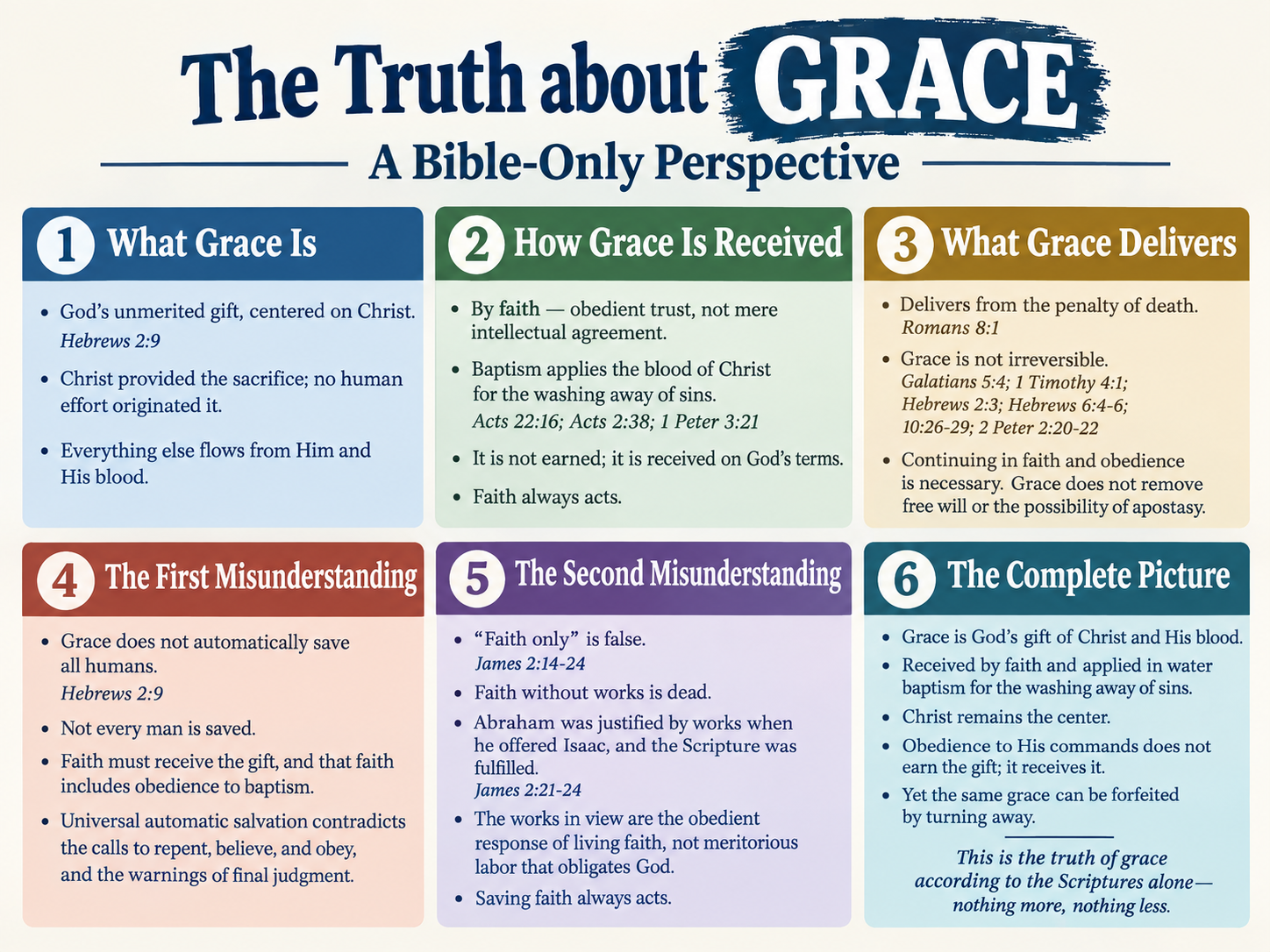
Grace is God’s unmerited GIFT expressed supremely in the sending of His Son to taste death for every man. Hebrews 2:9 declares that Jesus “by the grace of God should taste death for every man.” This is the heart of grace: God provided the sacrifice. No human effort originated it. Christ is the focus of the grace of God. Everything else flows from Him and His blood.
On man’s side, this grace is RECEIVED by faith. Faith is the obedient trust that takes hold of what God has freely offered. It is never mere intellectual agreement. The blood of God’s grace—the blood that cleanses from sin—is APPLIED when a believing person is baptized in water. At that point sins are washed away by His blood. Acts 22:16 records the command, “Arise, and be baptized, and wash away thy sins, calling on the name of the Lord.” Acts 2:38 links repentance and baptism “for the remission of sins.” First Peter 3:21 states that baptism “doth also now save us.” The power is not in the water itself but in the blood of Christ applied through the obedient act God appointed. COMPLYING with the Lord’s COMMAND is not earning salvation; it is receiving the gift on the terms God set. No one works his way into grace by obeying; one simply submits so that the blood can cleanse.
Grace delivers from the penalty of death. Through Christ we ESCAPE condemnation. Yet Scripture nowhere presents grace as irreversible once received. A person can be EJECTED from grace by turning away from God. Galatians 5:4 warns those who seek justification by law that “ye are fallen from grace.” 1Timothy 4:1 speaks of some who “shall depart from the faith.” Hebrews 2:3 asks how we shall escape if we neglect so great salvation. These and similar passages (Hebrews 6:4-6; 10:26-29; 2 Peter 2:20-22) show that continuing in faith and obedience is necessary. Grace does not cancel free will or remove the possibility of apostasy.
Two common misunderstandings distort this biblical picture. The first is the idea that grace automatically saves all humans. Hebrews 2:9 shows Christ died for every man, yet not every man is saved. Faith must receive the gift, and that faith includes the obedience of baptism for the washing away of sins. Universal automatic salvation contradicts the many calls to believe, repent, and obey, as well as the warnings of final judgment.
The second error is “faith only.” James 2:14-24 addresses it directly. Faith without works is dead. Abraham was justified by works when he offered Isaac, and the Scripture was fulfilled that “Abraham believed God, and it was imputed unto him for righteousness.” James concludes, “Ye see then how that by works a man is justified, and not by faith only.” The works in view are not meritorious labor that obligates God; they are the obedient response of living faith. Saving faith always acts. Separating faith from the obedience God requires empties faith of its biblical meaning and leaves a person still in sin.
Thus, the Bible’s teaching is straightforward. Grace is God’s gift of Christ and His blood. That grace is received by faith and applied in water baptism for the washing away of sins. Christ remains the center. Obedience to His commands does not earn the gift; it receives it. Yet the same grace can be forfeited by turning away. This is the truth of grace according to the Scriptures alone—nothing more, nothing less.
 Borger church of Christ @ Franklin & Juniper