BEARING FRUIT WORTHY OF REPENTANCE

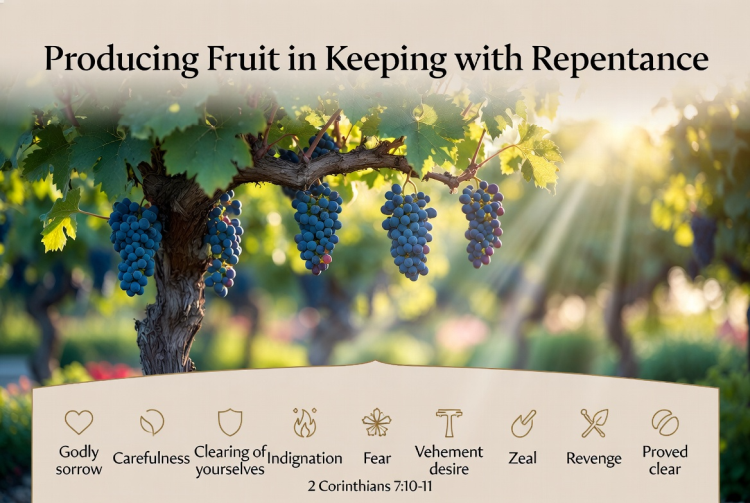
Producing Fruit in Keeping with Repentance
“Herein is my Father glorified, that ye bear much fruit; so shall ye be my disciples.” (John 15:8)

John the baptizer told the Pharisees, “Bring forth therefore fruits meet for repentance” (Matt 3:8).

What are the “Fruits Worthy of Repentance?” The simple answer is that it means to produce visible, ongoing evidence of an ongoing unity with Christ, in a Christlike character, in obedience (especially love), and a life that glorifies (points toward) God through abiding (keeping His commands) in Him. It also includes being profitable (useful) to Him in His ultimate purpose that “all men to be saved, and to come unto the knowledge of the truth” (1Tim 2:4).

Repentance always begins in the heart. We can’t read hearts, but the Holy Spirit has given an example of true and complete repentance from the heart as seen in the church at Corinth. They had need of repentance, the specifics of the charges and their repentance can be found by studying 1Corinthians. In Paul’s 2nd letter they had taken steps to repent, and Paul expresses how complete and thorough that repentance was. “For godly sorrow worketh repentance to salvation not to be repented of: but the sorrow of the world worketh death. For behold this selfsame thing, that ye sorrowed after a godly sort, what carefulness it wrought in you, yea, what clearing of yourselves, yea, what indignation, yea, what fear, yea, what vehement desire, yea, what zeal, yea, what revenge! In all things ye have approved yourselves to be clear in this matter” (2Cor 7:10-11). Notice the 9 attitudes the church at Corinth displayed proving true repentance.

• “ye sorrowed after a godly sort” [lupeo, & theos] A deep, God-centered grief over sin, contrasted with worldly sorrow, which is self-focused.
• “what carefulness it wrought in you, yea,” [spoudē] a diligent, active resolve to turn from sin and pursue obedience, rather than passive regret.
• “what clearing of yourselves, yea,” [apologia] A strong desire to vindicate or clear one’s name and conscience by openly acknowledging the sin, taking responsibility, and demonstrating innocence going forward.
• “what indignation, yea,” [aganaktēsis] Righteous anger or outrage, directed toward the sin itself, one’s own participation in it, and the damage it caused.
• “what fear, yea,” [phobo] Reverential fear of God, awareness of His holiness, and a wholesome dread of sin’s consequences.
• “what vehement desire, yea,” [epipothēsis] Intense, heartfelt longing for restoration to God, and to avoiding sin in the future.
• “what zeal, yea,” [zēlos] It shows fervent enthusiasm and passionate commitment to God and His word as opposed to indifference.
• “what revenge!” [ekdikēsis] A determined desire to see justice done by punishing (1Cor 5:4-5; 2Cor 2:6) or removing the evil involving self-discipline, and decisive action against sin in the church or personal life.
• “In all things ye have approved (proved) yourselves to be clear in this matter.” [sunistao] A complete demonstration of innocence and purity in the matter through consistent, observable change.

Bringing forth fruit worth of repentance is first a change in heart and attitude along with decisive, and determined action. True repentance includes both.

Agape
spencer

GO, TEACH, BAPTIZE… Who Does what?


“Go ye therefore, and teach all nations, baptizing them in the name of the Father, and of the Son, and of the Holy Ghost:” (Matt 28:19).

Who does what?
This may appear like a simple question to you, but some are making it difficult and are opposing Jesus’ commands on how to be saved. Here’s how the objection sounds; “Water is not stated in that verse therefore it’s Holy Spirit baptism.” They will make this claim in all the places that baptism is commanded, (see Acts 2:38; 8:12; 9:1-18; 22:16; 16:15; 25-34).

There are several ways to answer this objection but let’s just look at a simple and logical one; Answer the question: Who is being commanded to do what?

In every case that a command is given, the one receiving the command is the one expected to perform it. This includes both inward actions (faith, believing, repentance, loving) and outward actions (going, teaching, baptizing, praying, singing, giving). Scripture never presents a command that is fulfilled by another person performing the commanded action in the place of the one commanded. In other words, the command is being given to people to do, therefore people comply with the action being commanded.

Faith is not excluded from this principle simply because it is inward.
• Jesus commanded: “Believe the gospel.” (Mark 1:15);
• Paul told the jailer: “Believe on the Lord Jesus Christ.” (Acts 16:31);
• John writes: “This is his commandment, That we should believe on the name of his Son Jesus Christ.” (1 John 3:23);

Believing is therefore something the hearer is commanded to do. Likewise:
• Repent (Acts 17:30);
• Confess (Romans 10:9-10);
• Continue in the faith (Colossians 1:23).

These are personal responses. Although invisible to others, they are nevertheless actions of the person commanded. (this same reasoning answers other similar objections).

Back to Matthew 28:19; what kind of baptism can a person administer who is commanded to “go…baptizing them”? A human being cannot administer: the baptism of the Holy Spirit, nor the baptism of fire. John the Baptist distinguished these. “I indeed baptize you with water unto repentance… he shall baptize you with the Holy Ghost, and with fire” (Matthew 3:11). Notice the distinction. John administered water baptism. Christ administers Holy Spirit baptism. The administrator identifies the baptism. Only Jesus is ever said to baptize with the Holy Spirit. No apostle is ever commanded to baptize anyone with the Holy Spirit. But the apostles are commanded to baptize. Therefore, the baptism they administer must be one that men can administer. That baptism is water baptism.

Matthew 28 does not have to mention water explicitly. It identifies the administrator. Once Scripture identifies that men are to administer the baptism, the only baptism men are ever shown administering is water baptism.

Necessary inference. When Scripture gives a command:
• The person commanded is responsible for performing the commanded action.
• Matthew 28:19 commands people to baptize.
• People can administer only water baptism.
• Therefore, the baptism commanded in Matthew 28:19 is water baptism administered by one person to another.

Agape
Spencer

BONUS ANSWER: Acts 8:34-39
“And the eunuch answered Philip, and said, I pray thee, of whom speaketh the prophet this? of himself, or of some other man?
35 Then Philip opened his mouth, and began at the same scripture, and preached unto him Jesus.
36 And as they went on their way, they came unto a certain water: and the eunuch said, See, here is water; what doth hinder me to be baptized?
37 And Philip said, If thou believest with all thine heart, thou mayest. And he answered and said, I believe that Jesus Christ is the Son of God.
38 And he commanded the chariot to stand still: and they went down both into the water, both Philip and the eunuch; and he baptized him.
39 And when they were come up out of the water, the Spirit of the Lord caught away Philip, that the eunuch saw him no more: and he went on his way rejoicing.”

What Inescapable conclusions do you draw from this passage?

HEROES OF FAITH: Hebrews 11:33-39

Through faith, the writer of Hebrews tells us, some believers “subdued kingdoms, wrought righteousness, obtained promises, stopped the mouths of lions, quenched the violence of fire, escaped the edge of the sword.” Out of weakness they “were made strong, waxed valiant in fight, turned to flight the armies of the aliens.” Women “received their dead raised to life again.” Others, though, faced much darker days. They “were tortured, not accepting deliverance, that they might obtain a better resurrection.” Some went through “cruel mockings and scourgings,” through “bonds and imprisonment.” They “were stoned, they were sawn asunder,” and “slain with the sword.” These faithful people “wandered about in sheepskins and goatskins, being destitute, afflicted, tormented.” The world was not worthy of them. They wandered “in deserts, and in mountains, and in dens and caves of the earth.” And yet, “these all, having obtained a good report through faith, received not the promise.” It’s a powerful mix of triumph and terrible suffering, all held together by simple trust in God.

Could we endure like that?

Reading these lines makes me stop and wonder. The wins sound amazing. Who wouldn’t want to be part of stories where faith shuts the mouth of danger and turns the tide of battle? But then the tone shifts, and we see the cost. People choosing torture over compromise. Choosing a future hope over present relief. Living homeless and hunted, with nothing but their faith to keep them going.

We probably won’t face lions or flames in our everyday lives. Still, the question feels real. When smaller pressures come, when standing up for what’s right costs us friends or comfort or security, will we hold on? When answers don’t come quickly and the waiting gets heavy, can we keep believing there’s something better ahead?

These believers weren’t superhuman. What they had was a deep-rooted confidence that God is trustworthy, even when life hurts. They lived like this world isn’t the final chapter.

Can I honestly say I can do what they did? But the same God who carried them is the same God we hope in today. The real question is whether we’ll fix our eyes on Him and say He’s worth it, no matter what comes. Whether in the good days or the hard ones, may we run our part of the race, looking to Jesus, with the same quiet faithfulness (12:1-3). One day, faith will become sight, and all the waiting will have been worth it.

The writer concludes “God having provided some better thing for us, that they without us should not be made perfect.” The picture is that they will receive the promise when we receive the promise in Christ. The faithful from yesterday and the faithful today will share in the same perfect blessing in Christ.

Agape

spencer

All Spiritual Blessings In Christ: Adoption

Adoption & Heirs
Every spiritual blessing God gives comes to us only in Christ. The apostle Paul opens Ephesians with this sweeping truth: “Blessed be the God and Father of our Lord Jesus Christ, who has blessed us in Christ with every spiritual blessing in the heavenly places” (Ephesians 1:3).

Among the greatest of these blessings are adoption and inheritance. Through faith in Jesus, God takes us who were once outsiders and adopts us as His own children. We are no longer slaves or strangers but sons and daughters in His family. “But when the fulness of the time was come, God sent forth his Son, made of a woman, made under the law, To redeem them that were under the law, that we might receive the adoption of sons. And because ye are sons, God hath sent forth the Spirit of his Son into your hearts, crying, Abba, Father. Wherefore thou art no more a servant, but a son; and if a son, then an heir of God through Christ” (Galatians 4:4-7).

This adoption brings full rights. We receive the Spirit of adoption. And because we are now children, we become heirs of God and co-heirs with Christ. An eternal inheritance awaits us that nothing in this world can take away. “And if children, then heirs; heirs of God, and joint-heirs with Christ; if so be that we suffer with him, that we may be also glorified together” (Romans 8:15-17).

How did we come to this inheritance and adoption? Paul wrote by inspiration, “For ye are all the children of God by faith in Christ Jesus. For as many of you as have been baptized into Christ have put on Christ. There is neither Jew nor Greek, there is neither bond nor free, there is neither male nor female: for ye are all one in Christ Jesus. And if ye be Christ’s, then are ye Abraham’s seed, and heirs according to the promise” (Galatians 3:26-29).

We’re able to be baptized into Christ because of what He did on the cross. “And that he might reconcile both unto God in one body by the cross, having slain the enmity thereby… Now therefore ye are no more strangers and foreigners, but fellowcitizens with the saints, and of the household of God” (Ephesians 2:14-19);

All of it is found in Christ alone. Through Jesus we are welcomed home, fully adopted, and made rich with every spiritual blessing the Father has to give. Now all that remains is the redemption of our body when Christ returns. “…even we ourselves groan within ourselves, waiting for the adoption, to wit, the redemption of our body” (Romans 8:23). Having been justified by His grace we should become heirs according to the hope of eternal life (Titus 3:7).

“Blessed be the God and Father of our Lord Jesus Christ, which according to his abundant mercy hath begotten us again unto a lively hope by the resurrection of Jesus Christ from the dead, To an inheritance incorruptible, and undefiled, and that fadeth not away, reserved in heaven for you, Who are kept by the power of God through faith unto salvation ready to be revealed in the last time” (1Peter 1:3-5).

Agape
spencer