
“Blessed is the man that walketh not in the counsel of the ungodly, nor standeth in the way of sinners, nor sitteth in the seat of the scornful. But his delight is in the law of the LORD; and in his law doth he meditate day and night. And he shall be like a tree planted by the rivers of water, that bringeth forth his fruit in his season; his leaf also shall not wither; and whatsoever he doeth shall prosper.” (Psalms 1:1-3)
We all know someone who seems to meet every standard of goodness that human opinion can invent.
I can recall a person in my life who left an impression of goodness, kindness, generosity, and made me feel special just for being me. Some things I recall about them is that they were believers in God, prayerful, and had a good reputation among all. This kind person lit up every room they entered, and nearly everyone smiled and was glad to see them.
If you were to ask my opinion back then I would say these folks exemplified someone bound for heaven. If anyone was ready for heaven it would be them.
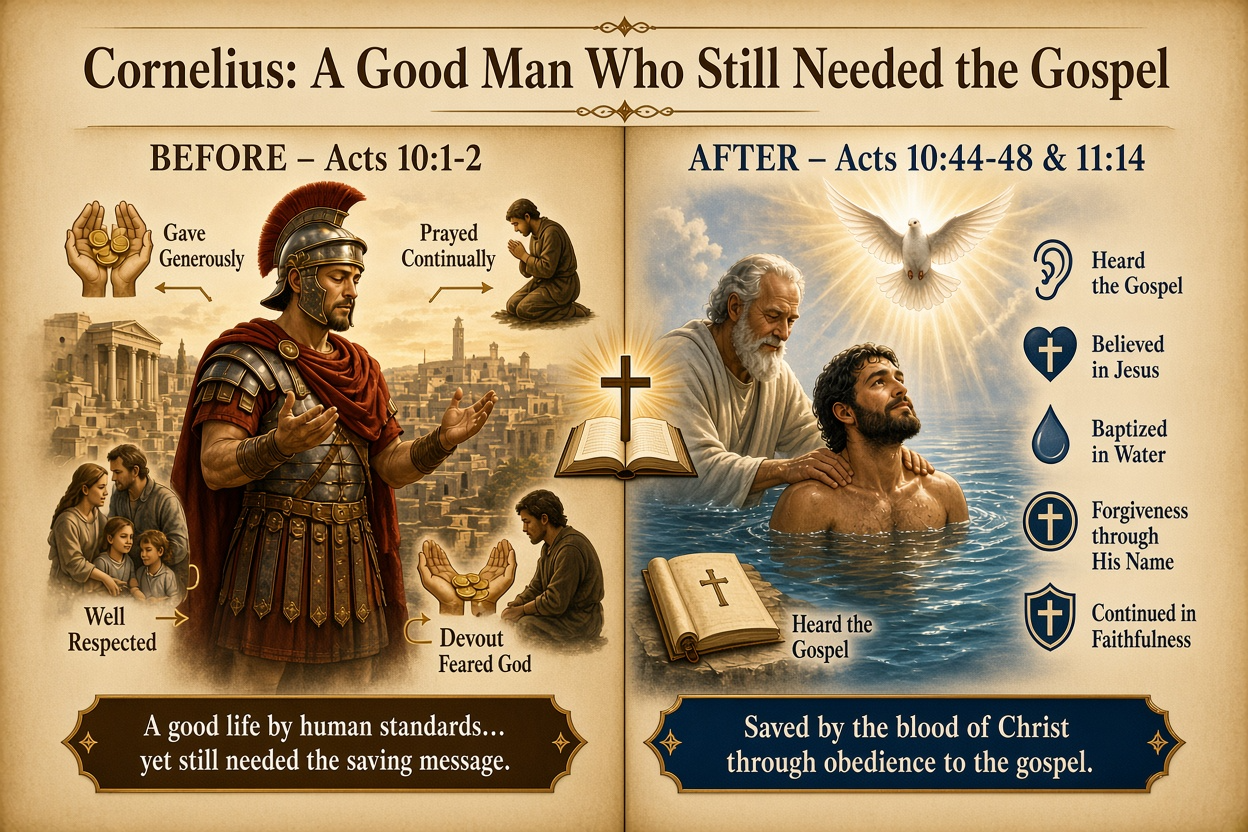
A similar real person appears in the pages of Scripture. Acts 10 and 11 tell us of a man named Cornelius, a centurion of the Italian cohort stationed in Caesarea. The text states that he was a devout man who feared God with all his household, gave alms generously to the people, and prayed continually to God. The report about him among men was, “a just man, and one that feareth God, and of good report among all the nation of the Jews…” (Acts 10:22). Left to us that would be the whole of the story. That would be our eulogy at his funeral had he died before the rest of the events in Acts 10 & 11.
An angel of God appeared to him and said that his prayers and alms had ascended as a memorial before God. The angel directed him to send men to Joppa for Simon who is called Peter. Cornelius obeyed at once. When Peter arrived, Cornelius gathered his relatives and close friends to hear the message. Peter would relate later what Cornelius told him, “how he had seen an angel standing in his house, who said to him, ‘Send men to Joppa, and call for Simon whose surname is Peter, who will tell you words by which you and all your household will be saved’” (Acts 11:13-14). You see, the angel told him he needed to hear words to be SAVED.
Peter proclaimed Jesus of Nazareth: how God anointed Him with the Holy Spirit and with power, how He went about doing good and healing, how He was put to death and raised on the third day, and how God appointed Him to be judge of the living and the dead. Peter declared that to Him all the prophets bear witness that everyone who believes in Him receives forgiveness of sins through His name. He preached the Gospel (v38-43).
While Peter was still speaking these words, the Holy Spirit fell on all who heard the message. The circumcised believers who had come with Peter were amazed because the gift of the Holy Spirit had been poured out even on the Gentiles. They heard them speaking in tongues and extolling God. “And as I began to speak, the Holy Spirit fell upon them, as upon us at the beginning” (Acts 11:15-16). This outpouring served as clear evidence that God was accepting the Gentiles.
Peter then asked “Can any man forbid water, that these should not be baptized,” (Acts 10:47). He commanded them, “to be baptized in the name of the Lord” (v48). Cornelius heard that message, believed in Jesus, and was baptized in water. He and his household continued thereafter in the way of the Lord.
The account leaves no room for doubt. Despite the genuine devotion, generous alms, continual prayer, and godly fear that marked Cornelius’s life, he still needed to hear the words by which he would be saved. Human reasoning might have concluded that such a person already stood accepted. Scripture records otherwise. The gospel required hearing about Jesus, believing in Him for the forgiveness of sins, and being baptized in water. The Holy Spirit’s descent confirmed God’s acceptance of the Gentiles, yet water baptism still followed as the commanded completion of faith.
We must not confuse a good life with having earned or owed salvation. A life filled with generosity, prayer, and respect may impress others, yet it cannot purchase forgiveness. We all need the blood of Christ. Nobody is saved outside of Christ, no matter how good we think they are. The same truth applies to the kind person I talked about at the beginning.
No matter how generous, prayerful, respected, or devout that individual may seem, the same need remains. Romans 3:23 states that “all have sinned and fall short of the glory of God.” Character that impresses people does not remove the requirement to hear the gospel of Jesus Christ, believe in Him, be baptized in water, and continue in faithfulness.
Cornelius’s story stands as a clear demonstration that even the most admirable life by human standards still requires obedience to the message that saves through the blood of Christ.
Agape
spencer



 Borger church of Christ @ Franklin & Juniper