
Leaning in to Learn
Salvation begins with a simple yet profound act. One must hear the word of God. Jesus made this clear when He said, “Everyone who hears these words of mine and does them will be like a wise man who built his house on the rock” (Matthew 7:24). Hearing is not automatic. It requires us to incline our ear toward God.
The Bible often uses the phrase “incline your ear” to describe attentive, humble listening. In the Old Testament, God repeatedly called His people to this posture. Isaiah urged, “Incline your ear, and come to me; hear, and your soul shall live” (Isaiah 55:3). Proverbs teach us to “incline your ear to wisdom” so that understanding enters our hearts (Proverbs 2:2; 4:20). This is no casual hearing. It means turning our full attention toward God, bending our will in His direction, and opening our hearts to receive what He says.
For us today, inclining the ear means listening to the written word of God. We pick up the Scriptures, read them carefully, and listen with a desire to understand and obey. In Acts, those who heard Peter’s message on Pentecost “were cut to the heart” and asked what they should do (Acts 2:37). They listened intently. Their response led to repentance and baptism. Thousands were added to the church that day.
Contrast this with those who refused to listen. In Jeremiah, God lamented that His people “did not listen or incline their ear” despite persistent warnings through the prophets. They stiffened their necks and missed God’s blessing. Jesus warns of this danger in His parables. He told of seed falling on different soils, where only the good soil “hears the word and understands it” and bears fruit (Matthew 13:23). The difference was not in the seed but in the hearer’s response. Stephen pointed this out when he said, “Ye stiffnecked and uncircumcised in heart and ears, ye do always resist the Holy Ghost: as your fathers did, so do ye” (Acts 7:51). Oh, you thought he was being insulting? Nay, Nay; he was only echoing what the prophets before had already said. “Yet they hearkened not unto me, nor inclined their ear, but hardened their neck: they did worse than their fathers” (Jeremiah 7:26).
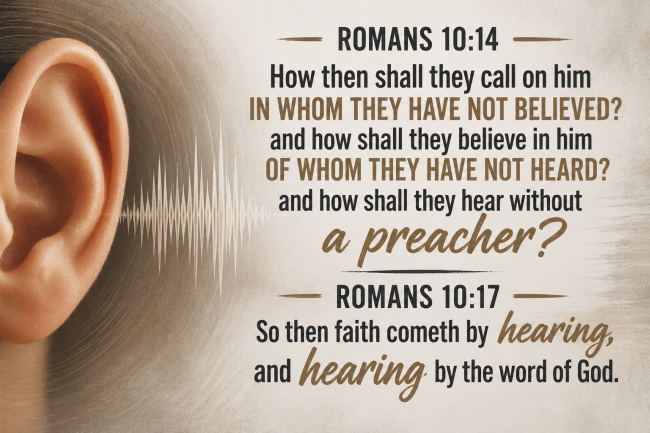
Inclining your ear is the necessary first step because faith comes by hearing, and hearing by the word of Christ (Romans 10:17). No one can believe what they have not heard. No one can obey what they have not received. This truth places beautiful responsibility on every person. God speaks through His word. We must choose to lean in and listen.
Think of the Bereans, who “received the word with all eagerness, examining the Scriptures daily to see if these things were so” (Acts 17:11). Or consider the Ethiopian eunuch, who was reading Isaiah when Philip joined him. One conversation about the written word opened his heart to salvation (Acts 8:26-38).
God’s plan is accessible to all. He has preserved His word so that anyone willing can incline their ear. You do not need special revelation or an irresistible pull. You need an open Bible, an open mind, and a willing heart. Read it daily. Meditate on it. Let the words sink deep.
The first step of salvation is to hear the word. Jesus stands ready. The question is whether we will incline our ear to Him. Many miss heaven by inches, not miles, simply because they never inclined their ear to the God who speaks. Turn your attention. Eternity hangs on it.
Agape
spencer


Long Hair Does Not Replace The Required Veil Or Head Covering!.The woman who…Prays or Prophesies with her head Unveiled/Uncovered Dishonors GOD, man and herself.A woman today when she is Praying to our GOD must Cover her physical head with an artificial Head Covering such as a Veil, Scarf, a Shawl, a Handkerchief, a Hat, Etc. For her to Refuse to do so is to bring Dishonor upon her head, GOD and man, because a Covered Head on her part is a Sign of her Subjection role to GOD and to man…verse 10. A Refusal to Wear a Veil or a artificial Head Covering is to show she is Not in Subjection or Submission to GOD nor man…hence the Dishonor is not only to our Wonderful, Merciful and Loving GOD, but to man as well..Verse Six:For if the woman be not Veiled/Covered, let her also be Shorn: but if it be a Shame to be Shorn or Shaven, let her be Veiled/Covered..In other words, if a woman will not cover her head with a veil or an artificial covering, let her carry her defiance to its ultimate conclusion, and let her cut her hair or shave her head. But since a shaven head is Shameful to a woman, she should do neither, but rather she should Veil or Cover her Head.The Head Covering here spoken of Cannot be the woman’s Long Hair for this Reason:The woman under consideration in this Verse 6 is Not Covered or Without A Head Covering. Now if the Head Cover or the Veil Covering and the Long Hair are One and the Same, then we may Substitute the word Long Hair for the word Veil or Head Covering in this Verse 6 and the meaning will be Unchanged.Notice:If the woman is Without a Head Covering (Long Hair), let her also be Shorn.If the woman is Without Hair, let her also be Shorn?See the Absurdity in the last statement?How can a woman who is Without Hair, also be Shorn?How can a woman Without Any Hair, get her Hair Cut Off?.The word also in this Verse 6 shows plainly once and for all that the Head Covering is Not the woman’s Hair but Must be a an Artificial Head Covering (Veil) as already described.The word Shear means Cut Off (Weymouth), Cut Short (Thayer), or Crop (Expositor’s Greek Testament).Verses 5 and 6 show that Two Head Coverings are in the Apostles teaching from GOD, the Long Hair being One Head Covering and the Veil or an Artificial Head Covering such as a shawl, a scarf, a handkerchief, a veil, etc., making Two Required Head Coverings from GOD..Verse 6…Why LONG HAIR does NOT logically fit into Verse 6.Keep in mind that with this position, COVERED equals LONG HAIR and UNCOVERED equals SHORT HAIR.Now let us see if these Verses make any sense:.1 Corinthians 11:5,6,135 But every woman who Prays or Prophesies with SHORT HAIR Dishonors her Head, for that is one and the same as if her Head were Shaved.6 For if a woman has SHORT HAIR, let her also be Shorn. But if it is Shameful for a woman to be Shorn or Shaved, let her have LONG HAIR.13 Judge among yourselves. Is it Proper for a woman to Pray to GOD with her with SHORT HAIR on her head?.We learn from Verse 5 that the Uncovered Head is Equal to the Shaven Head in the sense of bringing the same degree of Shame.If LONG HAIR is the Head Covering of Verses 5, 6, and 13 then Verse 5 states that SHORT HAIR (the Uncovered Head) is one and the Same with the Shaved Head. From this viewpoint, the woman who does Not have LONG HAIR is Shameful; it does Not matter if her Hair is SHAVEN, SHORN, OR SHORT – it is SHAMEFUL!.Verse 6 makes absolutely No Sense if LONG HAIR is the ONLY Head Covering in the passage..If SHORT HAIR is the UNCOVERED HEAD in Verse 6.If the woman has SHORT HAIR let her also be Shorn (Verse 6)If SHORT HAIR and SHORN HAIR are equally Shameful (verse 5) then where is the force and what is the purpose? Can you really believe that saint Paul would say, “if the woman has SHORT HAIR let her Also be Shorn”? There is No Reason or Purpose for saint Paul to instruct the woman with SHORT HAIR (Uncovered) to Also Shave her Head, because by this position, Any Length of Hair other than LONG HAIR is Shameful – whether it be Shaven, Shorn, or this SHORT HAIR. The Truth of the matter is that Two Head Coverings are under consideration in 1 Corinthians 11:1-16. And women are to use and Cover their head with a Veil or an Artificial Head Covering whenever they Pray or Prophesy Or else be Consistent and she should Also be Shaven or Shorn.The Greek grammar does not allow the substitution and it is evident here that the context argues against the HAIR or for that matter the LONG HAIR as being the Required Head Covering of 1 Corinthians chapter 11 Verses 5, 6, and 13..The Passage shows Two Head Coverings are Required. 1 Corinthians 11:15 indicates that the Long Hair of the woman is given her for A Covering and we might add that the Long Hair is Permanent – having this Head Covering at All Times. On the other hand, 1 Corinthians 11:5, 6, and 13 teach a Second Head Covering that is Temporary and a Veil or Artificial in the sense that Specific Times are Required for the Wearing of It – the woman is to have her Head Covered Whenever she is Praying or Prophesying. Since this Second Head Covering is Not Worn All the Time then it would naturally follow that this Second Head Covering is Artificial..1 Corinthians 11:15 = Long Hair – Permanent – At All Times.1 Corinthians 11:5, 6, 13 = Artificial – Temporary – Only Worn at the Times of Praying or Prophesying.Two Head Coverings Are Considered And Required.The fact that saint Paul Only Commands the Head Covering for Certain Times (1 Corinthians 11:4-5) hints that he has a Removable Head Covering in mind. Additionally, if Long Hair were the only Head Covering mentioned in this chapter then there is a Major Problem with Verse 6..If Long Hair were the same as being Covered according to saint Paul, then what would be being Uncovered?.It would mean having Short Hair, Right? The Opposite of Covered is Uncovered and the Opposite of Long Hair is Short Hair.So if that is what saint Paul had in mind, let us do some word replacement in Verse 6. Where we see the word “Cover Her Head”, let us Replace that with “Have Long Hair”..For if a woman does Not [Have Long Hair], let her also have her Hair Cut Off (1 Corinthians 11:6).For if a woman will not [Have Long Hair], then she should cut her hair short (1 Corinthians 11:6).If you Refuse to have Long Hair, you should Cut Your Hair Short? You would already have Short Hair!This Argument Would Not Make Any Sense..Some then object to the (ESV) rendering of “Cut Short”. They would understand “Cut Off” (NASB) as a synonym for Shaved making this argument less nonsensical. Paul’s argument would then be transformed into “If a woman has Short Hair, she should Shave it All Off”. The problem with this argument is “Cut Off” Cannot mean Shaved in this Context..The Greek word translated “Cut Off” is Keirō. This word is used again later in this very same passage and it’s differentiated from “Shaved” which is the Greek word Xuraō..Here is what it says: “Disgraceful for a woman to have her Hair Cut Off (Keirō) or her Head Shaved (Xuraō)”. Did you catch it? He said “Or” Shaved. So while “Cut Off” (Keirō) can be used to describe a Shaved Head, Paul could Not have had this in mind here. If we were to understand it that way his argument becomes “Disgraceful for a woman to have her Hair [Shaved] Or her Head Shaved”. Shaved or Shaved? Once again this just would Not make sense.