
any OTHER gospel? Galatians 1:6-9

The Uncompromising Gospel: A Warning Against Deviation

The Apostle Paul’s words in Galatians 1:8 are a thunderous declaration of the exclusivity and purity of the gospel: “But though we, or an angel from heaven, preach any other gospel unto you than that which we have preached unto you, let him be accursed.” This verse is not merely a caution but a divine boundary, safeguarding the truth of Christ’s gospel against distortion. Paul’s warning underscores the danger of deviating from the apostolic teaching, structure, and practice of the church as revealed in Scripture. Any alteration, whether in organization, doctrine, hierarchy, mission, or worship, risks leading souls astray. Let us explore this verse through the lens of biblical fidelity, examining why deviations are perilous and why Paul’s response is so severe.

No Other Centralized Organization Beyond the Local Church
Scripture establishes the local church as the sole earthly organization for God’s people, with Christ as the head and heaven as its headquarters (1 Corinthians 11:3). The New Testament knows no centralized authority—such as denominations, synods, or councils—beyond the autonomous local congregation. Each church, under the oversight of its elders, answers directly to Christ, who reigns from heaven. Introducing hierarchical structures or external governing bodies usurps Christ’s authority and distorts the simplicity of His design. Paul’s warning in Galatians 1:8 condemns such innovations as a departure from the gospel, for they shift allegiance from Christ to human institutions.

No Other Doctrine of Christ
The gospel is singular and unchangeable, rooted in the teachings of Christ and His apostles. Second John 9 warns, “Whosoever transgresseth, and abideth not in the doctrine of Christ, hath not God.” To preach “another gospel” is to introduce teachings foreign to the New Testament—whether adding human traditions, altering the plan of salvation, or diluting the truth with cultural compromises. The doctrine of Christ encompasses His deity, His sacrifice, His resurrection, and His commands for obedience (e.g., faith, repentance, baptism, and perseverance). Any deviation risks severing fellowship with God, making Paul’s curse a necessary defense of eternal truth.

No Other Hierarchy Beyond Elders, Deacons, and Saints
The New Testament prescribes a simple leadership structure for the church: elders (overseers), deacons, and saints (Philippians 1:1; 1 Timothy 3:1-10). Elders shepherd the flock, deacons serve practical needs, and all members are saints, called to holiness. No additional offices—such as popes, cardinals, or regional bishops—are authorized. Introducing such hierarchies elevates human authority above Scripture and undermines the priesthood of all believers. Paul’s anathema in Galatians 1:8 applies to those who impose unbiblical structures, as they distort the gospel’s call to humility and submission to Christ alone.

No Other Work Beyond Making, Teaching, and Helping Saints
The mission of the church is clear: make disciples, teach them, and provide limited benevolence to saints in need (Matthew 28:18-20). The church is not a social club, political organization, or community activity center. Its work is spiritual—evangelizing the lost, edifying believers, and assisting struggling Christians (e.g., widows, as in 1 Timothy 5:16). Romans 16:16 identifies congregations as “churches of Christ,” not entertainment hubs or welfare agencies. When churches prioritize secular goals over spiritual ones, they preach “another gospel” by redefining the church’s purpose, incurring Paul’s curse.

No Other Worship Practices
True worship is regulated by Scripture, limited to specific acts that honor God and edify the church. Acts 2:42, Ephesians 5:19, Colossians 3:16, and 1 Corinthians 16:1-2 outline these practices: partaking in Communion, hearing biblical preaching, singing understandable vocal songs, praying for God’s help, contributing financially to the church’s work, and encouraging one another to love and good deeds. Adding instrumental music, theatrical performances, or other innovations introduces “strange fire” into worship, akin to Nadab and Abihu’s unauthorized offering (Leviticus 10:1-2). Such practices deviate from the gospel’s pattern, inviting the condemnation of Galatians 1:8.

Why Was Paul So Harsh?
Paul’s pronouncement—“let him be accursed”—is jarring, but its severity reflects the stakes involved. The Greek word for “accursed” (anathema) denotes something devoted to destruction, cut off from God. Paul’s harshness stems from the eternal consequences of a corrupted gospel. The true gospel saves souls (Romans 1:16); a false gospel damns them. By invoking this curse, Paul emphasizes that no one—not even an apostle or an angel—has the authority to alter the message delivered once for all (Jude 3). His zeal mirrors Christ’s cleansing of the temple (John 2:17), protecting the purity of God’s truth from human tampering.

The Galatian churches were being swayed by Judaizers, who added circumcision and Mosaic law to the gospel (Galatians 1:6-7). This distortion threatened to enslave believers and nullify Christ’s sacrifice (Galatians 5:4). Paul’s curse is not vindictive but protective, urging believers to cling to the unaltered gospel. For modern readers, this serves as a sobering reminder: deviations in organization, doctrine, hierarchy, mission, or worship are not mere preferences but assaults on the truth that saves.

Galatians 1:8 is a blaring trumpet call to preserve the gospel in its pristine form. The church must remain a local, autonomous body under Christ’s headship, teaching only His doctrine, led by elders and deacons, focused on making and nurturing saints, and worshipping according to Scripture’s pattern. Any deviation risks preaching “another gospel,” leading souls to ruin. Paul’s harsh curse underscores the gravity of this truth: the gospel is not ours to modify. Let us heed his warning, holding fast to the faith delivered to the saints, ensuring that our churches reflect Christ’s design and our worship glorifies Him alone.

agape

A Plea to Our Catholic Friends

A Passionate Plea to My Catholic Friends: Turn to the True Gospel

MY DEAR CATHOLIC FRIENDS, I come to you with a heart overflowing with love and urgency, pleading with you to hear the truth about the dangers of the Catholic faith. As your friend, I cannot stay silent when I see you entangled in a system that strays from the pure gospel of Christ. With Scripture as our guide, here are five critical warnings, praying they will open your eyes to the truth and lead you to the freedom found in Jesus alone.

FIRST, Jesus Himself warned us in Matthew 23:9, “Call no man your father on earth, for you have one Father, who is in heaven.” Yet the Catholic Church exalts the Pope, calling him “Holy Father” or “Papa,” a title reserved for God alone. This is no minor mistake—it elevates a man to a position that belongs only to our Heavenly Father. Paul referenced himself “as a father” but never took on the title as “Holy Father.” He often used humbling language and pleaded with people not to bow down to him. “Sirs, why do ye these things? We also are men of like passions with you, and preach unto you that ye should turn from these vanities unto the living God, which made heaven, and earth, and the sea, and all things that are therein:” (Acts 14:15). I implore you to reject this practice and honor God alone as your Father.

SECOND, the organization of the Catholic Church, with its hierarchy of popes, cardinals, and priests, contradicts the biblical model for the church. In 1 Timothy 3:1-10, Paul outlines the qualifications for elders and deacons—humble, local leaders who serve the local body of Christ, not a global institution with supreme rulers. The Catholic structure, centered in the Vatican, adds layers of human authority that Scripture never endorses. The largest organization of the Lord’s church on earth is the local church with autonomy from any other. Please, compare this to God’s Word and see the difference for yourselves!

THIRD, the Catholic religion preaches a perverted gospel, which Paul condemns in Galatians 1:6-10. The Catholic Church distorts the biblical gospel by adding human inventions like infant baptism, the granting of indulgences, an infallible Pope, and purgatory, which obscure the truth of salvation. Scripture teaches that salvation comes through faith in Christ, expressed in obedience to His commands, such as believing and being baptized, as Jesus declared in Mark 16:16: “Whoever believes and is baptized will be saved.” In Acts 19:1-5, Paul taught the Ephesians to believe and be baptized, and they demonstrated repentance by burning their magic books, showing fruits worthy of their faith. While Ephesians 2:8-9 affirms salvation is by grace through faith, not by works of human merit, this faith is active and obedient, not a mere mental assent. By contrast, Catholicism’s reliance on sacraments, human mediators to forgive sins, and man-made doctrines perverts the gospel’s simplicity. Paul warns, “If anyone is preaching to you a gospel contrary to the one you received, let him be accursed!” My friends, this is a matter of eternal life—reject these false teachings and embrace the true gospel of Christ’s grace and obedient faith!

FOURTH, the Catholic Church elevates men above what is proper, violating 1 Corinthians 4:6, which warns us “not to think of men above that which is written.” The veneration of Mary, the canonization of saints, and the authority given to priests and popes place mere humans on pedestals that belong to God alone. Mary was a humble servant, not a co-redeemer; saints are all believers, not an elite class; and no man can stand between you and Christ as your mediator (1 Timothy 2:5). I plead with you to humble yourselves before God and reject these man-made traditions!

FINALLY, the Catholic Church promotes false signs and a misunderstanding of saints, contradicting 1 Corinthians 1:2 and 13:8-11. In 1 Corinthians 1:2, Paul calls all Christians saints, not just those canonized by the Church. The Catholic obsession with miracles, apparitions, and relics often borders on idolatry, and 1 Corinthians 13:8-11 tells us that miraculous signs were temporary, meant to confirm the gospel in the early church, not to be sought after today. Turn away from these deceptive signs and embrace the sufficiency of Christ and His Word!

MY FRIENDS, I know these words may be hard to hear, but they come from a heart that loves you and longs for you to know the freedom of the true gospel. The traditions of Catholicism may feel comforting, but they are a trap, leading you away from the simplicity and purity of Christ. I beg you, search the Scriptures for yourselves, test what I’ve said, and turn to Jesus alone for salvation. He is enough! May God open your eyes and draw you to His truth. With all my love, I pray for you.

—Anon

If I met the Pope

The DOOR was shut, Matthew 25:10

In Matthew 25:10, within the parable of the ten virgins, Jesus declares, “And while they were going to buy, the bridegroom came, and those who were ready went in with him to the marriage feast, and the door was shut.” This vivid imagery underscores a sobering truth: opportunities for salvation and readiness have limits. The shutting of the door represents finality, a point of no return in our spiritual journey. How, then, is this door shut in practical application? Scripture reveals four key ways that the door becomes shut.

First, death is a closed door. Hebrews 9:27 states, “It is appointed for man to die once, and after that comes judgment.” Life is the season for repentance and faith, but death ends that opportunity, once life ends, the opportunity for repentance ceases. The parable’s foolish virgins, unprepared when the bridegroom arrived, mirror those who delay repentance, assuming time remains. Death seals our choices, shutting the door to further chances to accept God’s grace by obeying the gospel. This urges us to live ready, embracing salvation now, as tomorrow is not promised (2 Corinthians 6:2). Like the foolish virgins who scrambled too late to prepare, those who postpone turning to Christ risk facing eternity unprepared. This reality presses us to act now, (by obeying the gospel through baptism by through faith, Colossians 2:11-12) because no one knows their final hour (James 4:14). Death’s finality demands we live ready.

Second, obstinance toward the Holy Spirit shuts the door. Acts 7:51 warns against resisting the Spirit, who convicts us of sin and guides us to truth (John 16:8). Rejecting the revealed Word (God’s plan for salvation through Christ and call to godliness) hardens the heart. Like Pharaoh, who ignored God’s signs (Exodus 8:15), persistent refusal to heed Scripture’s clear path (John 3:16; Acts 2:38) closes the door to grace. Jesus warned of blasphemy against the Spirit as an unforgivable sin (Matthew 12:31-32), reflecting a willful, persistent refusal to accept God’s way. The foolish virgins’ lack of oil mirrors this neglect, choosing self-reliance over surrender. The foolish virgins’ neglect of oil symbolizes this willful unpreparedness, choosing self over surrender to God’s Spirit. To keep the door open, we must heed the Spirit’s prompting today through the revealed word in scripture.

Third, refusing to open the door Jesus knocks upon seals our exclusion. Revelation 3:20 declares, “Behold, I stand at the door and knock. If anyone hears my voice and opens the door, I will come in.” Salvation is a personal choice; Jesus invites, but we must respond. Ignoring His call (through apathy, pride, or worldly distractions) leaves us outside the feast, as the virgins discovered. Scripture laments those who reject God’s invitation (Luke 14:24), underscoring that an unopened heart shuts the door to eternal life. There are several examples of those who turned away from Jesus. The Rich Young Ruler (Matthew 19:16-22). Some of Jesus’ Disciples (John 6:60-66). Answering Jesus now ensures entry.

Fourth, Christ’s return will shut the door finally for all. Matthew 25:31-46 describes the judgment day, when Christ separates the ready from the unprepared. The bridegroom’s arrival in the parable foreshadows this moment, when “the Son of Man comes” unexpectedly (Matthew 24:44). No further chances remain; every soul will account for their faith and deeds (2 Corinthians 5:10). As God shut the ark’s door before the flood (Genesis 7:16), Christ’s return will close salvation’s offer, finalizing destinies. On that day, “But the day of the Lord will come as a thief in the night; in the which the heavens shall pass away with a great noise, and the elements shall melt with fervent heat, the earth also and the works that are therein shall be burned up.” (2Peter 3:10). This compels us to live in readiness, clothed in Christ (Galatians 3:27), faith and obedience.

Matthew 25:10 is a call to vigilance. Death’s certainty, the Spirit’s voice, Jesus’ knock, and Christ’s return all remind us: the door is open now, but not forever. Like the wise virgins, we must prepare (embracing salvation, yielding to God’s Spirit, welcoming Christ, and awaiting His return). Let us act before the door is shut, securing our place at the eternal feast.

10 Traps Even Believers are Falling—Are You Next?

The Pitfalls of False Authority: A New Testament Perspective

In a world brimming with voices vying for influence, Christians must discern the true source of authority for faith and practice. The New Testament insists that all authority rests in Jesus Christ, who declared, “All authority in heaven and on earth has been given to me” (Matthew 28:18). Yet, both in Scripture and today, people frequently turn to counterfeit sources. These false authorities—ranging from human tradition to misapplied Scripture—promise guidance but lead astray. Let’s explore ten common wrong sources, grounded in biblical examples and reasoned insight, to sharpen our reliance on Christ alone.

First, human tradition often masquerades as authority. The Pharisees clung to their customs, prompting Jesus to rebuke them: “You leave the commandment of God and hold to the tradition of men” (Mark 7:8-9). Their rituals felt sacred, but without divine sanction, they were hollow. Today, churches may elevate practices—like specific holidays or dress codes—beyond Scripture, clouding God’s clear will.

Second, personal feelings or intuition can deceive. The sons of Sceva, zealous to cast out demons, assumed sincerity sufficed, only to be overpowered (Acts 19:13-16). Emotions sway us, especially in worship or moral choices, but they lack stability apart from God’s Word. A “gut feeling” might feel right yet contradict truth.

Third, religious leaders’ opinions tempt reliance. The Jewish leaders opposed Jesus, leaning on their titles, yet He exposed their hypocrisy (Matthew 23:2-7, 13). Charismatic pastors or scholars may inspire, but their words hold no weight unless tethered to Christ’s authority. Blind trust in human figures risks error.

Fourth, cultural norms exert subtle pressure. The Corinthians mirrored their society’s idolatry, needing Paul’s correction (1 Corinthians 10:14-21). Modern trends—materialism, relativism—shape morality or worship, but culture’s shifting sands lack divine permanence. What’s popular rarely aligns with God’s eternal standard.

Fifth, human reason or philosophy appeals to intellect. The Greeks mocked Paul’s resurrection message, trusting their logic (Acts 17:32). Today, skepticism dismisses miracles or grace when reason reigns alone. Without revelation, philosophy builds on a flawed foundation.

Sixth, false revelations or visions mislead. Paul warned against altered gospels, cursing their preachers (Galatians 1:8-9). False prophets then and now claim divine insight, but if it contradicts Scripture, it’s a lie. Modern “prophecies” must bow to the Bible’s completed authority.

Seventh, majority opinion sways the unwary. The crowd chose Barabbas over Jesus, driven by mob sentiment (Matthew 27:20-23). Polls or social consensus feel authoritative, yet they’re fickle. Truth isn’t a democracy; it stands with Christ, not the masses.

Eighth, wealth or power seduces. Simon the Sorcerer thought money could buy spiritual authority, earning Peter’s condemnation (Acts 8:18-23). Today, influential donors or leaders may dictate doctrine, but earthly clout holds no heavenly warrant.

Ninth, self-appointed authority usurps Christ’s place. Diotrephes craved control, rejecting apostolic guidance (3 John 1:9-10). Cults or lone wolves claim divine calling, but without Christ’s commission, their rule is baseless. True authority is delegated, not seized.

Finally, misapplied Scripture distorts truth. Satan twisted verses to tempt Jesus, who countered with proper context (Matthew 4:5-7). Quoting the Bible out of alignment—like the prosperity gospel—creates a false authority. God’s Word, rightly handled, is the only sure guide.

These false sources recur because they mimic legitimacy, exploiting human weakness. Yet, each fails the test of Christ’s mandate. The New Testament calls us to reject them, anchoring in Him who holds “all authority.”

Which of these do we lean on? How do we confront them? What’s the danger of feelings or crowds over Scripture? How does Satan’s tactic warn us? What steps ensure we follow Christ alone? In a world of counterfeits, only His Word endures.

agape

Spencer

This is the first part of a series of lessons on How to Determine Biblical Authority, or more simply, What does God want?

Evidence for our faith: Fine Tuning

The Laws of Physics: Evidence of a Lawgiver

Could the laws of physics—precise, universal, and life-sustaining—point to a purposeful design, a Lawgiver shaping the cosmos? Modern science offers compelling clues that resonate with biblical accounts, suggesting God’s hand in creation.

The universe’s fine-tuning is astonishing. Physicist Paul Davies (The Cosmic Blueprint, 1988) highlights that if gravity shifted by one part in 10^40, stars like our Sun—vital for life—wouldn’t exist.

Roger Penrose (The Emperor’s New Mind, 1989) calculates the initial entropy —essentially the universe’s starting level of disorder— required odds-defying precision (1 in 10^10^123) for a habitable cosmos. This suggests intent, not chance, mirroring Genesis 1:1: “In the beginning, God created the heavens and the earth.”

Equally remarkable is the rational order of these laws. Eugene Wigner’s 1960 paper, “The Unreasonable Effectiveness of Mathematics,” marvels at how abstract equations govern reality with uncanny accuracy. Why does the universe follow such logic? Psalm 19:1 offers a poetic parallel: “The heavens declare the glory of God; the skies proclaim the work of his hands,” declaring a mind behind the order.

The universe’s origin adds intrigue. The Big Bang, confirmed by cosmic microwave background radiation (Penzias and Wilson, 1965), marks a sudden start from nothing. Stephen Hawking (A Brief History of Time, 1988) notes this challenges materialist explanations, as “nothing” producing “something” implies a cause beyond physics. Genesis 1:3—“And God said, ‘Let there be light’”—echoes this emergence.

The anthropic principle—meaning the universe seems tailored for human life— deepens the case. Michael Denton (Nature’s Destiny, 1998) argues that physical laws governing carbon, water, and oxygen are uniquely tuned for life. Alter any constant slightly, and biology collapses. Isaiah 45:18 aligns: God “formed the earth… to be inhabited.” Such specificity strains random odds, suggesting deliberate calibration.

Skeptics propose a multiverse to explain our “lucky” universe, but this lacks evidence and complicates rather than clarifies. A single, purposeful design aligns with Occam’s razor. Romans 1:20 ties it together: God’s “invisible qualities… have been clearly seen, being understood from what has been made.” The laws of physics—fine-tuned, rational, and life-enabling— more than whisper of a Lawgiver, inviting us to ponder the Creator behind the cosmos.

Agape,

Spencer

Sources:

  • Davies, Paul. The Cosmic Blueprint. 1988.
  • Penrose, Roger. The Emperor’s New Mind. 1989.
  • Wigner, Eugene. “The Unreasonable Effectiveness of Mathematics.” 1960.
  • Hawking, Stephen. A Brief History of Time. 1988.

Denton, Michael. Nature’s Destiny. 1998.

Calling on the name of the Lord: What is it really?

Calling on the name of the Lord:

Prayer or obedience?

Acts 22:16 (KJV) states:

“And now why tarriest thou? Arise, and be baptized, and wash away thy sins, calling on the name of the Lord.”

This verse records Ananias’ instructions to Saul (later Paul) regarding his conversion. To understand what it means to “call on the name of the Lord,” we must look at how the Bible defines and uses this phrase.

1. Calling on the Name of the Lord Involves Obedience

Acts 22:16 ties “calling on the name of the Lord” directly to baptism, which is the moment when Saul’s sins were washed away. This aligns with Jesus’ own words in Mark 16:16:

“He that believeth and is baptized shall be saved; but he that believeth not shall be damned.”

Calling on the name of the Lord, then, is not merely a verbal plea but involves obedient action. This is further clarified by Romans 10:13-14:

“For whosoever shall call upon the name of the Lord shall be saved. How then shall they call on him in whom they have not believed? and how shall they believe in him of whom they have not heard? and how shall they hear without a preacher?”

Paul, writing later, shows that calling on the Lord’s name requires hearing the gospel, believing, and responding in obedience.

2. Calling on the Name of the Lord Is Not Just Prayer

Some assume that calling on the Lord’s name is merely saying a prayer for salvation, but Scripture does not support this idea. Consider Jesus’ words in Matthew 7:21:

“Not every one that saith unto me, Lord, Lord, shall enter into the kingdom of heaven; but he that doeth the will of my Father which is in heaven.”

Merely addressing Jesus as Lord does not save—doing His will does. This is consistent with Acts 22:16, where Paul had already been praying (Acts 9:11), yet he still needed to be baptized to wash away his sins.

3. Biblical Examples of Calling on the Name of the Lord

The phrase “call on the name of the Lord” is used throughout Scripture in connection with worship and obedience.

• Genesis 4:26 – “Then began men to call upon the name of the LORD.” This refers to worship and devotion to God.

• Joel 2:32 (quoted in Acts 2:21) – “Whosoever shall call on the name of the Lord shall be delivered.” This was fulfilled in Acts 2, where Peter preached that repentance and baptism in Jesus’ name were necessary for salvation (Acts 2:38).

In Acts 2, the people called upon the Lord by obeying Peter’s command to repent and be baptized. This directly parallels Acts 22:16, where Paul was instructed to do the same.

So what now?

To “call on the name of the Lord” is to appeal to Him for salvation by faithful obedience to His commands. Acts 22:16 shows that Saul (Paul) did this when he was baptized, at which point his sins were washed away. This is consistent with how the phrase is used throughout the Bible—faith in action, not merely words.

Spencer

Franklin & Juniper St

church of Christ

Borger, Tx

Jesus is the one to follow when we’re HURTING

Hope and Healing in Christ for the Hurting

Life is full of hardship. Suffering, loss, and disappointment are part of the human experience. Some struggle with grief, others with betrayal, loneliness, or physical pain. No one is immune to the trials of life. Yet, in the midst of sorrow, there is One who offers healing, hope, and peace—Jesus Christ.

Jesus understands suffering because He experienced it firsthand. Isaiah 53:3 describes Him as “a man of sorrows, and acquainted with grief.” He knew what it was like to be rejected, betrayed, and physically tormented. He endured humiliation and pain on the cross, bearing the weight of humanity’s sin. Because of this, He is uniquely qualified to comfort those who are hurting. Hebrews 4:15 assures us that we have a Savior who can sympathize with our weaknesses, for He was “tempted like as we are, yet without sin.”

Hope in Christ for the Hurt of This Life

Pain can make life feel unbearable. The world offers temporary distractions, but they cannot bring lasting peace. Only Christ provides true hope. John 16:33 reminds us of this reality: “In the world ye shall have tribulation: but be of good cheer; I have overcome the world.” The suffering of this present life is temporary, but the joy found in Christ is eternal. Paul declares in Romans 8:18, “For I reckon that the sufferings of this present time are not worthy to be compared with the glory which shall be revealed in us.” When we trust in Christ, we gain a perspective that allows us to endure, knowing that something far greater awaits.

Understanding from Christ, Who Endured Suffering

One of the most comforting truths about Jesus is that He understands human suffering. He was betrayed by a close friend (Luke 22:48; Psalm 41:9), falsely accused (Matthew 26:59-60), mocked (Matthew 27:29-31), and crucified (Luke 23:33). He knows what it feels like to be abandoned, rejected, and mistreated. This means that when we pour out our hearts to Him, we are speaking to One who truly understands. Psalm 34:18 assures us, “The Lord is nigh unto them that are of a broken heart.”

Rest and Peace in His Forgiveness and Mercy

Many suffer not only from external circumstances but also from the weight of guilt and shame. Sin leaves scars, and the burden of past mistakes can feel overwhelming. Yet, Jesus offers complete forgiveness. Matthew 11:28 invites us, “Come unto me, all ye that labour and are heavy laden, and I will give you rest.” Through His sacrifice, we are freed from sin’s condemnation. Psalm 103:12 declares, “As far as the east is from the west, so far hath he removed our transgressions from us.” In Christ, we find peace, knowing that our past does not define us.

Truth, Life, and True Joy

Many search for meaning in temporary pleasures, but Jesus alone is the source of true life. He declares in John 14:6, “I am the way, the truth, and the life.” The joy He gives is not dependent on circumstances but is rooted in a relationship with Him. John 15:11 states, “These things have I spoken unto you, that my joy might remain in you, and that your joy might be full.”

Jesus, Our Intercessor

For those who feel distant from God, Jesus bridges the gap. 1 Timothy 2:5 tells us, “For there is one God, and one mediator between God and men, the man Christ Jesus.” He intercedes for us before the Father, offering continual access to God’s grace and help.

He Never Leaves nor Forsakes Us

Loneliness is one of the deepest forms of suffering. Yet, Jesus promises, “I will never leave thee, nor forsake thee” (Hebrews 13:5). Even when we feel abandoned, He is always near.

Good Can Come Despite the Pain

While suffering is hard, God can bring blessings out of trials. Romans 8:28 reassures us, “And we know that all things work together for good to them that love God.” Even when we don’t understand, we can trust that He can bring about good despite the pain and suffering in this life.

Conclusion

No matter what pain or sorrow you carry, Jesus offers hope and healing. Turn to Him, and you will find peace, understanding, and the strength to endure. “Casting all your care upon him; for he careth for you.” (1 Peter 5:7)

Agape

Spencer

There is a way you may know if you have eternal life.

John 3:16, the greatest verse

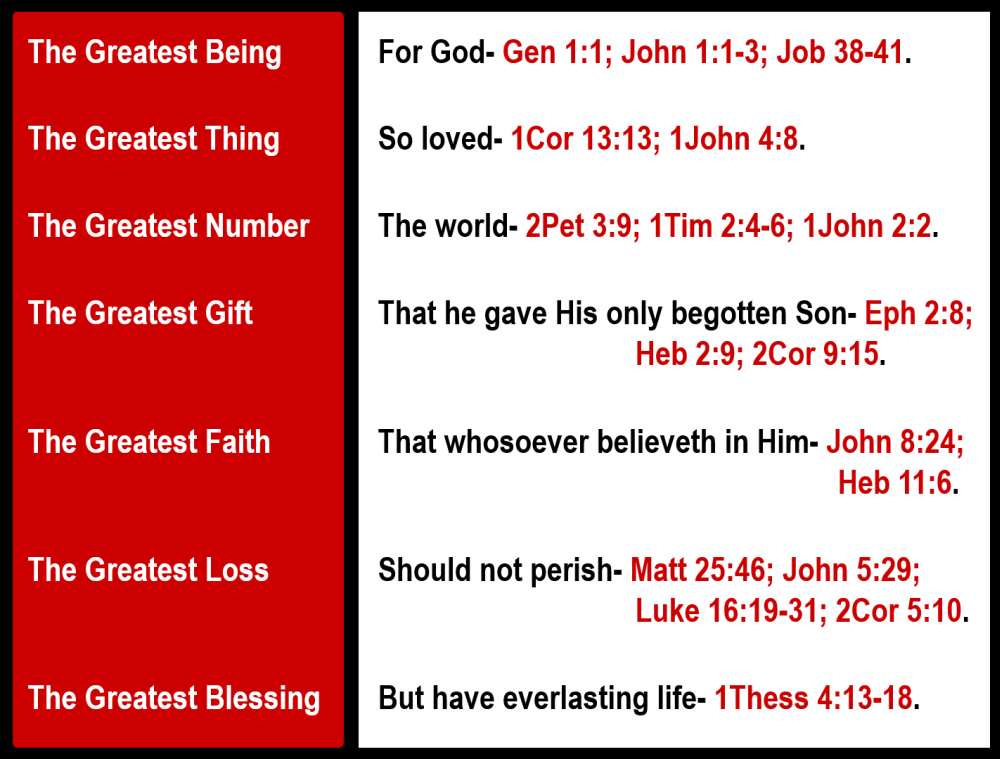
The Greatest Being

The verse begins with “FOR GOD.” The verse begins with the greatest being in existence. In Genesis 1:1, we read, “In the beginning, God created the heavens and the earth.” God is the Creator, the Alpha and the Omega, the beginning and the end. John 1:1-3 tells us, “In the beginning was the Word, and the Word was with God, and the Word was God. The same was in the beginning with God. All things were made by him; and without him was not any thing made that was made.” Job 38-41 presents a majestic depiction of God’s power and wisdom. Our faith rests upon the foundation of this greatest being, who is sovereign over all creation.

The Greatest Thing

Next, we see the greatest thing: “SO LOVED.” God is love. In 1Corinthians 13:13, we learn that “the greatest of these is love.” 1John 4:8 declares, “He that loveth not knoweth not God; for God is love.” God’s love is unparalleled and incomprehensible. It is a love that is willing to sacrifice, a love that seeks the well-being of others. It is the greatest thing because it defines the actions of the greatest being.

The Greatest Number

“THE WORLD.” This phrase encompasses the greatest number: the entire world. God’s love is not limited to a select few but extends to every person on this earth. 2Peter 3:9 states, “The Lord is not slack concerning his promise, as some men count slackness; but is longsuffering to us-ward, not willing that any should perish, but that all should come to repentance.” 1Timothy 2:4-6 reinforces this by saying, “Who will have all men to be saved, and to come unto the knowledge of the truth.” 1John 2:2 confirms that “And he is the propitiation for our sins: and not for ours only, but also for the sins of the whole world.” The greatest number shows the expanse of God’s love. God is not a respecter of persons (Rom 2:11).

The Greatest Gift

“THAT HE GAVE HIS ONLY BEGOTTEN SON.” In this we see the greatest gift. Ephesians 2:8 reminds us that “For by grace are ye saved through faith; and that not of yourselves: it is the gift of God.” Hebrews 2:9 tells us, “But we see Jesus, who was made a little lower than the angels for the suffering of death, crowned with glory and honour; that he by the grace of God should taste death for every man.” 2Corinthians 9:15 exclaims, “Thanks be unto God for his indescribable gift!” The greatest gift (grace) is God’s own Son, given for the redemption of mankind.

The Greatest Faith

“THAT WHOSOEVER BELIEVETH IN HIM.” This phrase highlights the greatest faith. Jesus declares in John 8:24, “I said therefore unto you, that ye shall die in your sins: for if ye believe not that I am he, ye shall die in your sins.” Hebrews 3:18-19 warns of the consequences of unbelief as seen through disobedience, while Hebrews 11:6 teaches that “without faith it is impossible to please God.” The greatest faith is an active belief in Jesus Christ as the Son of God and the Savior of the world (James 2:14-26).

The Greatest Loss

“SHOULD NOT PERISH.” The greatest loss is the eternal separation from God. While any can be saved, the bible tells us that not all will obey the Gospel (Matt 7:24-29; 2Thess 1:8-9). Matthew 25:46 warns of “everlasting punishment,” and John 5:29 speaks of those who will “resurrection of damnation.” The story of the rich man and Lazarus in Luke 16:19-31 vividly portrays the torment of those who perish. 2Corinthians 5:10 reminds us that “we must all appear before the judgment seat of Christ.” The greatest loss is the eternal consequence of rejecting God’s gift of salvation.

The Greatest Difference

“BUT.” While all may be saved, some won’t obey the gospel. “And being made perfect, he became the author of eternal salvation unto all them that obey him” (Heb 5:9). Some will hear, but not do; “Therefore whosoever heareth these sayings of mine, and doeth them, I will liken him unto a wise man, which built his house upon a rock: And the rain descended, and the floods came, and the winds blew, and beat upon that house; and it fell not: for it was founded upon a rock. And every one that heareth these sayings of mine, and doeth them not, shall be likened unto a foolish man, which built his house upon the sand: And the rain descended, and the floods came, and the winds blew, and beat upon that house; and it fell: and great was the fall of it.” (Matt 7:24-27). Many may confess Jesus as Lord and Savior, but not do what He says, “And why call ye me, Lord, Lord, and do not the things which I say” (Luke 6:46)?

The Greatest Blessing

“HAVE EVERLASTING LIFE.” Finally, we come to the greatest blessing. 1Thessalonians 4:13-18 describes the hope of the resurrection and the promise of eternal life with Christ. Everlasting life is the ultimate blessing, the fulfillment of God’s promise to those who believe.

John 3:16 is a verse that reveals to us the greatest being, the greatest thing, the greatest number, the greatest gift, the greatest faith, the greatest loss, and the greatest blessing. Let us hold fast to this truth, share it with others, and walk in the light of God’s incredible love and grace.

Agape, Spencer

Do we TRUST Jesus?

But Jesus said unto them, A prophet is not without honour, but in his own country, and among his own kin, and in his own house.” (Mark 6:4).

In Mark chapter six we see several scenes of varying levels of faith. Part of faith involves trust.

Jesus Rejected in Nazareth                               (Mark 6:1-6)

Sending Out the Twelve Apostles                    (Mark 6:7-13)

Herod’s Perplexity about Jesus                        (Mark 6:14-16)

John the Baptist Beheaded                               (Mark 6:17-29)

Feeding the Five Thousand                             (Mark 6:30-44)

Jesus Walks on Water                                      (Mark 6:45-52)

Healing in Gennesaret                                     (Mark 6:53-56)

Mark’s gospel may be the shortest of the four, but what it contains is of great help to us in our faith.

Let us take a glimpse at these scenes of trust.

In the first scene we find Jesus teaching in His own country and among His own people. Although many were astonished at His teaching, His wisdom, and His mighty works, they were offended at Him. His own people rejected Him. Now that’s astonishing!

But Jesus said unto them, A prophet is not without honour, but in his own country, and among his own kin, and in his own house. And he could there do no mighty work, save that he laid his hands upon a few sick folk, and healed them. And he marvelled because of their unbelief. And he went round about the villages, teaching” (Mark 6:4-6).

The next 3 scenes show differing levels of faith during times of uncertainty. The 12 apostles being sent out to preach, “And commanded them that they should take nothing for their journey, save a staff only; no scrip, no bread, no money in their purse” (v8). Then we see Herod’s perplexity about the identity Jesus, (14-17). The third is in the events leading to the death of John the baptizer at the birthday banquet for Herod, (18-29). From these we see faith, uncertain faith, and great faith.

Following these we come to another kind of banquet called the feeding of the 5,000 (30-44). This began with banquet of spiritual food because of the compassion of Jesus. Faith involves knowledge. Then Jesus is urged to send them away to go find physical food. He tells the 12, “Give ye them to eat.” Here we see another side of their faith when they say, “Shall we go and buy two hundred pennyworth of bread, and give them to eat?” Remember, they had just returned excitedly from preaching without any provisions.

The last scenes of faith are times of trouble. One a storm, the last the sick of Gennesaret (45-56; cf Matt 14:27-33). In the storm, after Jesus had sent the 12 away in boats, He comes to them walking on the water. It’s here that Peter wants confirmation by being allowed to walk on the water also. Peter indeed is able to walk on the water, but places his eyes on the storm, starts to fear, and begins to sink. “O thou of little faith, wherefore didst thou doubt?”

When they arrive at the shore we see an exact opposite response from the first of this chapter. “And when they were come out of the ship, straightway they knew him, And ran through that whole region round about, and began to carry about in beds those that were sick, where they heard he was. And whithersoever he entered, into villages, or cities, or country, they laid the sick in the streets, and besought him that they might touch if it were but the border of his garment: and as many as touched him were made whole.”

Agape,

Spencer

This is part 6 of a series called Preaching through Mark.

Seeking Jesus in Mark 5

In Mark chapter 5, we read about several encounters of those seeing Jesus. Amidst the miracles and interactions, these folks stand out, each exhibiting varying degrees of fear or awe towards Jesus. Let’s look at a few of their stories and see if their fear was justified, or why they ought to have no fear.

The Legion: The first in Mark 5, is a man possessed by a legion of demons. This legion, fearing Jesus, pleads not to be tormented. Their fear stems from the recognition of Jesus’ authority over the spiritual realm. They understand His power to cast them out and disrupt their malevolent activities. Their fear is justified, for Jesus indeed removes them from the man, demonstrating His supremacy over darkness.

The Citizens: Following the exorcism of the legion, the citizens of the region witness the transformation of the possessed man. Instead of rejoicing at this miraculous deliverance, they are gripped by fear and beg Jesus to leave their region. Their fear is rooted in the disruption caused by His power. They show no concern for the one who has been restored from his torments. Their fear is misplaced by priorities that lead them to reject Jesus, despite this miraculous deed.

The Exorcised Man: The man formerly possessed by is now clothed and in his right mind, sitting at Jesus’ feet. He has no fear of Jesus, but rather a desire to go with Him wherever He goes. He is instead told to “go home and tell,” where he boldly proclaims all that Jesus had done for him; and they marveled.  

Jairus: a synagogue leader, approaches Jesus in desperation, pleading for his daughter’s healing. Despite his high status in society, Jairus humbles himself before Jesus, acknowledging His power to heal. His fear is one of urgency and desperation, fueled by the impending death of his beloved daughter. Jairus’ faith outweighs his fear as he trusts in Jesus’ ability to perform the impossible. Unlike the denizens of the region who rejected Jesus, Jairus pleads with Him to come to his house.

The Woman with the Issue of Blood: Amidst the crowd pressing around Jesus, a woman suffering from a twelve-year hemorrhage reaches out in faith, believing that merely touching His garment would bring healing. Her fear is one of vulnerability and shame, as she has endured societal separation due to her condition. However, her faith overcomes her fear, and Jesus commends her for her courage and belief, declaring her healed.

In reflecting on these characters from Mark chapter 5, it becomes evident that fear can manifest in various ways when confronted with the divine presence of Jesus Christ. Some respond with reverence and faith, while others react with skepticism and rejection. Ultimately, those who approached Jesus with humility and trust found freedom, and healing, while those who allowed fear to hinder their faith miss out on the abundant blessings He offers.

Agape,

Spencer

This is part 6 of a series called Preaching through Mark.