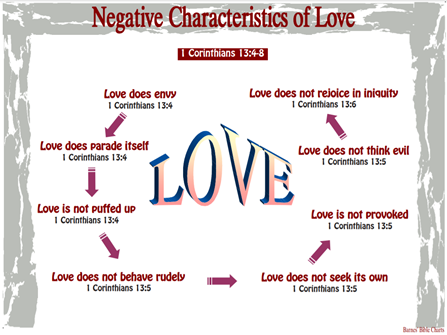
What’s LOVE got to do with it?

Love does not…

EVERYTHING!!

Love is the first & great commandment.

Paul calls love, “a more excellent way” [1Cor 12:31; 13:13].

“And Jesus answered him, The first of all the commandments is, Hear, O Israel; The Lord our God is one Lord: And thou shalt love the Lord thy God with all thy heart, and with all thy soul, and with all thy mind, and with all thy strength: this is the first commandment. And the second is like, namely this, Thou shalt love thy neighbour as thyself. There is none other commandment greater than these.” [Mark 12:29-31]

09-14-23 UPDATE ————————————-

In a world that has reduced love to just a feeling we need to understand Biblical love.

the culture of the day reminds me of the culture found in the book of judges; “In those days there was no king in Israel: every man did that which was right in his own eyes.” (Judges 21:25

Let’s be reminded of biblical love.

——————————————————————————–

The best commentary on Love is found in the Scriptures. Let’s see love from four perspectives.

  1. God’s Love for us
    1. God is Love – 1Jo 4:8 He that loveth not knoweth not God; for God is love. Titus 3:4-6
    2. God Gave His son – 1Jo 4:9, 10 In this was manifested the love of God toward us, because that God sent his only begotten Son into the world, John 3:16, 17; Rom 5:8; Eph 2:4,5
    3. God blesses His children – 1Jo 3:1 Behold, what manner of love the Father hath bestowed upon us, that we should be called the sons of God: Eph 1:3 every spiritual blessings
    4. Every good thing – James 1:17 – comes from above; Acts 17:28
    5. God sends sun & rain – Mt 5:45 for he maketh his sun to rise on the evil and on the good, and sendeth rain on the just and on the unjust.
  • Christ’s Love for us
    • Passes knowledge– Eph 3:19 And to know the love of Christ, which passeth knowledge, that ye might be filled with all the fulness of God.
    • As Father loved Him – Joh 15:9, 10 If ye keep my commandments, ye shall abide in my love; even as I have kept my Father’s commandments, and abide in his love.
    • He gave Himself – Joh 15:13 Greater love hath no man than this, that a man lay down his life for his friends.; Eph 5:2; 1Joh 3:16; Rev 1:5
    • His own– Joh 13:1, 34 A new commandment I give unto you, That ye love one another; as I have loved you, that ye also love one another.
    • Those who obey – Joh 14:21 He that hath my commandments, and keepeth them, he it is that loveth me: and he that loveth me shall be loved of my Father, and I will love him, and will manifest myself to him.
  • Man’s love for God & Christ
    • Great command– 1Jo 4:19 We love him, because he first loved us. Mark 12:28-30; Mt 22:36-40
    • Good thing for those that do – Ro 8:28 And we know that all things work together for good to them that love God, 1Corinthians 2:9 ings which God hath prepared for them that love him.
    • Crown of life / Kingdom – Jas 2:5 Hearken, my beloved brethren, Hath not God chosen the poor of this world rich in faith, and heirs of the kingdom which he hath promised to them that love him? [1:12]
    • Love displayed through obedience – 1Jo 5:3 For this is the love of God, that we keep his commandments:
      • 2Joh 6; John 14:15, 21, 23
    • Love for truth – 2Th 2:10-12 because they received not the love of the truth, that they might be saved.
  • Man’s love for others
    • Brethren – 1Th 4:9; 1Th 3:12 And the Lord make you to increase and abound in love one toward another, and toward all men, even as we do toward you:
      • John 13:34; 15:12; 1Pe 1:22; 2:17;
      • 1Jo 2:10, 3:11, 14, 23; 4:11, 12
      • 2Pe 1:7 And to godliness brotherly kindness; and to brotherly kindness charity.
    • Husbands & Wives – Eph 5:25, 28, 33; Col 3:19; Tit 2:3,4
    • Neighbor – Ro 13:8 Owe no man any thing, but to love one another: for he that loveth another hath fulfilled the law.
      • [Mr 12:31; James 2:8]
    • Enemies – Lu 6:35 But love ye your enemies, and do good, and lend, hoping for nothing again; and your reward shall be great, and ye shall be the children of the Highest:
      • Mt 5:43, 44 But I say unto you, Love your enemies, bless them that curse you, do good to them that hate you, and pray for them which despitefully use you, and persecute you;

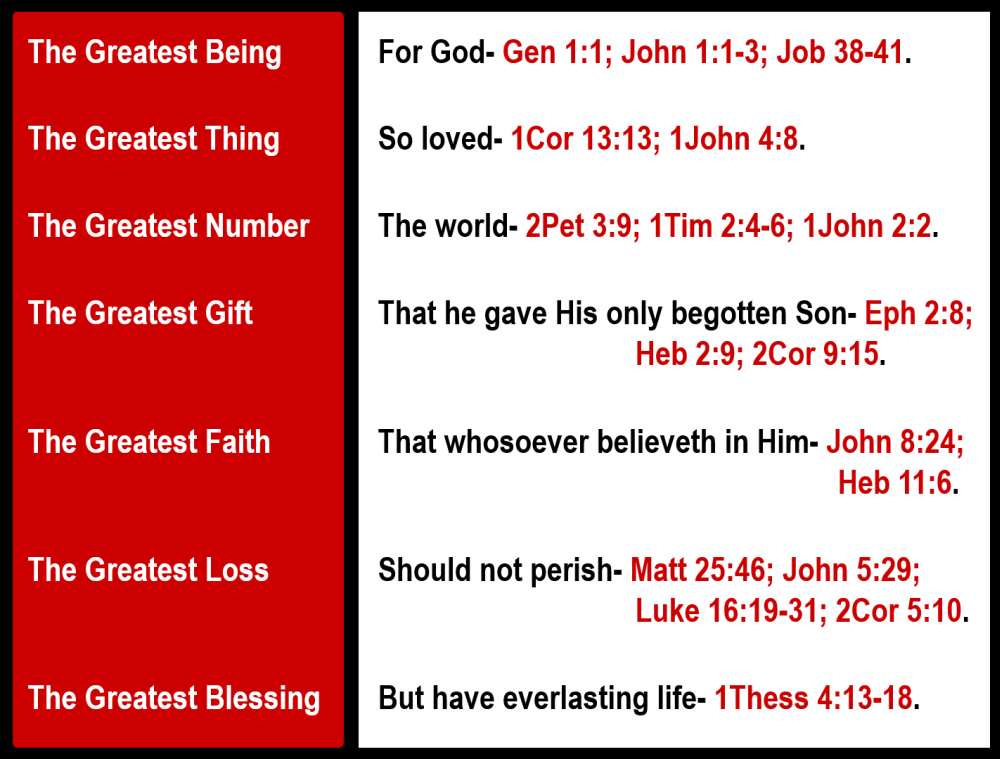
John 3:16, the greatest verse

The Greatest Being

The verse begins with “FOR GOD.” The verse begins with the greatest being in existence. In Genesis 1:1, we read, “In the beginning, God created the heavens and the earth.” God is the Creator, the Alpha and the Omega, the beginning and the end. John 1:1-3 tells us, “In the beginning was the Word, and the Word was with God, and the Word was God. The same was in the beginning with God. All things were made by him; and without him was not any thing made that was made.” Job 38-41 presents a majestic depiction of God’s power and wisdom. Our faith rests upon the foundation of this greatest being, who is sovereign over all creation.

The Greatest Thing

Next, we see the greatest thing: “SO LOVED.” God is love. In 1Corinthians 13:13, we learn that “the greatest of these is love.” 1John 4:8 declares, “He that loveth not knoweth not God; for God is love.” God’s love is unparalleled and incomprehensible. It is a love that is willing to sacrifice, a love that seeks the well-being of others. It is the greatest thing because it defines the actions of the greatest being.

The Greatest Number

“THE WORLD.” This phrase encompasses the greatest number: the entire world. God’s love is not limited to a select few but extends to every person on this earth. 2Peter 3:9 states, “The Lord is not slack concerning his promise, as some men count slackness; but is longsuffering to us-ward, not willing that any should perish, but that all should come to repentance.” 1Timothy 2:4-6 reinforces this by saying, “Who will have all men to be saved, and to come unto the knowledge of the truth.” 1John 2:2 confirms that “And he is the propitiation for our sins: and not for ours only, but also for the sins of the whole world.” The greatest number shows the expanse of God’s love. God is not a respecter of persons (Rom 2:11).

The Greatest Gift

“THAT HE GAVE HIS ONLY BEGOTTEN SON.” In this we see the greatest gift. Ephesians 2:8 reminds us that “For by grace are ye saved through faith; and that not of yourselves: it is the gift of God.” Hebrews 2:9 tells us, “But we see Jesus, who was made a little lower than the angels for the suffering of death, crowned with glory and honour; that he by the grace of God should taste death for every man.” 2Corinthians 9:15 exclaims, “Thanks be unto God for his indescribable gift!” The greatest gift (grace) is God’s own Son, given for the redemption of mankind.

The Greatest Faith

“THAT WHOSOEVER BELIEVETH IN HIM.” This phrase highlights the greatest faith. Jesus declares in John 8:24, “I said therefore unto you, that ye shall die in your sins: for if ye believe not that I am he, ye shall die in your sins.” Hebrews 3:18-19 warns of the consequences of unbelief as seen through disobedience, while Hebrews 11:6 teaches that “without faith it is impossible to please God.” The greatest faith is an active belief in Jesus Christ as the Son of God and the Savior of the world (James 2:14-26).

The Greatest Loss

“SHOULD NOT PERISH.” The greatest loss is the eternal separation from God. While any can be saved, the bible tells us that not all will obey the Gospel (Matt 7:24-29; 2Thess 1:8-9). Matthew 25:46 warns of “everlasting punishment,” and John 5:29 speaks of those who will “resurrection of damnation.” The story of the rich man and Lazarus in Luke 16:19-31 vividly portrays the torment of those who perish. 2Corinthians 5:10 reminds us that “we must all appear before the judgment seat of Christ.” The greatest loss is the eternal consequence of rejecting God’s gift of salvation.

The Greatest Difference

“BUT.” While all may be saved, some won’t obey the gospel. “And being made perfect, he became the author of eternal salvation unto all them that obey him” (Heb 5:9). Some will hear, but not do; “Therefore whosoever heareth these sayings of mine, and doeth them, I will liken him unto a wise man, which built his house upon a rock: And the rain descended, and the floods came, and the winds blew, and beat upon that house; and it fell not: for it was founded upon a rock. And every one that heareth these sayings of mine, and doeth them not, shall be likened unto a foolish man, which built his house upon the sand: And the rain descended, and the floods came, and the winds blew, and beat upon that house; and it fell: and great was the fall of it.” (Matt 7:24-27). Many may confess Jesus as Lord and Savior, but not do what He says, “And why call ye me, Lord, Lord, and do not the things which I say” (Luke 6:46)?

The Greatest Blessing

“HAVE EVERLASTING LIFE.” Finally, we come to the greatest blessing. 1Thessalonians 4:13-18 describes the hope of the resurrection and the promise of eternal life with Christ. Everlasting life is the ultimate blessing, the fulfillment of God’s promise to those who believe.

John 3:16 is a verse that reveals to us the greatest being, the greatest thing, the greatest number, the greatest gift, the greatest faith, the greatest loss, and the greatest blessing. Let us hold fast to this truth, share it with others, and walk in the light of God’s incredible love and grace.

Agape, Spencer

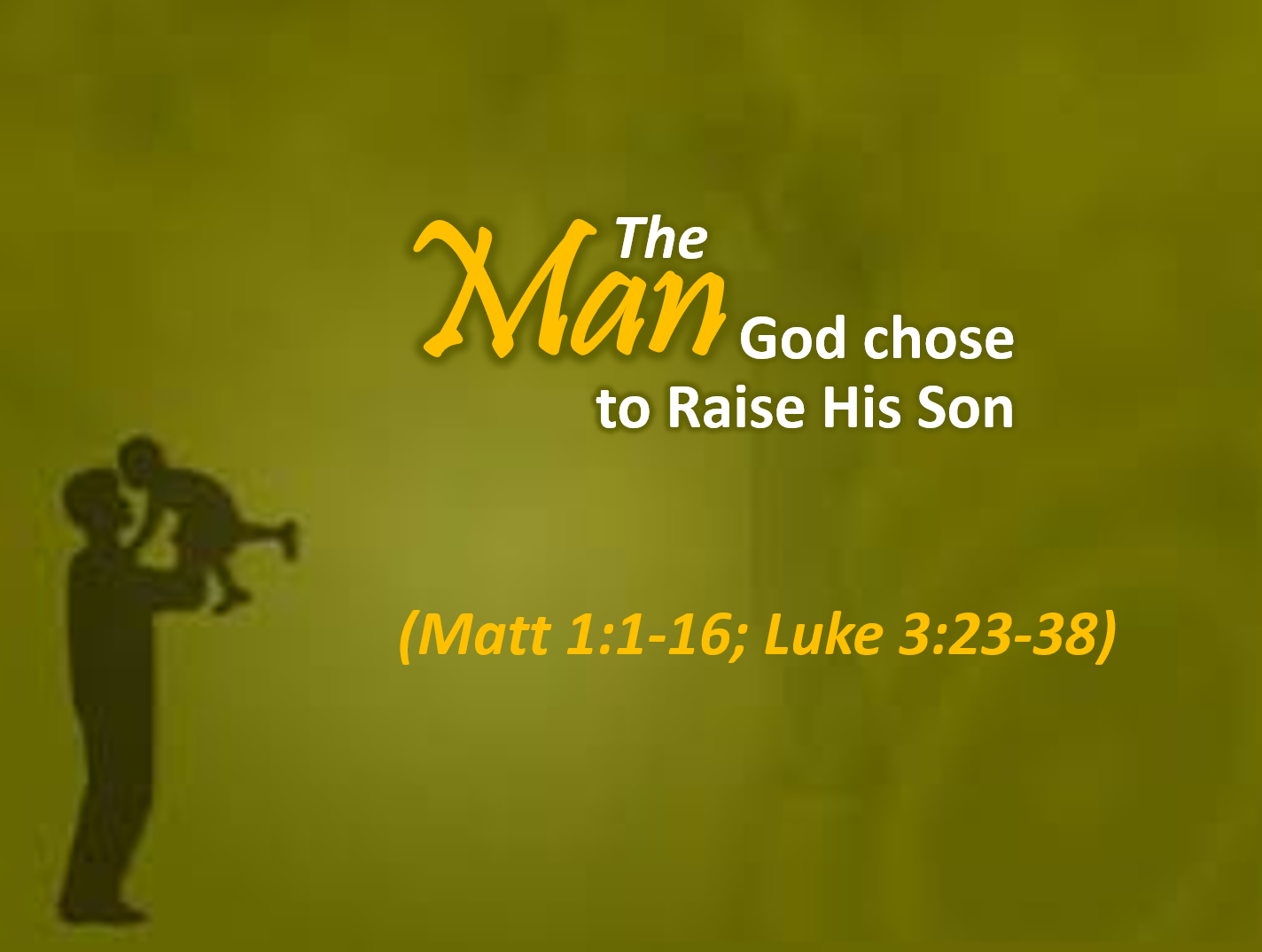
Joseph: the man God chose to raise His Son.

The Man God chose to Raise His Son.

Joseph’s life and actions, as depicted in the Gospels, offer an example of virtue and obedience, qualities that emphasize his critical role in the life of Jesus.

Described in the Gospel of Matthew as a “just man” (Matthew 1:19), Joseph’s character is first revealed through his merciful reaction to Mary’s unexpected pregnancy. Engaged to Mary, he discovers she is pregnant before they have come together, and knowing the child is not his, he faces a societal and personal crossroad. He chooses a path of kindness, intending to spare Mary from possible humiliation or harm, which alone sets a significant tone for his character.

Later, He is visited by an angel in a dream, instructing him to not fear taking Mary as his wife because the child conceived in her is from the Holy Spirit (Matthew 1:20). His response to this divine intervention highlights another of his virtues: obedience. Matthew 1:24-25 tells us that Joseph did as the angel of the Lord commanded; he took Mary as his wife and named the child Jesus. This act of faith and submission to God’s will shows him as a man deeply committed to following God’s direction without hesitation.

Later, he and Mary bring Jesus to the temple to present Him to the Lord as prescribed in the Law of Moses (Luke 2:22-24), and they make the annual pilgrimage to Jerusalem for Passover, demonstrating his commitment to his faith and his role as a spiritual guide to his family (Luke 2:41-43).

Joseph’s profession as a carpenter, mentioned in Matthew 13:55, underscores his role as a provider who earns a living for his family. Moreover, the offering described in Luke 2:24, “a pair of doves or two young pigeons,” which was allowed for those who could not afford a lamb, indicates that Joseph’s means were limited, yet he did what was necessary within his resources to fulfill his service to God (cf. 1Tim 5:8).

When Herod seeks to kill the newborn Jesus in Matthew 2:13-23, Joseph again heeds an angelic warning in a dream, this time to flee to Egypt, and later, to return to Nazareth, safeguarding his family from harm. These episodes not only portray him as a decisive protector but also as a man of action who places the safety and well-being of Mary and Jesus above his own comfort and security.

Lastly, Joseph’s honorable acceptance to adopt Jesus as his own son seals his legacy as a man of immense faith and virtue. This act of adoption was not merely a legal formality but a wholehearted acceptance of Jesus into his life, treating Him as his own and providing for Him as any father would, so that all knew Jesus as the son of Joseph and Mary. “And they said, Is not this Joseph’s son” (Luke 4:22; cf; John 6:42)?

Joseph’s life, therefore, offers a remarkable model of justice, obedience, scriptural fidelity, diligent earning, protection, and honor. In the grand narrative of Christianity, Joseph might often be seen in the background, but his influence and guidance were surely foreground in the early life of Jesus, the Savior of mankind. Through Joseph’s exemplary character, we see the qualities that God values in those He chooses.

Agape,

Spencer

Mark 1, My Beloved SON.

Chapter one of the Gospel of Mark may be concise, but it is full of information.

One could read this chapter as if it was the announcement and coronation of a King.

A New King has an announcement, “The beginning of the gospel of Jesus Christ, the Son of God” (Mark 1:1). To Romans and Jews, it would communicate the coming of a King.

A New King has a herald or a forerunner that announces the New King. In the Roman world, when someone took the throne, a messenger would go to all the villages announcing the good news of the King. John the Baptist serves as the forerunner of Jesus. “As it is written in the prophets, Behold, I send my messenger before thy face, which shall prepare thy way before thee. The voice of one crying in the wilderness, Prepare ye the way of the Lord, make his paths straight” (Mark 1:2-3).

John declares he is not the King. “There cometh one mightier than I after me, the latchet of whose shoes I am not worthy to stoop down and unloose” (Mark 1:7).

A New King has a coronation. This is when a King is anointed before all the people to identify the New King. When Jesus is baptized, the Holy Spirit comes upon Him. This was the sign given to John to identify the Christ. “And straightway coming up out of the water, he saw the heavens opened, and the Spirit like a dove descending upon him: And there came a voice from heaven, saying, Thou art my beloved Son, in whom I am well pleased” (Mark 1:10-11). “And I knew him not: but he that sent me to baptize with water, the same said unto me, Upon whom thou shalt see the Spirit descending, and remaining on him, the same is he which baptizeth with the Holy Ghost” (John 1:33).

A New King has an enemy to face. The New King brings peace by battling an enemy causing problems for the people. Jesus goes into the wilderness to battle against Satan. “And immediately the Spirit driveth him into the wilderness. And he was there in the wilderness forty days, tempted of Satan; and was with the wild beasts; and the angels ministered unto him” (Mark 1:12-13).

A New King has servants. We make note from above that Jesus has angels that ministered to Him. They didn’t come to prevent nor rescue Him from the battle against Satan. Consider the angels that brought Elijah food in the OT, (1Kings 19:5-8). It makes sense that these angels brought food for Jesus after having fasted 40 days in the wilderness.

A New King has a message. Jesus begins preaching; “Now after that John was put in prison, Jesus came into Galilee, preaching the gospel of the kingdom of God, And saying, The time is fulfilled, and the kingdom of God is at hand: repent ye, and believe the gospel” (Mark 1:14-15). This verse is significant in that it declares the prophecy from the Old Testament is fulfilled in Christ (cf. Dan 2:44; 7:14; 9:25)

A New King has followers and citizens. The first people called are four fishermen. The number will grow, but the text reveals that King Jesus has followers. “Now as he walked by the sea of Galilee, he saw Simon and Andrew his brother casting a net into the sea: for they were fishers. And Jesus said unto them, Come ye after me, and I will make you to become fishers of men. And straightway they forsook their nets, and followed him. And when he had gone a little further thence, he saw James the son of Zebedee, and John his brother, who also were in the ship mending their nets. And straightway he called them: and they left their father Zebedee in the ship with the hired servants, and went after him” (Mark 1:16-20).

Mark Chapter One is the announcing, coronation, and the beginning reign of our King.

Agape,

Spencer

This is part of a series of sermons preached at the Franklin & Juniper st church of Christ in Borger, Texas. Click here for Mark 2.

Preaching through the Gospel of Mark in 2024

Lord Willing, Each first Sunday of the month in 2024 will come from the Gospel of Mark. While there are 16 chapters in Mark and only 12 first Sundays, we will follow each chapter until chapter 12-16 which will have one sermon in December.

January: Mark 1. My Beloved SON.

February: Mark 2. Jesus is GOD.

March: Mark 3. Sinning against the Holy Spirit.

April: Mark 4. What Kind of SOIL am I?

May: Mark 5. Fearing Jesus, Mocking Jesus, Seeing Jesus.

June: Mark 6. How well do we TRUST Jesus?

July: Mark 7. LIP Service toward God.

August: Mark 8. The Value of a SOUL.

September: Mark 9. HEAR Him.

October: Mark 10. What do you WANT me to do?

November: Mark 11. From Heaven for from Men?

December: Mark 12-16. What did Judas BRING to the garden?

We invite you to attend one of our services at the Franklin & Juniper St church of Christ in Borger Texas.

Let’s talk about Jesus #5; He FORGIVES sin

Copyright Rob Baker, used with permission.

When Jesus saw their faith, he said unto the sick of the palsy, Son, thy sins be forgiven thee.

(Mark 2:5).

When speaking about Jesus, we must remember that He is able to forgive us our SINS. “And he is the propitiation for our sins: and not for ours only, but also for the sins of the whole world” (1John 2:2).

Some see license to sin in the above verse, but when carefully reading the context they’ll see the exact opposite. “My little children, these things write I unto you, that ye sin not. And if any man sin, we have an advocate with the Father, Jesus Christ the righteous” (1John 2:1).

For all have sinned, and come short of the glory of God” (Rom 3:23). We all sin, but what is that? Sin Separates us from God and is against Him, (Isa 59:2). It Imprisons us, (Rom 6:16; 23), and we have Nothing to pay the cost (Rom 3:23).

We need the forgiveness of Christ.

Sadly, some say their sin is so bad that Jesus can’t forgive them, or still feel guilt even after having faithfully obeying the gospel. Maybe we need a reminder of the sins Jesus FORGIVES for those that obey Him. We have a couple of lists of sins that Saints can have forgiven through Christ.

Jesus forgives Fornicators and all manner of sexual sins. “Know ye not that the unrighteous shall not inherit the kingdom of God? Be not deceived: neither fornicators, nor idolaters, nor adulterers, nor effeminate, nor abusers of themselves with mankind, Nor thieves, nor covetous, nor drunkards, nor revilers, nor extortioners, shall inherit the kingdom of God. And such were some of you: but ye are washed, but ye are sanctified, but ye are justified in the name of the Lord Jesus, and by the Spirit of our God” (1Cor 6:9-11). Notice that it says, “such WERE some of you.” They had repented and been forgiven, but how? It says, “ye are WASHED.” How were they washed? Look to what the writer said had happened to him when he obeyed the gospel. “And now why tarriest thou? arise, and be baptized, and wash away thy sins, calling on the name of the Lord” (Acts 22:16). Paul had his sins washed away through his faithful baptism in water.

Jesus forgives Outbursts of wrath, Drunkenness and Revelries which are works of the flesh. “Now the works of the flesh are manifest, which are these; Adultery, fornication, uncleanness, lasciviousness, Idolatry, witchcraft, hatred, variance, emulations, outbursts of wrath, strife, seditions, heresies, Envyings, murders, drunkenness, revellings, and such like: of the which I tell you before, as I have also told you in time past, that they which do such things shall not inherit the kingdom of God” (Gal 5:19-21). This passage shows that Jesus also forgives our Greed, Idolatry, theft, strife, and seditions. 

Jesus even forgives Violent & Murderous crimes as seen in the forgiveness of Paul. As Saul of Tarsus, he once persecuted the church of Christ. “I verily thought with myself, that I ought to do many things contrary to the name of Jesus of Nazareth. Which thing I also did in Jerusalem: and many of the saints did I shut up in prison, having received authority from the chief priests; and when they were put to death, I gave my voice against them. And I punished them oft in every synagogue, and compelled them to blaspheme; and being exceedingly mad against them, I persecuted them even unto strange cities” (Acts 26:9-11).

 He too found forgiveness in Christ; “This is a faithful saying, and worthy of all acceptation, that Christ Jesus came into the world to save sinners; of whom I am chief. Howbeit for this cause I obtained mercy, that in me first Jesus Christ might shew forth all longsuffering, for a pattern to them which should hereafter believe on him to life everlasting. Now unto the King eternal, immortal, invisible, the only wise God, be honour and glory for ever and ever. Amen.” (1Tim 1:15).

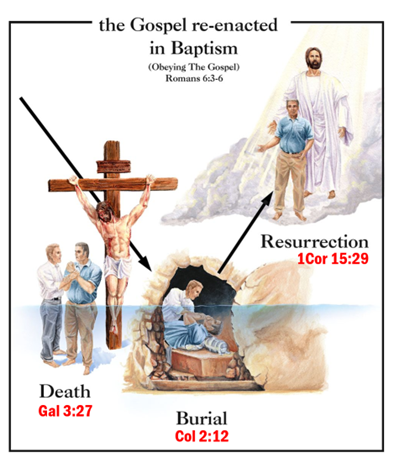
As noted above, we know how he obtained mercy; by obeying the Gospel, “And now why tarriest thou? arise, and be baptized, and wash away thy sins, calling on the name of the Lord” (Acts 22:16). It is what he taught everyone, “Know ye not, that so many of us as were baptized into Jesus Christ were baptized into his death? Therefore we are buried with him by baptism into death: that like as Christ was raised up from the dead by the glory of the Father, even so we also should walk in newness of life. For if we have been planted together in the likeness of his death, we shall be also in the likeness of his resurrection: Knowing this, that our old man is crucified with him, that the body of sin might be destroyed, that henceforth we should not serve sin” (Romans 6:3-6).

Jesus also forgives all manner of Evil, Envy, “and Such like” (Gal 5:21b).

Jesus FORGIVES sin. He has the power and the authority to forgive us of all unrighteousness, but we must obey the gospel and be faithful to Him. “Though he were a Son, yet learned he obedience by the things which he suffered; And being made perfect, he became the author of eternal salvation unto all them that obey him” (Hebrews 5:8-9).

There is only one sin that never has forgiveness. “Verily I say unto you, All sins shall be forgiven unto the sons of men, and blasphemies wherewith soever they shall blaspheme: But he that shall blaspheme against the Holy Ghost hath never forgiveness, but is in danger of eternal damnation” (Mark 3:28-29).

What is this unforgiveable sin? It is any unrepentant sin that a person is unwilling to put away before death or the return of Christ. This is the blasphemy of the Holy Spirit. Disobedience to the gospel is blaspheme of the Spirit, for it was the Holy Spirit that has revealed to us the commands of God through the inspired word. If we are unwilling to repent, we are committing the “sin leading to death” (1John 5:16).

This is the confidence we have in Christ, the forgiveness of sins. “My little children, these things write I unto you, that ye sin not. And if any man sin, we have an advocate with the Father, Jesus Christ the righteous: And he is the propitiation for our sins: and not for ours only, but also for the sins of the whole world. And hereby we do know that we know him, if we keep his commandments” (1John 2:1-3).

Jesus has power to FORGIVE sins.

Agape,

Spencer

Spencer is an evangelist for the Franklin & Juniper st church of Christ in Borger, Tx.

This is part of a series of articles about reasons to Talk About Jesus.

Let’s Talk about Jesus, the Eternal Life Giver

“Thou hast the words of eternal life.”

The statement above is one of the most significant realizations a person can make. (John 6:68)

There are 3 life questions that many folks ask about life…

Where are we from?

Why are we here?

Where are we going?

To answer these questions, one needs a divine source. Jesus is the answer to these questions, and His written word is where we will find His answers.

Let’s see how Jesus is the answer to the question of where we are going.

He has the words of ETERNAL LIFE.

There are some 30 specific references in the New Testament to “ETERNAL LIFE.” It seems to this writer that this holds some significance.

Jesus said, “Take my yoke upon you, and LEARN OF ME; for I am meek and lowly in heart: and ye shall find rest unto your souls.” (Matt 11:29) The context of this verse is about learning. “HEARING” is another way the Bible says the same thing. “Therefore whosoever heareth these sayings of mine, and doeth them, I will liken him unto a wise man, which built his house upon a rock:” (Mat 7:24). These verses clearly teach there is individual responsibility to Hear & LEARN. Some would have you believe that we’re unable to do either except miraculously. UNTRUE! We are all called by the Gospel message. “Whereunto he called you by our gospel, to the obtaining of the glory of our Lord Jesus Christ.” (2Thess 2:14).

Paul wrote to Timothy to remind Saints to “Give diligence to present thyself approved unto God, a workman that needeth not to be ashamed, handling aright the word of truth” (2Tim 2:15 ASV). The discourse of Jesus in John 6:26-68 is all about believing and learning of Christ. “I am the living bread which came down out of heaven” (John 6:51). Compare this to what Jesus said to the Devil, “It is written, Man shall not live by bread alone, but by every word that proceedeth out of the mouth of God” (Matt 4:4).

The beginning of attaining Eternal Life is LEARNING.

—-

Matthew 7:24-29 is a link in the chain connecting the first action with the next; we must be INVOLVED in doing the things that we’ve LEARNED. We’re involved by obeying the commands of God. “Therefore whosoever heareth these sayings of mine, and doeth them, I will liken him unto a wise man, which built his house upon a rock: And the rain descended, and the floods came, and the winds blew, and beat upon that house; and it fell not: for it was founded upon a rock. And every one that heareth these sayings of mine, and doeth them not, shall be likened unto a foolish man, which built his house upon the sand: And the rain descended, and the floods came, and the winds blew, and beat upon that house; and it fell: and great was the fall of it.”

The clear teaching by Jesus here, and in other places (cf. Phil 2:12), is that the INDIVIDUAL is responsible to LEARN & get INVOLVED in his own salvation. “Save yourselves from this untoward generation.” (Acts 2:40b). In the immediate context of this verse, they LEARNED to be baptized in the name of Jesus. “Then they that gladly received his word were baptized: and the same day there were added unto them about three thousand souls. (Acts 2:41).

James wrote under the influence of the Holy Spirit, “But be ye doers of the word, and not hearers only, deluding your own selves. For if any one is a hearer of the word and not a doer, he is like unto a man beholding his natural face in a mirror: for he beholdeth himself, and goeth away, and straightway forgetteth what manner of man he was. But he that looketh into the perfect law, the law of liberty, and so continueth, being not a hearer that forgetteth but a doer that worketh, this man shall be blessed in his doing” (James 1:22-25).

Eternal Life is for those INVOLVED people that obey.

—-

When we write articles like this some will often decry “LEGALISM” or say that we’re working our way into heaven. Nothing of the sort is being said. Obedience to the will of God is FAITH (Heb 11:6). We trust that God will do what He promises for those that obey Him. God works through our faith. “Buried with him in baptism, wherein also ye are risen with him through the faith of the operation of God, who hath raised him from the dead.” (Col 2:12). Eternal Life is for those who are emotionally engaged.

Therefore, that the person striving for Eternal Life must have FAITH from the heart and is not just checking boxes on a list. Jesus said, “Thou shalt love the Lord thy God with all thy heart, and with all thy soul, and with all thy mind.” (Mat 22:37). He said in another place, “If ye love me, keep my commandments” (John 14:15). And also, “This people honoureth me with their lips, but their heart is far from me.” (Mark 7:6). Those that have Eternal Life in Christ have their whole heart, mind, and soul engaged.

Eternal Life is for those that have FAITH.

—-

It then stands to reason that as a person LEARNS, is INVOLVED, this person must FINISH what he began. “For which of you, intending to build a tower, sitteth not down first, and counteth the cost, whether he have sufficient to finish it?” (Luke 14:28) The clear teaching here, and other places (cf. John 15:1-6; Rom 11:21), is that there’s no such thing as “once saved, always saved.” The Hebrew writer warned, “but Christ as a son, over his house; whose house are we, if we hold fast our boldness and the glorying of our hope firm unto the end” (Hebrews 3:6).

Eternal Life is for those that ENDURE to the end.

Agape,

Spencer is an evangelist for the Franklin & Juniper st church of Christ in Borger, Tx.

This is part of a series of articles about reasons to Talk About Jesus.

Let’s Talk about Jesus, the Joy Giver

We have no need of a season to talk about our Lord. Let it be continually on the tip of our tongue. While everyone around us is scurrying to find a reason for the season, we already have reason to rejoice.

Let’s talk about Jesus” will be the theme of the next several articles. It’s not because I desire to put Christ back into Christmas, He never really was part of that holiday. I write about things that are already on people’s minds, and perhaps we can persuade them to look into the True Jesus of the Bible (2Cor 11:4).

Since this is the season of giving and joy, in this first article Let’s talk about Jesus as being the Real Joy Giver. To do that we will look at the JOYS in Jesus from the book of Philippians.

This book is described as the book of Joy. Over and over, we can see the words “Joy” & “rejoice.”  This book is also one of the “prison epistles” of Paul, which makes those words even more astounding.

Let’s talk about the JOYS of Jesus.

JESUS IS PREACHED. While Paul was imprisoned for the cause of Christ (1:13), he found joy because JESUS was being preached. “What then? notwithstanding, every way, whether in pretence, or in truth, Christ is preached; and I therein do rejoice, yea, and will rejoice” (1:18). Some preached Christ out of insincerely, and out of contention, seeking to add to Paul’s bonds. While others preached Jesus out of Love and Good will. Paul rejoiced that Jesus is preached, and that many brethren had grown bolder. They preached boldly the word of Jesus without fear (1:14).

We can rejoice today knowing that Jesus is being preached. Certainly, many preach from error, but I see it as an opportunity to preach boldly the word of Jesus from sincerity and truth. Instead of taking the negative nelly approach, we can ask friendly questions to help folks think accurately about the truth. One was is to ask about the birth story of Christ. Here are a couple of ice-breaker questions to Preach Jesus more accurately (cf. Acts 8:26).

How many wise men are listed in the nativity story (Matt 2:1-12)?

How old was Jesus when the wise men came to Him (Matt 2:11-16)?

Open up your bible and show the answers to these questions. Perhaps a deeper discussion will occur because we were bold to preach Jesus.

ONE MIND IN CHRIST. Paul called for the Joy of having unity, ONE MIND in CHRIST. “If there be therefore any consolation in Christ, if any comfort of love, if any fellowship of the Spirit, if any bowels and mercies, Fulfil ye my joy, that ye be likeminded, having the same love, being of one accord, of one mind. Let nothing be done through strife or vainglory; but in lowliness of mind let each esteem other better than themselves” (Phil 2:1-3). Joy would be made complete when we have the same LOVE, being of one ACCORD (harmony), and of one MIND.

Does it bring you Joy to know that there are others out there who have come to the same conclusions when they read and study the truth for themselves? While the world is on a mission to have contrarian view points on everything, there is Joy in the church when folks from different backgrounds and walks of life come together in Unity having learned the truth and obey it. “Endeavouring to keep the unity of the Spirit in the bond of peace. There is one body, and one Spirit, even as ye are called in one hope of your calling; One Lord, one faith, one baptism, One God and Father of all, who is above all, and through all, and in you all” (Eph 4:2-6).

When we talk with folks about our faith with joy, we might meet someone who is coming to the same conclusions. Part of my evangelism is around seeking seekers. I’ve met several folks (pray for the seed to grow) who have started to question the practices in their religion. 

YOU AND I ARE TO REJOICE IN THE LORD. Paul continued to write about joy even as he gave warning about false teachers. “Finally, my brethren, rejoice in the Lord. To write the same things to you, to me indeed is not grievous, but for you it is safe. Beware of dogs, beware of evil workers, beware of the concision” (Phil 3:1-2). It seems a bit odd to rejoice in the midst of false teachers, but as you read you will see that it makes perfect sense. Because we know the truth, and how to recognize error, we can have Joy and Rejoice knowing that we have a home in heaven! “For our conversation is in heaven; from whence also we look for the Saviour, the Lord Jesus Christ: Who shall change our vile body, that it may be fashioned like unto his glorious body, according to the working whereby he is able even to subdue all things unto himself” (Phil 3:20-21).

While we still have the same problem today, let us rejoice in the fact we have the wisdom to recognize it, and that we have God’s word available to show the truth to others.

STRENGTHENED BY CHRIST. Paul could rejoice in all of these seemingly difficult obstacles to the cause of Christ because he drew his strength from Christ. “I can do all things through Christ which strengtheneth me” (4:13). He wasn’t saying that he could do whatever he wanted through Christ. He was saying that he could be strengthened to endure all the hardships of preaching Jesus as an Apostle and evangelist through Christ.

While we’re surrounded by a vexing world (2Pet 2:7-9), we can have the same joy and strength through the truth of God’s word. We can have joy because we have heard the truth, believed the truth, and obeyed the truth. We can have joy knowing that our names are written above in the Lamb’s book of life.

And I intreat thee also, true yokefellow, help those women which laboured with me in the gospel, with Clement also, and with other my fellowlabourers, whose names are in the book of life. Rejoice in the Lord alway: and again I say, Rejoice (Phil 3:3-4).

Agape,

Spencer is an evangelist for the Franklin & Juniper st church of Christ in Borger, Tx.

This is part of a series of articles about reasons to Talk About Jesus.