JESUS SAID, “If ye continue in my word, then are ye my disciples indeed; And ye shall know the truth, and the truth shall make you free.” [John 8:31-32]
Jesus orders us to “continue in my word,” and He connects it to the truth. (cr. John 17:17) When we keep His word, the truth, we will be FREE!
FREE from what? From what does obeying the word of God set us FREE?
We’re used to having liberty in our country (free speech, right to assemble etc.), but most fail to realize they’re in bondage.
Let’s search the scriptures to learn from what we’ve been set FREE.
The Truth shall set us FREE from:
The FEAR of death. “O death, where is thy sting? O grave, where is thy victory?” [1Cor. 15:56,57]. “For God hath not given us the spirit of fear; but of power, and of love, and of a sound mind.” [2Tim 1:7]
Being set free from the FEAR of Death is a powerful blessing from obeying Christ. By extension, we are FREE from the FEAR of men. “We ought to obey God rather than men.” [Acts 5:29].
The truth also sets us FREE to pursue RIGHTEOUSNESS. Prior to knowing (& obeying Gal 5:7) the truth we were in bondage to sin and free FROM righteousness. Now we are FREE from sin to pursue RIGHTEOUSNESS. “Being then made free from sin, ye became the servants of righteousness.” [Rom 6:18-20].
This does not mean that we can’t sin [1John 1:8-10], nor does it give us license to sin. Rather, it is teaching that we can have assurance on how to live faithfully, and avoid sin.
Another thing from which we’ve been set FREE is found in the letter to the Galatians. Paul reminded the saints that Christ set them FREE from the ENTAGLEMENT of the Law of Moses. “Stand fast therefore in the liberty wherewith Christ hath made us free, and be not entangled again with the yoke of bondage.” [Gal. 5:1; cr. 2:4; 4:9;]
Returning to the Law of Moses is tantamount to going back into bondage. It’s sad when folks appeal to the OT for NT practices, thereby becoming ENTANGLED in bondage. “Cursed is every one that continueth not in all things which are written in the book of the law to do them.” [Gal 3:10]. “But now we are delivered from the law, that being dead wherein we were held; that we should serve in newness of spirit, and not in the oldness of the letter.” [Rom. 7:6].
Going back to Romans we learn one more thing. Having been set FREE from sin, we may now have EVERLASTING LIFE. “But now being made free from sin, and become servants to God, ye have your fruit unto holiness, and the end everlasting life.” [Rom. 6:22]
None of the above will happen if we are ignorant of the truth. Remember, it is continuing in the TRUTH that sets us FREE. Before we can continue in it, we must first be in it.
…we become one of His disciples. HOW do I become a disciple of Christ? Remember, Jesus said, “If ye continue in my word, then are ye my disciples indeed; And ye shall know the truth, and the truth shall make you free.” [John 8:31-32] To become His disciple we must obey the Gospel. Before He ascended into heaven He gave this command, “Go ye therefore, and make disciples of all the nations, baptizing them into the name of the Father and of the Son and of the Holy Spirit:” [Matt 28:19 (ASV)]
The Gospel is what calls us [2Thess. 2:14]. By hearing the truth, we can then believe that Jesus is the Christ [John 20:30-31; Rom 10:17].
By hearing and believing the truth, we learn to repent [Luke 13:3], and we learn to confess that Jesus is the Christ [Act 8:37].
By hearing and believing the truth, we learn to be baptized for the remission of sins. [Acts 2:38; 22:16; Mark 16:16].
Being set FREE occurs AFTER obeying the gospel. The Gospel is the Death, Burial, and Resurrection of Jesus [1Cor 15:1-4]. Obeying the Gospel is the Death, Burial, and Resurrection of us through water baptism [Rom 6:3-4].
Obey the Gospel and be set FREE.
— spencer
Spencer is a gospel preacher residing in Borger Texas where he works with the congregation that meets at Franklin & Juniper streets.
Paul wrote to the Galatians warning about those that were troubling them over the GOSPEL. He called it
a different gospel
a perversion
an other gospel
He said that there is not another GOSPEL, and that the GOSPEL they heard originally was not from men, nor did it come from men. He said, “But though we, or an angel from heaven, preach any other gospel unto you than that which we have preached unto you, let him be accursed.” (Gal 1:8,9).
Very strong words with critical consequences. So critical that he says it twice!
Rather than list all the ways the Gospel can by perverted, let’s see what is the GOSPEL.
The GOSPEL literally means, “GOOD NEWS.” This Greek word for the GOSPEL is from the root word for evangelist. But it’s not enough to just be GOOD NEWS. The GOSPEL is GOOD NEWS from GOD. More than that, the GOSPEL is the GOOD NEWS about the GRACE of GOD. “But none of these things move me, neither count I my life dear unto myself, so that I might finish my course with joy, and the ministry, which I have received of the Lord Jesus, to testify the gospel of the grace of God.” (Acts 20:24)
As one looks up every one of the 98 verses where the word is used, they would find that the GOSPEL is something to be OBEYED. If it is to be OBEYED, then there is something we must do. “For the time is come that judgment must begin at the house of God: and if it first begin at us, what shall the end be of them that obey not the gospel of God?” (1Peter 4:17; cf. 2Thess 1:8).
As we look for those things we must do, we learn that a person must do these five things in order…
So, the GOSPEL is the Good News of the Grace of God, and is to be Obeyed, but for what reason? A search of the scriptures shows that the GOSPEL is for the SALVATION of mankind. “Moreover, brethren, I declare unto you the gospel which I preached unto you, which also ye have received, and wherein ye stand; By which also ye are saved, if ye keep in memory what I preached unto you, unless ye have believed in vain.” (1Cor 15:1-2; cf. 2Tim 1:10; Eph 1:13)
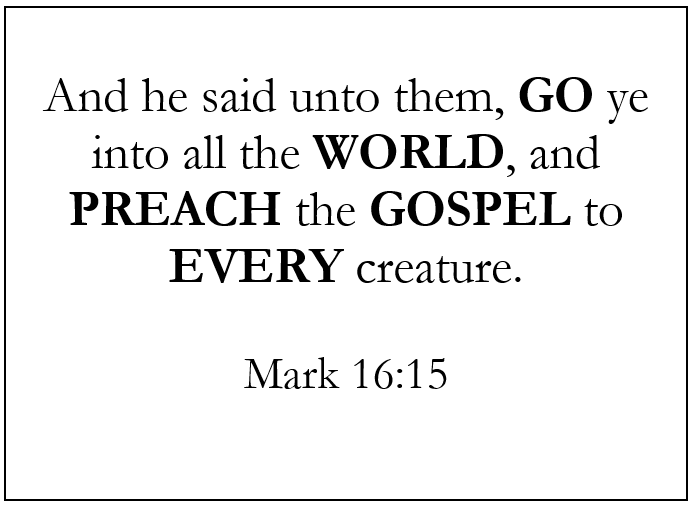
Continuing our research of the scriptures, two more ideas about the GOSPEL come to our attention. The GOSPEL is the “power of God unto salvation;” (Rom. 1:16), and that it is the Good News to be PREACHED by people by people. “Go ye into all the world, and preach the gospel to every creature.” (Mark 16:15) We have no other thing by which we shall reach people. We are limited to the Power of God through Preaching the Gospel.
Another important thing related to the GOSPEL of the GRACE of GOD, is that it is to be preached to EVERY CREATURE (Mark 16:15; cf Mark 13:10; 14:9). The GOOD NEWS of the GRACE of GOD regarding the SALVATION of man is not to be withheld from any person. To do so would be showing partiality and judging unrighteous judgment (cf. Matt 7:1-2).
The last thing one may notice in their study about the GOSPEL is that it is to be preached out of LOVE (Phil 1:15-17), and it is to be LIVED out for the remainder of our lives. “Only let your conversation be as it becometh the gospel of Christ:” (Phil 1:27)
The GOSPEL is the Good News of the Grace of God, it is to be Obeyed so that we may be Saved, this Power message is to be Preached to Every creature out of Love, and it is be Lived out daily in the life of the those that have received its power.
— spencer
Spencer is an evangelist in Borger Texas. He has labored with the Franklin & Juniper St church of Christ for the last 8 years.
Just about everyone knows that Jesus taught with parables. If you were to say the world parable, folks would automatically think of Jesus.
The PURPOSE of the parables is explained in scripture.
“And the disciples came, and said unto him, Why speakest thou unto them in parables? He answered and said unto them, Because it is given unto you to know the mysteries of the kingdom of heaven, but to them it is not given. For whosoever hath, to him shall be given, and he shall have more abundance: but whosoever hath not, from him shall be taken away even that he hath. Therefore speak I to them in parables: because they seeing see not; and hearing they hear not, neither do they understand. And in them is fulfilled the prophecy of Esaias, which saith, By hearing ye shall hear, and shall not understand; and seeing ye shall see, and shall not perceive:” (Matt 13:10-14).
We will notice that parables were part of PROPHECY which contributed to identifying Jesus as the Christ. “I will open my mouth in a parable:” (Psalm 78:2)
We will also notice that parables ASSIST people in understanding the lessons from Christ. We can easily identify the example in the parable to discover His teaching.
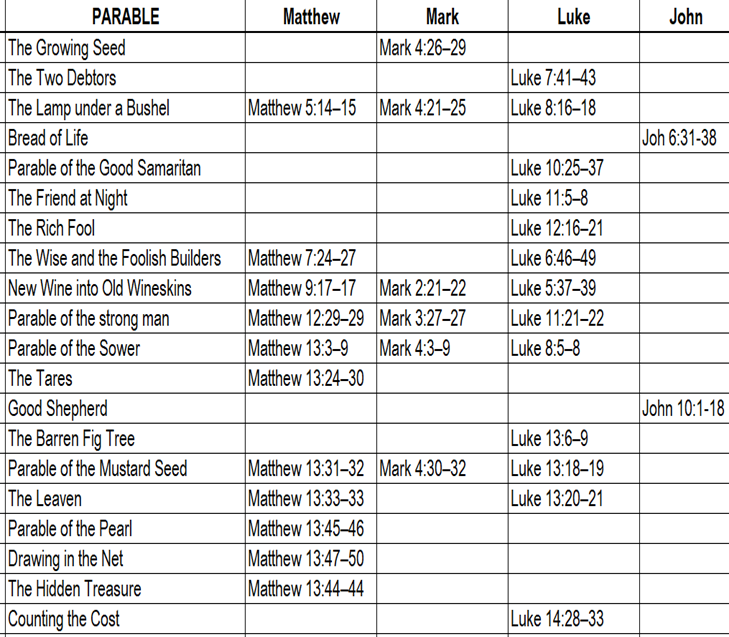
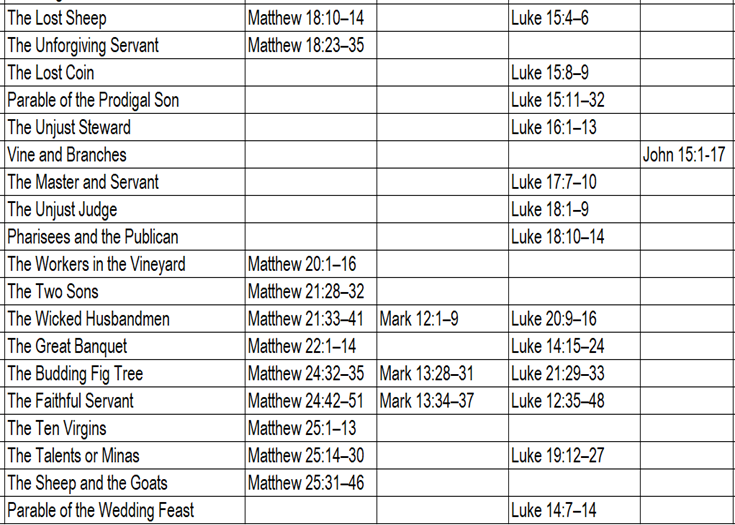
If you’ll look at the list of the parables you notice that Christ uses REAL life scenarios to explain His teachings. (ie. a sower)
Parables will ALLOW the seekers to see, but the BLIND not to see. Christ never keeps life saving truth from anyone, but some just don’t want it, hence they’re BLIND.
The meaning of the word parable is; to LAY along side. (cf. W.E. Vines). “And he said, Whereunto shall we liken the kingdom of God? or with what comparison shall we compare it?” (Mark 4:30)
Another way to describe a parable is as an EXTENDED metaphor or simile. It’s not intended to be mysterious, concealing, nor prevent the truth seeker from understanding.
Ultimately, a parable is a SPIRITUAL lesson using an understood physical scenario. Jesus uses a known thing to explain SPIRITUAL things.
“And he said unto them, Know ye not this parable? and how then will ye know all parables?” (Mark 4:13)
On the following page is a list of all the parables (I think). Luke carries the most parables. While many people categorize them in different ways, I’ve identified seven. Prayer Parables, Kingdom Parables, Forgiveness Parables, Christ Parables, Parables of the Lost, Readiness Parables, and Stewardship Parables.
Let’s get serious for a moment. All jokes aside, the slapping of Chris Rock by Will SMITH was a low moment in each of their lives. Chris making an inappropriate joke. Will’s physical assault to defend his wife’s honor. Jada’s janky past. It’s hard to tell who’s the victim.
As the crowd rushes to the internet with their memes in hand, it is very easy to be swept up in the frenzy and grab our own memes to throw. Before we hit ‘send’ (again), let’s LISTEN to the wisdom of our Lord.
In John 8, we may see similarities that can shed some light on our current condition. “Teacher, this woman was caught in adultery, in the very act. Now Moses, in the law, commanded us that such should be stoned. But what do You say?” (see John 8:3-11)
It’s easy to stand on the outside casting judgment on the sinful, maybe crack a joke or two. That’s where we see these folks in John 8, and where we find ourselves in the Rock / Smith Slap.
Without giving APPROVAL to the sin of adultery, (and by extension, not giving APPROVAL to Chris & Will), Jesus presses pause on the minds of the crowd to give them time to reflect. “He who is without sin among you, let him throw a stone at her first.”
You see, neither were in good standing with God. The woman caught in the very act, nor the accusers with their janky past and their stones of judgment. “Then those who heard it, being convicted by their conscience, went out one by one, beginning with the oldest even to the last.”
When I ask this same question of myself as I’m cracking the jokes, or casting the stones of judgment, I’m convicted. Which of us has not LOST their cool?
Before we step up and cast our stones of judgment, let’s take a moment to think. Which one of us hasn’t LOST his cool in the heat of the moment? Who hasn’t offended another, been offended by another, or has a janky past?
Perhaps I can take a moment to silently (and privately) write in the sand those things I’ve said and done when I last LOST control of myself.
“He who is slow to anger is better than the mighty, And he who rules his spirit than he who takes a city.” (Prov 16:32)
I’m convicted. “God, be merciful to me a sinner!” (Luke 18:13)
What do I do now with that SLAP heard ‘round the world? Press PAUSE, or better yet, Press DELETE on those memes and ask for PARDON.
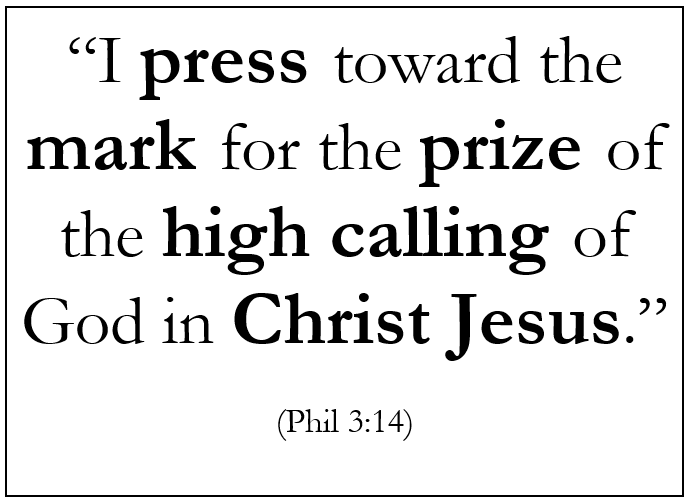
“I press toward the mark for the prize of the high calling of God in Christ Jesus.” (Phil 3:14)
What do you do when you hit bottom? Despite the depth of the losses I’ve felt, I’m sure I haven’t experienced that. But there are some examples in scripture that can give us insight.
Joseph suffered the loss of all at the hands of his own brothers. (Gen 37:28).
A Little maid suffered the loss of all at the hands of a man stealer. (2Kings 5:1-2).
Jeremiah suffered the loss of all at the hands of his brethren, being dropped into the depths of a pit. (Jer 38:6)
Then there was the Apostle Paul who said,
“…in labours more abundant, in stripes above measure, in prisons more frequent, in deaths oft. Thrice was I beaten with rods, once was I stoned, thrice I suffered shipwreck, a night and a day I have been in the deep; In journeyings often, in perils of waters, in perils of robbers, in perils by mine own countrymen, in perils by the heathen, in perils in the city, in perils in the wilderness, in perils in the sea, in perils among false brethren; In weariness and painfulness, in watchings often, in hunger and thirst, in fastings often, in cold and nakedness.” (2Cor 11:23-27).
Read that again and really focus on each of those experiences. Try to see yourself in his place in stripes, prisons, deaths, beaten, stoned, shipwreck, in the deep, journeyings, perils (water, robbers, his own, heathen, in the city, in the wilderness, in the see, among false brethren), weariness, painfulness, watching, hunger, thirst, fasting, cold and nakedness.
It’s difficult for me to imagine. How did he find the strength to endure such hostility and loss? In the letter to the Philippians, we find a clue, “I PRESS TOWARD THE MARK for the prize of the high calling of God in Christ Jesus.” In other words, he had a very large WHY. With a large enough WHY we can endure any HOW. There’s no bigger WHY than being in heaven with Christ.
Paul endured because of his WHY and with his HOW. We can PRESS just as he did.
To understand how, we need to learn about the word PRESS. From Strong’s we learn that the word press means; “to pursue (literally or figuratively); by implication, to persecute:–ensue, follow (after), given to, (suffer) persecute(-ion), press forward.” Did you see it? The word for press is also translated as “PERSECUTE.” (cf. Phil 3:6). Does that give you a better picture as to how Paul could endure? He Pressed, PERSECUTED toward the mark. Think of it as a full court PRESS as in basketball. Paul transferred his prior PERSECUTION of the church into a PERSECUTION to reach heaven.
He said it this way to Timothy, “I have fought a good fight, I have finished my course, I have kept the faith:” (2Tim. 4:7)
In his letter to the Corinthians, he makes another illustration. “Know ye not that they which run in a race run all, but one receiveth the prize? So run, that ye may obtain.” (1Cor 9:24). He compares it to a RUNNER in a RACE for a prize that only one receives. Not that only one person can go to heaven, but that we should have the attitude of the RUNNER where only one may win.
Paul also EXERCISED himself unto godliness. “But refuse profane and old wives’ fables, and exercise thyself rather unto godliness.” (1Tim. 4:7; cf. 1Tim 4:8). This word carries the meaning, ‘to train’ oneself. We are in constant training for godliness.
In another similar illustration Paul says, “And every man that striveth for the mastery is temperate in all things. Now they do it to obtain a corruptible crown; but we an incorruptible” (1Cor. 9:25). The one that will PRESS toward the mark can be compared to one that STRIVES for mastery. Mastery of what? Mastery of being a faithful Christian. (cf. 2Tim 2:15; 3:16-17)
Along those same lines, he kept his body in SUBJECTION. “But I keep under my body, and bring it into subjection: lest that by any means, when I have preached to others, I myself should be a castaway.” (1Cor 9:27; cf. 7:1-9). His meaning is to practice self-control over the lust of the flesh so as not to be ineligible for heaven.
Much is said in the secular world about goal setting. Our ultimate goal should be in going to heaven where Christ sits. We can do that by keeping our eyes and affections above (Col. 3:1-2). We also PRESS toward the mark. We can either give up or give it all.
— spencer
spencer is a gospel preacher located in Borger Texas where he has worked with the church on Franklin & Juniper St. since 2014.
“And he said unto them, Go ye into all the world, and preach the gospel to every creature.” (Mark 16:15)
There is a MESSAGE for the world. It’s an important message. Dare I say, it’s a vital message to the survival of the soul? It’s the Gospel.
But who shall take this message to the world? According to the bible, we will, the church. It began with the chosen Apostles, and then was extended to us.
“And the things that thou hast heard of me among many witnesses, the same commit thou to faithful men, who shall be able to teach others also.” (2Tim 2:2)
The Creator of the universe has entrusted us with this vital message. Are we up to the task?
Normal is not up to the task. We’re all familiar with the average man and his hesitancy to perform a task. When given such an assignment, will the regular person say, “Here am I; send me?” No, they will rather ask one or more of these questions:
When should I start?
Where do I go?
Who is the world?
Is that my job?
Do you mean right now?
“As vinegar to the teeth, and as smoke to the eyes, so is the sluggard to them that send him.”
(Prov 10:26)
The Lord wants laborers. “Therefore said he unto them, The harvest truly is great, but the labourers are few: pray ye therefore the Lord of the harvest, that he would send forth labourers into his harvest.” (Luke 10:2)
We are the laborers, each of us have been ‘hired’ for this important taks. “And about the eleventh hour he went out, and found others standing idle, and saith unto them, Why stand ye here all the day idle? They say unto him, Because no man hath hired us. He saith unto them, Go ye also into the vineyard; and whatsoever is right, that shall ye receive.” (Matt 20:1-16; cf Matt 25:24-30)
Now back to the command; “Go ye therefore, and teach all nations, baptizing them in the name of the Father, and of the Son, and of the Holy Ghost:” (Matt 28:19) Let us GO. The rest of this article we’ll look at the two qualities we need when we GO into all the world.
Firstly, we need ourselves to be changed people. Before we can present the Gospel to anyone, we must first be partakers of that gospel. Without GODLINESS it will be near impossible to convince anyone of the good news. You cannot teach the gospel just through a godly life, but it’s impossible without it.
“Having your conversation honest among the Gentiles: that, whereas they speak against you as evildoers, they may by your good works, which they shall behold, glorify God in the day of visitation.” (1Peter 2:12; 3:16)
“That ye may be blameless and harmless, the sons of God, without rebuke, in the midst of a crooked and perverse nation, among whom ye shine as lights in the world;” (Phil 2:15)
Many folks have rejected the gospel, the church, and pure religion, simply on the basis of the hypocrisy of its members. Let us GO in all GODLINESS. “But thou, O man of God, flee these things; and follow after righteousness, godliness, faith, love, patience, meekness.” (1Tim 6:11; cf 2Pet 1:1-10)
The second part of this simple command is to be of ONE mind with Christ in all that we do. “Servants, be obedient to them that are your masters according to the flesh, with fear and trembling, in singleness of your heart, as unto Christ;” (Eph 6:5).
Going into the world to preach does not require a vow of poverty nor for us to quit working (cf. Eph 4:28; 2Thess 3:10; 1Tim 5:8). Living godly lives in our work, our home, and our community gives us opportunity to meet folks and to shine our lights. From there we must have ONE mind with Christ, which is to share the life saving Gospel message. “For the Son of man is come to save that which was lost.” (Matt 18:11; Luke 19:10).
We as individuals may not reach them all, but all that we meet may be reached, and if all of us reach then some may be saved. “I am made all things to all men, that I might by all means save some.” (1Cor 9:22b) Go. You need not go very far. “…behold, I say unto you, Lift up your eyes, and look on the fields; for they are white already to harvest.” (John 4:35)
— spencer
Spencer is an evangelist for the Franklin & Juniper St church of Christ in Borger Texas. If you live in the Borger area and would like a personal bible study, please reach out & let us know how we can help you know more of God’s word.
“Rejoice in the Lord Always and again I say, Rejoice.” (Php 4:4)
Considering the state of our world this seems like an impossible task. One thing we forget however, is that those words were penned while Paul was in a Roman prison.
Every generation has to figure out how to complete this command in themselves despite the ‘troubles’ of their times. We’re no different.
Since the fall of man, we have all had to deal with the troubles that come from a broken sin filled world.
Despite this can we still find a way to REJOICE? Yes. If there is a command, then it’s within our ability to obey. But how?
How do we rejoice in the midst of turmoil? Can we rejoice when there is no peace in the world? We forget that there is no true peace if we’re not at peace with God. When we find peace with God, we can also see how to rejoice.
“And let the peace of God rule in your hearts, to the which also ye are called in one body; and be ye thankful.” (Col 3:15)
This verse comes in the midst of a list of instructions; it must then be true then, that when we follow these instructions, we might have that peace of God.
Going to the beginning of the chapter we find the first step. “If ye then be risen with Christ, seek those things which are above, where Christ sitteth on the right hand of God.” (Col 3:1-4). Before we can have peace from God, we need to seek and to set our affections above. From this verse and others, we learn that the child of God is to PURSUE righteousness, the things from above (cf. Jas 3:17; 1Tim 6:11; 2Tim 2:22; 1Pet 3:11).
The child of God is then to, “Mortify therefore your members which are upon the earth; fornication, uncleanness, inordinate affection, evil concupiscence, and covetousness, which is idolatry:” (Col 3:5-9). EVIL is to be put off of the child of God. How can any of us expect peace when we continue to participate in the earthly, carnal, sensual, evil of this world? “For which things’ sake the wrath of God cometh on the children of disobedience:” We used to live this way, but now we are to live differently (cf. 1Cor 6:9-11).
Removing bad habits is not enough, we must replace what we have put off. “Put on therefore, as the elect of God, holy and beloved, bowels of mercies, kindness, humbleness of mind, meekness, longsuffering;” (Col 3:12). We are to put on, ADORN ourselves with the new man. In obeying the gospel through faithful baptism, we are raised up to walk in newness of life (Rom 6:3-4). Failure to do this is why we often return to our old ways. It’s not enough to remove evil. We must replace it with good.
But we still have a little further to go. The elect of God is expected to go beyond just outer actions, we must engage our hearts. “And above all these things put on CHARITY [love], which is the bond of perfectness” (Col 3:14). Without love we are nothing (1Cor 13:1-3). Love is very powerful. “There is no fear in love; but perfect love casteth out fear: because fear hath torment. He that feareth is not made perfect in love.” (1John 4:18).
There is just one more thing in this list. Love is more than an emotion. It’s obedience to God. “For this is the love of God, that we keep his commandments:” (1John 5:3). We see this instruction in our passage. “And let the peace of God rule in your hearts, to the which also ye are called in one body; and be ye thankful. Let the word of Christ dwell in you richly in all wisdom; teaching and admonishing one another in psalms and hymns and spiritual songs, singing with grace in your hearts to the Lord.” (Col 3:15-17).
We must let the peace of God dwell in our hearts, and this is accomplished when we let the word of Christ dwell there also. The last line in this section explains what this means. “And whatsoever ye do in word or deed, do all in the name of the Lord Jesus, giving thanks to God and the Father by him.” “Whatsoever, do, word, deed, do all?” This covers EVERYTHING. The entirety of our lives is to be focused on serving God. A fitting bookend to the beginning where we were told to “set our affections on things above.”
Do we want peace? Do you want rejoicing? It’s possible. When we Pursue those things above, put off Evil, Adorn ourselves with the new, have Charity in our hearts, and let the word of God permeate the Entirety of our lives, then we can rejoice. We rejoice not because life is easier. We rejoice because we know we have hope of an eternal home in heaven where Christ sits.
— spencer
Spencer is an evangelist for the Franklin & Juniper St church of Christ in Borger Texas. If you live in the Borger area and would like to learn more about what the bible says on life and godliness, then let us know how we can help you know more of God’s word.
“Brethren, I count not myself to have apprehended: but this one thing I do, forgetting those things which are behind…” [Phil 3:13]
Paul’s storied past left much to be regretted and to be forgotten.
“I verily thought with myself, that I ought to do many things contrary to the name of Jesus of Nazareth. Which thing I also did in Jerusalem: and many of the saints did I shut up in prison, having received authority from the chief priests; and when they were put to death, I gave my voice against them. And I punished them oft in every synagogue, and compelled them to blaspheme; and being exceedingly mad against them, I persecuted them even unto strange cities.” (Acts 26:9-11).
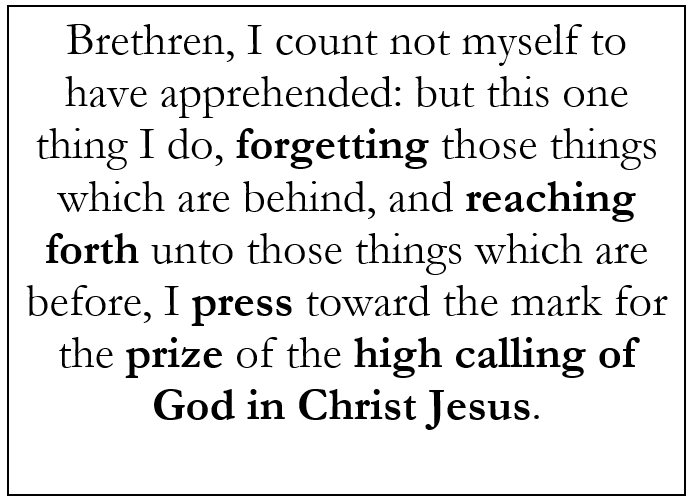
It’s Paul’s past that gives much more weight to this advice given through the inspiration of the Holy Spirit. What can we learn from Paul about how to forget the past? Here’s the rest of the passage in Philippians 3:13-14; “Brethren, I count not myself to have apprehended: but this one thing I do, forgetting those things which are behind, and reaching forth unto those things which are before, I press toward the mark for the prize of the high calling of God in Christ Jesus.”
“I press toward the mark for the prize” It’s not enough to just forget the past, one must PRESS toward the PRIZE. Each of us has a past that needs forgiving and forgetting (Rom 3:23). Thankfully we have obeyed that form of doctrine whereby we may have the forgiveness of sins and the forgetting of them by our heavenly Father (Rom 6:17; Heb 10:17). Having repented and been baptized, we are to move forward and not to remain in the past.
“Set your affection on things above,” (Col 3:1-3). In the letter to the Colossians, Paul gives more details on this subject. If we’ve been raised with Christ, we are to seek those things above by setting our AFFECTIONS on things above. This word means to ‘intensively interest oneself.’ [Strong’s Greek Concordance]. “For to be carnally minded is death; but to be spiritually minded is life and peace.” (Rom 8:6). Paul makes this point in our Philippians passage verses 15-16.
“For they that say such things declare plainly that they seek a country.” (Heb 11:13-14). This passage in Hebrews helps us learn from those who preceded us in faith. They needed to forget the past because, “And truly, if they had been mindful of that country from whence they came out, they might have had opportunity to have returned. But now they desire a better country, that is, an heavenly: wherefore God is not ashamed to be called their God: for he hath prepared for them a city.” (15-16). The third key to forgetting the past is to SEEK a heavenly home. To seek means; ‘to search (inquire) for; intensively, to demand, to crave.’ [Strong’s Greek Concordance].
So far, we have learned that to forget the past is to Press toward the prize, to set our Affections above, and to Seek a heavenly home. The last piece comes to us from the Lord…
“And Jesus said unto him, No man, having put his hand to the plough, and looking back, is fit for the kingdom of God.” (Luke 9:62). Just as we learned from the Patriarchs in the point above, we are not to TURN back from pressing forward. Looking back makes us ineligible for the kingdom of God. Please note, this is not about reflection on our past, it’s about longing to return to our past. Consider Lot’s wife. “But his wife looked back from behind him, and she became a pillar of salt.” (Gen 19:26). In retelling his past, Paul didn’t violate the word of God because he wasn’t desiring to go back to what he had left. He told it as a reminder of the importance of pressing forward.
Forgetting the past is about keeping our desires for the future glory of heaven before us that it keeps us from returning to sin. Peter said it best, “For if after they have escaped the pollutions of the world through the knowledge of the Lord and Saviour Jesus Christ, they are again entangled therein, and overcome, the latter end is worse with them than the beginning. For it had been better for them not to have known the way of righteousness, than, after they have known it, to turn from the holy commandment delivered unto them. But it is happened unto them according to the true proverb, The dog is turned to his own vomit again; and the sow that was washed to her wallowing in the mire.” (2Pet 2:20-22).
We can only live in one of two directions. Pressing ahead or longing for the Past. “Do not say, “Why were the former days better than these?” For you do not inquire wisely concerning this.” (Ecc 7:10).
Let us press toward the prize, it will be worth it.
—spencer
Spencer is an evangelist for the Franklin & Juniper St church of Christ in Borger Texas. Would you like a personal bible study? Please reach out & let us know how we can help you know more of God’s word.
While challenging Jesus, a certain lawyer seeking to justify himself, asked, “who is my neighbor?” Jesus answered with the parable of the good Samaritan to make him and us consider the answer to that question. (Luke 10:25-37)
Who is my neighbor?
What a great question! Seeing that the second great command is to love thy neighbor as thyself, we ought to ask it of ourselves today. (Matt 22:39; cf Lev 19:18)
It reminds me of NAAMAN’S stolen little maid (2King 5:1-14). Who was her neighbor?
It was the one that STOLE HER!!
From the parable and the story of the little maid we learn that EVERYONE we come in contact with is our neighbor, and let’s not forget about our online neighbor.
Do we have the love to INVITE our neighbor to the healing power of Jesus? Another question, would they accept or decline the invitation based on our GOOD works or lack thereof? “They profess that they know God; but in works they deny him, being abominable, and disobedient, and unto every good work reprobate.” (Titus 1:16). The story of the healing of Naaman hinges on an invitation from the stolen little maid. What does Naaman’s acceptance of her word speak about her good behavior?
Jesus speaks of love for, rather than HATRED of our enemies. “You have heard that it was said, ‘You shall love your neighbor and hate your enemy.’ But I say unto you, Love your enemies, bless them that curse you, do good to them that hate you, and pray for them which despitefully use you, and persecute you” (Matt 5:43-44). It makes me think of the server that had wronged a Christian. After he exacted his pound of flesh through a verbal assault, I wonder if the server would be open to an invitation to a home bible study with that Christian? (Ouch, that hurt.)
What about our BORDER neighbors, the ones with whom we share a fence line? If history is indicative of future possibilities, what would their answer be to our invitation to worship after our current land dispute? Let alone the Proverbs wisdom about being friendly with our property neighbors. “Better is a neighbor nearby than a brother far away.” (Prov 27:10; cf. Prov 3:29)
It can be difficult to be at peace with everyone, but we OUGHT to try. “Let every one of us please his neighbour for his good to edification.” (Rom 15:2) “If it be possible, as much as lieth in you, live peaceably with all men.” (Rom 12:18) We OUGHT to pursue peace with our neighbor if for no other reason than it interferes with both of us going to heaven. (cf. Mark 9:50; Rom 14:19; Heb 12:14) “For this is good and acceptable in the sight of God our Saviour; Who will have all men to be saved, and to come unto the knowledge of the truth.” (1Tim 2:3-4).
Lastly, let’s also think of our less fortunate neighbors without showing RESPECT of persons. Jesus said, “When you give a dinner or a supper, do not ask your friends, your brothers, your relatives, nor rich neighbors, lest they also invite you back, and you be repaid.” (Luke 14:12; cf. James 2:1-13). After disregarding our poor neighbors, or those different from us, could we invite them to worship and would they accept?
Who is our neighbor? Great question. The take away for me is to live in such a way as to not make enemies. This doesn’t mean to ignore nor to whitewash the truth of the gospel. Rather it’s about avoiding situations where we might create lifelong enemies that will hinder the spreading of the gospel. “I am made all things to all men, that I might by all means save some.” (1Cor 9:22)
—spencer
Spencer is an evangelist for the Franklin & Juniper St church of Christ in Borger Texas. If you live in the Borger area and would like a personal bible study, please reach out & let us know how we can help you know more of God’s word.





 Borger church of Christ @ Franklin & Juniper