
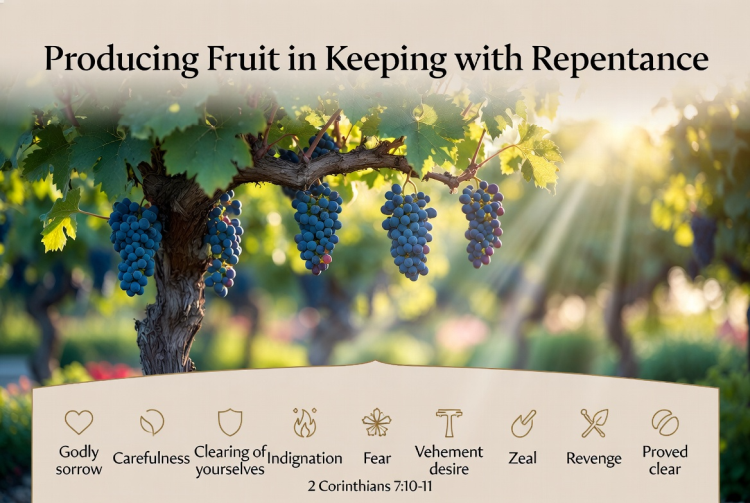
Producing Fruit in Keeping with Repentance
“Herein is my Father glorified, that ye bear much fruit; so shall ye be my disciples.” (John 15:8)
John the baptizer told the Pharisees, “Bring forth therefore fruits meet for repentance” (Matt 3:8).
What are the “Fruits Worthy of Repentance?” The simple answer is that it means to produce visible, ongoing evidence of an ongoing unity with Christ, in a Christlike character, in obedience (especially love), and a life that glorifies (points toward) God through abiding (keeping His commands) in Him. It also includes being profitable (useful) to Him in His ultimate purpose that “all men to be saved, and to come unto the knowledge of the truth” (1Tim 2:4).
Repentance always begins in the heart. We can’t read hearts, but the Holy Spirit has given an example of true and complete repentance from the heart as seen in the church at Corinth. They had need of repentance, the specifics of the charges and their repentance can be found by studying 1Corinthians. In Paul’s 2nd letter they had taken steps to repent, and Paul expresses how complete and thorough that repentance was. “For godly sorrow worketh repentance to salvation not to be repented of: but the sorrow of the world worketh death. For behold this selfsame thing, that ye sorrowed after a godly sort, what carefulness it wrought in you, yea, what clearing of yourselves, yea, what indignation, yea, what fear, yea, what vehement desire, yea, what zeal, yea, what revenge! In all things ye have approved yourselves to be clear in this matter” (2Cor 7:10-11). Notice the 9 attitudes the church at Corinth displayed proving true repentance.
• “ye sorrowed after a godly sort” [lupeo, & theos] A deep, God-centered grief over sin, contrasted with worldly sorrow, which is self-focused.
• “what carefulness it wrought in you, yea,” [spoudē] a diligent, active resolve to turn from sin and pursue obedience, rather than passive regret.
• “what clearing of yourselves, yea,” [apologia] A strong desire to vindicate or clear one’s name and conscience by openly acknowledging the sin, taking responsibility, and demonstrating innocence going forward.
• “what indignation, yea,” [aganaktēsis] Righteous anger or outrage, directed toward the sin itself, one’s own participation in it, and the damage it caused.
• “what fear, yea,” [phobo] Reverential fear of God, awareness of His holiness, and a wholesome dread of sin’s consequences.
• “what vehement desire, yea,” [epipothēsis] Intense, heartfelt longing for restoration to God, and to avoiding sin in the future.
• “what zeal, yea,” [zēlos] It shows fervent enthusiasm and passionate commitment to God and His word as opposed to indifference.
• “what revenge!” [ekdikēsis] A determined desire to see justice done by punishing (1Cor 5:4-5; 2Cor 2:6) or removing the evil involving self-discipline, and decisive action against sin in the church or personal life.
• “In all things ye have approved (proved) yourselves to be clear in this matter.” [sunistao] A complete demonstration of innocence and purity in the matter through consistent, observable change.
Bringing forth fruit worth of repentance is first a change in heart and attitude along with decisive, and determined action. True repentance includes both.
Agape
spencer
 Borger church of Christ @ Franklin & Juniper