Bearing Fruit: Pruning

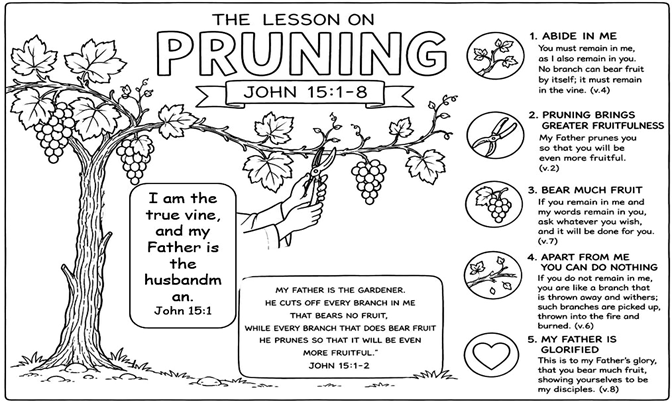
Every branch in me that beareth not fruit he taketh away: and every branch that beareth fruit, he purgeth (prunes) it, that it may bring forth more fruit.” (John 15:2)

PRUNING for greater fruitfulness.
In grape production (viticulture), the vinedresser removes dead or unfruitful branches entirely to concentrate the vine’s energy to improve growth and health for greater productivity. This is not destruction but care. God actively tends His people for fruitfulness, accomplished primarily through His Word, all aimed at greater Christlikeness and productivity. From this verse in John 15 we see two actions being taken by the vinedresser (God the Father):

ONE: Branches that produce no fruit are removed. “If a man abide not in me, he is cast forth as a branch, and is withered; and men gather them, and cast them into the fire, and they are burned” (John 15:6). This is a warning about those who were “in me” but are not bearing fruit. We see other scriptures warning of this same condition; The parable of the Sower (Mark 4:13-20); the warning about false prophets (Matt 7:15-20); and the breaking off of branches (Romans 11:11-27). The possibility of apostasy is real.

TWO: The Father cleanses or prunes fruitful branches “that it may bring forth more fruit.” The goal is increase, not comfort—removing what hinders maximum productivity. Paul wrote about a similar “pruning” using the metaphor of “mortifying” and “putting off” the works of the world (Colossians 3:5-17).

The primary instrument of pruning Jesus says is the word, “Now ye are clean through the word which I have spoken unto you… If ye abide in me, and my words abide in you” (John 15:3, 7). Reading, applying, and obeying Scripture convicts, corrects, and trains (cf. 2Timothy 3:16-17).

Another way God prunes is through the trials that are in this world since the fall. “My brethren, count it all joy when ye fall into divers temptations; Knowing this, that the trying of your faith worketh patience. But let patience have her perfect work, that ye may be perfect and entire, wanting nothing” (James 1:2-4). Trials test and develop endurance, leading to maturity (perfection). God has established principles in creation and redemption that automatically correct deviation (sowing and reaping, consequences of sin, Galatians 6:7). Any true understanding of discipline through trial comes from the revealed Word of God.

Hebrews 12 informs us that discipline is for our good, as a father who loves and disciplines his son. It’s considered loving to train a child. “For whom the Lord loveth he chasteneth, and scourgeth every son whom he receiveth” (Hebrews 12:6). God may use circumstances, but understanding flows from knowing His Word. God “prunes” for greater fruitfulness, because He loves us, for maturity, and to remove hindrances. We respond by abiding in Him (through His word), count trials as joy because of what it will produce in us, actively participate by removing sin & distractions, and fully trusting in God who wants us to be fully equipped for every good work. “Herein is my Father glorified, that ye bear much fruit; so shall ye be my disciples” (John 15:8).

Agape
spencer

Bearing Fruit: Members

Herein is my Father glorified, that ye bear much fruit; so shall ye be my disciples.” (John 15:8)

When we talk about being fruit bearers, we recognize that there is One vine (Christ) and One way of defining fruit (the word). What we may overlook is how different each of the branches are. While we are all part of the One vine, and bear fruit, we are still unique individuals. For this we look at another metaphor, the parts of the body.

“For the body is not one member, but many. If the foot shall say, Because I am not the hand, I am not of the body; is it therefore not of the body? And if the ear shall say, Because I am not the eye, I am not of the body; is it therefore not of the body? If the whole body were an eye, where were the hearing? If the whole were hearing, where were the smelling? But now hath God set the members every one of them in the body, as it hath pleased him. And if they were all one member, where were the body? But now are they many members, yet but one body. And the eye cannot say unto the hand, I have no need of thee: nor again the head to the feet, I have no need of you. Nay, much more those members of the body, which seem to be more feeble, are necessary: And those members of the body, which we think to be less honourable, upon these we bestow more abundant honour; and our uncomely parts have more abundant comeliness. For our comely parts have no need: but God hath tempered the body together, having given more abundant honour to that part which lacked: That there should be no schism in the body; but that the members should have the same care one for another. And whether one member suffer, all the members suffer with it; or one member be honoured, all the members rejoice with it” (1Cor 12:14-26). Another passage on this topic is in Romans 12:4-8, “For as we have many members in one body, and all members have not the same office.”

From these two passages we learn that each of us is individual fruit bearers attached to the One vine, who is Christ. He is the source of our nourishment and growth, and we each have differing abilities from which we bear fruit (cf. Matt 25:14-30). We have differing roles, functions, and abilities for “…the perfecting of the saints, for the work of the ministry, for the edifying of the body of Christ: Till we all come in the unity of the faith, and of the knowledge of the Son of God, unto a perfect man, unto the measure of the stature of the fulness of Christ” (Eph 4:12-13). These differences work together for the building up of the body.

One of the ways we can bear fruit is through personal evangelism. Our differences (not in the political sense of unity in diversity–which celebrates plurality itself, with less insistence on a single unifying purpose) give the church the greatest ability to reach the most people. Because of our differing interests, abilities, and spheres of influence, we are able to reach people with the gospel that others in the congregation may never meet. From my experience, some folks respond better to those who have similar backgrounds than to those who come from different ones.

Being one in Christ fuses many hearts into one purpose.

Agape
spencer

Bearing Fruit: 100 fold

Herein is my Father glorified, that ye bear much fruit; so shall ye be my disciples.” (John 15:8)

Bearing fruit is more than a positive affirmation, it has substance. In God’s law of sowing and reaping, the physical act of planting seed mirrors the spiritual work of evangelism. Jesus taught in the Parable of the Sower, “But he that received seed into the good ground is he that heareth the word, and understandeth it; which also beareth fruit, and bringeth forth, some an hundredfold, some sixty, some thirty” (Matthew 13:8, 23). When we scatter the seed of the Gospel, four powerful incentives assure us that our labor is never in vain.

First, we receive personal benefit—FOOD for ourselves. Just as the farmer’s harvest supplies daily bread, God promises the same in the spiritual realm: “Now he that ministereth seed to the sower both minister bread for your food, and multiply your seed sown, and increase the fruits of your righteousness” (2Corinthians 9:10). Every time we share the Gospel, our own faith is nourished. You’ve heard that the teacher gets more than the student. Evangelism also feeds the sower. Are you sowing the seeds of the kingdom, brother?

Second, we can expect a harvest OVER and ABOVE what we can imagine—30, 60, or 100-fold—but it may come well after us. Paul declares, “Now unto him that is able to do exceeding abundantly above all that we ask or think, according to the power that worketh in us” (Ephesians 3:20). A single conversion to Christ can ripple across decades and continents. The person you teach to obey the Gospel today may win others tomorrow, producing fruit far beyond your lifetime (2Timothy 2:2). The surplus benefits into future generations, and praise that glorifies God. While we can expect an overabundance, there is a caveat, “He which soweth sparingly shall reap also sparingly; and he which soweth bountifully shall reap also bountifully” (2Corinthians 9:6). Are you sowing the seeds of the kingdom, brother?

Third, we benefit from the LABORS of others, and others will benefit from ours. Jesus reminded His disciples, “One soweth, and another reapeth… I sent you to reap that whereon ye bestowed no labour: other men laboured, and ye are entered into their labours” (John 4:37-38). Every believer is the fruit of someone else’s faithful sowing—parents, teachers, friends, or even strangers who planted the seed of the kingdom years earlier. We in this place are beneficiaries of the labors of others. Are you sowing the seeds of the kingdom, brother?

Finally, we are to sow DILIGENTLY—while remaining wholly DEPENDENT on God. Even in paradise, Adam was commanded to cultivate the garden. The same command echoes in the Great Commission: go and sow the Gospel. Diligent Duty is the record of history; we cannot sit idle. Yet growth is never by our power alone. God sends the sunshine, the rain, and He gives the increase. All glory belongs to Him. Are you sowing the seeds of the kingdom, brother?

This goes beyond evangelism. These lessons can be applied to all fruit bearing. The fruit is felt first by the individual Saint, then there’s an overabundance of fruit, followed by lasting benefits for others. Finally, there’s a reminder to remain faithful and thankful to Christ, the Vine.

Agape,

spencer

Let’s Talk about Jesus #4; His Unspeakable Gift

Thanks be unto God for his unspeakable gift.

(2Corinthians 9:15).

While we’re talking about Jesus, let’s see if we can talk about this unspeakable gift.

The word here is the idea of indescribable, something we’re often unable to put into words. We are allowed to speak about it, but we’ll find it difficult to fully describe the good gifts of God.

Since most folks are talking about Jesus, let’s talk about Him too. Jesus told a healed man, “Go home to thy friends, and tell them how great things the Lord hath done for thee, and hath had compassion on thee” (Mark 5:19). Perhaps, we can do the same?

Maybe we can try to put into words the unspeakable GIFTS of Christ.
Every good gift and every perfect gift is from above, and cometh down from the Father of lights, with whom is no variableness, neither shadow of turning
 (James 1:17).

Blessed be the God and Father of our Lord Jesus Christ, who hath blessed us with all spiritual blessings in heavenly places in Christ” (Ephesians 1:3).

What are a few of the spiritual GIFTS we have from God in Christ?

We have GRACE. “For the grace of God that bringeth salvation hath appeared to all men” (Titus 2:11; cf Eph 2:8). We need to start here for it is by the GRACE of God in Christ that we have access to salvation. Grace is a gift of God. It is God’s Rescue plan for sinful man. Grace gives us Access to God through Christ. The sacrifice of Christ is the central component of God’s Grace. When we are baptized into Christ we are saved and can Escape the corruption of this life (for by Grace are you saved). Truly Grace is an indescribable gift.

The divinely INSPIRED word is a Gift of God. After James says that every perfect gift comes down from above, he writes this, “Of his own will begat he us with the word of truth, that we should be a kind of firstfruits of his creatures” (James 1:18). His inspired word is the source of knowledge about salvation in Christ, and is the source for how to live a life that is pleasing to Him. The Apostle Paul wrote to Timothy; “And that from a child thou hast known the holy scriptures, which are able to make thee wise unto salvation through faith which is in Christ Jesus. All scripture is given by inspiration of God, and is profitable for doctrine, for reproof, for correction, for instruction in righteousness: That the man of God may be perfect, throughly furnished unto all good works” (2Tim 3:15-17).

On a personal level, God gives us the Gift of bearing FRUIT. “But the fruit of the Spirit is love, joy, peace, longsuffering, gentleness, goodness, faith, Meekness, temperance: against such there is no law. And they that are Christ’s have crucified the flesh with the affections and lusts. If we live in the Spirit, let us also walk in the Spirit” (Galatians 5:22-25).

He also gives us gifts for our earthly TREASURE for our physical needs as well as for the church, “And God is able to make all grace abound toward you; that ye, always having all sufficiency in all things, may abound to every good work: (As it is written, He hath dispersed abroad; he hath given to the poor: his righteousness remaineth for ever. Now he that ministereth seed to the sower both minister bread for your food, and multiply your seed sown, and increase the fruits of your righteousness;) Being enriched in every thing to all bountifulness, which causeth through us thanksgiving to God” (2Corinthians 9:8-11; Mat 7:11).

Not just for our own use, but to share with those in need as the church in Macedonia did for the Saint in Jerusalem, “Moreover, brethren, we do you to wit of the grace of God bestowed on the churches of Macedonia; How that in a great trial of affliction the abundance of their joy and their deep poverty abounded unto the riches of their liberality. For to their power, I bear record, yea, and beyond their power they were willing of themselves; Praying us with much intreaty that we would receive the gift, and take upon us the fellowship of the ministering to the saints” (2Corinthians 8:1-4).

Lastly but certainly not least, God gives the gift of SALVATION. “For the wages of sin is death; but the gift of God is eternal life through Jesus Christ our Lord” (Romans 6:23). This gift He brings to all those that repent and are baptized (Acts 2:38) will not be removed. “For the gifts and calling of God are without repentance” (won’t take them back) (Romans 11:29).

People often mistake God’s Gifts as automatic & universal salvation, and that He gives physical blessings for all mankind regardless of their beliefs or actions. Not so. God gives the Gift of Access to salvation ONLY through His Son Christ Jesus. There is no other way. “Jesus saith unto him, I am the way, the truth, and the life: no man cometh unto the Father, but by me” (John 14:6).

The Gift of Salvation comes to those that obey Him. “And being made perfect, he became the author of eternal salvation unto all them that obey him” (Hebrews 5:9). Jesus has told us what will be said to the disobedient who call His name at the day of judgment, “And why call ye me, Lord, Lord, and do not the things which I say” (Luke 6:46)?

It is such a shame that even though we all have access to the Gift of God in Christ many will refuse it. God is full of Grace and Mercy, but one day everyone will stand before the throne of Christ to give an account and He “In flaming fire taking vengeance on them that know not God, and that obey not the gospel of our Lord Jesus Christ” (2Thessalonians 1:8).

While we still have breath, we can obey the Gift of the Gospel of Christ and be saved. Then when death comes, we shall hear, “Well done, thou good and faithful servant: thou hast been faithful over a few things, I will make thee ruler over many things: enter thou into the joy of thy lord” (Matthew 25:21).

Agape,

Spencer

Spencer is an evangelist for the Franklin & Juniper st church of Christ in Borger, Tx.

This is part of a series of articles about reasons to Talk About Jesus.