Hero of Faith: Epaphroditus

Philippians 2:25-30; 4:18.

Epaphroditus may not be the most remembered person in scripture, but what is said about him speaks volumes. Mentioned in Paul’s letter to the Philippians (2:25-30; 4:18), he stands as a model for Saints today. His story offers profound lessons on love, risk, and honor in God’s kingdom.

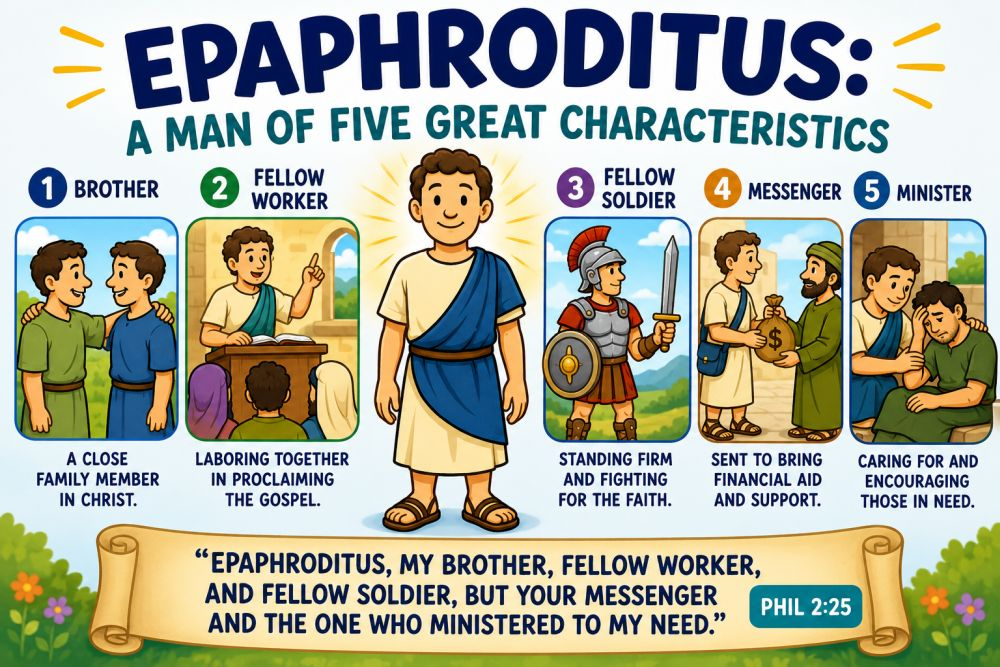
Paul describes him warmly as “my brother and fellow-worker and fellow-soldier, and your messenger and minister to my need” (Philippians 2:25). As a fellow worker and soldier alongside Paul, Epaphroditus labored tirelessly in the gospel. He was not a distant supporter but a close companion who shared in the hardships of ministry. To the church at Philippi, he served as their trusted representative, carrying their financial gift to the imprisoned apostle. Paul received “the things that came from you” through him—an “odor of a sweet smell, a sacrifice acceptable, well-pleasing to God” (4:18). Epaphroditus was the bridge between the Philippian believers and Paul, faithfully delivering their love in tangible form.

His journey, however, came at great personal cost. Somewhere along the way or after arriving at Rome, Epaphroditus became seriously ill, “nigh unto death” (2:30). Paul notes that he “longed after you all, and was sore troubled” (2:26), distressed not primarily for his own suffering but out of deep concern for his brethren in Philippi. He regarded not his own life and hazarded everything “for the work of Christ… to supply that which was lacking in your service toward me” (2:30). This was no reckless gamble but faithfulness, risking health and safety to advance the gospel and meet Paul’s needs.

Remarkably, Epaphroditus was not healed through the means of miraculous spiritual gifts. We know Paul had theses gifts, but their use was for a purpose determined by God (Heb 2:4; 1Cor 13:8-10). This became a lesson about the purpose of spiritual gifts, and prayer; “God had mercy on him; and not on him only, but on me also” (2:27). Epaphroditus’s recovery highlighted that God works providentially in the Saints lives. This episode underscores that faith and service do not always shield believers from suffering. Instead, it reveals that faithfulness isn’t determined by miraculous healing; a lesson we learned also from Job (Job 1-2). We trust in a future hope.

Because of such character, Paul urged the Philippians: “Receive him therefore in the Lord with all joy; and hold such in honor” (2:29). Men and women who risk their lives for Christ’s work deserve high esteem. Epaphroditus exemplified true servanthood—to the Philippians as their messenger, to Paul as a loyal companion, and ultimately to Christ as a faithful soldier who placed kingdom priorities above personal comfort.

In an age that still clings to the earthly measures of success, the life of Epaphroditus challenges us to consider spiritual measures of faith. He was eager, loving, sacrificial, and Christ-focused. His life, though briefly recorded, still speaks through centuries as an example for us to emulate. Like him, we can become fellow workers and soldiers who count not our lives dear unto ourselves, but pour them out as acceptable sacrifices to God and His people.

True heroes of faith rarely seek the spotlight. They simply obey, serve, and love—often at great cost—trusting God as they look forward to a future hope in Christ. Epaphroditus did exactly that, and the church is richer for his example.

Agape
spencer

Preacher or Pastor What’s the difference?

MOST FOLKS, myself included, have a hard time remembering names. However, many can remember what you do, probably because it’s more tangible than a name.    Let me share with you a conversation that I have nearly every single day;

Them: Hello pastor.
Me: Hello, I’m not a pastor, I’m a preacher.
Them: what’s the difference?
Me: a bunch, would you like to study it?
Them: No, I’m good.

This typical conversation has been condensed for space. I’m never short with them, always jovial and kind, but I do use it as an opportunity to engage in a gospel conversation with folks.

This article is for them. For all of us really. It will be posted online as a tool you can use when they ask you, “what’s your pastor like?”

What’s the difference?

Although all pastors are preachers, not all preachers are pastors.

PREACHERS: These people are “a herald, i.e. of divine truth (especially of the gospel)” WE Vines. Although any one can be a “preacher” when they speak about the Gospel, there is a position in the local congregation which is called “the evangelist.” According to scripture, this is a male who is a herald of the gospel during the preaching portion of the worship. He stands up and preaches the gospel, [2Timothy 4:2; 1Timothy 2:12; 1Corinthians 14:34]. It’s unpopular to say “male only”, but this is the teaching of the New Testament. In no way does this teaching speak to the worth of women, rather it is just a defining of roles. [Galatians 3:28]

In short, a preacher is an evangelist who, in addition to going out to spread the gospel, publicly preaches the gospel during the worship of the local congregation. Paul wrote to the evangelist / preacher Timothy, “But watch thou in all things, endure afflictions, do the work of an evangelist, make full proof of thy ministry.” [2Tim 4:5]

PASTORS: This is a specific position held in the local congregation, the qualifications of which are in 1Timothy 3:1-7 & Titus 1:5-9. There are some additional information about “pastors”, also called “elders” in Acts 20:17-35. Here we find that these men are to watch over the local church and to feed the flock; “Take heed therefore unto yourselves, and to all the flock, over the which the Holy Ghost hath made you overseers, to feed the church of God, which he hath purchased with his own blood.” [Acts 20:28]. From this verse it becomes clear why Elders are also Called Pastors.

An Elder / Pastor can also be an evangelist, laboring as his vocation in the Gospel. “Let the elders that rule well be counted worthy of double honour, especially they who labour in the word and doctrine.” [1Timothy 5:17]

What’s Your Pastor Like?” This is another question that is frequently asked. What they’re trying to determine is his speaking ability and personality. This questions is often asked by a person who’s thinking about visiting a particular church. While there’s nothing wrong in asking about the speaker, it shouldn’t be the FIRST nor ONLY prerequisite for choosing a church. (Other poor qualities for choosing a church are; games, entertainment, cafes of field trips)

One should seek first the truth; “But seek ye first the kingdom of God, and his righteousness; and all these things shall be added unto you” [Mat 6:33]. I’ve written about this in a previous article, “How to start a church” [April 19, 2015]. The basics of which are 3 points:

  • Reliance on God’s word for their only Authority. [1Peter 4:11]
  • Correct Worship in spirit and truth. [John 4:24]
    1. Assembling on the correct day, partaking of the Lord’s Supper [Acts 20:7]. Preaching, praying, singing (without the aid of mechanical music) and giving [Acts 20:7, 8, 36; Eph 5:19; 1Cor 16:1].
  • Doing the work of the church; Spreading the Gospel, Edification of the saints, and benevolence for needy saints. [Mat 28:18-20; Eph 4:12; 1Cor 16:1]

More could be said about this subject, hopefully this article has peaked your interest in confirming for yourself about the truth of all matters. Search the scriptures yourselves to learn all the counsel of God.  [Acts 17:11; 1John 4:1-3].

Prove all things; hold fast that which is good
[1Thess 5:21]