Does the Bible Answer Everything?

DURING A DISCUSSION with a 20 something, the question was raised, “do you really think that the Bible has answers for every situation of man?” I immediately responded with, “YES! In principle.”

What I mean by this is that the Bible contains principles that can aid us in working through any and every situation of life. The Bible is God’s revelation for man and contains His law, i.e. rules of conduct to govern man. (2Peter 1:21; 2Sam. 23:2; 1Cor. 2:7-13, Eph. 3:3-5; Gal. 6:2; James 2:12, etc.).  In fact, all Scriptures given by inspiration of God furnish man completely unto all good works, unto all things that pertain to life and godliness (2 Tim. 3:16-17, 2 Peter 1:3). This tells me that God has made known to mankind His will regarding every situation a person might face.

God, the creator of us all, knows what is best for us. Shall the clay question the potter? Unless we consult with God how shall we direct our own steps [Jeremiah 10:23]? This direction, given in His law, governs our total conduct. Conduct is the meaning of the word “conversation” in Phillippians 1:27; “Only let your conversation be as it becometh the gospel of Christ.” KJV

The total of man’s conduct may be catagorized into five relationship areas: religious, political, economic, domestic, and social.

God reveals His Direction for our conduct regarding our relationship to…

RELIGION in the gospel: John 4:24 ; James 1:27; Romans 12:13; Heb. 13:2; Gal. 6:10.

God is a Spirit: and they that worship him must worship him in spirit and in truth

GOVERNMENT (political: Rom. 13:1-7; 1Peter 2:13-14), to business (economic: Eph. 4:28; 2Thess. 3:10).

Let every soul be subject unto the higher powers. For there is no power but of God: the powers that be are ordained of God.

ECONOMIC (Eph 4:28; 2Thess 3:10;)

Let him that stole steal no more: but rather let him labour, working with his hands the thing which is good, that he may have to give to him that needeth.

FAMILY (domestic: 1 Tim. 5:1-6; Eph. 5:21; 6:4).

But if any provide not for his own, and specially for those of his own house, he hath denied the faith, and is worse than an infidel.

COMMUNITY (social: Matt. 7:12; Luke 10:30-37).

Therefore all things whatsoever ye would that men should do to you, do ye even so to them:

In the Bible, we can study God’s precepts and examples to learn how to direct our own steps. The conduct of many folks, good and bad, are recorded for our learning [1Corinthians 10:6,11; Romans 15:4]. God rejected sinful conduct and demonstrated His approval with conduct that was in harmony with His will. The conduct of their lives, exemplified in the scriptures, are aproved or disapproved according to the dispensation in which they lived.

We have a perfect example in Christ “For even hereunto were ye called: because Christ also suffered for us, leaving us an example, that ye should follow in his steps: who did no sin.” [1Peter 2:21-22]. Never did He violate God’s law [1John 3:4], but in every respect His conduct was in harmony with the Father’s will. This mind that was in Christ we are to imitate [Phil 2:5-11].

With regards to the final judgment, when this world will be dissolved, what manner of person ought we to be? [2Peter 3:11]. “But as he which hath called you is holy, so be ye holy in all manner of conversation; Because it is written, Be ye holy; for I am holy.” [1Pe 1:15-16].

The answer to the question is YES, the Bible does give us directions to face any situation in all of our relationships; Religion, Economic, Political, Family and socially. The Bible is God’s written instructions for mankind, His will for us.

So many people are walking around saying, “I know God has a plan for my life.” He does, yet many never bother to read it. God does have a plan for us, let us study it and do His will [2Timothy 2:15]. Most importantly, let us study His will on how to gain eternal life.

Then Simon Peter answered him, Lord, to whom shall we go? thou hast the words of eternal life. John 6:68
The one oar Christian

THERE’S A STORY TOLD OF an old wise man of God who was continually criticized for his motto, “pray and work.” A young pupil, struggling with the mounting problems of life, asked the wise man, “If God is so powerful, why then do you teach us also to work?” The wise man of God invited this youth to go fishing. As they entered the boat, the youth noticed that the old man only used one oar and said, “If you don’t use both, we’ll just go around in circles and you won’t get anywhere.” “That’s right, my son,” the elder man replied. “One oar is called prayer and the other is called work. Unless you use both at the same time, you just go in circles and you don’t get anywhere.”

Over the years I’ve learned that prayer alone, or work alone, is just like trying to row a boat using only one oar. All you ever seem to do is just go around in circles.

There is no doubt that prayer ought to be a part of every Christians day. Jesus taught this on several occasion, exemplifying it in His own life [Mat 14:23; 26:36,39; Mark 1:35; Luke 9:18,29].

_____________________________

And he spake a parable unto them to this end, that men ought always to pray, and not to faint;
Luke 18:1

_____________________________

Unfortunately, that is where many of us stop. We pray and pray and pray, wondering why nothing ever changes. What we forget is that God has also required us to act. Let us consider two Godly men Abraham, and Moses, men who are noted for how God spoke to them as a friend [Gen 18:17; Ex 33:11].

In reading Hebrews 11, we see that these two men had a great faith. Was their faith only seen in their prayer life? Are these men remembered for their inactive faith only? Do you recall reading about these men sitting in their easy chair, lifting up praise and prayers to God and softly drifting off to sleep comforted with the thought that God would take care of their troubles? No, never. What we DO READ is that these men of faith prayed and worked.

_____________________________

By faith Abraham, when he was called to go out into a place which he should after receive for an inheritance, obeyed; and he went out, not knowing whither he went. Heb 11:8

By faith Abraham, when he was tried, offered up Isaac: and he that had received the promises offered up his only begotten son, Heb 11:7

_____________________________

When Abraham heard God, he acted upon those commands. In the case of offering up Isaac, it is said that he “rose early” that morning to fulfill the commands of God [Gen 22:3].

Moses also acted upon the commands of God.

_____________________________

By faith Moses, when he was come to years, refused to be called the son of Pharaoh’s daughter; Choosing rather to suffer affliction with the people of God, than to enjoy the pleasures of sin for a season; Esteeming the reproach of Christ greater riches than the treasures in Egypt: for he had respect unto the recompence of the reward. Heb 11:24-26

_____________________________

Did either of these men think that they were accomplishing anything out of their own power? No, they had placed their trust in God, but this trust was manifested by a remarkable demonstration of action.

When we pray according to God’s will, we’re praying having sought to know His will through the study of His word [2Tim 2:15]. Then after we pray, we get up and apply that knowledge to our lives. We act, not because we think highly about ourselves, rather, because we are trusting God to bless our godly activities.

_____________________________

But be ye doers of the word, and not hearers only, deceiving your own selves. James 1:22

_____________________________

For if any be a hearer of the word, and not a doer, he is like unto a man beholding his natural face in a glass: 24 For he beholdeth himself, and goeth his way, and straightway forgetteth what manner of man he was. But whoso looketh into the perfect law of liberty, and continueth therein, he being not a forgetful hearer, but a doer of the work, this man shall be blessed in his deed.”  (KJV) [Jam 1:23-25]

God’s Succession Plan

ONE OF THE ARGUMENTS against the church is that we have no line of succession from the church in Jerusalem at Pentecost to the Franklin St. Church of Christ. Some point to Campbell as the originator of the church of Christ in America. This is a false teaching, and demonstrates their failure to understand biblical authority. We, as members of the Franklin St. Church of Christ, do have a direct connection to the first century church that began on Pentecost. Let’s go to the scriptures and look at God succession plan.

God’s 3 step succession Plan

FIRST, Teach our children. God expects His ways to be passed along through our children. In Genesis, we read about a man named Abraham. He was a righteous man and obeyed the Lord faithfully, from the command to leave Ur through the command to sacrifice his son. God said this about Abraham, “For I know him, that he will command his children and his household after him, and they shall keep the way of the LORD, to do justice and judgment; that the LORD may bring upon Abraham that which he hath spoken of him” [Ge 18:19]. Abraham was spoken well of because God knew that he would pass along the “ways of the Lord” to his children and his household.

Others in scripture seem to have failed in this. Eli had children that did horrible things against the ways of the Lord [1Sam 2:12, 22] and God rebuked Eli for failing to stop it. “For I have told him that I will judge his house for ever for the iniquity which he knoweth; because his sons made themselves vile, and he restrained them not” [1Sam 3:13].

The Lord has been very clear on this point;

De 6:7 And thou shalt teach them (commands, statutes & judgments of the Lord) diligently unto thy children, and shalt talk of them when thou sittest in thine house, and when thou walkest by the way, and when thou liest down, and when thou risest up. [De 4:9; 6:20; 11:19; Ps 78:4]

Pr 22:6 Train up a child in the way he should go: and when he is old, he will not depart from it. [Pr 19:18; 29:17;]

In the New Testament, Paul taught this same principle, teach it to our children. “And, ye fathers, provoke not your children to wrath: but bring them up in the nurture and admonition of the Lord” [Ephesians 6:4]. Parents play a vital role in God’s succession plan.

SECOND, Teach others. God commands Christians to pass along what they learn to others. This command is contained in the “great commission”; “Go ye therefore, and teach all nations, baptizing them in the name of the Father, and of the Son, and of the Holy Ghost: 20 Teaching them to observe all things whatsoever I have commanded you:” [Matthew 28:19-20]. Paul demonstrated his obedience to this command when he instructed Timothy and so many others. “And the things that thou hast heard of me among many witnesses, the same commit thou to faithful men, who shall be able to teach others also” [2Timothy 2:2]. This was also a qualification of an Elder, “able to teach” [1Timothy 3:2]. What are they to teach, what else than the “whatsoever I have commanded you.”

THIRDLY, Sow the seed of the kingdom. What all these verses have in common is The word of God. God’s succession plan has ALWAYS been through the teaching of His word to mankind. Look at the parable of the sower; “Hearken; Behold, there went out a sower to sow: 14 The sower soweth the word… And these are they which are sown on good ground; such as hear the word, and receive it, and bring forth fruit, some thirtyfold, some sixty, and some an hundred.” [Mr 4:3-20].

Let’s illustrate this point; If a person desired to grow Florida oranges he would go down to the place where he could buy some orange seeds. Taking that orange seed home, if he were to plant it, nurture it, and provide all that is needed for that seed to grow, in a short time he would be enjoying Oranges. The church today can be planted in any place by sowing the seeds of the kingdom of God, which is His word. We do this by reading, studying and obeying His divine word.

In human institutions we see succession by elections or by birth, as in the case of a monarchy. In God’s kingdom there is also a birth. Christians are “born again” when we obey His word. “Of his own will begat he us with the word of truth, that we should be a kind of firstfruits of his creatures” [James 1:18].

Let no one deceive you. We become Christians through His word. His word tells us to Hear the word [Rom 10:14], Believe His word [John 11:24], Repent of our sins [Luke 13:3], Confess Jesus as both Lord and Christ [Matthew 10:32-33], be baptized for the remission of our sins [Mark 16:15-16] and to live faithfully [2Peter 2:20-22]. Plant the seed of God in your heart and become just a Christian.   

– Spencer

Did you think to pray?

Dallas prayers


Late Thursday evening, as bedtime approached for many, gunfire rang out in downtown Dallas. In an apparent response to violence against black lives, a shooter (or multiple shooters), took aim at Dallas Police officers, injuring 12. The trouble continued well into the morning and we awoke to the news that 5 officers had been killed.

This article makes no attempt to clarify the issues surrounding the racial tensions of our country, it’s only purpose is to ask; DID YOU THINK TO PRAY? In our songbooks we have a song of the same title. The scriptural reference for this song is Philippians 4:6.

Be careful for nothing; but in every thing by prayer and supplication with thanksgiving let your requests be made known unto God.

So, did you? Did you think to pray as peace has seemingly turned to chaos? For Christians, prayer is our first line of defense against chaos. Prayer should be continually offered by those calling themselves the children of God. It’s commanded; “Pray without ceasing.” [1Thessalonians 5:17]

Certainly we offered prayers for our family, friends and the innocent who may have been affected by the violence. Friends (sisters in Christ) of mine were mere blocks away from the Dallas shooting. Is that where our prayers ended? DID YOU THINK TO PRAY for the others? Did you pray for the police officers, the peaceful protesters, or the myriad of others caught in the crossfire? DID YOU THINK TO PRAY for the shooter? We are commanded to pray, but those prayers are to go beyond just the folks we like. Our Lord and Master taught;

But I say unto you, Love your enemies, bless them that curse you, do good to them that hate you, and pray for them which despitefully use you, and persecute you[Matthew 5:44]

It may be difficult to pray for someone who has committed such heinous violence, just as it’s difficult to pray for those with whom we don’t agree, but the command is there. Can we ignore the commands we find uncomfortable? As a matter of fact, Christians ought to pray for ALL MANKIND…

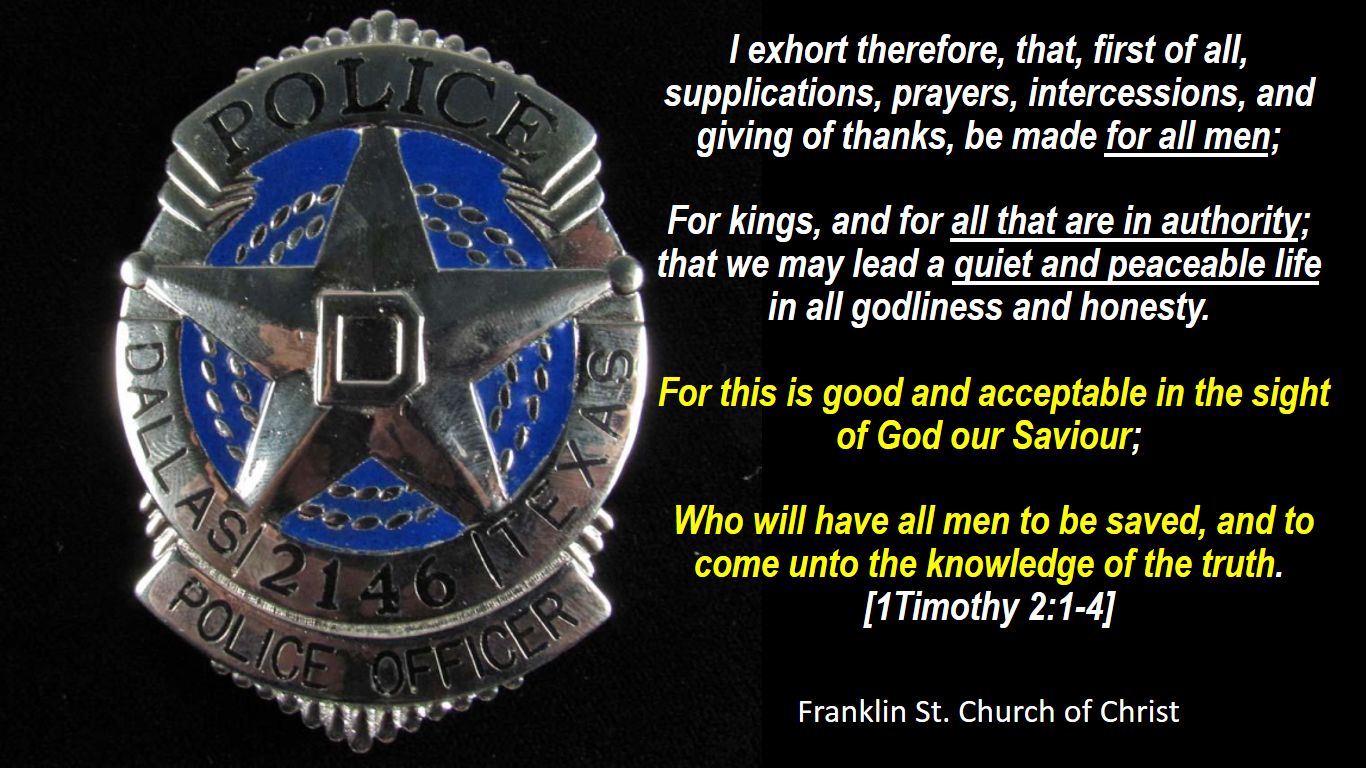
I exhort therefore, that, first of all, supplications, prayers, intercessions, and giving of thanks, be made for all men; For kings, and for all that are in authority; that we may lead a quiet and peaceable life in all godliness and honesty. For this is good and acceptable in the sight of God our Saviour; Who will have all men to be saved, and to come unto the knowledge of the truth[1Timothy 2:1-4]

It’s good that we pray for those we may call enemy, or those we dislike, along with those we love. It’s good because it’s nearly impossible to hold hatred in your heart for whose whom you’re praying. That is good, our God is so wise, for it’s hate that is the promoter of violence [Proverbs 10:12]. Hate can end in our prayers. It’s only then can we experience peace.

And the peace of God, which passeth all understanding, shall keep your hearts and minds through Christ Jesus[Philippians 4:7]

Remember to Pray.

spencer

Evangelism Depression

“It must be really depressing to be an evangelist, for very few people really care about the word of God.” Daniel S.

My good friend, a new convert, spoke those words to me after spending the first year after his conversion trying to spread the good news. Yes, it is depressing. Paul was depressed after sending his letter to the Corinthian church.

2Co 2:4 For out of much affliction and anguish of heart I wrote unto you with many tears; not that ye should be grieved, but that ye might know the love which I have more abundantly unto you.

He was filled with anguish because he was concerned for the church at Corinth. Would they repent, would they leave, would they take others with them in their disobedience. I can only imagine. But Paul did send the letter, and something great happened.

2Co 7:7 And not by his coming only, but by the consolation wherewith he was comforted in you, when he told us your earnest desire, your mourning, your fervent mind toward me; so that I rejoiced the more. 8 For though I made you sorry with a letter, I do not repent, though I did repent: for I perceive that the same epistle hath made you sorry, though it were but for a season. 9 Now I rejoice, not that ye were made sorry, but that ye sorrowed to repentance: for ye were made sorry after a godly manner, that ye might receive damage by us in nothing. 10 For godly sorrow worketh repentance to salvation not to be repented of: but the sorrow of the world worketh death.

You see, any of us who spread the message of the Gospel or seek to help a brother or sister in sin, whether we be paid laborers in the Gospel or Christians desiring to do the right thing, are often full of sorrow for those who reject God’s word. We often take it personally, but we need to remember, they haven’t rejected me, they’ve rejected God. 1Sam 8:7

That is why an evangelist, anyone really, needs to have their joy contained in another place other than people. For if we seek to just make other folks happy, then we’ve failed. Ga 1:10 For do I now persuade men, or God? or do I seek to please men? for if I yet pleased men, I should not be the servant of Christ.

Mt 6:21 For where your treasure is, there will your heart be also.

My invitation to all of you who desire to be a part of an evangelistic church, be warned. It’s sad, difficult and full of pain. But then, someone responds to the Gospel. Our children, our friends or people we meet. We rejoice, not because of what we have done, no, we rejoice with the angels in heaven for one sinner that repents.

Lu 15:10 Likewise, I say unto you, there is joy in the presence of the angels of God over one sinner that repenteth.

IGNORANCE, INTENT AND EMAILS

(this article may reference current events but is in no way a commentary on political views by the author as it relates to these events)

Confidential emails have been in the news of late. The jist of which is that a certain, high level, government employee, mishandled classified communication within the government. The FBI investigated and found unsecured & unguarded servers (the device where electronic mail would be stored and sent), “extremely careless” handling of email by this employee and her staff, and poor judgement on the part of this high level employee in the handling of Top Secret communication. The FBI then said, “We did not find…clearly intentional and willful mishandling of classified information.”

It’s on this last point that this article shall address as it relates sin, salvation and getting into heaven.

Under human laws, intent plays a major role. For example, if a person was negligent in their behavior, they may or may not be prosecuted. In recent cases of accidental harm to a person involving a vehicle, intent becomes the deciding factor. God spoke about these situations and gave instructions under the Law of Moses for unintentional harm. “as when a man goes to the woods with his neighbor to cut timber, and his hand swings a stroke with the ax to cut down the tree, and the head slips from the handle and strikes his neighbor so that he dies-he shall flee to one of these cities and live; [Deuteronomy 19:5] and in some cases were required to pay restitution.

Intent may be a factor, but ignorance of the law is another matter. Under our law system, Ignorantia juris non excusat (Latin for “ignorance of the law excuses not”) is a legal principle holding that a person who is unaware of a law may not escape liability for violating that law merely because he or she was unaware of its content. There are plenty of examples where a person is fined or punished having been unaware that they were committing a crime. If you doubt this, the next time you’re pulled over for speeding just tell the officer you didn’t know the speed limit.

For humanity, God leaves everyone without excuse whether they’ve read the Bible or not.

Look at Roman 1:18-21; “For the wrath of God is revealed from heaven against all ungodliness and unrighteousness of men, who suppress the truth in unrighteousness, 19 because what may be known of God is manifest in them, for God has shown it to them. 20 For since the creation of the world His invisible attributes are clearly seen, being understood by the things that are made, even His eternal power and Godhead, so that they are without excuse, 21 because, although they knew God, they did not glorify Him as God, nor were thankful, but became futile in their thoughts, and their foolish hearts were darkened.” [emphasis mine]

You see, God has made every effort to show himself to every person and it’s their willful disregard for Him that will earns His wrath.

In another place, regarding ignorance, Paul said, “Truly, these times of ignorance God overlooked, but now commands all men everywhere to repent, because He has appointed a day on which He will judge the world in righteousness by the Man whom He has ordained. He has given assurance of this to all by raising Him from the dead.” [Acts 17:30-31]

Peter also taught that we are not to remain in our ignorance but to obey; “Therefore gird up the loins of your mind, be sober, and rest your hope fully upon the grace that is to be brought to you at the revelation of Jesus Christ; as obedient children, not conforming yourselves to the former lusts, as in your ignorance; but as He who called you is holy, you also be holy in all your conduct, because it is written, “Be holy, for I am holy.” [1Peter 1:13-16]

Here’s the point of what I am saying, when we face the judgement of God, saying “I didn’t know” or “I didn’t intend to sin” will not open the gates of heaven unto us. The only way that we can survive the judgement and to receive an entry into heaven is through the saving blood of Jesus the Christ.

How can one be saved?

Now that you’ve heard about God’s wrath and salvation through Jesus, Repent and be converted from your ignorance. “Yet now, brethren, I know that you did it in ignorance, as did also your rulers. But those things which God foretold by the mouth of all His prophets, that the Christ would suffer, He has thus fulfilled. Repent therefore and be converted, that your sins may be blotted out, so that times of refreshing may come from the presence of the Lord,” [Acts 3:17-19]

After your repentance, their remains the blotting (washing) away of your sins. “And now why tarriest thou? arise, and be baptized, and wash away thy sins, calling on the name of the Lord.” [Acts 22:16] “Then Peter said unto them, Repent, and be baptized every one of you in the name of Jesus Christ for the remission of sins, and ye shall receive the gift of the Holy Ghost.” [Acts 2:38]

If you do this, you will be saved, but this doesn’t give you liberty to keep on sinning. Therefore, the Christian must remain faithful. “What shall we say then? Shall we continue in sin, that grace may abound? God forbid. How shall we, that are dead to sin, live any longer therein? Know ye not, that so many of us as were baptized into Jesus Christ were baptized into his death? Therefore we are buried with him by baptism into death: that like as Christ was raised up from the dead by the glory of the Father, even so we also should walk in newness of life.” [Romans 6:1-4] And if we sin, “My little children, these things write I unto you, that ye sin not. And if any man sin, we have an advocate with the Father, Jesus Christ the righteous:” [1John 2:1]

Though human courts overlook ignorance, God won’t. Why delay?

You will never hear

WILL YOU EVER hear our Baptist, Presbyterian or any of our denominational friends say, “The most influential men in our history were opposed to the use of instrumental music in Christian assemblies.”? No, you will never hear a Baptist say, “Charles Spurgeon, one of our greatest Baptist preachers, opposed instrumental music.” And you will never hear a Presbyterian admit: “John Calvin, one of the most famous theologians in history, rejected instrumental music in the sacred assembly.” Why? Because most are completely unaware of several facts about church history and may never hear them as their assemblies become more like concerts than a worship.

In the first century, Christians merely sang in their assemblies (Woodson). Hundreds of years passed before instrumental music was ever introduced into the apostate church. In fact, instrumental music was rejected by leading Protestants; and even when introduced into the mainline denominations, there was resistance.

Men who influenced the Protestant landscape were themselves opposed to instrumental music. For example, in his commentary on Psalm 33:2-“Give thanks unto Jehovah with the harp: Sing praises unto him with the psaltery of ten strings”-John Calvin wrote:

For even now, if believers choose to cheer themselves with musical instruments, they should, I think, make it their object not to dissever their cheerfulness from the praises of God. But when they frequent their sacred assemblies, musical instruments in celebrating the praises of God would be no more suitable than the burning of incense, the lighting up of lamps, and the restoration of the other shadows of the law. The Papists, therefore, have foolishly borrowed this, as well as many other things, from the Jews. Men who are fond of outward pomp may delight in that noise; but the simplicity which God recommends to us by the apostle is far more pleasing to him.”

The Methodist scholar Adam Clarke wrote with reference to 2 Chronicles 29:25.

But were it even evident, which it is not, either from this or any other place in the sacred writings, that instruments of music were prescribed by Divine authority under the law, could this be adduced with any semblance of reason, that they ought to be used in Christian worship? No: the whole spirit, soul, and genius of the Christian religion are against this: and those who know the Church of God best, and what constitutes its genuine spiritual state, know that these things have been introduced as a substitute for the life and power of religion; and that where they prevail most, there is least of the power of Christianity. Away with such portentous baubles from the worship of that infinite Spirit who requires his followers to worship him in spirit and in truth, for to no such worship are those instruments friendly.”

In connection with Psalms 42:4, Charles Spurgeon wrote:

Here are the facts. The instrument was not taken out of worship; rather, the instrument was an innovation brought into assemblies. On Christ’s authority, congregational singing of spiritual songs is what belongs in the church.”

John L. Girardeau’s strong opposition among the Presbyterians to the instrument included this statement:

It is almost inconceivable that the majority of the officers and members of the Presbyterian Church can have abandoned the consecrated principle that a divine warrant is needed for every element which enters into the worship of God’s house (197). What a degradation to supplant the intelligent song of the whole congregation by … the blowing off of wind from inanimate bellows and pipes! We might as well pray by machinery as praise by it (272).”

Church history is very clear, the instrument was not taken out of worship; rather, the instrument was BROUGHT IN and it was TAUGHT IN by MEN. Jesus said – and I believe it – that such worship is VAIN. On Christ’s authority, congregational singing of spiritual songs is what belongs in the church.

1Corinthians 14:15; Ephesians 5:18, 19; Colossians 3:16

We Ought to pray

THE LORD TAUGHT US that we ought always to pray and to not lose heart [Luke 18:1]. This parable tells the story of a woman who pleaded with an unjust judge to avenge her of her adversaries, which he eventually did due to her persistance in her requests. The lesson is explained in vs 7, 8; “And shall not God avenge his own elect, which cry day and night unto him, though he bear long with them? I tell you that he will avenge them speedily. Nevertheless when the Son of man cometh, shall he find faith on the earth?”

Life is full of sorrow, said the preacher [Ecc 1:18]. If you’ve ever experienced the ocean waves, you may understand what I mean. The pains and troubles of this life sometimes overtake us, and keep on overtaking us as wave after wave of sorrow washes over us, preventing us from standing, oftentimes, suffocating us of all hope. Life on Earth is like that. We all have pain which makes it all the more imperitive that we ought to pray.

Lest we add sorrow upon sorrow, we need to stop and pray to the only one that can provide help. Let us remember the lesson, “men ought always to pray, and not to faint.”

The Lord has taught us to pray. Go to a quiet place [Mat 6:6], and pray to the Father who sees in secret. When we study the comforting word [2Cor 1:3] we learn how to pray and for what to pray in difficult times.

It’s in these times that I pray….

Most gracious heavenly Father, my great master and most righteous friend. I know that you are full of all goodness, mercy and grace.
[John 15:14; James 1:17; 2Cor 1:3; John 1:14]

I Thank You Father for what has gone right in the midst of what is wrong. Thank you for the breath that I have, the food you’ve provided and the salvation given through Christ Jesus.
[1Thess 5:17-18]

You’ve commanded me to cast my cares upon you, for you care for me. Therefore, I bring to you my sorrow and worries, seeking your guidance and help, according to your will.
[1Peter 5:7; Luke 11:2].

I pray for wisdom and remembrance of Your godly instructions of what to do in difficult times. Knowing that You Father, give with all liberality. Help me to remember all that you’ve taught through your word that I may know how to proceed.
[James 1:5; John 14:15-24; 16:13]

May your peace come upon me as I think upon the good things of life helping me to think clearly that I may endure what has befallen me.
[Phil 4:6-9]

May a blessing be upon those that are fighting against me. Help me to do good to them that hate me and to love them and forgive them as you’ve forgiven me. Please forgive me of all unrighteousness.
[Mat 5:44; Mark 11:25; 1John 1:9]

May You grant unto me boldness that I may endure the difficulties of life and to take purposeful action knowing that as a child of Yours, You are always beside me.
[Acts 4:29; Hebrews 13:5]

Finally, I pray knowing that today will be a great day. Though every day is filled with some sorrow, it’s even more so filled with your goodness. Because You live, I can face the day! May my light shine through this darkness and into the darkness of this sinful place.
[Phil 3:1; John 14:19; 1Peter 2:15; Mat 5:16]

That’s what I would do. Then I get busy, for I fear boredom. It is the enemy to my thoughts. I get up and go do something of service. What can you do? According to the scriptures, there are many things you can do. God has given us a talent to serve Him, each according to our own ability [Mat 25:15].

We serve Him through…

Diligence in our vocations. Ephesians 6:5-8
Diligence in the raising of our children. Ephesians 4:1-4
Diligence in service for our brethren. Mat 25:31-46
Diligence in our display of hope during trouble, knowing that salvation is upon the true believer. 1Peter 2:15
And Diligence in our sowing the seeds of the kingdom. Mat 28:18-20

— Spencer

Is Demon Possession Possible today? pt2

IN LAST WEEK’S ARTICLE, I showed through scripture how demonic possession is no longer possible today. For the sake of review, let me remind you of two references that deal with the binding of fallen / sinful angels. “For if God spared not the angels that sinned, but cast them down to hell, and delivered them into chains of darkness, to be reserved unto judgment;” [2Peter 2:4]. And in Jude 1:6 “And the angels which kept not their first estate, but left their own habitation, he hath reserved in everlasting chains under darkness unto the judgment of the great day.” Demons (fallen angels) are bound, awaiting the judgment.

Now we turn our attention to the verse in 1Peter 5:8; “Be sober, be vigilant; because your adversary the devil, as a roaring lion, walketh about, seeking whom he may devour:” What is being taught by this verse?

Before we proceed, let’s not undo the previous truth; DEMON POSSESSION IS NOT POSSIBLE TODAY. Zechariah 13:2 prophesied it, and the New Testament confirms it. So whatever 1Peter 5:8 teaches, it cannot include the demonic possession of one’s person.

THE TRUTH ABOUT SATAN

We first read of Satan in the book of Genesis. There is no information given about his origin, but the Bible displays his working throughout. He is called the “adversary” in our passage and seeks to supplant the authority of God [Luke 4:7]. He is a liar, and the father of lies [John 8:44]. 1John 3:8, says that the devil sinned from the beginning and has been condemned [1Timothy 3:6].

Satan is also called the “god of this world” [2Corinthians 4:4]. “World” as used in this context is speaking about people who are separated from God, people who are doing what is right in their own eyes and not following the will of God. Paul wrote in Ephesians 2:1-2, that He (Christ) has made alive…those who previously had walked according to the course of the world. To walk the course of the world (Satan’s playground) is to follow Satan’s example of rebellion and disobedience toward God. Verse 3 points out that these in the world, “once conducted ourselves in the lusts of our flesh, fulfilling the desires of the flesh and of the mind, and were by nature children of wrath...” This condition fits the description of the progression of sin in James 1:14-15.

Just as knowing God’s truth can set one free from sin [John 8:32], “He that committeth sin is of the devil” [1John 3:8]. Although Satan is a real being, HE CANNOT IRRISISTABLY CONTROL MEN. We act as his agents when we seek to do as he does, to pervert, corrupt, depart from or misrepresent the word of God [Mat 16:23; 2Corinthians 11:3; Galatians 1:6-9; 1Timothy 4:1-3].

Just as modern day Nazi’s or Marxists act as agents for their long dead leaders, so too those who wish to follow the workings of Satan. Because they don’t have a love for the truth, “God will send them strong delusion that they should believe a lie” [2Thessalonians 2:9-12].

Satan doesn’t physically possess anyone today. He has always been limited, [Job 1:12, 2:6; 1Cor 10:13]. Lies and all evil was introduced into this world by Satan, and this disease of sin is spread by wicked men who are “lovers of their own selves, covetous, boasters, proud, blasphemers, disobedient to parents, unthankful, unholy, without natural affection, trucebreakers, false accusers, incontinent, fierce, despisers of those that are good, Traitors, heady, highminded, lovers of pleasures more than lovers of God; Having a form of godliness, but denying the power thereof” who will lead astray the gullible [2Timothy 3:2-6].

God’s people can resist the devil [James 4:7], and the Omnipotent God will not allow us to be tempted beyond our ability [1Corinthians 10:13]. It is the gospel of Christ, the word of God, that is our defense against Satan’s teachings. Jesus combated Satan with “it is written” and we also have the same weapon in the “sword of the Spirit, which is the word of God” [Matthew 4:4; Ephesians 6:17]. We are instructed to withstand the devil by faith [1Peter 5:9] and we know that faith comes by hearing the Word of God [Romans 10:17].

God is great, and His love is so great that He gave us His Son, to free us from sin, and “deliver us from this present evil world” [Galatians 1:4].

— Spencer

Is Demon Possession Possible today?

is demon possession possible

Folks today believe in the demonic possession of a person. They have this belief because of the many passages in scripture where people are possessed. [Matthew 9:32-33; 12:22; 17:18; Mark 5:1-20; 7:26-30; Luke 4:33-36; Luke 22:3; Acts 16:16-18]

The teachers of this doctrine explain demon possession today by saying that a person “allows” the demon to enter them by rejecting God’s word, allowing your heart to be ruled by habitual sin, inviting Satan [or one of his angels] to enter.

They also teach that a “true Christian” can never be possessed, because they have the indwelling of the Holy Spirit, [2Corinthians 1:22; 5:5; 1Corinthians 6:19], saying that the Spirit of God would not share residence with a demon.

WHAT DOES THE BIBLE SAY?

It is true that demon possession occurred in the OT [seldom, if at all], in the Gospels and in the first century church, but the question is; Can demon possession happen today?

First, it should be noted, that not every association with Satan qualifies as demon possession. For example, Jesus said to the Pharisees, “Ye are of your father the devil, and the lusts of your father ye will do” [John 8:44]. He was not speaking as if the devil gave birth to them, rather their actions indicated they were following Satan’s teaching.

Second, concerning demons, we are told: There are being called “angels” [Psa. 8:5; Heb. 2:7, 9] which are higher in nature than humans. Not knowing when, some of these angels fell / sinned [2 Pet. 2:4; Jude 6]. These fallen angels seem to be the same angels as the devil’s angels [Matt. 25:41; Rev. 12:7, 9]. These may be called, “demons” [Luke 11:15], “evil spirits” [Acts 19:12-13], “unclean spirits” [Matthew 10:1], or Satan’s angels [Matt. 25:41; Rev. 12:7, 9].

Third, the bible teaches that evil spirits and demons would depart. In Zechariah 13:2, referring to the age of the Messiah, God promises; “… I will cause the prophets and the unclean spirit to pass out of the land.” This is fulfilled in the Gospels as the disciples were able to cast out demons and Jesus said, “I beheld Satan as lightning fall from heaven.” [Luke 10:18-20]. This shows the weakening power of Satan and his angels.

Finally, in the New Testament, there are two references to the binding of fallen / sinful angels. “For if God spared not the angels that sinned, but cast them down to hell, and delivered them into chains of darkness, to be reserved unto judgment;” [2Peter 2:4]. And in Jude 1:6 “And the angels which kept not their first estate, but left their own habitation, he hath reserved in everlasting chains under darkness unto the judgment of the great day.” These are bound, awaiting the judgment.

Sound Doctrine provides comfort

I’ve shown these things to folks and some have gotten very upset with the idea that demon possession is no longer possible. What a strange reaction. The truth should provide us with much comfort, it does me. Imagine living a life where the possession of your person is possible.

Movies like “Damien” and the “The Exorcist” have generated fear, in the hearts of men, that it is possible to be possessed, but I find comfort in the Scriptures of God, clearly teaching that we should never fear Satan and his angels.

One final note, some people say, “The devil made me do it” when referring to some sin they’ve done. No sir, he did not. God teaches us in the book of James, “But every man is tempted, when he is drawn away of his own lust, and enticed. Then when lust hath conceived, it bringeth forth sin: and sin, when it is finished, bringeth forth death” [James 1:14-15]. We can follow the teaching of Satan, but we are accountable for the sins we commit. I don’t need Satan to help me to sin, I’m doing a fine job all on my own.

— Spencer