
Faith, Hope, and Love: The Keys to Overcoming Troubles and Troublers

Life can throw some heavy punches, can’t it? For the believers in Thessalonica, those punches came in the form of persecutions, false teachings, and even some within their own community slacking off and stirring up trouble. Yet, in his second letter to them, Paul points to three timeless virtues (faith, hope, and love) as the keys to standing firm, no matter what others say or do. Rooted in knowing God’s word, these qualities enabled the Thessalonians to rise above their troubles and the “lowness” of their troublers.

Chapter 1: Enduring Through Faith, Hope, and Love

The Thessalonian church was under fire, literally and figuratively. They faced “persecutions and tribulations” (2 Thessalonians 1:4, KJV), likely from hostile neighbors or authorities who opposed their faith. Yet Paul couldn’t stop bragging about them: “We ourselves glory in you in the churches of God for your patience and faith in all your persecutions and tribulations that ye endure” (1:4). Their faith wasn’t just a Sunday morning nod to God; it was a steadfast trust in His promises, even when the world seemed against them. That faith, Paul says, was “growing exceedingly” (1:3), and their love for one another was increasing right alongside it.

But what kept them going? HOPE. Paul paints a vivid picture of hope tied to God’s justice and Christ’s return: “Seeing it is a righteous thing with God to recompense tribulation to them that trouble you; And to you who are troubled rest with us, when the Lord Jesus shall be revealed from heaven with his mighty angels” (1:6-7). The promise that God would deal with their troublers and grant them relief gave them a reason to hold on. This hope wasn’t wishful thinking, it was grounded in God’s word, which assured them that their suffering was “a manifest token of the righteous judgment of God” (1:5). Knowing God’s word fueled their faith to endure, their hope to look forward, and their love to care for one another, even under pressure. Paul prayed for this to continue, asking God to “fulfil all the good pleasure of his goodness, and the work of faith with power” (1:11).

So, what’s the lesson? When trouble comes (whether it’s people attacking your faith or life’s hardships piling up) lean into faith, hope, and love. Trust God’s word, hold fast to the promise of Christ’s return, and keep loving those around you. That’s how you stay faithful, no matter what others do.

Chapter 2: Standing Firm Against Deception

The troubles didn’t stop with persecution. Someone was spreading lies, maybe even claiming Paul’s authority, saying the day of the Lord had already come. This shook the Thessalonians, leaving them “troubled” and “shaken in mind” (2 Thessalonians 2:2). Imagine the confusion, thinking you missed the biggest event in history! But Paul steps in with clarity, urging them not to be “soon shaken in mind, or be troubled, neither by spirit, nor by word, nor by letter as from us” (2:2). He reminds them of God’s word, which he’d already taught: the day of the Lord won’t come until the “man of lawlessness” is revealed (2:3-4) and destroyed by Christ’s return (2:8).

Here’s where faith, hope, and love shine again. Their faith in the truth (God’s word) kept them from falling for deception. Paul calls them “brethren beloved of the Lord” (2:13), chosen for salvation “through sanctification of the Spirit and belief of the truth” (2:13; see John 17:17). That belief anchored them. Hope came from knowing Christ would return to set things right: “The Lord Jesus Christ… shall destroy with the brightness of his coming” (2:8). This hope steadied them against false alarms. And love? Paul prays for their hearts to be comforted and established “in every good word and work” (2:16-17), a call to keep loving and serving each other despite the chaos.

The troublers spreading lies were low, trying to unsettle God’s people. But Paul’s answer is clear: “Therefore, brethren, stand fast, and hold the traditions which ye have been taught, whether by word, or our epistle” (2:15). Stay rooted in God’s word. Let faith keep you grounded, hope keep you looking up, and love keep you moving forward. That’s how you abound, no matter what others say.

Chapter 3: Overcoming Internal Troubles

If external persecution and false teachings weren’t enough, the Thessalonians had trouble within their own ranks. Some believers were “walking disorderly,” refusing to work and meddling as busybodies (2 Thessalonians 3:6, 11). This idleness wasn’t just laziness, it disrupted the work of the church. Paul doesn’t mince words: “If any would not work, neither should he eat” (3:10). Yet even this discipline is rooted in love, as he urges the church to correct the idle “as a brother” (3:15), not an enemy.

Faith shows up in Paul’s confidence that the Thessalonians would stay faithful: “We have confidence in the Lord touching you, that ye both do and will do the things which we command you” (3:4). Their hope was tied to God’s word, which provided clear instructions for living, and to the promise of God’s peace: “Now the Lord of peace himself give you peace always by all means” (3:16). Love guided their response to the troublers within, balancing discipline with care, and Paul prayed that “the Lord direct your hearts into the love of God, and into the patient waiting for Christ” (3:5).

The idle were acting low, causing trouble by neglecting their responsibilities. But Paul calls the church to a higher standard: “Be not weary in well doing” (3:13). By staying faithful to God’s word (working diligently, loving one another, and holding fast to His commands) they could overcome even internal challenges.

Tying It All Together

What do we learn from the Thessalonians? Troubles and troublers come in many forms: persecutors who mock your faith, deceivers who twist the truth, or even fellow believers who let you down. But faith, hope, and love, rooted in knowing God’s word, are your strength. Faith keeps you trusting God’s truth, like the Thessalonians’ belief in the gospel (2:13) and obedience to Paul’s teaching (3:4). Hope lifts your eyes to God’s vengeance (1:6-9, 2:8) and Christ’s return (1:7, 2:8), assuring you that troubles won’t have the last word. Love binds you to your brothers and sisters, growing even in tough times (1:3) and guiding how you correct the wayward (3:15).

Knowing God’s word is the thread that ties it all together. It’s the foundation for faith, the source of hope, and the guide for love. The Thessalonians’ troubles didn’t define them, their faithfulness did. They stayed abounding, growing in faith and love (1:3), standing firm against lies (2:15), and doing good despite setbacks (3:13). So, when others try to drag you down with their words or actions, don’t stoop to their level. Hold fast to God’s word. Let faith, hope, and love keep you faithful and abounding, just as they did for the Thessalonians.


any OTHER gospel? Galatians 1:6-9

The Uncompromising Gospel: A Warning Against Deviation

The Apostle Paul’s words in Galatians 1:8 are a thunderous declaration of the exclusivity and purity of the gospel: “But though we, or an angel from heaven, preach any other gospel unto you than that which we have preached unto you, let him be accursed.” This verse is not merely a caution but a divine boundary, safeguarding the truth of Christ’s gospel against distortion. Paul’s warning underscores the danger of deviating from the apostolic teaching, structure, and practice of the church as revealed in Scripture. Any alteration, whether in organization, doctrine, hierarchy, mission, or worship, risks leading souls astray. Let us explore this verse through the lens of biblical fidelity, examining why deviations are perilous and why Paul’s response is so severe.

No Other Centralized Organization Beyond the Local Church
Scripture establishes the local church as the sole earthly organization for God’s people, with Christ as the head and heaven as its headquarters (1 Corinthians 11:3). The New Testament knows no centralized authority—such as denominations, synods, or councils—beyond the autonomous local congregation. Each church, under the oversight of its elders, answers directly to Christ, who reigns from heaven. Introducing hierarchical structures or external governing bodies usurps Christ’s authority and distorts the simplicity of His design. Paul’s warning in Galatians 1:8 condemns such innovations as a departure from the gospel, for they shift allegiance from Christ to human institutions.

No Other Doctrine of Christ
The gospel is singular and unchangeable, rooted in the teachings of Christ and His apostles. Second John 9 warns, “Whosoever transgresseth, and abideth not in the doctrine of Christ, hath not God.” To preach “another gospel” is to introduce teachings foreign to the New Testament—whether adding human traditions, altering the plan of salvation, or diluting the truth with cultural compromises. The doctrine of Christ encompasses His deity, His sacrifice, His resurrection, and His commands for obedience (e.g., faith, repentance, baptism, and perseverance). Any deviation risks severing fellowship with God, making Paul’s curse a necessary defense of eternal truth.

No Other Hierarchy Beyond Elders, Deacons, and Saints
The New Testament prescribes a simple leadership structure for the church: elders (overseers), deacons, and saints (Philippians 1:1; 1 Timothy 3:1-10). Elders shepherd the flock, deacons serve practical needs, and all members are saints, called to holiness. No additional offices—such as popes, cardinals, or regional bishops—are authorized. Introducing such hierarchies elevates human authority above Scripture and undermines the priesthood of all believers. Paul’s anathema in Galatians 1:8 applies to those who impose unbiblical structures, as they distort the gospel’s call to humility and submission to Christ alone.

No Other Work Beyond Making, Teaching, and Helping Saints
The mission of the church is clear: make disciples, teach them, and provide limited benevolence to saints in need (Matthew 28:18-20). The church is not a social club, political organization, or community activity center. Its work is spiritual—evangelizing the lost, edifying believers, and assisting struggling Christians (e.g., widows, as in 1 Timothy 5:16). Romans 16:16 identifies congregations as “churches of Christ,” not entertainment hubs or welfare agencies. When churches prioritize secular goals over spiritual ones, they preach “another gospel” by redefining the church’s purpose, incurring Paul’s curse.

No Other Worship Practices
True worship is regulated by Scripture, limited to specific acts that honor God and edify the church. Acts 2:42, Ephesians 5:19, Colossians 3:16, and 1 Corinthians 16:1-2 outline these practices: partaking in Communion, hearing biblical preaching, singing understandable vocal songs, praying for God’s help, contributing financially to the church’s work, and encouraging one another to love and good deeds. Adding instrumental music, theatrical performances, or other innovations introduces “strange fire” into worship, akin to Nadab and Abihu’s unauthorized offering (Leviticus 10:1-2). Such practices deviate from the gospel’s pattern, inviting the condemnation of Galatians 1:8.

Why Was Paul So Harsh?
Paul’s pronouncement—“let him be accursed”—is jarring, but its severity reflects the stakes involved. The Greek word for “accursed” (anathema) denotes something devoted to destruction, cut off from God. Paul’s harshness stems from the eternal consequences of a corrupted gospel. The true gospel saves souls (Romans 1:16); a false gospel damns them. By invoking this curse, Paul emphasizes that no one—not even an apostle or an angel—has the authority to alter the message delivered once for all (Jude 3). His zeal mirrors Christ’s cleansing of the temple (John 2:17), protecting the purity of God’s truth from human tampering.

The Galatian churches were being swayed by Judaizers, who added circumcision and Mosaic law to the gospel (Galatians 1:6-7). This distortion threatened to enslave believers and nullify Christ’s sacrifice (Galatians 5:4). Paul’s curse is not vindictive but protective, urging believers to cling to the unaltered gospel. For modern readers, this serves as a sobering reminder: deviations in organization, doctrine, hierarchy, mission, or worship are not mere preferences but assaults on the truth that saves.

Galatians 1:8 is a blaring trumpet call to preserve the gospel in its pristine form. The church must remain a local, autonomous body under Christ’s headship, teaching only His doctrine, led by elders and deacons, focused on making and nurturing saints, and worshipping according to Scripture’s pattern. Any deviation risks preaching “another gospel,” leading souls to ruin. Paul’s harsh curse underscores the gravity of this truth: the gospel is not ours to modify. Let us heed his warning, holding fast to the faith delivered to the saints, ensuring that our churches reflect Christ’s design and our worship glorifies Him alone.

agape

A Plea to Our Catholic Friends

A Passionate Plea to My Catholic Friends: Turn to the True Gospel

MY DEAR CATHOLIC FRIENDS, I come to you with a heart overflowing with love and urgency, pleading with you to hear the truth about the dangers of the Catholic faith. As your friend, I cannot stay silent when I see you entangled in a system that strays from the pure gospel of Christ. With Scripture as our guide, here are five critical warnings, praying they will open your eyes to the truth and lead you to the freedom found in Jesus alone.

FIRST, Jesus Himself warned us in Matthew 23:9, “Call no man your father on earth, for you have one Father, who is in heaven.” Yet the Catholic Church exalts the Pope, calling him “Holy Father” or “Papa,” a title reserved for God alone. This is no minor mistake—it elevates a man to a position that belongs only to our Heavenly Father. Paul referenced himself “as a father” but never took on the title as “Holy Father.” He often used humbling language and pleaded with people not to bow down to him. “Sirs, why do ye these things? We also are men of like passions with you, and preach unto you that ye should turn from these vanities unto the living God, which made heaven, and earth, and the sea, and all things that are therein:” (Acts 14:15). I implore you to reject this practice and honor God alone as your Father.

SECOND, the organization of the Catholic Church, with its hierarchy of popes, cardinals, and priests, contradicts the biblical model for the church. In 1 Timothy 3:1-10, Paul outlines the qualifications for elders and deacons—humble, local leaders who serve the local body of Christ, not a global institution with supreme rulers. The Catholic structure, centered in the Vatican, adds layers of human authority that Scripture never endorses. The largest organization of the Lord’s church on earth is the local church with autonomy from any other. Please, compare this to God’s Word and see the difference for yourselves!

THIRD, the Catholic religion preaches a perverted gospel, which Paul condemns in Galatians 1:6-10. The Catholic Church distorts the biblical gospel by adding human inventions like infant baptism, the granting of indulgences, an infallible Pope, and purgatory, which obscure the truth of salvation. Scripture teaches that salvation comes through faith in Christ, expressed in obedience to His commands, such as believing and being baptized, as Jesus declared in Mark 16:16: “Whoever believes and is baptized will be saved.” In Acts 19:1-5, Paul taught the Ephesians to believe and be baptized, and they demonstrated repentance by burning their magic books, showing fruits worthy of their faith. While Ephesians 2:8-9 affirms salvation is by grace through faith, not by works of human merit, this faith is active and obedient, not a mere mental assent. By contrast, Catholicism’s reliance on sacraments, human mediators to forgive sins, and man-made doctrines perverts the gospel’s simplicity. Paul warns, “If anyone is preaching to you a gospel contrary to the one you received, let him be accursed!” My friends, this is a matter of eternal life—reject these false teachings and embrace the true gospel of Christ’s grace and obedient faith!

FOURTH, the Catholic Church elevates men above what is proper, violating 1 Corinthians 4:6, which warns us “not to think of men above that which is written.” The veneration of Mary, the canonization of saints, and the authority given to priests and popes place mere humans on pedestals that belong to God alone. Mary was a humble servant, not a co-redeemer; saints are all believers, not an elite class; and no man can stand between you and Christ as your mediator (1 Timothy 2:5). I plead with you to humble yourselves before God and reject these man-made traditions!

FINALLY, the Catholic Church promotes false signs and a misunderstanding of saints, contradicting 1 Corinthians 1:2 and 13:8-11. In 1 Corinthians 1:2, Paul calls all Christians saints, not just those canonized by the Church. The Catholic obsession with miracles, apparitions, and relics often borders on idolatry, and 1 Corinthians 13:8-11 tells us that miraculous signs were temporary, meant to confirm the gospel in the early church, not to be sought after today. Turn away from these deceptive signs and embrace the sufficiency of Christ and His Word!

MY FRIENDS, I know these words may be hard to hear, but they come from a heart that loves you and longs for you to know the freedom of the true gospel. The traditions of Catholicism may feel comforting, but they are a trap, leading you away from the simplicity and purity of Christ. I beg you, search the Scriptures for yourselves, test what I’ve said, and turn to Jesus alone for salvation. He is enough! May God open your eyes and draw you to His truth. With all my love, I pray for you.

—Anon

If I met the Pope

10 Traps Even Believers are Falling—Are You Next?

The Pitfalls of False Authority: A New Testament Perspective

In a world brimming with voices vying for influence, Christians must discern the true source of authority for faith and practice. The New Testament insists that all authority rests in Jesus Christ, who declared, “All authority in heaven and on earth has been given to me” (Matthew 28:18). Yet, both in Scripture and today, people frequently turn to counterfeit sources. These false authorities—ranging from human tradition to misapplied Scripture—promise guidance but lead astray. Let’s explore ten common wrong sources, grounded in biblical examples and reasoned insight, to sharpen our reliance on Christ alone.

First, human tradition often masquerades as authority. The Pharisees clung to their customs, prompting Jesus to rebuke them: “You leave the commandment of God and hold to the tradition of men” (Mark 7:8-9). Their rituals felt sacred, but without divine sanction, they were hollow. Today, churches may elevate practices—like specific holidays or dress codes—beyond Scripture, clouding God’s clear will.

Second, personal feelings or intuition can deceive. The sons of Sceva, zealous to cast out demons, assumed sincerity sufficed, only to be overpowered (Acts 19:13-16). Emotions sway us, especially in worship or moral choices, but they lack stability apart from God’s Word. A “gut feeling” might feel right yet contradict truth.

Third, religious leaders’ opinions tempt reliance. The Jewish leaders opposed Jesus, leaning on their titles, yet He exposed their hypocrisy (Matthew 23:2-7, 13). Charismatic pastors or scholars may inspire, but their words hold no weight unless tethered to Christ’s authority. Blind trust in human figures risks error.

Fourth, cultural norms exert subtle pressure. The Corinthians mirrored their society’s idolatry, needing Paul’s correction (1 Corinthians 10:14-21). Modern trends—materialism, relativism—shape morality or worship, but culture’s shifting sands lack divine permanence. What’s popular rarely aligns with God’s eternal standard.

Fifth, human reason or philosophy appeals to intellect. The Greeks mocked Paul’s resurrection message, trusting their logic (Acts 17:32). Today, skepticism dismisses miracles or grace when reason reigns alone. Without revelation, philosophy builds on a flawed foundation.

Sixth, false revelations or visions mislead. Paul warned against altered gospels, cursing their preachers (Galatians 1:8-9). False prophets then and now claim divine insight, but if it contradicts Scripture, it’s a lie. Modern “prophecies” must bow to the Bible’s completed authority.

Seventh, majority opinion sways the unwary. The crowd chose Barabbas over Jesus, driven by mob sentiment (Matthew 27:20-23). Polls or social consensus feel authoritative, yet they’re fickle. Truth isn’t a democracy; it stands with Christ, not the masses.

Eighth, wealth or power seduces. Simon the Sorcerer thought money could buy spiritual authority, earning Peter’s condemnation (Acts 8:18-23). Today, influential donors or leaders may dictate doctrine, but earthly clout holds no heavenly warrant.

Ninth, self-appointed authority usurps Christ’s place. Diotrephes craved control, rejecting apostolic guidance (3 John 1:9-10). Cults or lone wolves claim divine calling, but without Christ’s commission, their rule is baseless. True authority is delegated, not seized.

Finally, misapplied Scripture distorts truth. Satan twisted verses to tempt Jesus, who countered with proper context (Matthew 4:5-7). Quoting the Bible out of alignment—like the prosperity gospel—creates a false authority. God’s Word, rightly handled, is the only sure guide.

These false sources recur because they mimic legitimacy, exploiting human weakness. Yet, each fails the test of Christ’s mandate. The New Testament calls us to reject them, anchoring in Him who holds “all authority.”

Which of these do we lean on? How do we confront them? What’s the danger of feelings or crowds over Scripture? How does Satan’s tactic warn us? What steps ensure we follow Christ alone? In a world of counterfeits, only His Word endures.

agape

Spencer

This is the first part of a series of lessons on How to Determine Biblical Authority, or more simply, What does God want?

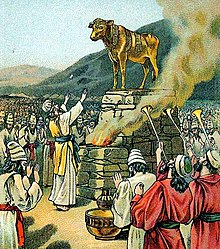
Jeroboam REPLACED the worship

“Here are your gods, Israel, who brought you up out of Egypt.” (1Kings 12:28)

Jeroboam, the first king of the northern kingdom of Israel, initiated a series of significant changes that altered the course of worship for his people. His actions were driven by political motives rather than spiritual fidelity, leading to the establishment of a false system of worship that had long-lasting ramifications.

Replacing the Place, Object, and Priests of Worship

His primary objective was to prevent his subjects from traveling to Jerusalem, in the southern kingdom of Judah, for worship. He feared that such pilgrimages would foster loyalty to the house of David and threaten his own reign. To counter this, Jeroboam replaced the central place of worship and also substituted the object of worship with idols. He also appointed non-Levitical priests to serve, undermining the divinely ordained priesthood.

The Enduring Error of Jeroboam

Jeroboam’s innovations did not end with his reign but extended into the next generations. His establishment of idolatrous practices became a stumbling block for the northern kingdom of Israel. Kings who followed Jeroboam perpetuated these errors, leading the people further away from true worship. The legacy of Jeroboam’s apostasy was so significant that it became a standard by which the sins of Israel’s kings were measured (1Kings 16:26).

The Idolatrous Practices of Ahab and Jezebel

The reign of Ahab and his queen, Jezebel, marked a further decline in the spiritual state of Israel. Jezebel introduced the worship of Baal and Asherah into Israel, practices that were abominable to the Lord. Ahab provoked the Lord more than all the kings of Israel before him (1Kings 16:31-33).

The Lord’s disapproval on Mount Carmel

The prophet Elijah emerged as a powerful voice against the rampant idolatry. In one of the most dramatic confrontations recorded in Scripture, Elijah challenged the prophets of Baal on Mount Carmel. He called upon the Lord to demonstrate His sovereignty, and God responded with fire from heaven, consuming Elijah’s sacrifice (1Kings 18:36-39). This miraculous event underscored the Lord’s disapproval of Israel’s idolatry and called the people back to genuine worship.

Prophetic Admonishment and Call for Repentance

Despite Elijah’s victory, the prophets continuously admonished Israel to repent. The persistent call for repentance echoed throughout the ministries of subsequent prophets, yet the people remained obstinate. Their refusal to abandon false worship led to their downfall (see Hos 8:4-6; Amos 4:4-5).

The Consequences of Continued Apostasy

Israel’s continued apostasy ultimately resulted in their captivity. In 722 BC, the Assyrians conquered the northern kingdom, scattering the ten tribes and bringing an end to the Northern Kingdom. The seeds of their destruction were sown by Jeroboam’s initial departure from true worship.

The Persistence of Errors in Judah

In the southern kingdom of Judah, despite periodic reforms, such as those under King Josiah, errors persisted. Josiah’s reforms were extensive, yet they could not completely eradicate the entrenched practices of idolatry.

Nehemiah’s Acknowledgment of Persistent Disobedience

Centuries later, Nehemiah reflected on Israel’s history of disobedience and idolatry. In his prayer, he acknowledged the persistent sinfulness that had plagued the nation, attributing their suffering to their unfaithfulness (Nehemiah 9:26-37). Nehemiah’s reflection underscores the long-lasting impact of Jeroboam’s initial errors, demonstrating that false worship and disobedience to God’s commands lead to severe consequences.

Conclusion

The establishment of false worship by Jeroboam in 1Kings 12:25-33 had long-lasting effects on the northern kingdom of Israel. This sin was perpetuated by subsequent kings and contributed to the spiritual decline of Israel. Prophets repeatedly condemned these practices and called for repentance, but the people’s persistence in idolatry ultimately led to their downfall and exile. The enduring influence of Jeroboam’s sin is a stark reminder of the consequences of deviating from God’s commands.

Agape,
Spencer

What is a DEVO book really?

What’s a DEVO book? DEVO is short for “DEVOTIONAL.”

A devotional book is a text, often religious in nature, designed to inspire and guide individuals in their spiritual practices. These books typically contain daily readings, reflections, prayers, or meditations aimed at fostering a deeper connection with one’s faith or spiritual beliefs. They can cover a wide range of topics, from personal growth and introspection to theological teachings and biblical passages.

While devotional books can be valuable tools for spiritual growth and contemplation, they can also potentially lead individuals into a false sense of godliness or spirituality for several reasons:

One. Verse. Every. Day.

What’s wrong with reading a DEVO?

DEVO’s…

Surface-Level Engagement: Some devotional books offer quick, easily digestible readings that may encourage a superficial understanding of faith or spirituality. Readers may mistake this cursory engagement for genuine spiritual depth.

Acts 20:27 KJV. For I have not shunned to declare unto you all the counsel of God.

Emotional Appeal: Devotional books often appeal to readers’ emotions, offering comforting words or inspiring stories. While emotional resonance can be a powerful aspect of spiritual experience, it can also lead individuals to prioritize feelings over critical thinking or authentic spiritual growth.

Romans 10:2 KJV. For I bear them record that they have a zeal of God, but not according to knowledge.

2 Timothy 2:15 KJV. Study to shew thyself approved unto God, a workman that needeth not to be ashamed, rightly dividing the word of truth.

Lack of Covenant context: Many devotional books are written from a particular Old Covenant, potentially limiting readers’ exposure to the New Testament covenant. This lack of diversity can reinforce existing biases and prevent individuals from engaging with more accurate and applicable viewpoints.

Hebrews 8:13 In that he saith, A new covenant, he hath made the first old. Now that which decayeth and waxeth old is ready to vanish away.

For example, do we need to do animal sacrifices? Nope! Look at this verse. Are we to continue to make animal sacrifices now that Christ has sacricfied Himself?

Psalm 66:15 KJV. I will offer unto thee burnt sacrifices of fatlings, with the incense of rams; I will offer bullocks with goats. Selah.

Hebrews 10:11 And every priest standeth daily ministering and offering oftentimes the same sacrifices, which can never take away sins:

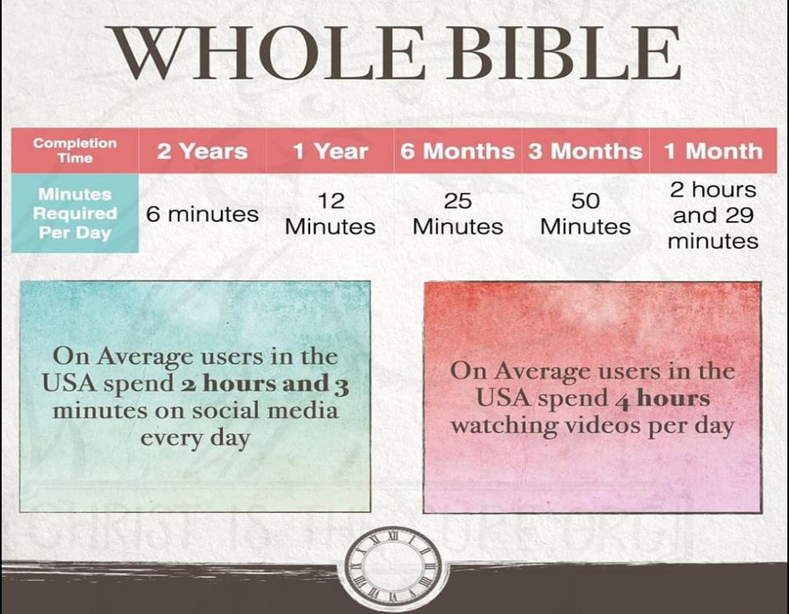
There are 31,102 verses in the Bible. At that pace of One. Verse. Every. Day. It would take 85 years to read through the Bible.

I don’t have that kind of time left.

Agape,

Spencer

Here is a link to printable bookmarks to help you read through the bible in an organized fashion.

Test every spirit. 1John 4:1-6

How do we know who is an antichrist?

1Jo 4:6 We are of God: he that knoweth God heareth us; he who is not of God heareth us not. By this we know the spirit of truth, and the spirit of error.

The spirit of truth HEARS…

HEAR the sayings of Jesus. Matt 7:24; John 12:48
EXAMPLES that match Christ. 1Cor 11:1; Php 3:17; 2Th 3:9; John 13:15; 1Tim 4:12; 1Pet 2:1-6, 21;
APOSTLES Doctrine. Acts 2:42; 1John 1:5; 2:19; John 17:20; 1Thess 2:13; 1Cor 2:9-13
READING is hearing. John 20:30-31; Eph 3:3-4; 1John 2:12-14.

additional outlines from 1John can be found here.

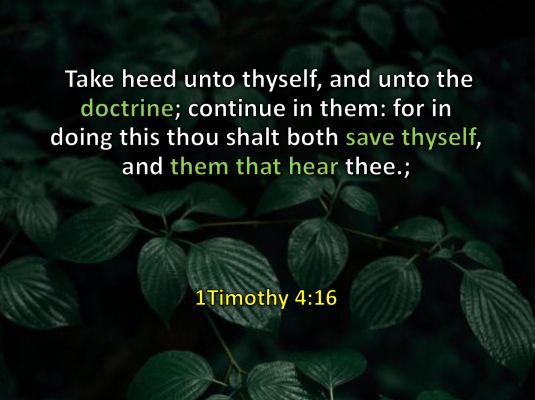
Take Heed unto the Doctrine

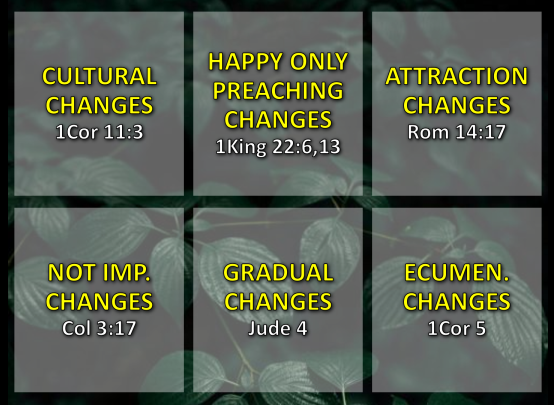
The denominational world is trying to CHANGE the church, which means they’re trying to CHANGE the doctrine of Christ.

DOCTRINE DEFINED. Doctrine is Teaching.

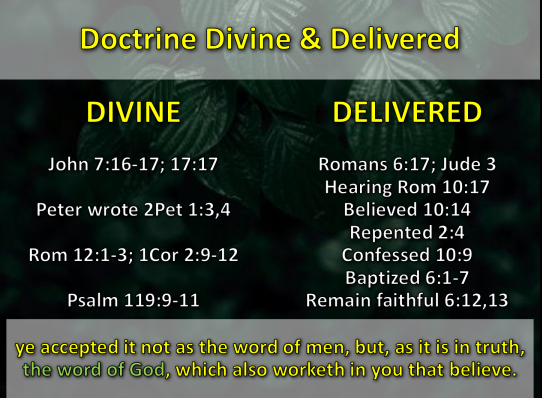
DOCTRINE DIVINE & DOCTRINE DELIVERED.

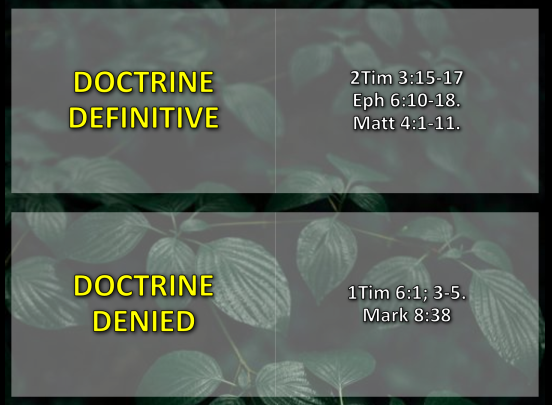
DOCTRINE that is DIFINITIVE, and DOCTRINE that is DENIED.

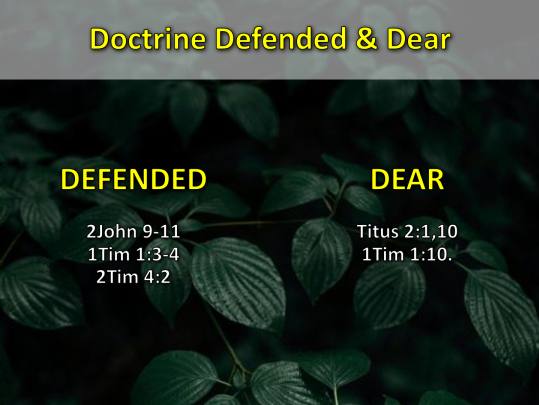
DOCTRINE to be DEFENDED, and a DOCTRINE so DEAR.

Why so urgent about the Doctrine of Christ? Because heaven is at stake. Fellowship with God and His Son Christ Jesus demand it.

Agape,

Spencer

Spencer is an evangelist for the church of Christ at Franklin & Juniper st. in Borger Texas. You’re invited to visit one of our services to learn more about the doctrine of Christ.

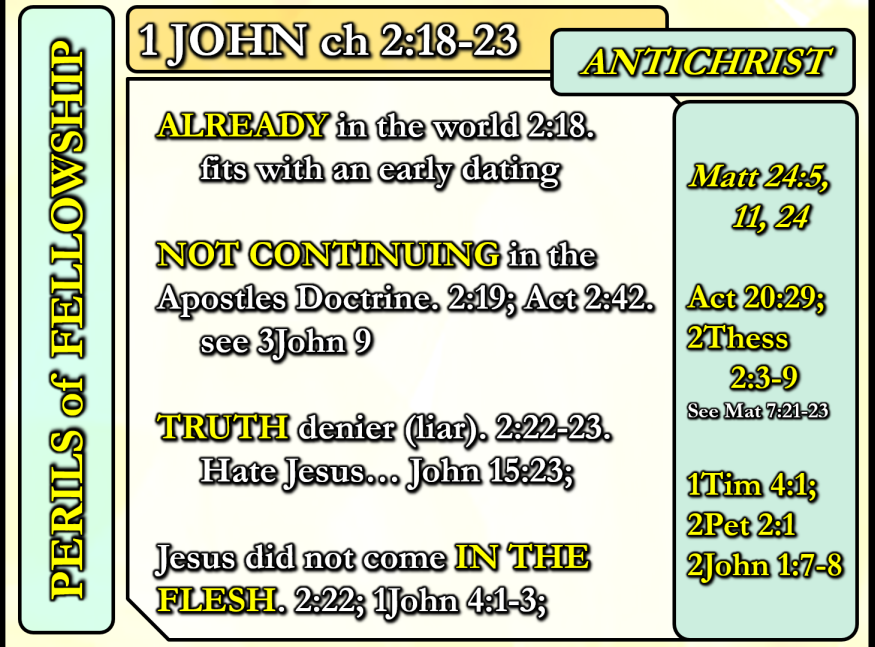
1JOhn 2:18-23 Who is the ANTICHRIST?

Who is the ANTICHRIST? 18-23

ALREADY in the world 2:18.
fits with an early dating

NOT CONTINUING in the Apostles Doctrine. 2:19; Act 2:42.
see 3John 9

TRUTH denier (liar). 2:22-23.
Hate Jesus… John 15:23;

Jesus did not come IN THE FLESH. 2:22; 1John 4:1-3;

Here’s a link to all the published studies from 1 John.

The Franklin and Juniper church of Christ begins an overview study of the book of 1John. If you live in the Borger area, We invite you to join us at 9:30am each Sunday Morning.