Why do we DOUBT? Oppression.

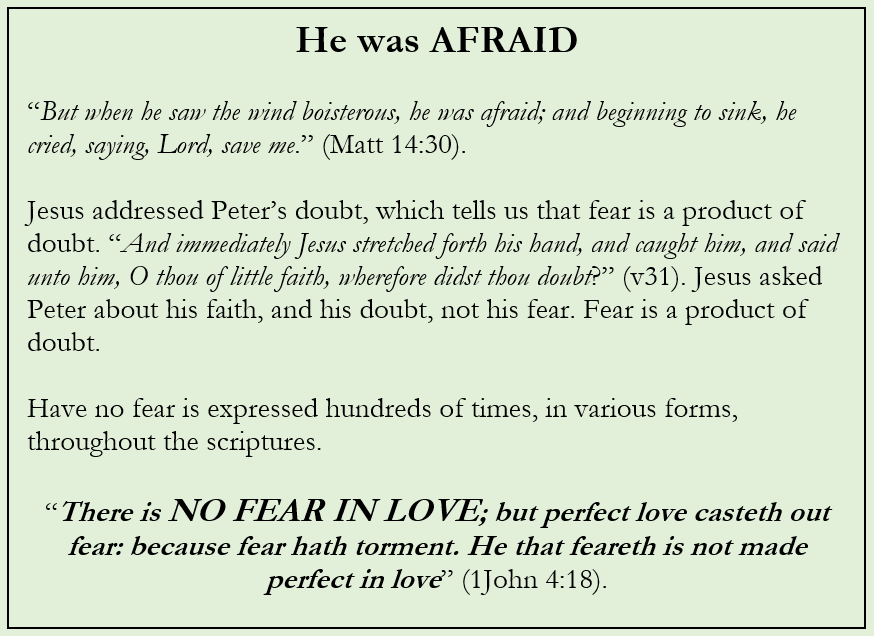
When Jesus asked Peter; “why did you doubt?” they were standing in the midst of a storm on tossing seas (Matt 14:24-31).

Isn’t that how it is for us? Our doubts arise in the midst of the storms on the crashing seas of life. We seldom doubt on the calm, and peaceful waters.

This scene with Peter on the sea reminds me of the parable of the Sower. Jesus’ teaching about the rocky soil resembles the fear and doubt that arise during times of trouble.

“But he that received the seed into stony places, the same is he that heareth the word, and anon with joy receiveth it; Yet hath he not root in himself, but dureth for a while: for when tribulation or persecution ariseth because of the word, by and by he is offended” (Matt 13:20-21).

Doubt, and falling away, often comes in the face of opposition, or persecution for the word’s sake.

If we can learn to overcome doubt in these situations, perhaps we’ll be able to endure the regular troubles of life.

Why do we doubt? What is the source of doubt? This series of articles will seek to search the scriptures for the answer, and to learn how to combat, or to Overcome Doubt. The first article showed that Doubt is based on Disbelief, and the way to overcome disbelief is through knowledge of the Lord Jesus Christ. This article will attempt to Overcome Doubt that arises from the Oppression of life. 

In the parable of the soils, and in the example of Peter, it becomes clear that trouble reveals our DOUBTS instead of causing them. There are some who teach the error that becoming a Christian relieves us of all pain & suffering. The bible says something completely different.

“Yea, and all that will live godly in Christ Jesus shall suffer persecution” (2Tim 3:12).

“Confirming the souls of the disciples, and exhorting them to continue in the faith, and that we must through much tribulation enter into the kingdom of God” (Acts 14:22).

“Be not thou therefore ashamed of the testimony of our Lord, nor of me his prisoner: but be thou partaker of the afflictions of the gospel according to the power of God” (2Tim 1:8)

“Marvel not, my brethren, if the world hate you” (1John 3:13).

These few verses should be sufficient to show that suffering for the faith is a reality for the faithful. Resilience & Endurance is the antidote to DOUBT, but developing these is key. Resilience is the capacity to recover quickly from difficulties; toughness. Endurance is the ability or strength to continue or last, especially despite fatigue, stress, or other adverse conditions.

There is a very good reason why we ought to endure. “You therefore must endure hardship as a good soldier of Jesus Christ” (2Tim 2:3). “If we endure, We shall also reign with Him. If we deny Him, He also will deny us” (2Tim 2:12).

How does one develop endurance? This lesson goes along with the first lesson about faith; remember to remember the Lord and have faith. “Remember that Jesus Christ of the seed of David was raised from the dead according to my gospel: Wherein I suffer trouble, as an evil doer, even unto bonds; but the word of God is not bound. Therefore I endure all things for the elect’s sakes, that they may also obtain the salvation which is in Christ Jesus with eternal glory. It is a faithful saying: For if we be dead with him, we shall also live with him: If we suffer, we shall also reign with him: if we deny him, he also will deny us” (2Timothy 2:8-12).

Have Faith, then after that, the next thing is to stand firm for the faith. The way we can do this is through 5 reminders.

First, Stand back and ask, “is this the worst that can happen?” Before we sink, take time to think. “For our light affliction, which is for the moment, worketh for us more and more exceedingly an eternal weight of glory” (2Cor 4:17). “Fear him that can destroy in Hell” (Mat 10:28; Luke 12:5). “For I reckon that the sufferings of this present time are not worthy to be compared with the glory which shall be revealed to us-ward” (Rom 8:18). We often give up long before our endurance expires. 

Then ask, “How can I endure this?” Before we give up, remember the example of those that faced trials before you. “rejoicing that they were counted worthy to suffer dishonor for the Name” (Acts 5:41; cf. 2Cor 11:22-33). “Behold, we count them happy which endure. Ye have heard of the patience of Job, and have seen the end of the Lord; that the Lord is very pitiful, and of tender mercy” (James 5:11). Can you steel yourself against the pain, can you TOUGHEN up? Paul wrote, “Watch ye, stand fast in the faith, quit you like men, be strong” (1Cor 16:13).

A third question to ask is, “Are there any good things that can come from this?” Paul saw the good of preaching Christ even under false pretenses (Phil 1:12-18). James wrote that the trying of our faith produces patience (Jas 1:3).

Nature itself teaches us that growth comes through enduring difficulties. The writer of Hebrews noted this. “Furthermore we have had fathers of our flesh which corrected us, and we gave them reverence: shall we not much rather be in subjection unto the Father of spirits, and live? For they verily for a few days chastened us after their own pleasure; but he for our profit, that we might be partakers of his holiness. Now no chastening for the present seemeth to be joyous, but grievous: nevertheless afterward it yieldeth the peaceable fruit of righteousness unto them which are exercised thereby. Wherefore lift up the hands which hang down, and the feeble knees” (Heb 12:9-13).

Then make a commitment to NEVER, NEVER, NEVER, NEVER, GIVE UP! “And let us not be weary in well doing: for in due season we shall reap, if we faint not” (Gal 6:9; cf. Phil 4:13; Rev 2:10). Make endurance the only option.

Lastly, and most importantly, do all you can do to stand. “Wherefore take unto you the whole armour of God, that ye may be able to withstand in the evil day, and having done all, to stand” (Eph 6:13; cf. 10-18). Be a doer of God’s word and not a hearer only. Do the best you can and when you learn to do better, do better.

“I press toward the mark for the prize of the high calling of God in Christ Jesus.” “I can do all things through Christ which strengtheneth me”. (Phil 3:14; 4:13). The troubles of life reveal our doubts, but we can do it, the Lord said so (1Cor 10:13).

Agape,

Spencer

FILED UNDER: Overcoming doubt.

You’re invited to attend one of the services of the Franklin & Juniper st church of Christ in Borger Texas.

Overcoming Doubt

Why do we doubt? What is the source of doubt? This series of articles will seek to search the scriptures for the answer, and to learn how to combat, or to Overcome Doubt.

LESSON LINKS.

Why do we DOUBT? Don’t Believe. 09/08/23

Why do we DOUBT? Oppression. 9/14/23

Why do we DOUBT? Uncertainties. 9-22-23

Why do we DOUBT? Backbiting. 09-30-23

Why do we DOUBT? Thorns. 10-07-23

You’re invited to visit our services at the Franklin & Juniper St church of Christ in Borger Texas.
Why do we DOUBT?

Jesus asked this question of Peter when he began to sink after walking on the water.

“And in the fourth watch of the night Jesus went unto them, walking on the sea. And when the disciples saw him walking on the sea, they were troubled, saying, It is a spirit; and they cried out for fear. But straightway Jesus spake unto them, saying, Be of good cheer; it is I; be not afraid. And Peter answered him and said, Lord, if it be thou, bid me come unto thee on the water. And he said, Come. And when Peter was come down out of the ship, he walked on the water, to go to Jesus. But when he saw the wind boisterous, he was afraid; and beginning to sink, he cried, saying, Lord, save me. And immediately Jesus stretched forth his hand, and caught him, and said unto him, O thou of little faith, wherefore didst thou doubt? And when they were come into the ship, the wind ceased. Then they that were in the ship came and worshipped him, saying, Of a truth thou art the Son of God”

(Matthew 14:25-23).

You may wonder why the Lord was so critical of Peter’s doubt, because walking on water is not normal. But that was not the Lord’s rebuke. Peter was walking on water. Jesus was walking on water. They both walked on water together in the storm.

Do we also doubt in the storms of life?
Why do we doubt? What is the source of doubt? This series of articles will seek to search the scriptures for the answer, and to learn how to combat, or to Overcome Doubt.

The first thing we ought to do is to make certain we know what it means. Jesus asked Peter, “why did you doubt (duplicate, i.e. mentally to waver in opinion) [Strong’s Greek dictionary; distazo]. The dictionary defines doubt as; “to be uncertain about; consider questionable or unlikely; hesitate to believe.” DOUBT is the opposite of BELIEF. Therefore, our first source of DOUBT is DISBELIEF. This will be the ultimate root of all the sources.

DISBELIEF is the target of the Lord’s question to Peter (v31), and is our challenge today. Belief in God is the beginning of our salvation. It’s placed first of all other commands in obeying the gospel. Works without faith is vanity. Faith is a work (John 6:29; 1Thess 1:3; 2Thess 1:11).

“But without faith it is impossible to please him: for he that cometh to God must believe that he is, and that he is a rewarder of them that diligently seek him” (Hebrews 11:6).

“He that believeth and is baptized shall be saved; but he that believeth not shall be damned” (Mark 16:16).

The type of Belief under consideration is compared to the faith of Abraham when he went to sacrifice the son of promise. “Was not Abraham our father justified by works, when he had offered Isaac his son upon the altar? Seest thou how faith wrought with his works, and by works was faith made perfect? And the scripture was fulfilled which saith, Abraham believed God, and it was imputed unto him for righteousness: and he was called the Friend of God. Ye see then how that by works a man is justified, and not by faith only” (James 2:21-24). His belief was so certain that he supposed God would raise Isaac from the dead (Heb 11:17).

However, faith is not blind. “Now faith is the substance of things hoped for, the evidence of things not seen” (Hebrews 11:1). There’s evidence to believe. Peter’s evidence was the prior miracles of Jesus (which are still evidence for us today John 20:30-31). Peter had participated in the feeding of the 5,000 just preceding his water ambulation. How many steps he made on the water we do not know, but one step out of a boat into the deep stormy waters is sufficient. He had gone out in the limited commission with powers, “against unclean spirits, to cast them out, and to heal all manner of sickness and all manner of disease” (Matthew 10:1).

Well, that was Peter you may say; what about us? We don’t see those miracles today. No, we don’t see biblical miracles today, but that’s okay. The miracles Peter saw, and those in the early church are for our belief. “And many other signs truly did Jesus in the presence of his disciples, which are not written in this book: But these are written, that ye might believe that Jesus is the Christ, the Son of God; and that believing ye might have life through his name” (John 20:30-31). But there’s more…

God’s word says that God’s creation is for belief. “Because that which may be known of God is manifest in them; for God hath shewed it unto them. For the invisible things of him from the creation of the world are clearly seen, being understood by the things that are made, even his eternal power and Godhead; so that they are without excuse” (Romans 1:19-20). God’s creation is enough to begin our belief in Him.

Paul used this same evidence for belief. “Nevertheless he left not himself without witness, in that he did good, and gave us rain from heaven, and fruitful seasons, filling our hearts with food and gladness” (Acts 14:17; 17:27-28). The evidence of creation and human life will point you in the right direction to look further. There are only 2 possibilities about creation: 1) that everything came from a thoughtless nothing, or 2) everything came from a very wise, powerful, and brilliant God.

Belief is not blind. It has evidence and there’s so much evidence inside and outside of scripture. If you doubt, perhaps a study of evidences is for you to combat that doubt. Here are a few areas to study…

I have a few resources in my library. One of my favorites is by a brother in Christ named A.O. Schnabel, “Has God Spoken?” This book references scriptures of nature that science discovered many hundreds and thousands of years later. Some discoveries as recent as the 1960’s!

There’s no need to doubt. We can know and be assured.

(to be continued)

Agape,

Spencer

What can the 7 Sayings of Jesus on the Cross teach us about our pain?

Jesus said, “Take up your cross and follow me” (Matt 16:24). We are to die to self and live for Him.

The Gospels reveal 7 sayings of Jesus when He was on His cross. These sayings have important meaning for themselves, but they also leave an example for us who are suffering on our crosses.

What can the 7 sayings of Jesus on the cross teach us about handling our own pain, suffering, & earthly hurting?

“Father, forgive them; for they know not what they do.” (Luke 23:34)

We often suffer at the hands of those close to us. Jesus suffered at the hands of God’s chosen people. We will often complain about what they should do, but didn’t do. Yes, they shoulda, and coulda, but didn’t. This powerful example of Jesus teaches us to be a forgiving people. We need to complain with grace, ready to Forgive, or Forebear, or Forget (release from our heart). Forgive those that are hurting you…

But Stay on the cross.

“To day shalt thou be with me in paradise.” (Luke 23:43)

When others fail, remember that God doesn’t fail. There’s hope in the midst of our pain. There’s even hope when our pain is self induced. The thief admitted his guilt, and was a mocker along with the other one, but later he had a change of heart. It’s then he looked to the only one that could help, Jesus. Sometimes our suffering is self induced, but the Lord is faithful to forgive those that are in Him (1John 1:9). Repent…

But Stay on the cross.

“Woman, behold, thy son! Behold, thy mother!” (John 19:26-27)

Your friends may have turned their back on you. I hate that. However, If you’ll look, you’ll see that not everyone has left you. Some are nearby unable to take away your pain, But they can take some of your responsibilities. Just ask them for help. Some of us just don’t know what to do, but we’re willing if you’ll let us know.

When you’re overwhelmed with your main priority, let go of some of the other important, but lesser stuff.

But Stay on the cross.

“My God, my God, why hast thou forsaken me?” (Mat 27:46)

People will let you down at your lowest point. The disciples left Jesus. It will also APPEAR that God has left you too. He hasn’t. He’s with you. While this saying has prophetic significance, it is a reminder of how lonely we can feel in our darkest moments. We need to remember that Jesus said, “I will never leave thee, nor forsake thee” (Heb 13:5).

But Stay on the cross.

“I thirst.” (John 19:28-29)

Life is a dry, and thirsty struggle, metaphorically speaking. Jesus asked the woman at the well for a drink. He received a bit of a rebuke (John 4:7-9). Isn’t that the way it goes sometimes? Jesus said, “I thirst,” and He received sour wine. When we need help we sometimes receive a sour response. Ask anyway…

But Stay on the cross.

“It is finished.” (John 19:30)

Jesus stayed on that cross to the very end because He knew that what He was doing was essential for salvation for the world. (cf. Matt 16:21-23; 26:52-55). Keep on pushing through the pain until you complete your duty as a child of God. It’s important that we stay the course of faithfulness. We may not see the benefits until much later (Rev 2:10),

But Stay on the cross.

“Father, into thy hands I commend my spirit.” (Luke 23:46)

Even when all others fail you, God never does. Trust God. “For the which cause I also suffer these things: nevertheless I am not ashamed: for I know whom I have believed, and am persuaded that he is able to keep that which I have committed unto him against that day.” (2Tim 1:12). Whatever happens to you…

Stay on the cross.

Agape,

Spencer

We Gotta have GRIT

you’re going to Endure You Gotta have Grit.

“Behold, we count them happy which endure. Ye have heard of the patience of Job, and have seen the end of the Lord; that the Lord is very pitiful, and of tender mercy.”  (James 5:11)

Endurance is a highly favored quality of mankind. It is most often associated with success despite difficulty or pain. We praise endurance because of the win that usually follows.

Endurance is necessary to our survival, and essential for our salvation. “And ye shall be hated of all men for my name’s sake: but he that endureth to the end shall be saved” (Matt 10:22).

“Fear none of those things which thou shalt suffer: behold, the devil shall cast some of you into prison, that ye may be tried; and ye shall have tribulation ten days: be thou faithful unto death, and I will give thee a crown of life” (Rev 3:10; cf Jas 1:12).

GRIT is another description of endurance. It is having a firmness of character; an unconquerable spirit. We gotta have GRIT, but how do we get us some?

The Hebrew writer in chapter 12, a chapter about endurance, gives us 4 keys on how to get GRIT.

[12] Therefore, lift up the hands which hang down and the feeble knees,

[13] and make straight paths for your feet, lest that which is lame be turned out of the way, but let it rather be healed.

[14] Follow peace with all men, and holiness, without which no man shall see the Lord,

[15] looking diligently lest any man fail of the grace of God; lest any root of bitterness spring up to trouble you, and thereby many be defiled;

Key #1 is GET UP AND GO.

“Therefore, strengthen the hands which hang down, and the feeble knees” (Heb 12:12). This is a command for us to get busy working on strength building.

When Elijah was facing persecution, God told him to GO. “And there he went into a cave, and spent the night in that place; and behold, the word of the LORD came to him, and He said to him, “What are you doing here, Elijah?” So he said, “I have been very zealous for the LORD God of hosts; for the children of Israel have forsaken Your covenant, torn down Your altars, and killed Your prophets with the sword. I alone am left; and they seek to take my life” (1Kings 19:9). “Go, return on your way to the Wilderness of Damascus; and when you arrive, anoint Hazael as king over Syria” (19:15).

Key #1 is GET UP AND GO.

Key #2 is to READ the Bible with a focus on the New Testament.

“…and make straight paths for your feet, lest that which is lame be turned out of the way, but let it rather be healed” (Heb 12:13). The straight path for our feet is found through the illumination of the word of God, consider Psalm 119:105… “Thy word is a lamp unto my feet, and a light unto my path.”

Key #2 is READ the Bible with a focus on the New Testament.

Key #3 is to be INTERESTED in and pursue peace with people.

“Follow peace with all men, and holiness, without which no man shall see the Lord,” (Heb 12:14). We can endure longer when we stop making enemies.

“If it be possible, as much as lieth in you, live peaceably with all men” (Rom 12:18). “I exhort therefore, first of all, that supplications, prayers, intercessions, and giving of thanks be made for all men, [2] for kings and for all who are in authority, that we may lead a quiet and peaceable life in all godliness and honesty” (1Tim 2:1-2).

Key #3 is to be INTERESTED in and pursue peace with people.

Key #4 is to look and TEST everything people are teaching.

“…looking diligently lest any man fail of the grace of God; lest any root of bitterness spring up to trouble you, and thereby many be defiled” (Heb 12:15). Looking diligently is about searching out the truth, proving it, and applying it to our lives.

Paul wrote; “Test all things; hold fast to that which is good” (1Thess 5:21). We must be on guard against error and false teachers. “But there were false prophets also among the people, even as there shall be false teachers among you…” (2Pet 2:1a). We’ll gain more endurance as we clear away errors and false teachers.

Key #4 is to look and TEST everything people are teaching.

Summary:

Key #1 is GET UP AND GO. Strengthen the hanging hands.

Key #2 is to READ the Bible to shine a light on your path.

Key #3 is to be INTERESTED in and pursue peace with people.

Key #4 is to look diligently and TEST everything people are teaching.

Agape,

Spencer

Hebrews 12; developing GRIT

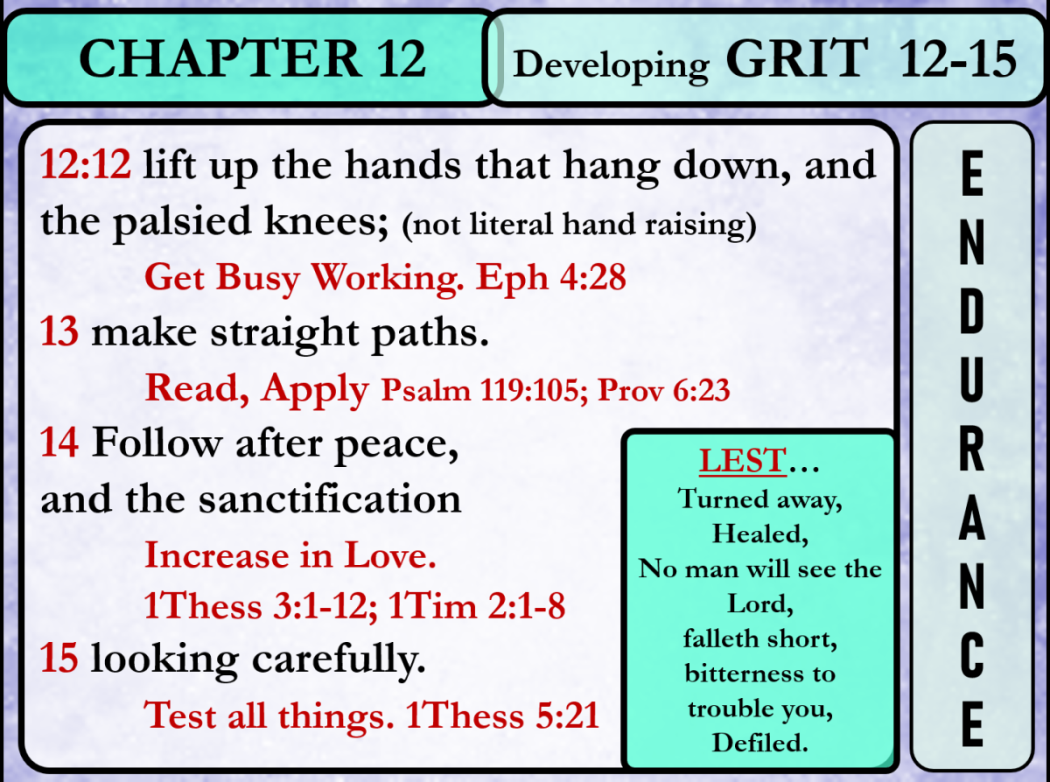
Hebrews 12:12-15 provides a great formula for developing Endurance (GRIT).

Heb 12:12 Wherefore lift up the hands that hang down, and the palsied knees;

Get Busy Working. cf. Eph 4:28

13 and make straight paths for your feet, that that which is lame be not turned out of the way, but rather be healed.

Read, Apply Psalm 119:105; Prov 6:23

14 Follow after peace with all men, and the sanctification without which no man shall see the Lord:

Increase in Love. 1Thess 3:1-12; 1Tim 2:1-8

15 looking carefully lest there be any man that falleth short of the grace of God; lest any root of bitterness springing up trouble you, and thereby the many be defiled;

Test all things. 1Thess 5:21

Along with it the writer provides a warner for lacking endurance.

LEST…

Turned away,

Healed,

No man will see the Lord,

falleth short,

bitterness to trouble you,

Defiled.

for an overview of the book of Hebrews.

Hearing the Voice of Jesus, Pt2

“My sheep hear my voice, and I know them, and they follow me” (John 10:27)

Last week we began the discussion about hearing the VOICE of Jesus. The previous article included the first 3 of 5 points.

This article will touch on the next 2 points in this series.

What does it mean to hear the VOICE of Jesus? Some claim He will speak directly, personally, and miraculously to us. What is the truth?

Hearing the VOICE of Jesus.

The voice of Jesus (through the study of His Word) is a source of comfort for us in our pains, sorrows, and hurts. The letters of the New Testament are also the commands of Jesus; “If any man think himself to be a prophet, or spiritual, let him acknowledge that the things that I write unto you are the commandments of the Lord” (1Cor 14:37), The truths contained therein contain comfort. One example is in 1Thess 4.

“But I would not have you to be ignorant, brethren, concerning them which are asleep, that ye sorrow not, even as others which have no hope. For if we believe that Jesus died and rose again, even so them also which sleep in Jesus will God bring with him. For this we say unto you by the word of the Lord, that we which are alive and remain unto the coming of the Lord shall not prevent them which are asleep. For the Lord himself shall descend from heaven with a shout, with the voice of the archangel, and with the trump of God: and the dead in Christ shall rise first: Then we which are alive and remain shall be caught up together with them in the clouds, to meet the Lord in the air: and so shall we ever be with the Lord. Wherefore comfort one another with these words” (1Thess 4:13-18).

We can find comfort through the words of Jesus. “Blessed be God, even the Father of our Lord Jesus Christ, the Father of mercies, and the God of all comfort; Who comforteth us in all our tribulation, that we may be able to comfort them which are in any trouble, by the comfort wherewith we ourselves are comforted of God” (2Cor 1:3-4)

Another one of the ways His word comforts us is through the assurance we have from His promises. “That by two immutable things, in which it was impossible for God to lie, we might have a strong consolation, who have fled for refuge to lay hold upon the hope set before us: Which hope we have as an anchor of the soul, both sure and stedfast, and which entereth into that within the veil” (Heb 6:18-19). “But without faith it is impossible to please him: for he that cometh to God must believe that he is, and that he is a rewarder of them that diligently seek him” (Heb 11:6).

Paul wrote; “I have fought a good fight, I have finished my course, I have kept the faith: Henceforth there is laid up for me a crown of righteousness, which the Lord, the righteous judge, shall give me at that day: and not to me only, but unto all them also that love his appearing” (2Tim 4:7-8).

When we seek His voice through the reading & study of His inspired word, and we Obey it, we can have the assurance that He will reward us.

Finally, His voice has the words of ETERNAL Life.

“My sheep hear my voice, and I know them, and they follow me: And I give unto them eternal life; and they shall never perish, neither shall any man pluck them out of my hand” (John 10:27-28).

Sadly, some will hear it & turn from it. “From that time many of his disciples went back, and walked no more with him. Then said Jesus unto the twelve, Will ye also go away? Then Simon Peter answered him, Lord, to whom shall we go? thou hast the words of eternal life” (John 6:66-68).

Jesus said, “He that rejecteth me, and receiveth not my words, hath one that judgeth him: the word that I have spoken, the same shall judge him in the last day” (John 12:48). “It is the spirit that quickeneth; the flesh profiteth nothing: the words that I speak unto you, they are spirit, and they are life” (John 6:63).

The writer of Hebrew was inspired to write, “And being made perfect, he became the author of eternal salvation unto all them that obey him” (Heb 5:9). Cornelius was told he needed to hear words, so he sent for Peter who came to tell him words and they were ready to, “hear all things that are commanded thee of God” (Acts 10:6, 22, 33).

When we read, we can believe that we might have life, “But these are written, that ye might believe that Jesus is the Christ, the Son of God; and that believing ye might have life through his name” (John 20:31). When we read, we can understand the mystery, “Whereby, when ye read, ye may understand my knowledge in the mystery of Christ” (Eph 3:4).

The VOICE of Jesus is represented as a sword in the imagery seen by John in Revelation 1:16. The Hebrew writer said, “For the word of God is quick, and powerful, and sharper than any twoedged sword, piercing even to the dividing asunder of soul and spirit, and of the joints and marrow, and is a discerner of the thoughts and intents of the heart” (Heb 4:12).

The sheep will find comfort, peace, assurance, and salvation through the words of the Good Shepherd, Christ Jesus.

–Spencer

Lessons from 1Peter 5; SATAN

unscriptural portrait of Satan; this what people who don’t read the bible think he looks like cf. 2Cor 11:14

1Peter 5:8 Be sober, be vigilant; because your adversary the devil, as a roaring lion, walketh about, seeking whom he may devour:
9 Whom resist stedfast in the faith, knowing that the same afflictions are accomplished in your brethren that are in the world.

Some truths about SATAN.

SUBJECT TO GOD. Mark 5; Job 1

ANGEL OF LIGHT. 2Cor 11:14

TAKES AWAY THE WORD. Mark 4:15; 2Thess 2:11-12; Eph 2:2

ACCUSER. Rev 9:11; Abaddon. Adversary, 1Pet 5:8

NEVER QUITS. 2Cor 11:14; 1Pet 5:8

7 Things we ought to PROTECT pt 1

pt1. Personal Safety.

“O Timothy! keep that which is committed to thy trust,” (1Tim 6:20).

Last week we looked at an overview of 7 things we ought to protect. These next 7 articles will dive deeper into each of those items.

The first one is about PERSONAL SAFETY.

Can a child of God protect, preserve, save their life? Is it always necessary to die for the cause of Christ? Yes and no, it depends on the situation.

We have several examples from the life of the Apostle Paul. Let’s learn from his example when his life was under threat of imminent death.

On his way to Jerusalem the Apostle Paul said, “for I am ready not to be bound only, but also to die at Jerusalem for the name of the Lord Jesus” (Acts 21:13). Upon arriving to Jerusalem and entering the Temple he was arrested. Paul was ready to die.

At first, he was going to be scourged by the Roman guard. “The chief captain commanded him to be brought into the castle, and bade that he should be examined by scourging; that he might know wherefore they cried so against him” (Acts 22:24). Paul was ready to die.

But Paul said, “Is it lawful for you to scourge a man that is a Roman, and uncondemned” (v25)? Upon further questioning, they discovered that Paul was a natural born Roman citizen. They became afraid of what they were about to do to him and they backed away. “Then straightway they departed from him which should have examined him: and the chief captain also was afraid, after he knew that he was a Roman, and because he had bound him” (v29). Paul was ready to die.

We conclude that while it is important to be ready to be beaten for the cause of Christ, it’s not necessary if you can lawfully avoid it without denying your faith in Christ. He did not violate Matt 16:25, “For whosoever will save his life shall lose it: and whosoever will lose his life for my sake shall find it.” Paul was ready to die.

Later, during this same arrest event, a plot was discovered to assassinate Paul. “And when it was day, certain of the Jews banded together, and bound themselves under a curse, saying that they would neither eat nor drink till they had killed Paul. And they were more than forty which had made this conspiracy. And they came to the chief priests and elders, and said, We have bound ourselves under a great curse, that we will eat nothing until we have slain Paul. Now therefore ye with the council signify to the chief captain that he bring him down unto you to morrow, as though ye would enquire something more perfectly concerning him: and we, or ever he come near, are ready to kill him. And when Paul’s sister’s son heard of their lying in wait, he went and entered into the castle, and told Paul” (Acts 23:12-16). Paul was ready to die.

Upon learning of the plot Paul did this, “Then Paul called one of the centurions unto him, and said, Bring this young man unto the chief captain: for he hath a certain thing to tell him” (Acts 23:17). The plot was told to the chief captain, “But do not thou yield unto them: for there lie in wait for him of them more than forty men, which have bound themselves with an oath, that they will neither eat nor drink till they have killed him: and now are they ready, looking for a promise from thee” (22:21). The chief captain then sent Paul that night along with two hundred soldiers to go to Caesarea, and horsemen threescore and ten, and spearmen two hundred (v23). Paul was ready to die, but it wasn’t necessary, and he did not deny the Lord in the process.

We conclude that a Christian ought to be ready to be jailed, beaten, and even die for the cause of Christ (Acts 5:4-41). However, if there is a lawful means of protecting your life without denying the Lord that bought you, then do it. We could cite other such examples from Paul’s missionary journeys (Acts 9:25; 2Cor 11:33; Acts 16:35-40), in all Paul was ready to die.

If the means necessary to avoid persecution is to deny the Lord, then we’ve violated the command, denied the faith, and are in jeopardy for our soul. “But whosoever shall deny me before men, him will I also deny before my Father which is in heaven” (Matt 10:33).

Paul was ready to die, arrest, beatings, and eventually did die. All for the cause of Christ (2Cor 11:23-33; Phil 1:20-22; 2Tim 4:6-7).

“Fear none of those things which thou shalt suffer: behold, the devil shall cast some of you into prison, that ye may be tried; and ye shall have tribulation ten days: be thou faithful unto death, and I will give thee a crown of life” (Rev 2:10).

Spencer