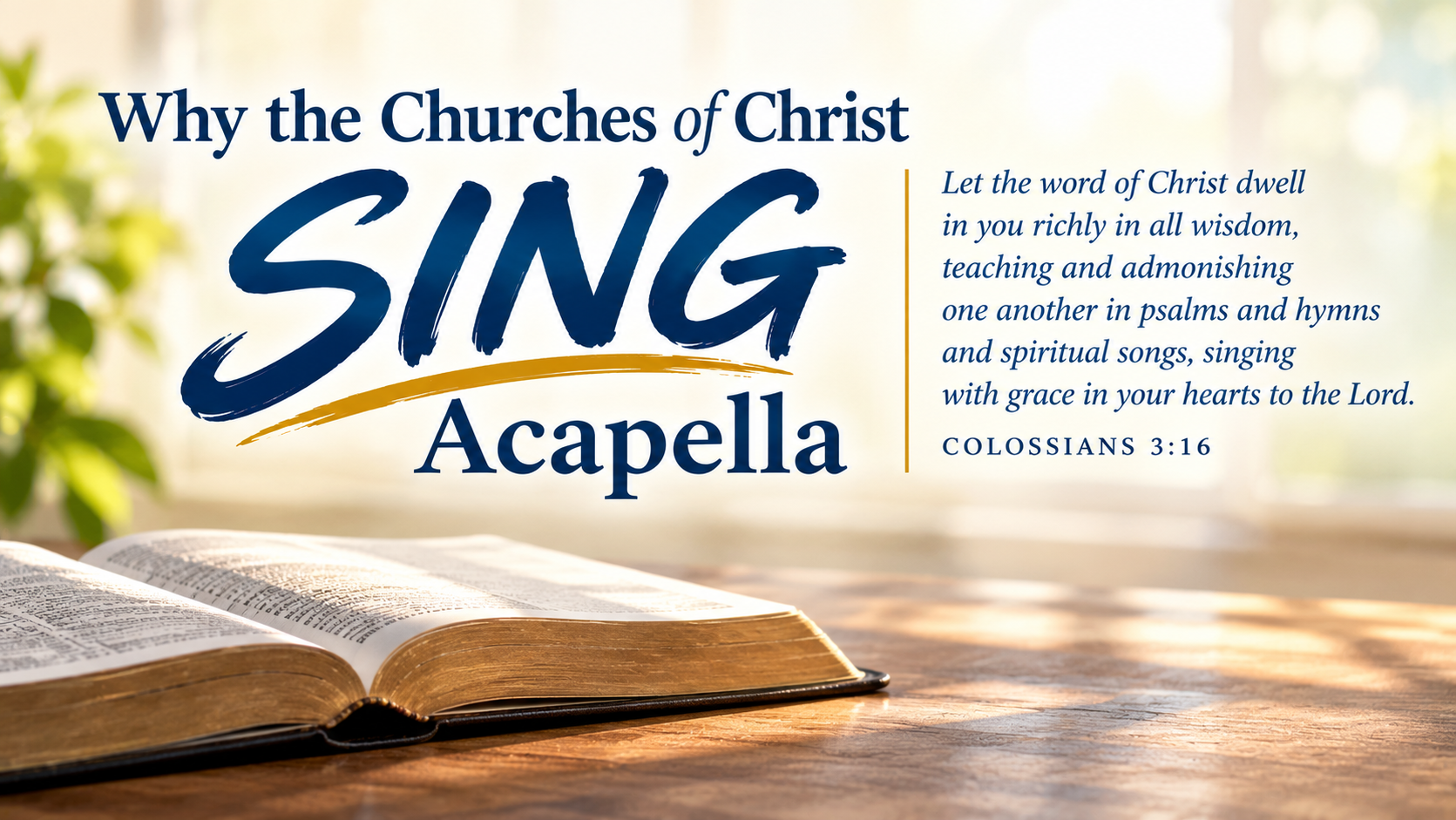
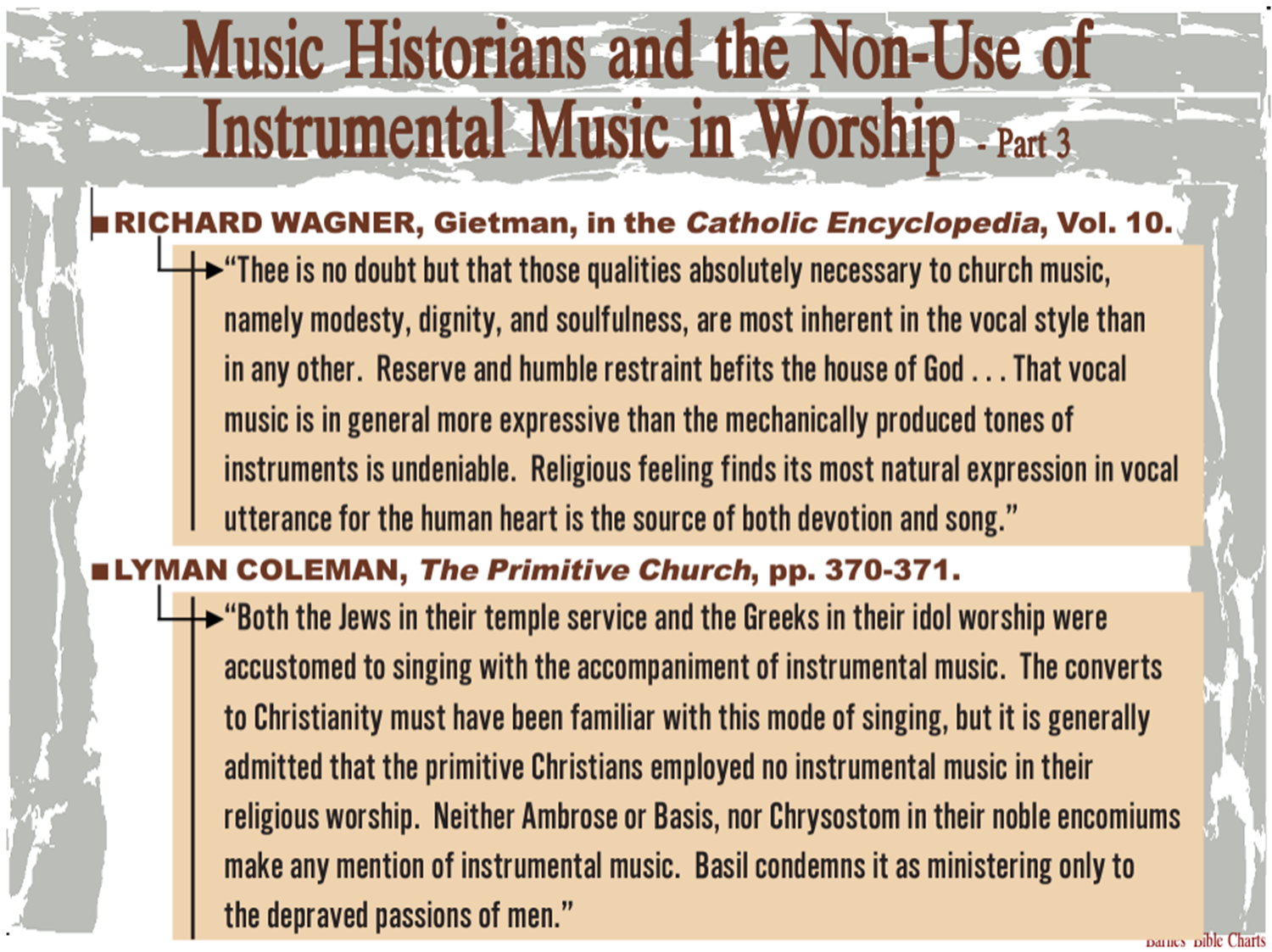
Answering why the churches of Christ sing acapella in the worship.
4 reasons why we JUST SING SONGS.
1) Singing Is Specifically Commanded God has specifically commanded us to sing in worship. Ephesians 5:19 says, “SPEAKING to one another in psalms and hymns and spiritual songs, singing and making melody to the Lord with your heart.” Supporting this, Colossians 3:16 instructs us “teaching and admonishing one another in psalms and hymns and spiritual songs, singing with grace in your hearts to the Lord”, and James 5:13 tells the cheerful to “sing praise.” The New Testament repeatedly SPECIFIES SINGING in the church’s worship.
SPECIFIC IS TERRIFIC, for it tells us exactly what God wants. When God gives a SPECIFIC command, it eliminates all other options.
2) We Sing to One Another to Instruct and Admonish Our singing is not for entertainment purposes; it is mutual teaching. Colossians 3:16 commands, “Let the word of Christ dwell in you richly… teaching and admonishing one another in all wisdom, singing psalms and hymns and spiritual songs.” Ephesians 5:19 adds that we SPEAK to one another in these songs, and 1 Corinthians 14:15 shows that when the church gathers, we sing with understanding. We sing to instruct and encourage one another. Instruments cannot fulfil that command.
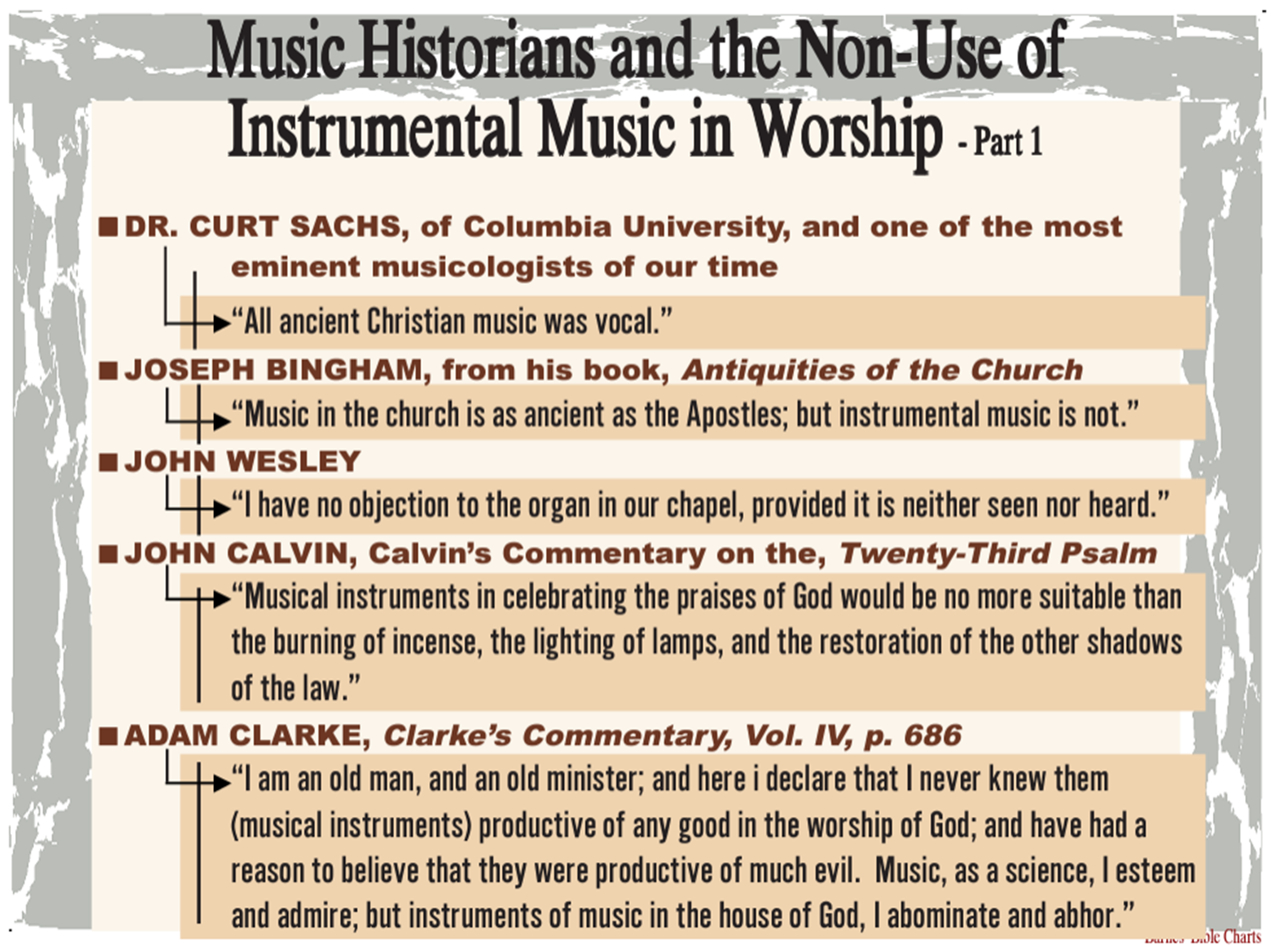
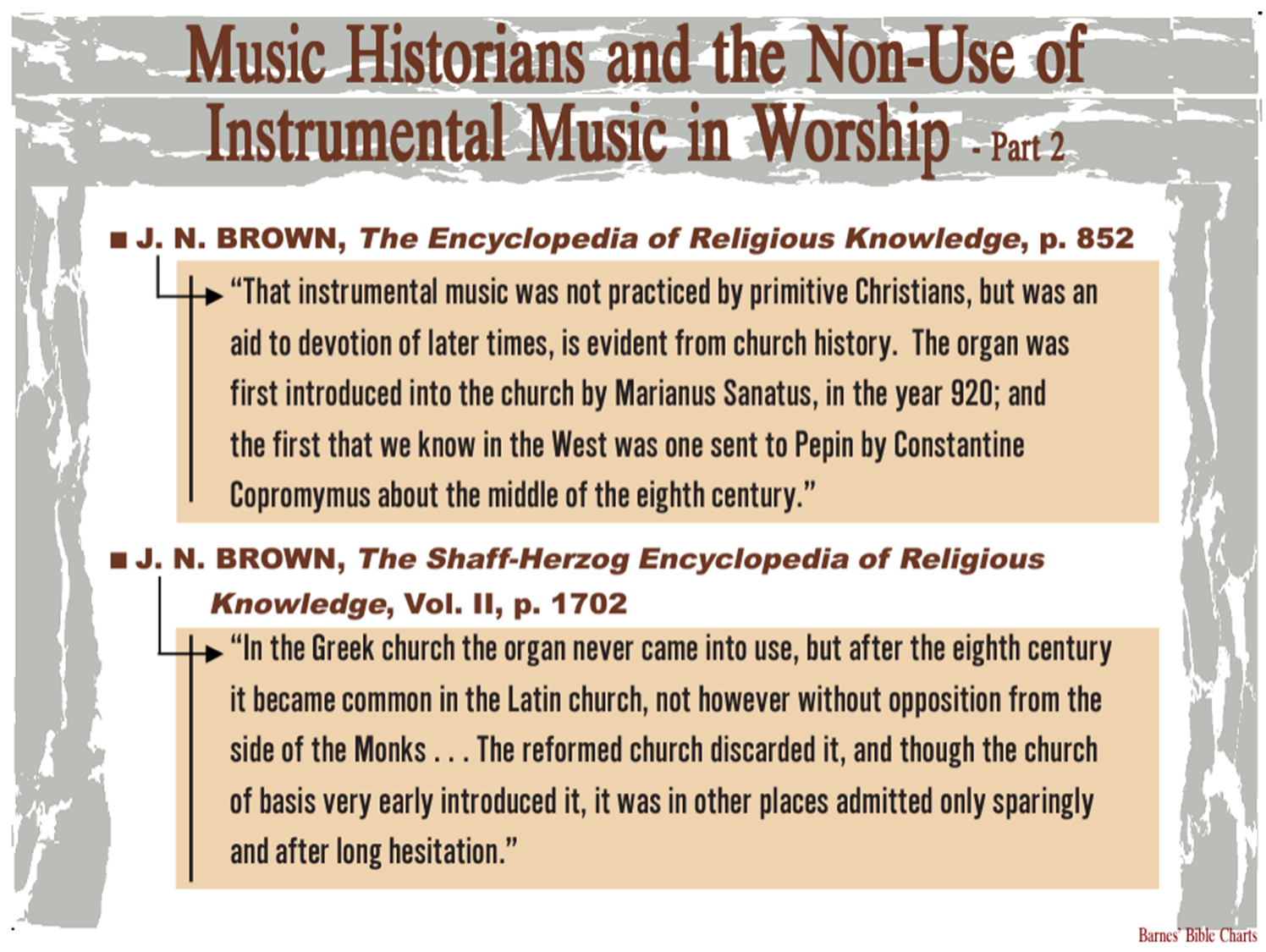
3) We Sing with Our Natural Voice Connected to the Heart We use the natural voice God gave us because true worship flows from the heart. Mark 7:15-21 teaches that what comes out of a person defiles or honors God, for “from within, out of the heart of man,” come the things that matter. Ephesians 5:19 says we make melody “with your heart,” and Colossians 3:16 says we sing “with thankfulness in your hearts.” This heartfelt vocal praise was so universal in the early church that the practice itself became known as a cappella “in the style of the chapel.” Instrumental music in worship is a relatively young idea.
4) We Sing with Grace, Gratitude, and Gladness Christian singing is filled with grace, gratitude, and gladness. Colossians 3:16 tells us to sing “with thankfulness in your hearts to God.” Hebrews 13:15 calls us to “offer up a sacrifice of praise to God, that is, the fruit of lips that acknowledge his name,” and James 5:13 says, “Is anyone cheerful? Let him sing praise.” We lift our voices with grateful hearts, and gladness of heart for the great things God has done.
I’ve spoken to all kinds of folks from the religious world… NONE, NOT ONE, NADA, ZIP have ever said that our worship would violate their conscience if they attended. They ALL AGREE that acapella singing in the church is authorized, accepted, and alright.
After reading this passage, Let’s Imagine this conversation…
PersonA: Walking into the assembly carrying a lamb, a man asks, “can I bring a lamb to worship and sacrifice it to the Lord? David did it.”
PersonB: No. That is part of the OT system. Jesus is the Lamb of God and it’s His blood that takes away sin (Heb 10:1-12). “Behold the Lamb of God, which taketh away the sin of the world” (John 1:29).
PersonA: Walking into the assembly carrying a burning lamp of incense, a man asks, “can I burn incense of rams in the worship today? David did it.”
PersonB: No, that is not authorized in the New Testament. Jesus is the sweet-smelling savor. “And walk in love, as Christ also hath loved us, and hath given himself for us an offering and a sacrifice to God for a sweetsmelling savour” (Eph 5:2).
PersonA: Walking into the assembly carrying a guitar, or some other mechanical instrument, a man asks, “can I bring this into the assembly to worship using my God given talent to play an instrument? David did it.”
PersonB: YES! David did, so we can too! Come on in!!
Do you see the ridiculousness of the above conversation? Let’s imagine an alternative ending to this conversation.
PersonA: Walking into the assembly carrying a guitar, or some other mechanical instrument, a man asks, “can I bring this into the assembly to worship using my God given talent to play an instrument? David did it.”
Person B: Hold on a moment. Just because David did something doesn’t necessarily mean it’s authorized for us in the New Testament. As I’ve shown at other times, we need to look at the teachings and guidelines given in the New Testament for worship practices. Regarding music in the worship, we are given specific instructions.
“Speaking to yourselves in psalms and hymns and spiritual songs, singing and making melody in your heart to the Lord” (Eph 5:19).
“Let the word of Christ dwell in you richly in all wisdom; teaching and admonishing one another in psalms and hymns and spiritual songs, singing with grace in your hearts to the Lord” (Col 3:16). Note the specifics of the command which eliminates all other items. Sing, Speak, Teaching, Admonishing, Melody & Grace in your hearts; instruments can do none of that.
Person A: But if David did it, shouldn’t it be acceptable for us to do the same? After all, he was a man after God’s own heart.
Person B: While David was a significant figure in the Old Testament and had commands for worship in his age, the New Testament provides specific instructions and teachings for believers. It’s important to follow those guidelines rather than solely relying on David’s actions.
Person A: I see your point. So, if the New Testament hasn’t commanded bringing a lamb, burning incense, nor instruments, God has not authorized those practices in our worship. But there’s no command not to have it.
Person B: That’s correct, and we don’t need one. We should seek to worship in spirit and truth according to the teachings given in the New Testament. When God specifies what He wants, it cancels all other possibilities. We have no need of a passage to condemn it. The specific command automatically eliminates any additions.
Person A: That makes sense. We should prioritize aligning our worship practices with the teachings of the New Testament rather than simply imitating the actions of individuals from the Old Testament.
Person B: Exactly. It’s essential to have a solid foundation in the New Testament and understand the principles it teaches to ensure our worship is pleasing to God and in line with His will. “For do I now persuade men, or God? or do I seek to please men? for if I yet pleased men, I should not be the servant of Christ” (Gal 1:10).
Person A: I appreciate your insight. I’ll take the time to study the New Testament further and seek a thus saith the Lord to ensure our worship practices are in accordance with God’s Word.
Person B: That’s a wise approach. Let’s strive to worship in a way that honors God and reflects the truths revealed in the New Testament. Jesus says, “And why call ye me, Lord, Lord, and do not the things which I say?” And Paul wrote by the command of the Lord, “And whatsoever ye do in word or deed, do all in the name of the Lord Jesus, giving thanks to God and the Father by him” (Col 3:17).
Years ago, as we were beginning our walk as children of God, we had a few ‘why’ questions. Why don’t we have crosses on the building? Why does everyone correct us when we say, “going to church?” One of the why questions was, “why do we sing Acapella music without instrumental accompaniment during worship?”
The gospel preacher at this congregation would always give us a bible answer to all our questions, but this time, the bible answer was so different than all the other answers he had given. He said, “I’m going to read to you every single passage in the Bible authorizing instrumental music in New Testament worship.” And he did.
The lesson was so powerful that I have used it myself when others have asked this question and I want to share it with you. The chart below lists every single passage in the Bible authorizing instrumental music in New Testament worship.
New Testament Scriptures Authorizing Instrumental Music in the Worship
(this page left blank intentionally)
That’s it, every single passage. You may be saying, “but the chart is blank” and I would say, “yup, because that is what God has said about instrumental music in New Testament worship, NOTHING.”
Speak when the Bible speaks, and remain silent when it’s silent
There can be no clear instructions, no command keeping if we don’t have a respect for silence. “The bible doesn’t say I can’t” is NOT a valid reason to play an instrument during worship of God. If silence doesn’t restrict our actions, then we can’t get upset when Mcd’s gets our order wrong. All they need to say is, “you didn’t say we couldn’t.”
God The Holy Spirit told us what He wants in our worship regarding music, VOCAL. “Speaking to yourselves in psalms and hymns and spiritual songs, singing and making melody in your heart to the Lord;” “Let the word of Christ dwell in you richly in all wisdom; teaching and admonishing one another in psalms and hymns and spiritual songs, singing with grace in your hearts to the Lord.” [Ephesians 5:19; Colossians 3:16]
When you tell your child to make his bed, and later you find out he made it and painted it, are you going to accept, “you didn’t say I couldn’t?” Certainly not! Why? Because what is expressly stated eliminates all other options and additions. Imaging trying to give instructions if you also must include all the things you DON’T WANT.
Some will say, “Well David used instruments to worship God.” Really, you’re going to follow an OT example? [Colossians 2:14] Are you going to also slaughter bulls and goats, because that’s what David did? Here’s a question for you, did God authorize David’s use of the instrument? David also had multiple wives, can I do that? What did God think of David’s use of the instrument? God rebuked His people in Amos 6:5 saying, “Who sing idly to the sound of stringed instruments, And invent for yourselves musical instruments like David;” It seems God was no more happy with David’s instrumental music than He was with the multiplying of wives [Acts 17:30], and you want to use that for permission? Let’s just do this, respect what God has commanded, and leave what He hasn’t said where He left it…SILENT.