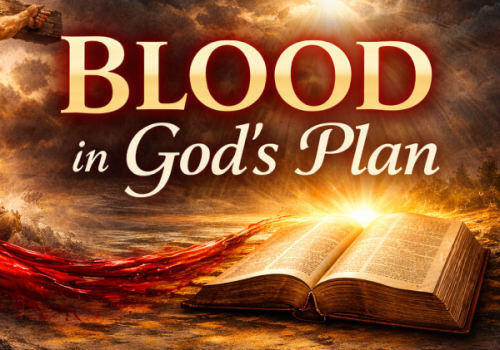
Blood in God’s plan

Blessed be the God and Father of our Lord Jesus Christ, who hath blessed us with all spiritual blessings in heavenly places in Christ” (Eph 1:3)

As we continue to count our spiritual blessings in Christ, today is a fitting time to talk about the blessings we have in Christ through His blood. For us to appreciate the full impact of this blessing, we need to go back and see the impact of blood in the Old Testament.

The first implied reference to blood appears in Genesis 3, when God took animal skins to cover Adam and Eve after their sin. “Unto Adam also and to his wife did the LORD God make coats of skins, and clothed them” (Gen 3:21).

The next reference we find in the scene with Cain and Abel. Abel made an offering to the Lord from the firstlings of his flock. It says, “And the LORD had respect unto Abel and to his offering” (Gen 4:4; cf. Heb 11:4). Three things stand out: first, that Abel gave the ‘firstling’; second, that it was the shedding of blood; and third, he offered it by faith (Heb 11:4).

We see animal sacrifices continue throughout Genesis, often involving the building of an altar and the offering of clean animals as burnt offerings. They emphasize faith, obedience, thanksgiving, or covenant relationship. When we get to Abraham we see another important element. Initially, his son Isaac was to be offered as a burnt offering, but God provided a ram caught in a thicket, which Abraham sacrificed in his son’s place. This event is seen as a foreshadowing of substitutionary sacrifice. “And Abraham lifted up his eyes, and looked, and behold behind him a ram caught in a thicket by his horns: and Abraham went and took the ram, and offered him up for a burnt offering in the stead of his son. And Abraham called the name of that place Jehovahjireh (the LORD will see to it [will provide]): as it is said to this day, In the mount of the LORD it shall be seen” (Gen 22:13-14).

In Exodus God turned the waters of the Nile to blood and commanded the Israelites to apply blood to the doorposts and lintel during the final plague. This Passover event powerfully foreshadows the sacrifice of Christ. Jesus Himself used the elements of the Passover meal as symbols of His body and blood: “And as they were eating, Jesus took bread… this is my body… For this is my blood of the new testament, which is shed for many for the remission of sins” (Matt 26:26-28).

Another notable instance of the use of blood is at the dedication of the tabernacle. Blood was used—along with oil—to consecrate both the tabernacle and the priests setting them apart as holy for God’s service. Moses applied blood to the horns of the altar to purify it (Lev. 8:15), and he placed blood on the right ear, thumb, and big toe of Aaron and his sons before sprinkling them and their garments with a mixture of blood and oil (Lev. 8:23–24, 30; see also Ex. 29:12, 20-21, 36–37).

Blood plays a central role in God’s plan of redemption.

Agape
spencer

BLOOD

And almost all things are by the law purged with blood; and without shedding of blood is no remission.

(Hebrews 9:22)

For the life of the flesh is in the blood: and I have given it to you upon the altar to make an atonement for your souls: for it is the blood that maketh an atonement for the soul. (Leviticus 17:11)
Living STONES

https://www.bible.ca/premillennialism-rapture-replacement-theology-supersessionism-kingdom-is-church.htm

There’s a common misconception about the Kingdom of God. It’s taught in error that Jesus will one day set up a physical kingdom, reigning in Jerusalem. According to the error, His plans were foiled by the Jews who rejected Him, and murdered Him. This is commonly called the doctrine of PREMILLENIALISM. Is this true?

It’s against scripture for Christ to reign from a physical throne in Jerusalem. “Thus saith the LORD, Write ye this man childless, a man that shall not prosper in his days: for no man of his seed shall prosper, sitting upon the throne of David, and ruling any more in Judah” (Jer 22:30).

Never trust a doctrine based on the premise that mankind foiled God’s plans. LOL. “He shall not fail nor be discouraged,” (Isaiah 42:4).

His own disciples expected an earthly kingdom, but Jesus said, “Neither shall they say, Lo here! or, lo there! for, behold, the kingdom of God is within you” (Luke 17:21; cf John 18:36).

However, He does have a Kingdom and it does have a TEMPLE on earth, a spiritual house. In Christ’s Spiritual Kingdom, the church, there is a Temple and it’s being built continually with LIVING STONES. What does the bible say about these living STONES?

Ye also, as lively stones, are built up a spiritual house, an holy priesthood, to offer up spiritual sacrifices, acceptable to God by Jesus Christ” (1Peter 2:5).

God’s Temple today is a SPIRITUAL HOUSE. “For we are labourers together with God: ye are God’s husbandry, ye are God’s building” (1Cor 3:9-15; cf. 1Pet 2:5). The church of Christ is the Spiritual House of God, the individuals are the living stones.

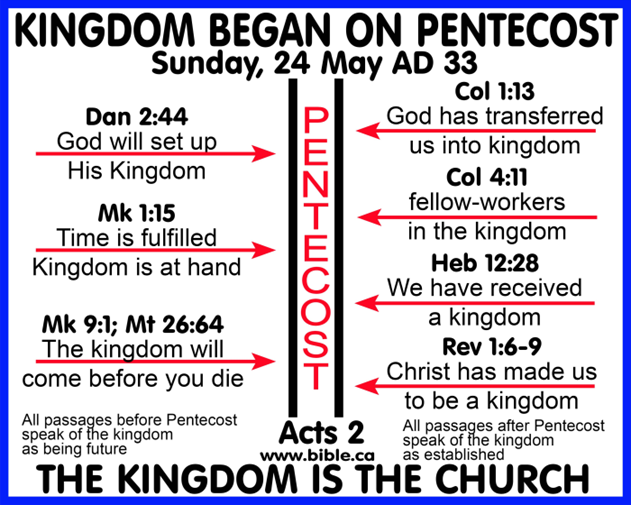
The church of Christ is the TEMPLE of God and individual members are the living stones. “Know ye not that ye are the temple of God, and that the Spirit of God dwelleth in you” (1Cor 3:16-17)? “What? know ye not that your body is the temple of the Holy Ghost which is in you, which ye have of God, and ye are not your own” (6:19; Eph 2:21-22)? Anyone that claims that there will be a physical kingdom on earth has overlooked that the Kingdom of God is the church of Christ. “Who hath delivered us from the power of darkness, and hath translated us into the kingdom of his dear Son” (Col 1:13).

There is only ONE Kingdom, ONE BODY. “And hath put all things under his feet, and gave him to be the head over all things to the church, Which is his body, the fulness of him that filleth all in all” (Eph 1:22-23; cf. Eph 4:4). Since the church is the Kingdom, and the church is His body, then there is only ONE BODY (temple) in His Kingdom.

Every Temple has a foundation, and this Spiritual Temple is no exception. NO OTHER FOUNDATION exists except the Chief Cornerstone, which is Christ. “And are built upon the foundation of the apostles and prophets, Jesus Christ himself being the chief corner stone; In whom all the building fitly framed together groweth unto an holy temple in the Lord” (Eph 2:20-21). Referring back to a previous passage about the Spiritual House, Paul said, “For other foundation can no man lay than that is laid, which is Jesus Christ” (1Cor 3:11; cf. Matt 16:18).

As was prophesied, this Kingdom is an ENDURING Kingdom if we keep His commands “And in the days of these kings shall the God of heaven set up a kingdom, which shall never be destroyed: and the kingdom shall not be left to other people, but it shall break in pieces and consume all these kingdoms, and it shall stand for ever” (Daniel 2:44). “But Christ as a son over his own house; whose house are we, if we hold fast the confidence and the rejoicing of the hope firm unto the end” (Heb 3:6).

Lastly, since people are the Living Stones, we are to STAND FIRM. “If ye continue in the faith grounded and settled, and be not moved away from the hope of the gospel,” (Col 1:23). The stones that STAND FIRM are precious STONES, but those stones that are not of precious material will be burned. “Now if any man build upon this foundation gold, silver, precious stones, wood, hay, stubble; Every man’s work shall be made manifest: for the day shall declare it, because it shall be revealed by fire; and the fire shall try every man’s work of what sort it is” (1Cor 3:12-13).

— spencer

Spencer is an evangelist in Borger, Texas.

THE KINGDOM is the CHURCH:

The Same Beginning: Pentecost. (Mark 9:1; Acts 2:47)

The Same Duration: Forever.

(Daniel 2:44; Matthew 16:18; Hebrews 12:28; Ephesians 3:21)

The Same Ownership: God and Christ. (Ephesians 5:5)

The same historical period: During Roman empire.

(Luke 2:1; Acts 2:1; Colossians 1:13)

The same eschatological beginning: In the “Last Days” or “end times

(Hebrews 1:2; 1 Peter 1:20; Acts 2:15–17; James 5:1–3)

Kingdom and church used interchangeably: (Matthew 16:18)