Hero of Faith: HUR

An example of Helping weary hands.

“So Joshua did as Moses had said to him, and fought with Amalek: and Moses, Aaron, and Hur went up to the top of the hill. And it came to pass, when Moses held up his hand, that Israel prevailed: and when he let down his hand, Amalek prevailed. But Moses’ hands were heavy; and they took a stone, and put it under him, and he sat thereon; and Aaron and Hur stayed up his hands, the one on the one side, and the other on the other side; and his hands were steady until the going down of the sun. And Joshua discomfited Amalek and his people with the edge of the sword.” (Exodus 17:10-13)

This scene unfolds early in the Exodus journey. Little is recorded about Hur except here and in Exodus 24, where he appears alongside Aaron. In the heat of the first battle after leaving Egypt, Hur stood faithfully on the hilltop with Moses and Aaron while Joshua fought below.

When Moses’ hands grew heavy as he lifted them (he was holding them up so Joshua would prevail), Hur and Aaron stepped in. They held his arms up, one on each side, through the entire day until sunset. Because of their support, Moses’ hands remained steady, and Israel triumphed.

Helping Weary Hands
Leaders grow tired. Even Moses, who confronted Pharaoh and parted the Red Sea, reached a point of exhaustion. Hur shows us that one meaningful way to serve is by lifting what another can no longer hold alone. In daily life, this means encouraging a weary spouse, supporting an overburdened leader, or helping a friend through a difficult season. You do not need a title or spotlight. Quiet support can help another endure through whatever battle rages.

Staying by Their Side Through the Length of the Day
Hur did not offer a quick boost and leave. He stayed until the sun went down. The battle lasted all day, and his presence remained steady and reliable. True support requires endurance and unwavering commitment. In a world quick to give temporary encouragement, Hur models consistent loyalty. Whether the season is long or the struggle intense, staying nearby can make all the difference.

Remaining Steady So the One Helped Remains Steady
The Scripture notes that Moses’ hands were steady because Aaron and Hur held them up. Their strength created stability for Moses, which brought victory for the entire nation. When we help others remain steady, the impact can multiply beyond the one being steadied. Our faithfulness can lead to greater victories.

Be a Hur in Someone’s Battle
Hur never led the army or stood in the spotlight like Moses. Yet his quiet strength proved essential. From his example we may want to ask: Whose hands can I help hold up today?

Look around. Someone near you may be growing weary. You can be the steady presence that keeps their hands and heart lifted. Let’s learn from Hur to serve humbly, stay faithfully, and hold steady until the end. Your quiet faithfulness matters in the eyes of God. Go and be a Hur.

Agape

seb
Letter to a Friend (2o3)

Dear Friend, (continued 2o3)

The church is to be subject to Christ in all things (Ephesians 5:23,24). Jesus is the head of the church (Colossians 1:18; Ephesians 1:22,23), not any representative on earth. The church that belongs to Christ requires a “thus saith the Lord,” a scriptural reason for everything that it says and does (2 Timothy 3:16,17; 1Peter 4:11; 2 John 9; Revelation 22:18,19). The church cannot go beyond that which is written. If a man teaches something other than the truth he is to be cut off from the church (Galatians 1:6-10; 2 John 9-11). That means the church will do what Christ has authorized; no more, no less (Colossians 3:17; Acts 4:7). There must be a “thus saith the Lord” before the church can act. As the army of Christ, composed of soldiers of Christ, it cannot advance unless given the command of Christ.

The commands of Christ are found in the New Testament, Jesus took the Old Testament out of the way, nailing it to the cross (Colossians 2:12-14; Ephesians 2:14-17; Galatians 3:1-5, 17-29; 4:21-5:5; Hebrews 8:1-28; 12:18-29; 13:11-12; 2 Corinthians 3:1-18). We are not under the Old Testament, for Christ is become of no effect unto you, whosoever of you are justified by the law; ye are fallen from grace (Galatians 5:4).

The conditions for pardon and fellowship are given in the New Testament. Those who receive pardon and are accepted into the fellowship of the church are:

  • those who, having HEARD the word of God, and have FAITH (Romans 10:17; Hebrews 11:1,6);
  • those whose faith causes them to REPENT (Acts 17:30; 2Peter 3:9);
  • those who CONFESS their faith in Jesus as the Son of God (Acts 8:36,37; Romans 10:9,10; Matthew 10:32,33);
  • those who are IMMERSED in water in order to obtain the remission of sins (Mark 16:16; Acts 2:38; 22:16; Galatians 3:26,27; 1Peter 3:21);
  • those who REMAIN FAITHFUL in obedience, for those who walk disorderly are rejected John 15:1-6; 2Peter 2:20-22; Revelation 3:15,16). Any other conditions are commandments and doctrines of men.

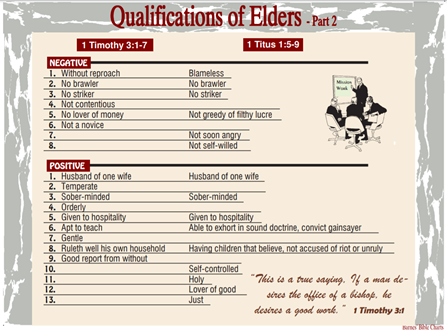
The church is subject to Christ in organization. There is no organization revealed in God’s Word larger than the local congregation. The local congregation is to have a plurality of men who watch over that congregation who are known as elders, overseers, bishops, and pastors (Acts 14:23; 20:17,28; Titus 1:5-7; Ephesians 4:11). This is not one individual, but a group of individuals. These men must meet all of the qualifications set forth to serve (1Timothy 3:1-7; Titus 1:5-9). There is no record of a singular pastor over a congregation. The local congregation also has deacons who meet the qualifications (Philippians 1:1; Acts 6:1-6; 1 Timothy 3:8-13). 

The local congregation also has preachers, or evangelists (Acts 21:8; 2Timothy 4:1-5). The church no longer has living apostles or prophets (Acts 1:21-26; Ephesians 2:20).  There is no separation of clergy and laity, for all are priests unto God (1Peter 2:5,9). A congregation can exist without elders, deacons or a preacher.  But no man has the right to assume the eldership without the correct credentials.  We cannot make up our own government for the church.

The church is to be subject to Christ in its worship. The local church meets together in one place upon the first day of the week, every week, and partakes of the unleavened bread and the fruit of the vine in the Lord’s Supper (Acts 20:7; Matthew 26:26-30; 1Corinthians 11:17-34). The church as it gathers together sings without instrumental music nor specialized singers (Ephesians 5:19; Colossians 3:16). The worship also includes prayer (Acts 2:42; 12:5), preaching (Acts 20:7), and a free will contribution (1Corinthians 16:1-2; 2 Corinthians 9:6,7). During the assembly the women are to keep silence (1Corinthians 14:34,35; 1Timothy 2:11-15).

  • Friend, do the “churches” that you are attending realize and teach that the church is the saved, and since it is that which Christ shed his blood for, and is the Savior of, you must be a part of the church to be saved?
  • Do the “churches” that you are attending teach and practice that Christ is the head of the church, rejecting all creeds and councils for the church, and accepting the New Testament as their only creed book?
  • Friend, Do the “churches” that you attend justify their actions from the Old Testament? or do they abide by the doctrine of Christ?
  • Do the “churches” you attend teach and practice the conditions of pardon and fellowship that the apostles revealed by inspiration, or do they have other conditions?
  • Friend, do the “churches” you attend have the organization found in the New Testament? or do they have a state, regional and/or national organization?
  • Do the “churches” you attend follow the New Testament plan for worship in partaking of the Lord’s Supper every week, having congregational singing without instrumental music, praying, preaching the word, and having a free-will contribution?

Ask the preachers if they have a creed book. Ask them if they have a ruling council. Ask the preachers if they justify their actions by the Old Testament. Ask them what it takes to become a member of their denomination. Are the answers to these questions the answers which are given in the New Testament? Are they the church you read about in the New Testament?

(continued next week)