
Evidence for our faith: Fine Tuning

The Laws of Physics: Evidence of a Lawgiver

Could the laws of physics—precise, universal, and life-sustaining—point to a purposeful design, a Lawgiver shaping the cosmos? Modern science offers compelling clues that resonate with biblical accounts, suggesting God’s hand in creation.

The universe’s fine-tuning is astonishing. Physicist Paul Davies (The Cosmic Blueprint, 1988) highlights that if gravity shifted by one part in 10^40, stars like our Sun—vital for life—wouldn’t exist.

Roger Penrose (The Emperor’s New Mind, 1989) calculates the initial entropy —essentially the universe’s starting level of disorder— required odds-defying precision (1 in 10^10^123) for a habitable cosmos. This suggests intent, not chance, mirroring Genesis 1:1: “In the beginning, God created the heavens and the earth.”

Equally remarkable is the rational order of these laws. Eugene Wigner’s 1960 paper, “The Unreasonable Effectiveness of Mathematics,” marvels at how abstract equations govern reality with uncanny accuracy. Why does the universe follow such logic? Psalm 19:1 offers a poetic parallel: “The heavens declare the glory of God; the skies proclaim the work of his hands,” declaring a mind behind the order.

The universe’s origin adds intrigue. The Big Bang, confirmed by cosmic microwave background radiation (Penzias and Wilson, 1965), marks a sudden start from nothing. Stephen Hawking (A Brief History of Time, 1988) notes this challenges materialist explanations, as “nothing” producing “something” implies a cause beyond physics. Genesis 1:3—“And God said, ‘Let there be light’”—echoes this emergence.

The anthropic principle—meaning the universe seems tailored for human life— deepens the case. Michael Denton (Nature’s Destiny, 1998) argues that physical laws governing carbon, water, and oxygen are uniquely tuned for life. Alter any constant slightly, and biology collapses. Isaiah 45:18 aligns: God “formed the earth… to be inhabited.” Such specificity strains random odds, suggesting deliberate calibration.

Skeptics propose a multiverse to explain our “lucky” universe, but this lacks evidence and complicates rather than clarifies. A single, purposeful design aligns with Occam’s razor. Romans 1:20 ties it together: God’s “invisible qualities… have been clearly seen, being understood from what has been made.” The laws of physics—fine-tuned, rational, and life-enabling— more than whisper of a Lawgiver, inviting us to ponder the Creator behind the cosmos.

Agape,

Spencer

Sources:

  • Davies, Paul. The Cosmic Blueprint. 1988.
  • Penrose, Roger. The Emperor’s New Mind. 1989.
  • Wigner, Eugene. “The Unreasonable Effectiveness of Mathematics.” 1960.
  • Hawking, Stephen. A Brief History of Time. 1988.

Denton, Michael. Nature’s Destiny. 1998.

Calling on the name of the Lord: What is it really?

Calling on the name of the Lord:

Prayer or obedience?

Acts 22:16 (KJV) states:

“And now why tarriest thou? Arise, and be baptized, and wash away thy sins, calling on the name of the Lord.”

This verse records Ananias’ instructions to Saul (later Paul) regarding his conversion. To understand what it means to “call on the name of the Lord,” we must look at how the Bible defines and uses this phrase.

1. Calling on the Name of the Lord Involves Obedience

Acts 22:16 ties “calling on the name of the Lord” directly to baptism, which is the moment when Saul’s sins were washed away. This aligns with Jesus’ own words in Mark 16:16:

“He that believeth and is baptized shall be saved; but he that believeth not shall be damned.”

Calling on the name of the Lord, then, is not merely a verbal plea but involves obedient action. This is further clarified by Romans 10:13-14:

“For whosoever shall call upon the name of the Lord shall be saved. How then shall they call on him in whom they have not believed? and how shall they believe in him of whom they have not heard? and how shall they hear without a preacher?”

Paul, writing later, shows that calling on the Lord’s name requires hearing the gospel, believing, and responding in obedience.

2. Calling on the Name of the Lord Is Not Just Prayer

Some assume that calling on the Lord’s name is merely saying a prayer for salvation, but Scripture does not support this idea. Consider Jesus’ words in Matthew 7:21:

“Not every one that saith unto me, Lord, Lord, shall enter into the kingdom of heaven; but he that doeth the will of my Father which is in heaven.”

Merely addressing Jesus as Lord does not save—doing His will does. This is consistent with Acts 22:16, where Paul had already been praying (Acts 9:11), yet he still needed to be baptized to wash away his sins.

3. Biblical Examples of Calling on the Name of the Lord

The phrase “call on the name of the Lord” is used throughout Scripture in connection with worship and obedience.

• Genesis 4:26 – “Then began men to call upon the name of the LORD.” This refers to worship and devotion to God.

• Joel 2:32 (quoted in Acts 2:21) – “Whosoever shall call on the name of the Lord shall be delivered.” This was fulfilled in Acts 2, where Peter preached that repentance and baptism in Jesus’ name were necessary for salvation (Acts 2:38).

In Acts 2, the people called upon the Lord by obeying Peter’s command to repent and be baptized. This directly parallels Acts 22:16, where Paul was instructed to do the same.

So what now?

To “call on the name of the Lord” is to appeal to Him for salvation by faithful obedience to His commands. Acts 22:16 shows that Saul (Paul) did this when he was baptized, at which point his sins were washed away. This is consistent with how the phrase is used throughout the Bible—faith in action, not merely words.

Spencer

Franklin & Juniper St

church of Christ

Borger, Tx

Jesus is the one to follow when we’re HURTING

Hope and Healing in Christ for the Hurting

Life is full of hardship. Suffering, loss, and disappointment are part of the human experience. Some struggle with grief, others with betrayal, loneliness, or physical pain. No one is immune to the trials of life. Yet, in the midst of sorrow, there is One who offers healing, hope, and peace—Jesus Christ.

Jesus understands suffering because He experienced it firsthand. Isaiah 53:3 describes Him as “a man of sorrows, and acquainted with grief.” He knew what it was like to be rejected, betrayed, and physically tormented. He endured humiliation and pain on the cross, bearing the weight of humanity’s sin. Because of this, He is uniquely qualified to comfort those who are hurting. Hebrews 4:15 assures us that we have a Savior who can sympathize with our weaknesses, for He was “tempted like as we are, yet without sin.”

Hope in Christ for the Hurt of This Life

Pain can make life feel unbearable. The world offers temporary distractions, but they cannot bring lasting peace. Only Christ provides true hope. John 16:33 reminds us of this reality: “In the world ye shall have tribulation: but be of good cheer; I have overcome the world.” The suffering of this present life is temporary, but the joy found in Christ is eternal. Paul declares in Romans 8:18, “For I reckon that the sufferings of this present time are not worthy to be compared with the glory which shall be revealed in us.” When we trust in Christ, we gain a perspective that allows us to endure, knowing that something far greater awaits.

Understanding from Christ, Who Endured Suffering

One of the most comforting truths about Jesus is that He understands human suffering. He was betrayed by a close friend (Luke 22:48; Psalm 41:9), falsely accused (Matthew 26:59-60), mocked (Matthew 27:29-31), and crucified (Luke 23:33). He knows what it feels like to be abandoned, rejected, and mistreated. This means that when we pour out our hearts to Him, we are speaking to One who truly understands. Psalm 34:18 assures us, “The Lord is nigh unto them that are of a broken heart.”

Rest and Peace in His Forgiveness and Mercy

Many suffer not only from external circumstances but also from the weight of guilt and shame. Sin leaves scars, and the burden of past mistakes can feel overwhelming. Yet, Jesus offers complete forgiveness. Matthew 11:28 invites us, “Come unto me, all ye that labour and are heavy laden, and I will give you rest.” Through His sacrifice, we are freed from sin’s condemnation. Psalm 103:12 declares, “As far as the east is from the west, so far hath he removed our transgressions from us.” In Christ, we find peace, knowing that our past does not define us.

Truth, Life, and True Joy

Many search for meaning in temporary pleasures, but Jesus alone is the source of true life. He declares in John 14:6, “I am the way, the truth, and the life.” The joy He gives is not dependent on circumstances but is rooted in a relationship with Him. John 15:11 states, “These things have I spoken unto you, that my joy might remain in you, and that your joy might be full.”

Jesus, Our Intercessor

For those who feel distant from God, Jesus bridges the gap. 1 Timothy 2:5 tells us, “For there is one God, and one mediator between God and men, the man Christ Jesus.” He intercedes for us before the Father, offering continual access to God’s grace and help.

He Never Leaves nor Forsakes Us

Loneliness is one of the deepest forms of suffering. Yet, Jesus promises, “I will never leave thee, nor forsake thee” (Hebrews 13:5). Even when we feel abandoned, He is always near.

Good Can Come Despite the Pain

While suffering is hard, God can bring blessings out of trials. Romans 8:28 reassures us, “And we know that all things work together for good to them that love God.” Even when we don’t understand, we can trust that He can bring about good despite the pain and suffering in this life.

Conclusion

No matter what pain or sorrow you carry, Jesus offers hope and healing. Turn to Him, and you will find peace, understanding, and the strength to endure. “Casting all your care upon him; for he careth for you.” (1 Peter 5:7)

Agape

Spencer

There is a way you may know if you have eternal life.

John 3:16, the greatest verse

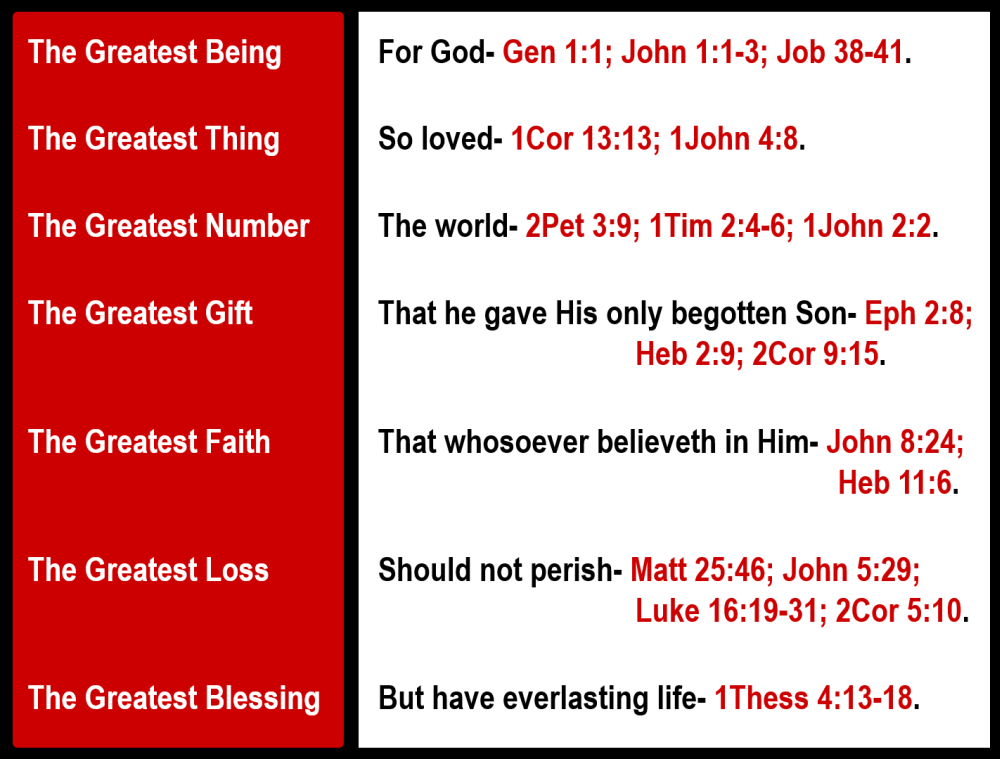
The Greatest Being

The verse begins with “FOR GOD.” The verse begins with the greatest being in existence. In Genesis 1:1, we read, “In the beginning, God created the heavens and the earth.” God is the Creator, the Alpha and the Omega, the beginning and the end. John 1:1-3 tells us, “In the beginning was the Word, and the Word was with God, and the Word was God. The same was in the beginning with God. All things were made by him; and without him was not any thing made that was made.” Job 38-41 presents a majestic depiction of God’s power and wisdom. Our faith rests upon the foundation of this greatest being, who is sovereign over all creation.

The Greatest Thing

Next, we see the greatest thing: “SO LOVED.” God is love. In 1Corinthians 13:13, we learn that “the greatest of these is love.” 1John 4:8 declares, “He that loveth not knoweth not God; for God is love.” God’s love is unparalleled and incomprehensible. It is a love that is willing to sacrifice, a love that seeks the well-being of others. It is the greatest thing because it defines the actions of the greatest being.

The Greatest Number

“THE WORLD.” This phrase encompasses the greatest number: the entire world. God’s love is not limited to a select few but extends to every person on this earth. 2Peter 3:9 states, “The Lord is not slack concerning his promise, as some men count slackness; but is longsuffering to us-ward, not willing that any should perish, but that all should come to repentance.” 1Timothy 2:4-6 reinforces this by saying, “Who will have all men to be saved, and to come unto the knowledge of the truth.” 1John 2:2 confirms that “And he is the propitiation for our sins: and not for ours only, but also for the sins of the whole world.” The greatest number shows the expanse of God’s love. God is not a respecter of persons (Rom 2:11).

The Greatest Gift

“THAT HE GAVE HIS ONLY BEGOTTEN SON.” In this we see the greatest gift. Ephesians 2:8 reminds us that “For by grace are ye saved through faith; and that not of yourselves: it is the gift of God.” Hebrews 2:9 tells us, “But we see Jesus, who was made a little lower than the angels for the suffering of death, crowned with glory and honour; that he by the grace of God should taste death for every man.” 2Corinthians 9:15 exclaims, “Thanks be unto God for his indescribable gift!” The greatest gift (grace) is God’s own Son, given for the redemption of mankind.

The Greatest Faith

“THAT WHOSOEVER BELIEVETH IN HIM.” This phrase highlights the greatest faith. Jesus declares in John 8:24, “I said therefore unto you, that ye shall die in your sins: for if ye believe not that I am he, ye shall die in your sins.” Hebrews 3:18-19 warns of the consequences of unbelief as seen through disobedience, while Hebrews 11:6 teaches that “without faith it is impossible to please God.” The greatest faith is an active belief in Jesus Christ as the Son of God and the Savior of the world (James 2:14-26).

The Greatest Loss

“SHOULD NOT PERISH.” The greatest loss is the eternal separation from God. While any can be saved, the bible tells us that not all will obey the Gospel (Matt 7:24-29; 2Thess 1:8-9). Matthew 25:46 warns of “everlasting punishment,” and John 5:29 speaks of those who will “resurrection of damnation.” The story of the rich man and Lazarus in Luke 16:19-31 vividly portrays the torment of those who perish. 2Corinthians 5:10 reminds us that “we must all appear before the judgment seat of Christ.” The greatest loss is the eternal consequence of rejecting God’s gift of salvation.

The Greatest Difference

“BUT.” While all may be saved, some won’t obey the gospel. “And being made perfect, he became the author of eternal salvation unto all them that obey him” (Heb 5:9). Some will hear, but not do; “Therefore whosoever heareth these sayings of mine, and doeth them, I will liken him unto a wise man, which built his house upon a rock: And the rain descended, and the floods came, and the winds blew, and beat upon that house; and it fell not: for it was founded upon a rock. And every one that heareth these sayings of mine, and doeth them not, shall be likened unto a foolish man, which built his house upon the sand: And the rain descended, and the floods came, and the winds blew, and beat upon that house; and it fell: and great was the fall of it.” (Matt 7:24-27). Many may confess Jesus as Lord and Savior, but not do what He says, “And why call ye me, Lord, Lord, and do not the things which I say” (Luke 6:46)?

The Greatest Blessing

“HAVE EVERLASTING LIFE.” Finally, we come to the greatest blessing. 1Thessalonians 4:13-18 describes the hope of the resurrection and the promise of eternal life with Christ. Everlasting life is the ultimate blessing, the fulfillment of God’s promise to those who believe.

John 3:16 is a verse that reveals to us the greatest being, the greatest thing, the greatest number, the greatest gift, the greatest faith, the greatest loss, and the greatest blessing. Let us hold fast to this truth, share it with others, and walk in the light of God’s incredible love and grace.

Agape, Spencer

Do we TRUST Jesus?

“But Jesus said unto them, A prophet is not without honour, but in his own country, and among his own kin, and in his own house.” (Mark 6:4).

In Mark chapter six we see several scenes of varying levels of faith. Part of faith involves trust.

Jesus Rejected in Nazareth                               (Mark 6:1-6)

Sending Out the Twelve Apostles                    (Mark 6:7-13)

Herod’s Perplexity about Jesus                        (Mark 6:14-16)

John the Baptist Beheaded                               (Mark 6:17-29)

Feeding the Five Thousand                             (Mark 6:30-44)

Jesus Walks on Water                                      (Mark 6:45-52)

Healing in Gennesaret                                     (Mark 6:53-56)

Mark’s gospel may be the shortest of the four, but what it contains is of great help to us in our faith.

Let us take a glimpse at these scenes of trust.

In the first scene we find Jesus teaching in His own country and among His own people. Although many were astonished at His teaching, His wisdom, and His mighty works, they were offended at Him. His own people rejected Him. Now that’s astonishing!

“But Jesus said unto them, A prophet is not without honour, but in his own country, and among his own kin, and in his own house. And he could there do no mighty work, save that he laid his hands upon a few sick folk, and healed them. And he marvelled because of their unbelief. And he went round about the villages, teaching” (Mark 6:4-6).

The next 3 scenes show differing levels of faith during times of uncertainty. The 12 apostles being sent out to preach, “And commanded them that they should take nothing for their journey, save a staff only; no scrip, no bread, no money in their purse” (v8). Then we see Herod’s perplexity about the identity Jesus, (14-17). The third is in the events leading to the death of John the baptizer at the birthday banquet for Herod, (18-29). From these we see faith, uncertain faith, and great faith.

Following these we come to another kind of banquet called the feeding of the 5,000 (30-44). This began with banquet of spiritual food because of the compassion of Jesus. Faith involves knowledge. Then Jesus is urged to send them away to go find physical food. He tells the 12, “Give ye them to eat.” Here we see another side of their faith when they say, “Shall we go and buy two hundred pennyworth of bread, and give them to eat?” Remember, they had just returned excitedly from preaching without any provisions.

The last scenes of faith are times of trouble. One a storm, the last the sick of Gennesaret (45-56; cf Matt 14:27-33). In the storm, after Jesus had sent the 12 away in boats, He comes to them walking on the water. It’s here that Peter wants confirmation by being allowed to walk on the water also. Peter indeed is able to walk on the water, but places his eyes on the storm, starts to fear, and begins to sink. “O thou of little faith, wherefore didst thou doubt?”

When they arrive at the shore we see an exact opposite response from the first of this chapter. “And when they were come out of the ship, straightway they knew him, And ran through that whole region round about, and began to carry about in beds those that were sick, where they heard he was. And whithersoever he entered, into villages, or cities, or country, they laid the sick in the streets, and besought him that they might touch if it were but the border of his garment: and as many as touched him were made whole.”

Agape,

Spencer

This is part 6 of a series called Preaching through Mark.

Seeking Jesus in Mark 5

In Mark chapter 5, we read about several encounters of those seeing Jesus. Amidst the miracles and interactions, these folks stand out, each exhibiting varying degrees of fear or awe towards Jesus. Let’s look at a few of their stories and see if their fear was justified, or why they ought to have no fear.

The Legion: The first in Mark 5, is a man possessed by a legion of demons. This legion, fearing Jesus, pleads not to be tormented. Their fear stems from the recognition of Jesus’ authority over the spiritual realm. They understand His power to cast them out and disrupt their malevolent activities. Their fear is justified, for Jesus indeed removes them from the man, demonstrating His supremacy over darkness.

The Citizens: Following the exorcism of the legion, the citizens of the region witness the transformation of the possessed man. Instead of rejoicing at this miraculous deliverance, they are gripped by fear and beg Jesus to leave their region. Their fear is rooted in the disruption caused by His power. They show no concern for the one who has been restored from his torments. Their fear is misplaced by priorities that lead them to reject Jesus, despite this miraculous deed.

The Exorcised Man: The man formerly possessed by is now clothed and in his right mind, sitting at Jesus’ feet. He has no fear of Jesus, but rather a desire to go with Him wherever He goes. He is instead told to “go home and tell,” where he boldly proclaims all that Jesus had done for him; and they marveled.  

Jairus: a synagogue leader, approaches Jesus in desperation, pleading for his daughter’s healing. Despite his high status in society, Jairus humbles himself before Jesus, acknowledging His power to heal. His fear is one of urgency and desperation, fueled by the impending death of his beloved daughter. Jairus’ faith outweighs his fear as he trusts in Jesus’ ability to perform the impossible. Unlike the denizens of the region who rejected Jesus, Jairus pleads with Him to come to his house.

The Woman with the Issue of Blood: Amidst the crowd pressing around Jesus, a woman suffering from a twelve-year hemorrhage reaches out in faith, believing that merely touching His garment would bring healing. Her fear is one of vulnerability and shame, as she has endured societal separation due to her condition. However, her faith overcomes her fear, and Jesus commends her for her courage and belief, declaring her healed.

In reflecting on these characters from Mark chapter 5, it becomes evident that fear can manifest in various ways when confronted with the divine presence of Jesus Christ. Some respond with reverence and faith, while others react with skepticism and rejection. Ultimately, those who approached Jesus with humility and trust found freedom, and healing, while those who allowed fear to hinder their faith miss out on the abundant blessings He offers.

Agape,

Spencer

This is part 6 of a series called Preaching through Mark.

The Dilemma of Situation Ethics: Does Context Override Sin?

In the annals of ethical debates, one recurring question persists: Does the situation in which an action occurs negate its moral implications? This quandary, often debated through the lens of religious texts, confronts individuals with profound moral choices. In examining this issue, we turn to the biblical narrative and explore various instances where situation ethics clash with divine standards.

Consider the tragic fate of Uzzah, recounted in 2 Samuel 6:6-7. When the oxen shook the Ark of God, Uzzah instinctively reached out to steady it, resulting in his untimely death. David’s subsequent realization underscores the importance of adhering to divine commands, (1Chron 15:2).

Despite Uzzah’s noble intention to prevent the Ark from falling, his actions were deemed irreconcilable with God’s decree that only Levites should handle the holy chest. Here, the severity of the situation did not absolve Uzzah of his transgression.

Integrity with God’s word emerges as a central theme in assessing ethical conduct. Matthew 22:37-39 underscores the importance of genuine intentions rooted in love for God and others. However, the case of misguided zeal, exemplified by Saul of Tarsus before his conversion to Christ, serves as a cautionary tale. Despite his fervent dedication to what he perceived as righteous, Saul’s actions contradicted God’s will, as evidenced in Acts 22:3-4 and Acts 26:9. This distinction between sincerity and righteousness highlights the inadequacy of integrity alone in determining moral correctness.

The danger of zeal divorced from truth is clarified in Romans 10:1-2, where Paul laments the misplaced fervor of his fellow Jews. Their zeal, though commendable, lacked the necessary foundation of divine knowledge, rendering it futile. This warning resonates in contemporary contexts where churches compromise doctrinal integrity to appeal to broader audiences, as seen in the emphasis on entertainment over spiritual truth.

Scriptural admonitions against deviating from doctrinal purity underscore the gravity of adhering to divine truth. 1Timothy 1:3 and 2John 1:10 caution against the acceptance of alternative teachings, emphasizing the exclusivity of divine doctrine. The solemn declaration in Galatians 1:8, 9 reinforces the unequivocal nature of the gospel, rejecting any deviation from its foundational truths. “But though we, or an angel from heaven, preach any other gospel unto you than that which we have preached unto you, let him be accursed. As we said before, so say I now again, If any man preach any other gospel unto you than that ye have received, let him be accursed.”

The problem of situation ethics poses a formidable challenge to individuals grappling with moral decisions. The biblical narrative offers valuable insights into the intersection of context and morality, emphasizing the enduring relevance of divine standards. While circumstances may vary, the timeless principles articulated in Scripture serve as unwavering guides, reminding believers that situational complexities do not negate the eternal truths of righteousness and integrity. We are to navigate the intricacies of ethical dilemmas with steadfast adherence to divine precepts, knowing that no situation can justify a departure from the immutable standards of God.

Agape,

Spencer

This article is part 4 of a series titled, God’s Moral Law. click here for part one.

You’re invited to attend one of our services at the church of Christ on Franklin and Juniper in Borger Texas.

From Milk to Meat, Heb 5:12-6:2

“Therefore leaving the principles of the doctrine of Christ, let us go on unto perfection; not laying again the foundation of repentance from dead works, and of faith toward God, Of the doctrine of baptisms, and of laying on of hands, and of resurrection of the dead, and of eternal judgment” (Heb 5:12-6:2).

In the book of Hebrews, the writer admonishes believers to progress from the foundational principles of the doctrine of Christ towards spiritual maturity, (Heb 5:12-14).

Believers are likened to infants who require milk, unable to digest the deeper truths of the gospel. Instead, they are urged to embrace the “strong meat” of the Word, reserved for those who are mature and spiritually discerning. The writer then lists 6 foundational principles that believers are to be building upon.

The first principle is repentance from dead works. Galatians 5:19-26 underscores the contrast between the works of the flesh and the fruit of the Spirit, emphasizing the need for genuine repentance and fruits worthy of repentance.

The next is faith toward God, which is central to the doctrine of Christ. This faith is not merely intellectual assent but a deep-seated trust in the character and promises of God. Without faith it is impossible to please God. (Heb 11:6). Believers are commanded to add to their faith (2Peter 1:5-11).

The third is the doctrine of baptisms which encompasses various forms of baptism, including water baptism and baptism in the Holy Spirit. Hebrews 9:10 references the ceremonial washings prescribed in the Old Testament law, while Ephesians 4:4-6 emphasizes the unity of believers through the one baptism in Christ. Believers are called to understand the significance of water baptism as the moment one’s sins are washed away and marks the beginning of a new life in Christ (Acts 2:38; 8:35-39; 22:16; Rom 6:3-4).

Next is the laying on of hands which has 3 forms in the NT Apostolic age of the church; the impartation of spiritual gifts, in healing the sick, and commissioning for ministry. Acts 8:17 shows through the laying on of the Apostles’ that the Holy Spirit was given, while Acts 6:6 and Acts 13:3 shows the ordination of individuals for service in the early church. Believers today are only able to practice the ordination of men to the work of the ministry.

Fifth is the resurrection of the dead which is a foundational truth of the Christian faith, affirming the hope of eternal life. Scriptures such as Matthew 22:23 and 1Corinthians 15:12-19 underscore the reality of resurrection and its implications for believers. Acts 17:32 shows how the resurrection is a stumbling block for unbelievers. As followers of Christ, believers are called to live in light of eternity, knowing that death is not the end but the beginning of a glorious new existence in Christ (1Thess 4:13-18).

Finally, believers are reminded of the reality of eternal judgment, wherein every person will give an account for their actions. Matthew 25:26 and Mark 9:41-50 emphasize the seriousness of sin and its consequences. Believers are called to live in reverence and obedience to God, knowing that we must all appear before the judgment seat of Christ (2Cor 5:10-11a).

The doctrine of Christ is not merely a set of beliefs to be acknowledged but is foundational truth from which we are expected to grow & mature, and become effective citizens in the Lord’s Kingdom. “But grow in grace, and in the knowledge of our Lord and Saviour Jesus Christ. To him be glory both now and for ever. Amen” (2Pet 3:18).

Agape,

Spencer

This article is part 3 of a series titled, God’s Moral Law. click here for part one.

You are invited to visit one of our services in Borger Texas. Here is a link to information about finding a church, who we are, and why we’re different.

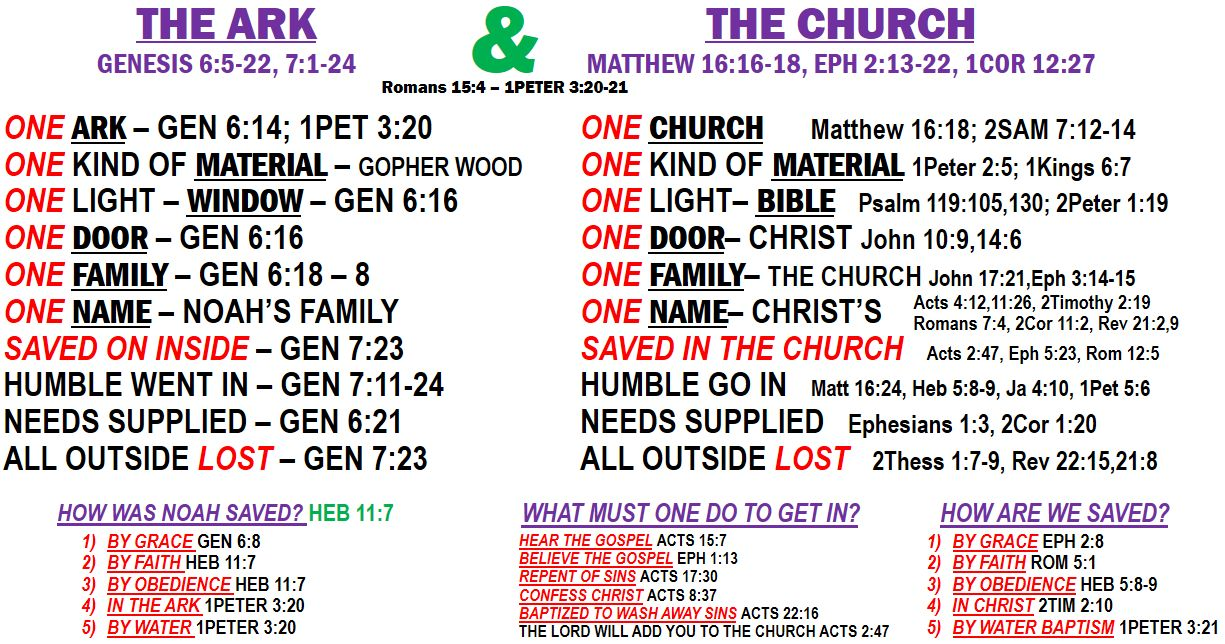
How was Noah saved?

What does the bible say about how Noah was saved?

By Grace (Gen 6:8) But Noah found grace in the eyes of the LORD.

By Faith (Heb 11:7) By faith Noah, being warned of God of things not seen as yet, moved with fear, prepared an ark to the saving of his house; by the which he condemned the world, and became heir of the righteousness which is by faith.

By Obedience (Heb 11:7) By faith Noah, being warned of God of things not seen as yet, moved with fear, prepared an ark to the saving of his house; by the which he condemned the world, and became heir of the righteousness which is by faith.

In the Ark (1Pet 3:20) Which sometime were disobedient, when once the longsuffering of God waited in the days of Noah, while the ark was a preparing, wherein few, that is, eight souls were saved by water.

By Water (1Pet 3:21) The like figure whereunto even baptism doth also now save us

What does the bible say about how WE are saved?

By Grace (Eph 2:8) For by grace are ye saved through faith; and that not of yourselves: it is the gift of God:

By Faith (Rom 5:1) Therefore being justified by faith, we have peace with God through our Lord Jesus Christ:

By Obedience (Heb 5:8-9) Though he were a Son, yet learned he obedience by the things which he suffered; And being made perfect, he became the author of eternal salvation unto all them that obey him;

In Christ (2Tim 2:10) Therefore I endure all things for the elect’s sakes, that they may also obtain the salvation which is in Christ Jesus with eternal glory.

Baptized into Christ (Gal 3:27; Col 2:11; Acts 8:35-38; Rom 6:3-5) For as many of you as have been baptized into Christ have put on Christ.

1Peter 3:21 The like figure whereunto even baptism doth also now save us.

Which of the following sentences are true? Let them that oppose it erase the one he says is NOT true.

baptism doth also NOW save us.

baptism doth also NOT save us.

What questions do you have about this material? Please let us know.

The church of Christ at Franklin & Juniper st in Borger invites you to attend one of their services.

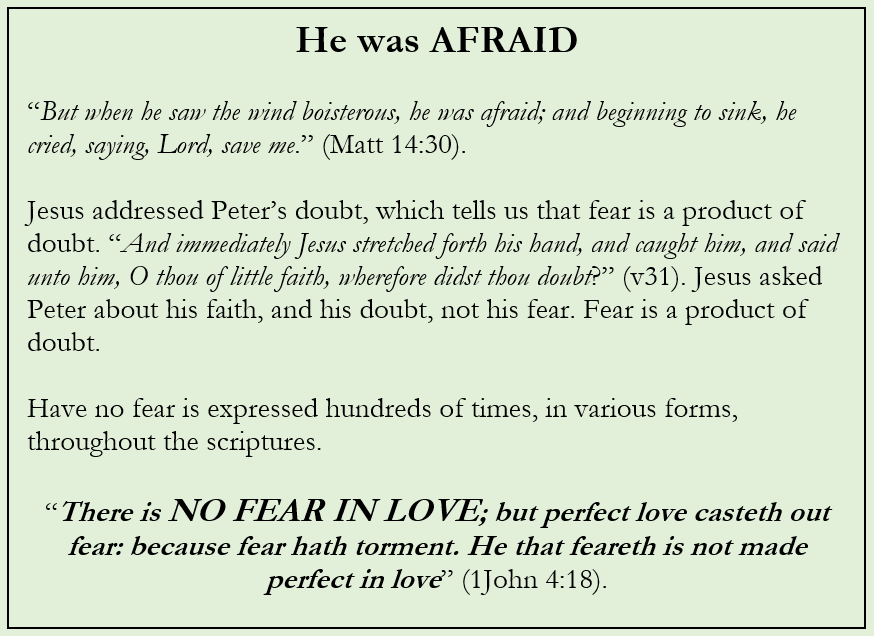
Why do we DOUBT?

Jesus asked this question of Peter when he began to sink after walking on the water.

“And in the fourth watch of the night Jesus went unto them, walking on the sea. And when the disciples saw him walking on the sea, they were troubled, saying, It is a spirit; and they cried out for fear. But straightway Jesus spake unto them, saying, Be of good cheer; it is I; be not afraid. And Peter answered him and said, Lord, if it be thou, bid me come unto thee on the water. And he said, Come. And when Peter was come down out of the ship, he walked on the water, to go to Jesus. But when he saw the wind boisterous, he was afraid; and beginning to sink, he cried, saying, Lord, save me. And immediately Jesus stretched forth his hand, and caught him, and said unto him, O thou of little faith, wherefore didst thou doubt? And when they were come into the ship, the wind ceased. Then they that were in the ship came and worshipped him, saying, Of a truth thou art the Son of God”

(Matthew 14:25-23).

You may wonder why the Lord was so critical of Peter’s doubt, because walking on water is not normal. But that was not the Lord’s rebuke. Peter was walking on water. Jesus was walking on water. They both walked on water together in the storm.

Do we also doubt in the storms of life?
Why do we doubt? What is the source of doubt? This series of articles will seek to search the scriptures for the answer, and to learn how to combat, or to Overcome Doubt.

The first thing we ought to do is to make certain we know what it means. Jesus asked Peter, “why did you doubt (duplicate, i.e. mentally to waver in opinion) [Strong’s Greek dictionary; distazo]. The dictionary defines doubt as; “to be uncertain about; consider questionable or unlikely; hesitate to believe.” DOUBT is the opposite of BELIEF. Therefore, our first source of DOUBT is DISBELIEF. This will be the ultimate root of all the sources.

DISBELIEF is the target of the Lord’s question to Peter (v31), and is our challenge today. Belief in God is the beginning of our salvation. It’s placed first of all other commands in obeying the gospel. Works without faith is vanity. Faith is a work (John 6:29; 1Thess 1:3; 2Thess 1:11).

“But without faith it is impossible to please him: for he that cometh to God must believe that he is, and that he is a rewarder of them that diligently seek him” (Hebrews 11:6).

“He that believeth and is baptized shall be saved; but he that believeth not shall be damned” (Mark 16:16).

The type of Belief under consideration is compared to the faith of Abraham when he went to sacrifice the son of promise. “Was not Abraham our father justified by works, when he had offered Isaac his son upon the altar? Seest thou how faith wrought with his works, and by works was faith made perfect? And the scripture was fulfilled which saith, Abraham believed God, and it was imputed unto him for righteousness: and he was called the Friend of God. Ye see then how that by works a man is justified, and not by faith only” (James 2:21-24). His belief was so certain that he supposed God would raise Isaac from the dead (Heb 11:17).

However, faith is not blind. “Now faith is the substance of things hoped for, the evidence of things not seen” (Hebrews 11:1). There’s evidence to believe. Peter’s evidence was the prior miracles of Jesus (which are still evidence for us today John 20:30-31). Peter had participated in the feeding of the 5,000 just preceding his water ambulation. How many steps he made on the water we do not know, but one step out of a boat into the deep stormy waters is sufficient. He had gone out in the limited commission with powers, “against unclean spirits, to cast them out, and to heal all manner of sickness and all manner of disease” (Matthew 10:1).

Well, that was Peter you may say; what about us? We don’t see those miracles today. No, we don’t see biblical miracles today, but that’s okay. The miracles Peter saw, and those in the early church are for our belief. “And many other signs truly did Jesus in the presence of his disciples, which are not written in this book: But these are written, that ye might believe that Jesus is the Christ, the Son of God; and that believing ye might have life through his name” (John 20:30-31). But there’s more…

God’s word says that God’s creation is for belief. “Because that which may be known of God is manifest in them; for God hath shewed it unto them. For the invisible things of him from the creation of the world are clearly seen, being understood by the things that are made, even his eternal power and Godhead; so that they are without excuse” (Romans 1:19-20). God’s creation is enough to begin our belief in Him.

Paul used this same evidence for belief. “Nevertheless he left not himself without witness, in that he did good, and gave us rain from heaven, and fruitful seasons, filling our hearts with food and gladness” (Acts 14:17; 17:27-28). The evidence of creation and human life will point you in the right direction to look further. There are only 2 possibilities about creation: 1) that everything came from a thoughtless nothing, or 2) everything came from a very wise, powerful, and brilliant God.

Belief is not blind. It has evidence and there’s so much evidence inside and outside of scripture. If you doubt, perhaps a study of evidences is for you to combat that doubt. Here are a few areas to study…

I have a few resources in my library. One of my favorites is by a brother in Christ named A.O. Schnabel, “Has God Spoken?” This book references scriptures of nature that science discovered many hundreds and thousands of years later. Some discoveries as recent as the 1960’s!

There’s no need to doubt. We can know and be assured.

(to be continued)

Agape,

Spencer