The COMFORT of the scriptures

Romans 15:4 Such things were written in the Scriptures long ago to teach  us. And the Scriptures give us hope and encouragement as we wait patiently  for God's promises to be fulfilled. |
…through COMFORT of the scriptures we might have hope.

“For whatsoever things were written aforetime were written for our learning, that through patience and through comfort of the scriptures we might have hope.” [Romans 15:4]

Read that again; “…through the comfort of the scriptures we might have hope.” Did you catch it? Paul was referring to the Old Testament scriptures, and that those scriptures can give us comfort and hope.

I know many that find the Old Testament unpalatable, being too disgusting and violent. While it’s true that the OT is full of those things, the Holy Spirit has revealed that through them we may have COMFORT and HOPE.

The new year is upon us. Let’s renew our efforts to read for COMFORT and HOPE.  

7 ways we may find…

COMFORT and hope in the OT Scriptures.

The first thing we can notice is that CHRIST is in the Old Testament. “Search the scriptures; for in them ye think ye have eternal life: and they are they which testify of me.” Jesus taught of Himself to those on the road to Emmaus, and they said, “Was not our heart burning within us, while he spake to us in the way, while he opened to us the scriptures?” [John 5:39; Luke 24:13-27,32]

Paul wrote in two of his letters saying the scriptures were written for OUR Learning and OUR admonition upon whom the end of the age are come. We have a huge advantage in that we have the full revelation of Jesus Christ. [Rom 15:4; 1Cor 10:11]

In the letter to the Corinthians he wrote about those God brought out of Egypt, “Howbeit with MOST of them God was not well pleased: for they were overthrown in the wilderness. Now these things were our examples, to the intent we should not lust after evil things, as they also lusted. We always learn by others example or experiences. The Old Testament scriptures reveal both good and negative examples. It is foolish to try to learn from just your own mistakes. You may never recover! [1Cor 10:1-13]

A major lesson the entire world needed from the very first day of man in the Garden until now is to learn the FEAR of the Lord. Every generation, every person must learn this. The Old Testament teaches this lesson over and over through the example of those that disobeyed God. “And unto man he said, Behold, the fear of the Lord, that is wisdom; And to depart from evil is understanding.” Some dislike this idea of the FEAR of the Lord, but they misunderstand. If you’re in Christ through faithful baptism, you will have a reverential fear. But if not, you ought to have a terror type fear. “Knowing therefore the terror of the Lord, we persuade men.” [Job 28:28; 2Cor 5:11; cr Prov 1:7; Ecc 12:13; Mat 10:28]

Another lesson is that the OLD Covenant was hard, really hard. By reading Leviticus & Deuteronomy (reading through Romans & Hebrews also) we can see that the Law of Moses went well beyond the 10 Commandments. The Jewish traditions teach that there are about 613 commandments. But now we are under the Liberty of Christ. “A better covenant, which hath been enacted upon better promises.” We are no longer under the bondage of the OLD testament system that couldn’t remove sins, but left a reminder of sin year by year. “Thanks be to God for his unspeakable gift.” [Heb 8:6; Gal 2:4; 4:3, 9, 24, 25; 5:1]

The Law of Moses has been REMOVED & REPLACED by the Love and Blood of Christ on that cross. Having abolished in his flesh the enmity, even the law of commandments. We now live under grace through the doctrine of Christ. [Col 2:12-14; Eph 2:15; 2John 1:9]

Finally, we can use both the Old and the New Testament scriptures to TEST the spirits. The Bereans were “more noble than those in Thessalonica, in that they received the word with all readiness of the mind, examining the Scriptures daily, whether these things were so.” Who’s teaching where they testing? It was the Apostle Paul’s delivered to him through the inspiration of the Holy Spirit, AND THEY ARE CALLED MORE NOBLE! [Acts 17:11; Eph 3:3-4; cr. 1Thess 5:21; 1John 4:1-4; Deut 13:1-11; 18:20-22]

We need not abhor the OT scriptures for in them is COMFORT and HOPE.

What made the Wise Men WISE?

What made the Wise Men WISE?

FOLLOWING THE STAR…

We know not the date of His birth

We have no command to celebrate it.

We have no idea how many Wise men.

Mat 2:1-12 Wise men following the star

Following the star, what made these…

WISE men? Matt 2:1-12

What can we learn from these WISE men?

It’s WISE to…

WORSHIP. Mat 2:11.

When Christ was born, all the angels of God worshipped Him. (Heb 1:6)

John 4:24 must, in spirit and in truth.

It’s WISE to…

INVEST in Christ. Mat 2:11; 6:20

GIVE. Gold = King; Fran = Priest; Myrhh = Burial.

GOD has always required it.

Deut 14:22-29 (1st Tithe, Lev 27:30-33; 2nd & 3rd Tithe Deut 14:22-29

Abraham gave; [Heb 7:4].

Give of yourself first! 2Cor 8:5

INDIVIDUALLY, directly. Luke 10:33.

The judgment scene, Mat 25:31-46

VOLUNTARY. 2Cor 8:12, 9:7

EVEN a cup of water. Mr 9:41 For whosoever shall give you a cup of water to drink in my name,

It’s WISE to…

SEEK Christ. What GUIDE to use?

Those with lessor wisdom seek the perishing things. Col 2:22-23 perish with using.

They had a divine GUIDE, the star.

Mat 6:33 seek ye first. Col 2:1-2 seek, set…

Emotionalism. Deceived, joy or hurt. Consider Jacob about Joseph. Gen 37:34; 45:26

A painful or joyful falsehood, if believed by us, will affect us in the same way.

Wise men depend not on uncertain guides.

DIRT man wisdom.

Mars Hill Men’s IGNORANCE. Act 17:22,23

Man’s wisdom doesn’t know God. 1Cor 1:21

The wisdom from above is not within man. James 3:17; Jer 10:23. Judges 21:25

INSIDE your conscience? consider Paul.

Ac 26:9 I verily thought with myself, contrary

His conscience was perfectly clear. Act 23:1

A Conscience trained in the truth urges.

A conscience untrained cannot bear the truth.

Rom 2:15 conscience accusing or excusing

Weak (1Cor 8:12), Defiled (Titus 1:15), Seared (1Tim 4:2), Evil (Heb 10:22).

Wise men depend not on uncertain guides.

UNIVERSE, nature?

While the heavens declare (Rom 1:20; Psa 19:1)

Nature as a sole guide makes sun, river, moon, animal worshippers. EGYPT.

We can learn from nature… Prov 6:6

Nature alone doesn’t lead us to know God.

Wise men depend not on uncertain guides.

NOT… Emotion, Dirty man, Inside us, Universe…

The wise men followed a divinely created star, the only divine guide for today’s wise man is…

GOD’S revealed, inspired word.

Ps 119:105 Thy word is a lamp unto my feet, and a light unto my path.

Pr 6:23 For the commandment is a lamp; and the law is light; and reproofs of instruction are the way of life:

John 8:33 The truth shall make you free. John 17:17

2John 1:9 abide not… hath not God.

Mat 7:21-23; Luke 6:46

It’s WISE to go the…

ENTIRE way.

The wise of the east did not stop until they reached.

Far too many stop SHORT of reaching Jesus…

SCRIBE was close. Mar 12:34 Thou art not far from the kingdom of God.

HARD sayings stop some short. Joh 6:60-66

One w/ greater sin, Judas. Mat 26:14-17; John 19:11

RULER so young, lacked one thing. Mark 10:17-22

TURNING back once the hand is at the plow… Luke 9:62 And Jesus said unto him, No man, having put his hand to the plough, and looking back, is fit for the kingdom of God.

ENDURE unto the end.

“But he that endureth to the end, the same shall be saved.” Matthew 24:13

Preaching JESUS in order

Preaching JESUS.

“For Christ sent me not to baptize, but to preach the gospel.” [1Cor 1:17]

Many will cite the above verse as proof that baptism is unnecessary for salvation. Does it really mean that? Not if you understand the context of the passage and the problem of sectarianism that existed in the church at Corinth.

Another point can be drawn out of this passage; preaching the gospel of Christ out of order. Because denominations reject baptism so vehemently, we often place baptism at the front of preaching of the Gospel.

It reminds me of a preacher trying to reach a denominational group. He said, “I think I’m only making them better Lutherans.”

We often preach against certain sins and unscriptural practices of denominationalism. (ie. instrumental music, social gospel, false worship etc.) While we are preaching the truth, there are preeminent truths.

Here’s an illustration of what I am saying. Before a child can run, they must first build strength to crawl, then stand, and then walk.

Another illustration is the building a house. We never begin to build with the roof! We begin with pouring a foundation, then the walls, and then the roof.

Much of our preaching emphasizes baptism without laying first the foundation of the Authority of Christ. We rightfully understand that the ‘steps’ of salvation are; Hear, then Believe, then Repent, then Confess, and then be Baptized. Once we become Christians we Grow and Endure. Unfortunately, we get caught up cramming faithfulness and baptism verses down the throats of those who haven’t truly yet believed in the Preeminence of Christ. [Col 1:18]

Jesus gave us the order when He gave what is commonly called “the Great Commission.” “All authority hath been given unto me in heaven and on earth. Go ye therefore, and make disciples of all the nations, baptizing them into the name of the Father and of the Son and of the Holy Spirit: teaching them to observe all things whatsoever I commanded you: and lo, I am with you always, even unto the end of the world.” [Matt 28:18-20]

An evangelist named Philip met up with a Eunuch where we read that he “preached unto him Jesus.” [Acts 8:35]. While nothing else is revealed about his preaching, we can necessarily infer that ‘preaching Jesus’ included submission to His authority.

How can we preach Jesus?

Philip…preached unto him…

JESUS, Acts 8:35; Matt 28:18-20 ‘Go ye…’

We begin with showing that…

JESUS is the Christ, and He has all authority.

Mat 28:18 “All authority hath been given unto me in heaven and on earth.”

Hebrews 1; Mark 9:7 ‘Hear ye Him.’

Hearing is first, and hearing leads to Believing. [Rom 10:17; John 20:30-31]

Preaching Jesus must include the…

EXAMPLE of His life leading to His Death, Burial, and Resurrection.  

This is the GOSPEL. 1Cor 15:1-4

Preaching Jesus must include teaching that we must…

SUBMIT to His will,

Luke 6:46 And why call ye me, Lord, Lord, and do not the things which I say? [Mat 7:21-23; John 14:15; 15:14; 1John 5:3]

“And whatsoever ye do, in word or in deed, do all in the name of the Lord Jesus, giving thanks to God the Father through him.” [Col 3:17]

This teaches us about Repentance from sins and Confessing Him.

Preaching Jesus must include teaching that we must go…

UNDER the water to come in contact with His blood,

The Eunuch, upon hearing the preaching of Jesus, concluded baptism was necessary for Salvation. [Acts 8:35-38]

Matt 26:28; Rom 6:3-4

Only after laying the foundation of Hearing, Believing, Repenting, Confessing, will we have laid the foundation for scriptural Baptism. Mat 28:19

With a foundation in the Authority of Jesus, they’ll also believe they’re…

SAVED if they Grow and Endure until the end.

“But grow in the grace and knowledge of our Lord and Saviour Jesus Christ.” 2Peter 3:18

“But he that endureth to the end, the same shall be saved.” Matt 24:13

Matt 28:20; Rev 2:10

Spencer

Sixth of Seven Musts of Salvation; GROWTH

Spiritual Growth

The sixth of Seven Musts of Salvation: GROW in Grace & Knowledge…

“But grow in the grace and knowledge of our Lord and Saviour Jesus Christ. To him be the glory both now and for ever. Amen.” [2Peter 3:18]

Everyone recognizes the need for growth. Mothers desire for their children to not only grow physically, but to grow emotionally and intellectually.

God is no different. He uses Parent-child phrases to demonstrate our relationship with Him…

He is our Father. Heb 12:9

Jesus is like a Mother Hen. Mat 23:37

He calls us Newborn babes. 1Peter 2:2

We’re His children. 1Peter 1:14 Let us examine a few verses where God is commanding and therefore expecting spiritual GROWTH.

#6, we must GROW: All quotations are from the ASV or KJV

  1. “For when by reason of the time ye ought to be teachers, ye have need again that some one teach you the rudiments of the first principles of the oracles of God; and are become such as have need of milk, and not of solid food.” Hebrews 5:12
  • “Putting away therefore all wickedness, and all guile, and hypocrisies, and envies, and all evil speakings, as newborn babes, long for the spiritual milk which is without guile, that ye may grow thereby unto salvation;” 1Peter 2:1-2
  • “…that we may be no longer children, tossed to and fro and carried about with every wind of doctrine, by the sleight of men, in craftiness, after the wiles of error; but speaking truth in love, we may grow up in all things into him, who is the head, even Christ;” Ephesians 4:14-15
  • “Flee also youthful lusts: but follow righteousness, faith, charity, peace, with them that call on the Lord out of a pure heart.” 2Timothy 2:22
  • “And these are they which are sown on good ground; such as hear the word, and receive it, and bring forth fruit, some thirtyfold, some sixty, and some an hundred.” Mark 4:20
  • “Yea, and for this very cause adding on your part all diligence, in your faith supply virtue; and in your virtue knowledge; and in your knowledge self-control; and in your self-control patience; and in your patience godliness; and in your godliness brotherly kindness; and in your brotherly kindness love.” 2Peter 1:5-7
  • “But grow in the grace and knowledge of our Lord and Saviour Jesus Christ. To him be the glory both now and for ever. Amen.” 2Peter 3:18

No verse states we are to grow at the same pace as another. We grow, each according to our ability. [cr. Mat 15:15]

5 keys to spiritual…

GROWTH? 2Peter 3:18

We are to have GROWTH in…

GRACE and knowledge of our Lord and Savior Jesus Christ. 2Peter 3:18. It is to be cultivated. Grace is a gift from God to be received by us and utilized.

GROWTH requires…

REFLECTION and examination to see if we are in the faith. 2Cor 13:5. “But let a man examine himself,” [1Cor 11:28]

GROWTH requires spiritual weeding by…

OFFLOADING (put off) the old man of sin. “But now ye also put off all these…” [Colossians 3:8; cr. Heb 12.1; 1Pet 2:1; Eph 4:22; Jas 1:21]

GROWTH requires a…

WEIGHT check. “the LORD weigheth the spirits.” [Prov 16:2; cr. Dan 5:27; 1Sam 2:3; Job 31:6] God weighs the thoughts and intents of the heart.

When GROWTH stalls, a Mother will often make a…

TEMPERATURE check. God does also, “I know thy works, that thou art neither cold nor hot: I would thou wert cold or hot. So then because thou art lukewarm, and neither cold nor hot, I will spue thee out of my mouth.” [Rev 3:14-16; cr. Titus 2:14]

Finally, GROWTH requires a…

HEALTHY diet of spiritual food. “And Jesus said unto them, I am the bread of life:” [John 6:35, 48, 51]. “As newborn babes, desire the sincere milk of the word, that ye may grow thereby:” [1Peter 2:2; cr. Heb 5:12]

No two children grow at exactly the same rate. There are benchmarks to which the Great Physician will look to determine our GROWTH. As we mature, we ought to examine those benchmarks in ourselves so we may be will pleasing to our HEAVENLY FATHER. May God Bless you all. Spencer

Ad Hominem and Personal Attacks pt3: That’s your OPINION.

That's Just Your Interpretation!” - ppt video online download

The third ATTACK sounds like this: “That’s just your interpretation (OPINION).”

This objection most often occurs when we refer to a bible passage from memory, or even if we quote it accurately and in context. It sounds more like an opinion without evidence. Therefore, whenever you’re speaking with someone about the Bible, OPEN your bible and show them. Quoting scripture from memory has value. You can quote it then repeat it by showing them in God’s word. Have a bible and show it. People will have to direct their anger at the Word when they read it for themselves. Then we may ask, “Can we sit down and figure this out together?”

We might could show them 2Peter 1:20; “…no prophecy of scripture is of PRIVATE interpretation.” Used with the first principle in this guide, we can show that the word stands alone and is against any PRIVATE beliefs or ‘I think so.’ We live in a culture that looks at contradictory viewpoints as being equally valid. “There’s no absolute truth,” some might even say. What they fail to see is they’re being dogmatic against dogmatism.

When hearing this attack (objection), one must realize that the person may not believe in the INSPIRATION of Scripture. Many denominations today don’t teach that the Bible is the only way to hear from God. From the Catholics onward, they’re taught that extra-biblical books, feelings and opinions are just as valid as the written Word. Perhaps pausing and looking at the evidence for the INSPIRED word before continuing.

Another approach to answering this challenge is by showing examples of people doing similar things. NAAMAN is one such example. When told clearly and concisely what needed to be done, his response was ‘I thought.’ [2Kings 5:1-14]. Point out that it was the objector who has a private interpretation. This may work only IF you are following the first point, to OPEN your bible and let the person read for themselves.

It must also be said that we’re not INTERPRETING, we’re reading. What we do when we read is to seek understanding. Many passages teach that we can understand when we read. [John 20:30-31; Romans 10:17; Eph 3:3-4; 2Timothy 3:16-17]

Recognized that this objection comes usually when a clear, concise teaching OPPOSES the person’s practices. (ie. MDR, Instrumental music, Fornication etc.) An appeal to the authority of God through the scriptures may be in order. [Luke 6:46; John 12:48; Mat 7:21-23; Acts 17:11] There are resources available to teach how to determine Biblical Authority. [Billy Moore, James P. Needham, Roy Cogdill and others.]

Lastly, one of the reasons why this objection is raised is because of our own words. We say things like, “I believe” “In my opinion.” We do this with a mind of humility, unfortunately it is working against us. NEVER say ‘I think’ or ‘I believe’ when you’re quoting from the word of God. A Thus saith the Lord shouldn’t be watered down by our fear or cowardice.

Young Samuel knew this lesson. Although he was afraid to tell Eli what the Lord had spoken to him, he didn’t withhold one word of it nor did he water it down to make it easier to swallow.

“And Samuel told him every whit, and hid nothing from him.” [1Sam 3:18a]

Let’s proclaim God’s word boldly without pride on our part. It’s God’s word, not ours.

–Spencer

Ad Hominem & Personal Attacks p1; You’re ARROGANT

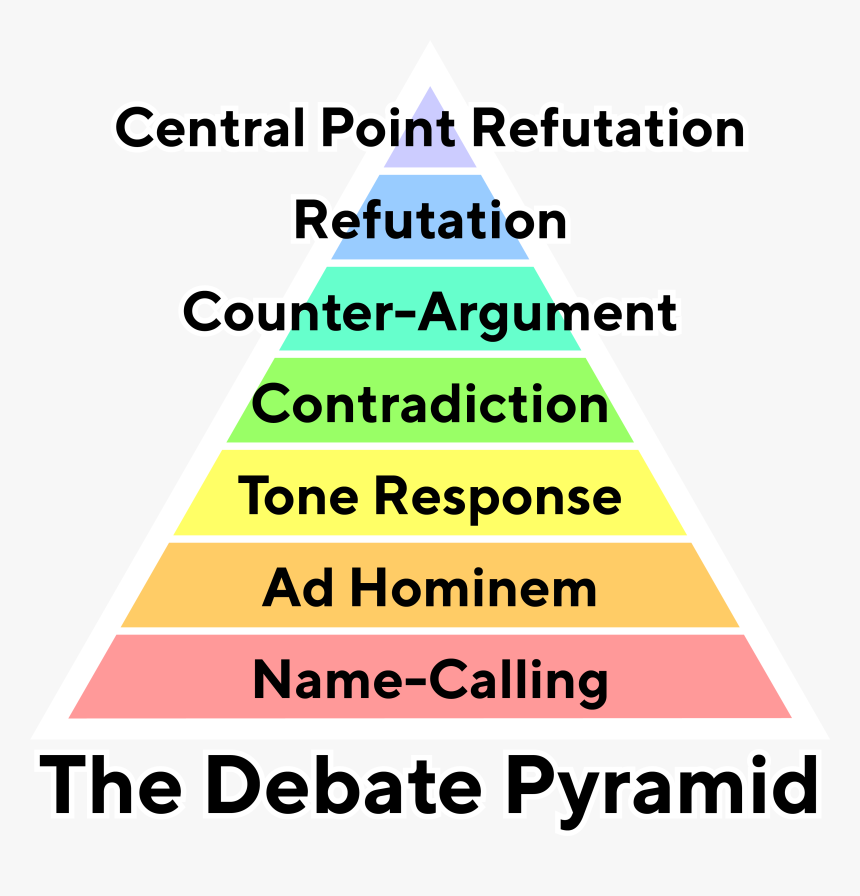
The Debate Pyramid V2 Simple Tt Norms Bold Text - Pyramid, HD Png ...   The Ad Hominem Fallacy (3 Flavors) and Ridicule in the Bible


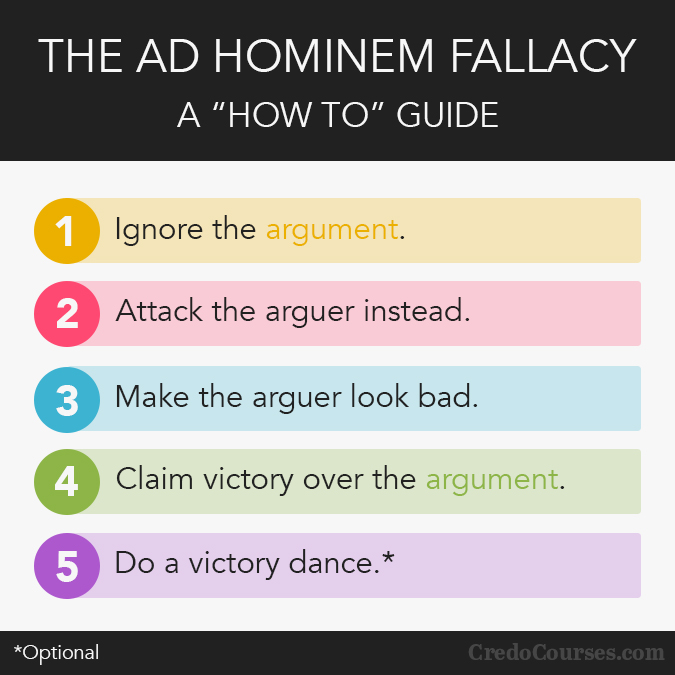
If you’ve done any evangelism at all, you’ve likely experienced a personal attack (Ad Hominem; in a way that is directed against a person rather than the position they are maintaining).

This should come as no surprise for Christ gave us warnings about it in addition to experiencing the ultimate attack, the one against His life. “And ye shall be hated of all men for my name’s sake: but he that shall endure unto the end, the same shall be saved.” [Mark 13:13]

While some accusations may be well founded due to our own poor attitudes, words & acts, most are ad hominem attacks.

Let’s look at a few and learn how to respond without reviling.


Before we answer this attack, we need to remember how Jesus responded to personal attacks. He didn’t revile in return. “Who, when he was reviled, reviled not again; when he suffered, he threatened not; but committed himself to him that judgeth righteously:” [1Peter 2:23; Isa 53:7]


The First ATTACK has a few versions: “You’re Arrogant. You’re just closed minded. It’s obvious you’ve already got your mind made up.”

First off, ACCURATELY define your intentions & motives. Tell them that it is true that you have your mind made up, and it’s not because you haven’t examined the evidence nor heard the arguments. It’s made up BECAUSE you’ve given careful consideration to the scriptures. “These were more noble than those in Thessalonica, in that they received the word with all readiness of mind, and searched the scriptures daily, whether those things were so.” [Acts 17:11].

This attack is vile in that it impugns your motives. It attempts to judge you unfairly and we know how the Lord feels about that [Matt &:1-2].

RESPOND calmly with a question; “Are you saying it’s arrogant to say & do what the bible teaches? [Luke 6:46; Mat 7:21-23; Col 3:16] Jesus often used questions (about 100) to challenge His accusers & His disciples. [Matt 15:3; 21:25]

One good question from Christ’s spiritual arsenal is, “Have you READ this scripture?” [Matt 21:42]. It’s much more effective to show someone the verse in the bible than it is to refer to it or even to quote it from memory. Otherwise it’s just arguing opinions. Show them, not just tell them. Let them READ it for themselves.

I sometimes ask; “Is it ONLY the OTHER guy that has his mind made up?” The other person has their own steadfastness and sees your steadfastness as pride. “How come your unwavering assertions aren’t arrogant?” This response is not to conflate the conversation. It’s to calm it down by finding common ground. Paul used a similar strategy at the beginning of his speech on Mars Hill [Acts 17:22].

It’s a good reminder for them and for yourself that GOD HATES pride & arrogance. [Prov 8:13; Luke 18:14]. Perhaps you can restore civility by admitting that you’re working on avoiding this sin.

Remember that debate is healthy, ARGUMENT is not. We must have discussions about our differences, but we mustn’t allow ourselves to resort to ANGER & HATE. “Let nothing be done through strife or vainglory; but in lowliness of mind let each esteem other better than themselves.” [Phil 2:3] Consider these passages for additional study on scriptural debate [1Thess 5:21; Titus 2:15; 2Tim 4:2; 1Tim 5:20; 2Tim 2:24-26; Jude 3; 1Tim 6:12; 2Cor 10:4-5; Acts 14:26-15:2] It’s better to end the discussion if either of you are having trouble with their emotions. [Mat 7:6; 15:14]

Another good reminder is that it’s NOT ABOUT WINNING an argument, it’s about winning a soul. “To the weak became I as weak, that I might gain the weak: I am made all things to all men, that I might by all means save some.” [1Cor 9:22]

Finally, if you’ve handled yourself well, made no mistakes in your defense of the Gospel and never raised your voice or rolled your eyes, THEY MAY STILL accuse you of pride. THEY did it to the Master Teacher, are you any more special than He? [Mark 14:61-65]

–Spencer

Have no FEAR?

No Fear Inc Logo Decal Sticker


Can Caution become Cowardly? 

Rev 21:8 “But the cowardly, unbelieving, abominable, murderers, sexually immoral, sorcerers, idolaters, and all liars shall have their part in the lake which burns with fire and brimstone, which is the second death.”


Can Concern become Worry?

2Cor 11:28 besides the other things, what comes upon me daily: my deep concern for all the churches.

Mat 6:25 “Therefore I say to you, do not worry about your life,


Can Obeying the Government become disobedience to God?

Rom 13:1 Let every soul be subject to the governing authorities. For there is no authority except from God, and the authorities that exist are appointed by God.

Acts 5:29 But Peter and the other apostles answered and said: “We ought to obey God rather than men.


These are questions each of us must consider and answer as we continue to face this new world of COVID fear.


What is FEAR? 

FAILURE?

Mat 25:24 “Then he who had received the one talent came and said, ‘Lord, I knew you to be a hard man, reaping where you have not sown, and gathering where you have not scattered seed. 25 ‘And I was afraid, and went and hid your talent in the ground. Look, there you have what is yours.’


Are we afraid of EVIL men?

Lu 12:4 And I say unto you my friends, Be not afraid of them that kill the body, and after that have no more that they can do. Mat 10:28


Perhaps we’re afraid of the ANONYMOUS or invisible enemies.

Ro 8:35 Who shall separate us from the love of Christ? Shall tribulation, or distress, or persecution, or famine, or nakedness, or peril, or sword? 36 As it is written: “For Your sake we are killed all day long; We are accounted as sheep for the slaughter.” 37 Yet in all these things we are more than conquerors through Him who loved us. 38 For I am persuaded that neither death nor life, nor angels nor principalities nor powers, nor things present nor things to come, 39 nor height nor depth, nor any other created thing, shall be able to separate us from the love of God which is in Christ Jesus our Lord.


Maybe our FEAR has opened the door to RATIONALIZING our disobedience?

Num 14:2 And all the children of Israel complained against Moses and Aaron, and the whole congregation said to them, “If only we had died in the land of Egypt! Or if only we had died in this wilderness! Num 14:10 And all the congregation said to stone them (Joshua & Caleb) with stones.


We live in a new world now that COVID-19 has entered. Say what you will about the virulence of the virus, it matters not. The FEAR of it exists in many hearts regardless of the reality.

It’s easy to talk about FEAR when there’s not much to fear. It becomes much more difficult when you are facing the command to cross the Jordan into battle.


WHAT IS COURAGE?

Courage is not the lack of FEAR. Courage is taking action despite the fear.

Courage is not taking action without precautions. Paul was both ready to be bound, but also to die [Acts 21:13]. But that boldness didn’t mean he shouldn’t take precautions. The Lord told him he would make it to Rome, but it was Paul that foiled the plot against his life. It was Paul that stopped the Roman soldiers from scourging him by appealing to his Roman citizenship.


FEAR is a natural emotional response that protects us from harm. It is good when it prompts you to take precautions. We recognize fire’s power to burn, but it doesn’t stop us from utilizing it for good.

FEAR becomes sin [Rev 21:8] when it stops one from doing that which is right. When it stops one from obeying God.


Let us move away from fear. The answer to casting out fear is LOVE.

1John 4:17 Love has been perfected among us in this: that we may have boldness in the day of judgment; because as He is, so are we in this world. 18 There is no fear in love; but perfect love casts out fear, because fear involves torment. But he who fears has not been made perfect in love.


Let us LOVE God so much that we will do His will.

John 14:15 “If you love Me, keep My commandments.


Joshua 1:9 “Have I not commanded you? Be strong and of good courage; do not be afraid, nor be dismayed, for the LORD your God is with you wherever you go.”


Mat 5:13 “You are the salt of the earth; but if the salt loses its flavor, how shall it be seasoned? It is then good for nothing but to be thrown out and trampled underfoot by men.
14 “You are the light of the world. A city that is set on a hill cannot be hidden.
15 “Nor do they light a lamp and put it under a basket, but on a lampstand, and it gives light to all who are in the house.
16 “Let your light so shine before men, that they may see your good works and glorify your Father in heaven.


Our Light needs recharging!


Congregational Worship and COVID-19

Virtual worship: Should you live stream, do a podcast, or send an ...

Congregational Worship and COVID-19

By Joe R. Price

“The more things change, the more they stay the same.” So the saying goes. Indeed, there is nothing new under the sun (Eccl. 1:9).

The present COVID-19 pandemic reminds us of valuable spiritual lessons we may have taken for granted until this moment of crisis. For instance, God, in His providence, continues to furnish our needs so that our faith does not turn into anxiety (Matt. 6:24-34). Also, while we have free will with its choices and consequences, we still live under the unexpected reality of “time and chance” (Eccl. 9:11-12). Such times warn us to turn to God with all our heart (Joel 2:12-14). And, we call to mind that “Thy will be done” must be our north star as we navigate life (Jas. 4:13-17).

Even as 9-11 brought new travel screenings and requirements, this event is likely to produce its share of social changes as we move beyond the temporary “stay at home” orders. Social or physical distancing may continue to impact going to large crowd events, restaurants, doctor’s offices, etc. Education continues to be affected. Sure, online study courses have been around for a long time. Now, online learning has increased to accommodate the stay at home orders prompted by the COVID-19 pandemic. The Washington State Superintendent of Public Instruction (Chris Reykdal) recently said to expect distance learning to be in place “for quite a long time” (“State schools chief: Expect to use distance learning ‘for quite a long time,’” James Drew, The Bellingham Herald, April 6, 2020). Restaurants are introducing no-touch food delivery systems to prevent food contamination. Tele-med services are on the increase and may become a more standardized way of visiting doctors in the future. These are just some of the innovations and changes happening as we pass through this temporary crisis.

The COVID-19 crisis is also affecting churches of Christ. Many have temporarily rearranged or canceled worship assemblies. Online Bible classes have multiplied to fill this space. Each congregation is making these temporary decisions for the safety of its members (much as they do when extreme weather prevents safe passage to its place of assembly).

The COVID-19 pandemic has seen a surge of internet activity among brethren. Most congregations have been providing online sermons, Bible study, and teaching material on their websites for years. During this time, many brethren have turned to additional online methods of communication like Facetime, Skype, Messenger, and internet conferencing services like Zoom to facilitate teaching God’s word.

Perhaps it will be helpful to review the meaning of “virtual” within the context of the internet and computer world. Virtual is defined as:

“being something in essence or effect, though not actually or in fact” is from mid-15c., probably via sense of “capable of producing a certain effect” (early 15c.). Computer sense of “not physically existing but made to appear by software” is attested from 1959” (Online Etymology Dictionary).

The Concise Oxford English Dictionary says of virtual computing, “not physically existing as such but made by software to appear to do so.”  It also notes that to “virtualize” is to “convert to a computer-generated simulation of reality” (Ibid).

Merriam-Webster corroborates the definition of virtual as “being on or simulated on a computer or computer network…occurring or existing primarily online… of, relating to, or existing within a virtual reality” (merriam-webster.com).

By definition, the virtual world is simulated; it does not physically exist. It is not an actual world. The internet is a medium (a network) by which we communicate through computer-generated codes (and many things that go way over my head)! But I do know this: I have not changed my location when I am online. I am at my keyboard in front of a monitor (or using a smartphone or some other internet device). I am in virtual reality (the virtual world), but I am actually (really) still in a physical or material location.

That said, our purpose here is to issue a gentle warning to avoid letting the temporary become the norm. Just as our country and the world must return to regular activities, so also must local churches. As the virtual world becomes more and more useful and used, we should be careful not to change the nature of the local church of Christ as we use the bandwidth of cyberspace.

In other words, we must not take Bible authority for granted as we used the internet. Even in the virtual world, we must have Bible authority for whatever we say and do (Col.. 3:17).

The Bible is a book of patterns to which we must conform and hold fast (2 Tim. 1:13; Phil. 3:17; 4:9; 2 Thess. 2:15). By doing so, we obey the commands of Christ’s apostles (2 Thess. 3:4; 1 Cor. 11:1).

Holding fast to Bible patterns is another way of referring to having and applying Bible authority (God’s authority). Just as God told Moses to build the tabernacle and its furnishings “according to the pattern” shown him on Mt. Sinai, we are charged not to alter the gospel of Christ (Heb. 8:5; Gal. 1:6-9).

When we follow God’s word, we will hold fast to the pattern of work for the local church that He approves and blesses. For example, God commanded King Saul to utterly destroy the Amalekites as God’s act of just punishment for their sins against Israel (1 Sam. 15:1-3). God regarded Saul’s failure to follow His revealed will (His pattern) as disobedience and rebellion (1 Sam. 15:9-11, 22-23). Saul changed the nature of his conduct into rebellion when he failed to follow God’s pattern. As a result, God rejected Saul as king.

The New Testament pattern for the work of the local church is spiritual. The local church’s work is evangelism, edification, and benevolence to needy Christians (cf. Acts 2:42-46; 4:32-35; 6:1-7; 1 Thess. 1:8; et al.). When we change the pattern of work for the local church, we have changed the nature of that work into disobedient rebellion against God. Surely, God is no more pleased with us when we change His pattern of work for the local church as He was with Saul when he did not follow God’s command.

When we follow God’s word, we hold fast to the pattern of worship for the local church that He approves and blesses. For example, the fire Nadab and Abihu offered God was “strange” because God “had not commanded it” (Lev. 10:1). They changed (corrupted) the nature of worship when they offered unauthorized fire. Their worship became “strange” (profane, foreign) and unacceptable to God.

The New Testament reveals a pattern for the worship of the local church. Local churches assembled to pray, to sing, to eat the Lord’s Supper, to give as they have prospered, and to hear the word of God (Acts 2:42; 20:7; 1 Cor. 14:15; Eph. 5:19; 1 Cor. 16:2). When we change the pattern of worship for the local church, we have changed the nature of that worship into “strange fire” that God has not commanded. Surely, God is no more pleased with us when we change His pattern of worship as He was with Nadab and Abihu when they changed the fire He commanded.

When we follow God’s word, we hold fast to the pattern of congregational worship that He approves and blesses. Each Christian is responsible for his or her worship. And, God has provided the congregational arrangement for us to express our individual worship responsibilities. For example, the church at Corinth came “together…as a church…in one place…to eat the Lord’s Supper” (1 Cor. 11:17, 18, 20). (Unfortunately, their worship became corrupted, which the apostle addressed.) Each Christian was to eat the Supper while gathered together (1 Cor. 11:23-34). The Lord arranged the assembling of ourselves together as a feature of regular worship (Heb. 10:24-25; 1 Cor. 14:23, 26; Acts 20:7). And so, when we come together as a church in one place, we are following the New Testament pattern of congregational worship.

During this period of temporary suspension of worship assemblies, we should realize we are not attempting to reconstitute the congregational worship assembly when we arrange a virtual Bible study online. We are individuals in different places, not in one place, communicating via the internet. The internet is no more an actual “place” we gather any more than the old telephone party line was an actual place we met. Both the party line and an internet conference call are forms of communication individuals use at the same time when they are in different places. We may indeed “meet” on the phone or online to converse, but we are not in “one place.” When we “come together to eat,” it is contrasted with and different from activities done “at home” (1 Cor. 11:33-34).

God’s pattern reveals some acts of worship are designed exclusively for when the church comes together in one place. The Lord’s Supper and the weekly contribution are of this nature (1 Cor. 11:17-22, 33-34; 16:2). Other acts of worship (singing, praying, and listening to the God word) are included in, but not limited to, a congregational context (Jas. 5:13-16; Acts 20:20).

We understand and practice this when a Christian is sick and unable to attend the worship assembly. We do not take the Lord’s Supper to them, because the word of God places the Supper in the assembly of the local church. We do not take the collection plate to the sick Christian, either…

Let us remember that honorable intentions do not equate to God’s approval (Bible authority). There was a time when many Christians would take the Lord’s Supper to brethren who were shut-in in nursing homes. Though well-intended, this practice overlooks the congregational arrangement for the Supper. And, perhaps unwittingly, it reflected an undue elevation of the Supper to a near sacramental status as the most essential part of worship.

Just here, it helps us to recall King Saul’s impatient disobedience in 1 Samuel 13. When Samuel did not arrive at Gilgal in the time expected, Saul went ahead and offered a burnt offering. When Samuel came and questioned Saul, he replied by describing the circumstances he faced, then explained, “Therefore I FELT compelled, and offered a burnt offering” (1 Sam. 13:11-12). But in truth, what Saul did (however good his intentions) was foolish disobedience (1 Sam. 13:13).

Good intentions do not equal Bible authority and God’s approval. In our zeal to actively maintain a connection with our brethren through online Bible studies and prayers while going through the temporary suspension of our assemblies, let us be careful that we do not change the nature of God’s pattern of congregational worship.

After this current situation passes, it will still be a violation of God’s word to forsake the assembling of ourselves together. Arranging a virtual worship service at the lake (or at home) instead of coming together as a church will not suffice (Heb. 10:24-25). If this is incorrect, then let us simply abandon the actual assembling of ourselves and transition to virtual assembling and virtual congregational worship. Or, if there is no distinction, then let us provide a “tradition” worship assembly (so as not to offend the older, more traditional brethren), and also arrange a “virtual” worship assembly (for those who are more comfortable with a new reality). But, to do these things changes the nature of the worship assembly. When we change the nature of congregational worship from actual to virtual, it amounts to offering God “strange fire” that He has not commanded.

Please understand, we are not charging anyone with deliberately and willfully changing the nature of worship. Not at all. By all means, we are thrilled to see many Christians having online Bible studies and sharing video sermons to spread the gospel and edify the saints. There is a needed place for such worthy endeavors. As we do so, may we be cautious and not allow our temporary, virtual practice to redefine (or replace) the actual practice of congregational worship.

We pray for a swift reversal of this present crisis, for the sake of saving lives and so that Christians may soon come together in one place for the congregational worship God designed (Heb. 10:24-25).


http://www.bibleanswer.com/2020_Vol_22_No_14_12Apr.htm#Congregational
 

What Think Ye of Christ?


“Saying, What think ye of Christ? whose son is he?” Matthew 22:42


What’s our ATTITUDE toward CHRIST?

For Some…

  • My Lord & my God. John 20:28.
  • Fell down to worship Him. Mat 2:11 Wise men; Mat 8:2 leper; Mat 15:25 a woman of Canaan; John 9:38 the blind man; Luke 24:52 Men on road to Emmaus; Mark 5:6 Legion of demons; Mat 28:9 His disciples. Mat 14:33 after walking on water. Mat 9:18 a ruler.
  • He is POWERFUL. Mark 5:25-28; Mark 4:41 storm;
  • Marveled at His words. Luke 4:22; 7:9; 20:26
  • Saw Him as having authority, Mat 7:29; Mark 1:22
  • Thou art the Christ. Peter in Mat 16:16.
  • As a King. John 6:15; 12:13 Triumphal entry; John 18:37 Jesus said.


EVEN DEMONS said…

  • Holy One of God. Mark 1:24 I know thee who thou art, the Holy One of God. Luke 4:34
  • You are the Christ, the Son of God. Luke 4:41; Mat 8:29
  • Thou art the Son of God. Mark 3:11 unclean spirits, Mark 5:7; Luke 8:28;
  • Demons believe & tremble. Jas 2:19
    • Acts 19:15 Jesus I know, and Paul I know; but who are ye?


Others said…

  • He has a devil. John 10:20; Mark 3:22;
  • He was a law breaker. John 5:18
  • He was mad. Mark 3:21 his Relatives;
  • He was a food pantry. John 6:25-26;
  • He was a blasphemer. John 10:33 Jews sought to stone Him. Luke 5:21 forgiving sins.
  • He was a court jester. Luke 23:8 Herod to see a miracle.
  • Some didn’t think much of Him at all. Luke 7:39 A Pharisee.
    • The Weeping Woman; v37-38. What did she think of Him?

What is WORSHIP on the 1st day of the week?


WORSHIP on the Lord’s Day is on the 1st day of the week when the saints gather together.

2 Types of worship.

  • Daily Glorification of God in our godliness. Cr. Acts 16:25
  • 1st Day of the week with 3 unique things.
    • Lord’s Supper. 1Cor 11:17-33; Acts 20:7
    • Contribution. 1Cor 16:1-2
    • Gathered Together in one place. 1Cor 11:17,18,20,33

ONE Another is together. 1Cor 11:17-33; Acts 20:7; Heb 10:25; Eph 5:19; Col 3:16

REQUIRED of God. John 4:24, Heb 10:24-25 (with exception to CRISIS)

  • Control is not yours. Paul in custody Acts 27
  • Real, not made up. ‘my ox fell in the ditch.’ Who pushed it in?
    • Lu 14:5 And answered them, saying, Which of you shall have an ass or an ox fallen into a pit, and will not straightway pull him out on the sabbath day?
    • Ex 23:5; De 22:4; Lu 13:15
  • Illness, Lev 13:46 outside of the camp.
  • Storms & other dangerous events
  • Infectious, Lepers.
    • Lev 13:45-46 face covered.
  • Sometimes, not habitual or customary
    • Heb 10:25 manner of some

SUPPER of the Lord has 2 elements [Exo 12; Luke 22:14-21 & a few conditions [tarry for one another 1Cor 11:33]. 1st Day, together, Spirit & Truth.

  • How do you forsake assembling of ourselves together if it’s incidental? Heb 10:25
  • How do we sing to one another? Eph 5:19, Col 3:16
  • How do we tarry for one another? 1Cor 10:33

HAVE no fear, some say. Does being fearless also include being reckless? Consider Paul who was not afraid to die, but avoided death on a few occasions. [Acts 9:23-25, 21:13; 23:11-22]

  • “God’s in Control” & “If it’s my time to die…”
  • Then play with rattlesnakes in the freeway.
  • “don’t tempt God.” EXACTLY! Don’t tempt God by being reckless. If you wish to be reckless, do it for yourself!

INDIVIDUALLY together. We come together, but God examines each heart individually. cf. Rev 3:4; Heb 4:12

PLEASING to God has to first be authorized. Gal 1:10; Mark 7:7; Phil 3:19; Col 2:23. 2Sam 7:1-7

It’s not necessarily Pleasing to God when it just feels good in our heart.


CLOSE; 1Cor 1:10 Paul Pleading with a divided church.

Now I beseech you, brethren, by the name of our Lord Jesus Christ, that ye all speak the same thing, and that there be no divisions among you; but that ye be perfectly joined together in the same mind and in the same judgment.

Watch video here.